What scares you is the thing you need most
About This Video:
What if the biggest risk in your life isn’t taking action—but waiting too long to act? I’ve been thinking about that after a conversation with risk strategist Susan Schramm. Like many entrepreneurs, I used to see risk as opportunity, but I eventually realized that what really holds us back isn’t uncertainty—it’s the stories we’ve been carrying since our earliest experiences.
In this video, I share how childhood beliefs, small experiments, and a simple shift in perspective changed the way I approach risk. We explore why fear is really about the unknown, how to build confidence one step at a time, and the question that may change how you make your next big decision.
Transcript:
Okay, I wanna try something.
When I say the word risks, what’s the first thing that comes to mind?
Take a second. Really.
If you said danger or caution, you’re completely normal. Congratulations. You’ve got a well-functioning human brain.
If you said opportunity, you’re probably an entrepreneur, or you’ve been hanging around entrepreneurs for way too long.
Either way, we need to talk.
Because here’s the thing, most of us are not afraid of risk.
We’re afraid of the last time we tried something and that went sideways.
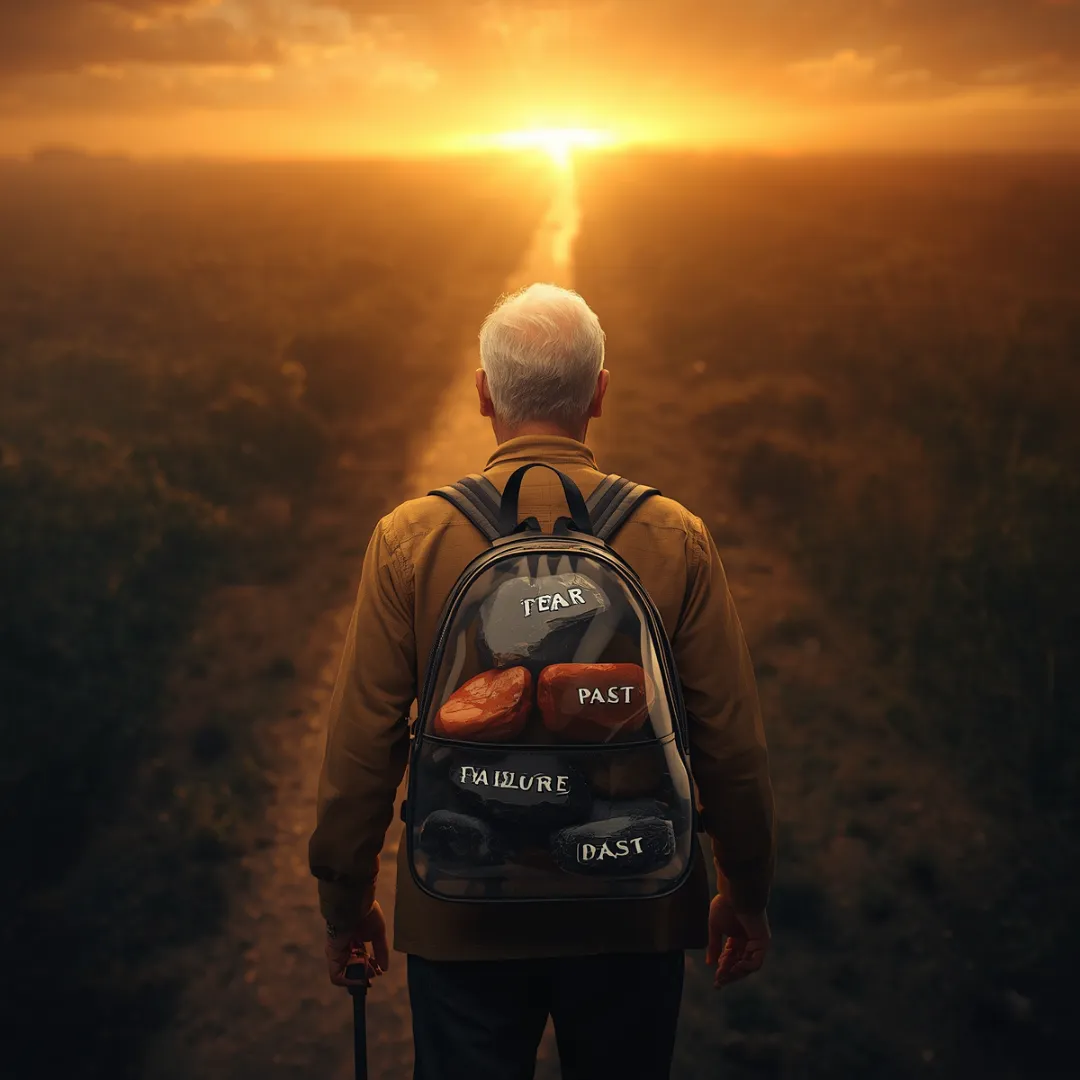
We’re carrying around that around like a little backpack we forgot we put on, and that backpack is making all your decisions.
You know, I had a conversation recently with Susan Schramm.
She’s a risk strategist, and she wrote a whole book about this.
She asked me that exact question:
“What’s the first word that comes to my mind when I say risk?”
I said, “Opportunity.”
She laughed. She said, “Of course you did. You’re an entrepreneur.”
And I thought, “Yeah. Guilty.”
But also, it hasn’t always been that way for me.
I had to learn that, and the teacher wasn’t a book or a seminar.
The teacher was my dad.
So, the first public talk I ever gave, I’m twenty-four years old.
I’m out in Reno, Nevada, speaking at a vending conference, which, yes, is a real thing.
People are very serious about their vending, and I thought the talk went pretty well.
At the end, my father comes over and he says, “You know, that was pretty good.”
And I’m thinking, “Great. Dad’s proud of me.”
And then he says, “One thing. Don’t tell jokes. You’re not funny.”
Now I wanna be clear, multiple people have since told me that I am in fact reasonably funny.
My father may have been slightly off on that one, but in that moment, I believed him completely because that’s what we do when someone we love tells us we’re not enough.
We just absorb it, no questions asked.
And here’s what Susan helped me see.
What I absorbed wasn’t even really about me.
It was about him, about his discomfort, his fear of being embarrassed by association.
But kids don’t know that, and honestly, most adults never figure it out either.
So here’s what’s actually happening when you’re scared of taking a risk.
Susan defines a risk as unknowns.
That’s it.
Things you don’t have a plan for yet, and your brain, your beautiful, protective, slightly paranoid brain, cannot handle an unknown without a plan.
The second it detects one, it goes into what she calls fight or flight.
Not because you’re weak, because you’re wired.
We all are.
The trick is not to turn that off.
You can’t.
The trick is to make the unknown a little smaller.
Give your brain a plan for the first step.
Just the first step.
You know what that is?
It’s learning to ride a bicycle.
Nobody just gets on a bike and zooms away at full speed.
You wobble.
You grab all the handlebars.
Maybe somebody holds the back of the seat.
You fall over exactly once.
You get back up.
That’s it.
That’s the whole system.
I call it fail fast, fail cheap.
Small experiments.
Test something.
See what happens.
Back out if it doesn’t work before it costs you much.
Your nervous system doesn’t go haywire because the stakes are actually low.
This is, by the way, the secret of almost every successful business owner I’ve ever met.
People think they’re massive risk-takers.
They’re not.
They’re just really comfortable with small experiments.
Here’s the other piece, and this one’s personal for me.
Back when I was running my food service vending company, year six, seven, I had a bad habit.
When someone made a mistake, I would ask them, “Why did you do that?”
Which, if you’ve ever been on the receiving end of that question, you know it’s really not a question.
It’s more of a rhetorical accusation.
I changed it to “What did you learn?”
And people would say, “I don’t know.”
And I’d say, “Okay, if you did know, what would you...”
Still nothing from the other person.
So I go to level three, which sounds ridiculous, but I’m telling you, it works every time.
I’d say, “Make something up. I don’t care whether it’s true or not. I don’t care. Just make up an answer.”
And they would.
And it was always the right answer, because making it up forced them to actually think instead of just bracing for impact.
Seven or eight years of doing that?
Well, the culture completely changed.
People started admitting mistakes and then immediately saying, “Here’s what I think I learned,” without anyone asking, because basically we built a self-correcting team.
You know, W. Edwards Deming, the quality control genius, said it best:
“It’s not the employee’s fault, it’s the manager’s fault when a mistake happens.”
You’ve got a bad system.
Fix the system, make mistakes okay, and you build something that actually gets better over time.
Here’s where I land on all this.
At 73, navigating my own cancer diagnosis, I think about risk differently than I used to.
Not less, differently.
The experiments that matter to me now are the ones I keep postponing, the conversations I keep almost having, the things I keep waiting until I feel more ready for.
Here’s what Susan asks every client she works with, and I wanna ask you the same thing:
What’s the risk of not changing?
Not the risk of doing the thing, the risk of not doing it.
The quiet risk, the one that doesn’t make noise, because that one, that one’s real, and it’s patient, and it will wait for you as long as you’re willing to wait.
So don’t wait.
Hey, I’m Josh Patrick.
This is The Long Strange Trip, and I am, against my father’s best advice, at least a little bit funny.
The link to the full conversation with Susan is in the comments.
Go listen.
And if you’ve been carrying around a risk you keep talking yourself out of, drop it into the comments.
You have more company than you think.
We’ll see you next time.
