
What a 45-Year-Old Marketing Guru Taught Me About the Thing I Thought I Already Had
A conversation from The Long Strange Trip that I didn't expect
Here's the thing about wisdom — most of us think we're acquiring it.
We read the books. We run the businesses. We sit with the failures and the wins. We clock the hours and log the miles and somewhere along the way we start to assume that experience and wisdom are basically the same thing.
They're not. And it took a conversation with Matthew Kimberly to remind me of that.
Matthew is 45. He's a marketing expert who's been running Book Yourself Solid — one of the most recognized client-attraction systems in the world — for years. He knows how to build a business, how to market it, and how to help other people do the same. He's sharp, he's funny, and he's genuinely good at what he does.
He also wrote a self-help book in his twenties called How to Get a Grip. And here's what I love about Matthew: he's the first person to tell you where that book got it wrong.
That honesty? That's where this conversation actually begins.
The Book That Outgrew Itself
When Matthew wrote How to Get a Grip, he was 28. And look, I'm not going to pile on — I did some pretty overconfident things at 28 too. We all did. But Matthew described something that I think most of us have felt at some point: that particular certainty you have when you're young and smart and haven't yet been knocked around enough to know what you don't know.
He laid out the rules. He had a framework. He was sure.
Then life happened.
He became a husband and a father. One of his kids faced serious learning challenges. Another landed in intensive care with heart problems. And all those neat little rules he'd written down with such confidence — they started to look a lot less tidy.
"Certainty is warm," he told me. "It feels safe. Curiosity feels shaky because you're admitting you don't have the full picture."
I've been thinking about that line ever since.
Because here's the uncomfortable truth: most of us don't trade certainty for curiosity voluntarily. We do it because something forces us to. A business that doesn't work the way we thought it would. A relationship that breaks in a way we didn't expect. A kid who doesn't fit the mold we had in mind. Life has a way of doing the teaching whether we signed up for the class or not.
What Matthew figured out — and what makes him genuinely interesting to talk to — is that you can actually choose curiosity before the crisis forces it on you. You don't have to wait for the hard thing to happen before you start asking better questions.
Think about the last time you were absolutely certain about something in your business. A hiring decision. A pricing call. A bet on a new service. How many of those certainties turned out to be exactly right? And how many of them looked a little different six months later when you had more information?
Certainty feels like strength. But a lot of the time, it's just expensive stubbornness wearing a confidence costume.
Matthew's version of curiosity isn't soft or wishy-washy. He's not suggesting you wander around with no convictions. He's suggesting you hold your convictions a little more loosely — that you stay genuinely open to being wrong, and that you build the habit of asking one real question when you'd normally just double down on what you already believe.
Simple habits. But they change the quality of your thinking over time in ways that are hard to overstate.
The Program That's Basically Anti-Guru
Before we go further, I want to tell you about what Matthew is doing now, because I think it says a lot about how his thinking has evolved.
He runs a program where you send him one email a week. That's it. Five minutes. You write down what you accomplished over the past seven days, and he holds you accountable for it.
No elaborate system. No 12-module course. No complicated framework you have to master before you can start. No lengthy onboarding process that makes you feel busy without actually doing anything.
Just: what did you actually do this week?
I find this fascinating, coming from someone with Matthew's background. This is a guy who could build something complex and charge accordingly. He has the credibility. He has the track record. He could make it complicated, and nobody would question him.
Instead, he built something that strips away all the noise and gets to the one thing that actually matters — did you do the work?
That, to me, reflects a kind of hard-won wisdom that's genuinely difficult to teach. The wisdom of knowing what to leave out. Of trusting that simple and consistent beats complicated and impressive almost every single time.
Here's the thing, most people don't want to hear: we love complexity because it gives us somewhere to hide. If the system is complicated enough, we can always blame the system when results don't come. A weekly email doesn't give you that escape hatch. Either you did something this week, or you didn't. Either you're moving forward, or you're not. And unfortunately for me, I didn’t much more often than I did.
That kind of radical simplicity takes more courage than building an elaborate framework. And it reflects something Matthew and I talked about at length — that real expertise isn't about knowing more things. It's about knowing which things actually matter, and being willing to throw the rest out.
What I Got Wrong With My Kids
Matthew brought up something I want to be honest about because it hit close to home.
He talked about the question that sits in the back of his mind as a father: Am I doing enough, or am I messing my kids up in ways I won't be able to see for another decade? He said it out loud, which took some guts, especially on a podcast where you can't take words back.
It made me think about my own kids when they were young.
I was a good provider. I worked hard. I built things. But if I'm being honest — and that's kind of the whole point of this show — I treated my kids a lot like employees. Transactional. Problem-solving mode. When they brought me complaints or problems, I processed them efficiently and moved on to the next thing.
It felt minor to me at the time. It wasn't minor to them.
There's a specific pattern Matthew described that I recognized immediately in myself. When his kids bring him something — a complaint, a worry, a frustration — his first instinct is to fix it. To solve it. To offer logic. And what they actually need, most of the time, is someone to sit with them in it for a minute before jumping to solutions.
That's not a parenting insight. That's a leadership insight. That's a marriage insight. That's a management insight dressed up in dad clothes. Yup, lots of insight here.
How many times have you had an employee come to you with a problem and immediately launch into fix-it mode, only to watch their face fall a little because they just needed to feel heard first? How many times has your spouse brought you something difficult, and you handed them a solution when what they wanted was someone to actually listen?
The wisest leaders I know — and I've been around a lot of them over 40 years — share one quality that doesn't show up on any resume. They're genuinely interested in the other person's experience before they start talking about their own. They ask more questions than they answer. They're comfortable with a pause.
Matthew's therapist told him something that made me sit back: by the time your kids are old enough for you to ask how to avoid harming them, the core wiring is already done. The job now isn't to erase what you passed on. It's to manage it honestly. To own your flaws without drowning in them. To give the people around you tools you didn't have yourself.
You can't go back and re-parent a 35-year-old. But you can repair. You can listen differently now. You can be the version of yourself today that you wish you'd been back then.
And that's not nothing. Actually, that might be everything.
The Smartest Sentence in Business
There's something Matthew said about the pressure to have an opinion on absolutely everything that I keep coming back to.
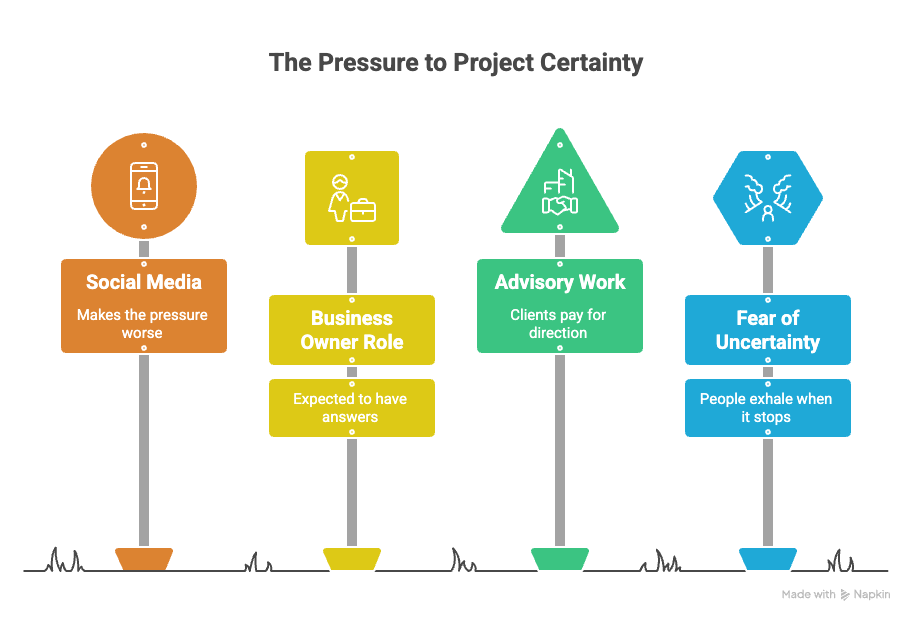
Social media makes this worse, but it's not new. The pressure to project certainty — especially as a business owner, especially as someone who's supposed to have answers — is relentless. Pick a side. Have a take. Be confident. Never let them see you unsure.
Matthew is actively learning to resist that. He's building the habit of sitting with "I don't know yet" as a complete and acceptable response. Not a placeholder for a better answer. An honest answer in its own right. I love to say I don’t know. It shows vulnerability, and others will see you as more authentic.
I know this tension firsthand. I spent years in advisory work as the person who had answers. That was part of the job. Clients weren't paying for "I'm not sure" — they were paying for direction. For somebody to look them in the eye and tell them what to do.
But here's what I've noticed: the overconfident answers are the ones that create the biggest problems later. The ones you have to walk back. The ones that cost you credibility far faster than a well-placed "I need to think about this more" ever would have.
There's also something that happens when you admit uncertainty in a room full of people. The people who are also uncertain — which is usually most of them — exhale. The pretending stops. The conversation gets real. And real conversations produce better decisions than confident ones almost every time.
Matthew's version of this is practical. Instead of fake certainty, try:
"I have an opinion, but I want more facts before we commit."
"Here's what I don't know yet, and here's how I'm going to find out."
"I can see this from at least two sides — let me walk through both."
Those sentences might feel soft if you're used to projecting confidence. But they're actually the language of someone who's playing a longer game. Someone who's more interested in being right eventually than in sounding right immediately.
That distinction took me an embarrassingly long time to fully appreciate. And I suspect I'm not alone in that.
The Lawyer by the Lake
One of my earlier guests — a lawyer who'd built a serious practice and was managing a big team — shared a ritual that I've mentioned a few times since because I think it's one of the most practical examples of applied wisdom I've ever come across.
Every night before he drove home from his office, he stopped at a lake. Sat there for 15 minutes. Just sat.
He let the stress of being the boss settle. He pictured walking into his house differently — less managing partner, more husband and dad. He made a conscious decision about who he wanted to be when he walked through the front door. And then he drove home.
That's the whole ritual. That's it.
Not complicated. Just intentional.
I brought this up with Matthew because it connects directly to something he'd said about the gap between knowing what to do and actually doing it. We both know, intellectually, that we should leave work at work. We know that walking through the front door still in boss mode doesn't serve our families or ourselves. The knowing is easy. The 15 minutes by the lake is the hard part.
Wisdom lives in that gap. Not in the knowing. In the doing.
And here's the thing about that lawyer's ritual — it didn't require any special knowledge or expensive program. It required him to decide, once, that the 15 minutes mattered. And then to actually do it every single day.
That's the model. Small. Consistent. Non-negotiable.
Matthew's weekly email program operates on the exact same principle. You know you should be accountable for your actions. The program just makes you actually do it — once a week, five minutes, no excuses, no complicated framework to hide behind. The simplicity is the point. The consistency is the whole game.
Reflection Without the Retreat
Here's something I want to leave you with, because I think it's the most practical thing that came out of this whole conversation.
Most people treat reflection like a once-a-year event. A planning retreat. A New Year's resolution. A quiet moment on a milestone birthday where you take stock. And then life rushes back in, the urgency takes over, and six weeks later, you can't remember what you decided.
What Matthew and I kept circling back to — from different angles and with different stories — is that the small, daily practice beats the big occasional one every single time. Not because any single reflection is profound. But the habit of honest self-examination compounds over time in ways that are hard to explain until you experience them.
It doesn't have to be complicated. Here's the version I'd suggest you try:
Pick one moment from your day that had some emotional weight to it. A conversation that went sideways. A decision you made that you're second-guessing. A moment where you snapped when you didn't mean to. Just one thing.
Then ask yourself three questions:
What actually happened?
What did I do, and why?
What would I do differently?
Five minutes. Maybe ten if it was a day worth examining more closely. You can write it down or just sit with it on the drive home. The medium doesn't matter. The honesty does.
Do that consistently for six months, and you will think differently. Not because any one reflection changes everything, but because you start to see your own patterns. The triggers that set you off. The habits that serve you and the ones that don't. The gap between who you want to be and how you're actually showing up.
That gap — seeing it clearly and being honest about it — is where wisdom lives.
Matthew's built an entire accountability program around this principle. I've been practicing my own version of it for years in different forms. It's not glamorous. It doesn't make for a great marketing pitch. But it's probably the single most useful practice I know for actually getting wiser rather than just older.
One More Thing Before I Let You Go
Matthew said something near the end of our conversation that I want to leave you with.
He said that by the time you feel wise, you've made enough mistakes to know that "wise" is a moving target. The moment you feel like you've arrived is probably the moment you've stopped growing. Real wisdom, he thinks, comes with a kind of permanent humility — not the performed kind, but the genuine article. The kind that comes from having been confidently wrong enough times that you stop mistaking confidence for accuracy.
I think he's right. I don't walk around feeling wise. I feel like I'm still learning, still finding things I got wrong, still having conversations that rearrange how I see things.
This one rearranged a few things for me.
Now here's what I actually want to know from you.
Has something shifted your thinking about wisdom — about the gap between what you know and how you actually live? Was there a moment, a conversation, a failure, or something someone said that changed how you see it? Did any of what Matthew and I talked about land for you, or did some of it miss the mark entirely?
Tell me. Drop it in the comments, or hit reply if you're reading this in your inbox. I read every one. These conversations are better when they go both directions — and honestly, some of the best material for this show has come from what readers send back.
Until the next time
— Josh
The Long Strange Trip is Josh Patrick's podcast about work, transitions, and what actually matters. You can find Matthew Kimberly and his weekly accountability program at https://matthewkimberley.com/.

Facebook
LinkedIn
Youtube