Two steps forward and fifteen steps back
About Video:
Have you ever looked at your life and wondered why it didn’t turn out anything like the straight line you imagined? I have. Looking back, my life has been full of loops, setbacks, unexpected turns, and moments where I felt like I was moving backward.
In this video, I share how a major setback in my food service company, a salmonella outbreak, and my own cancer diagnosis taught me something I wish I’d understood much earlier: real progress rarely moves in a straight line. The setbacks aren’t necessarily evidence that you’re failing. Sometimes they’re where you learn how to think differently.
I also share why scenario planning became one of the most valuable tools I learned in business, and a simple exercise I use now: draw the real shape of your life, loops and all, and look at where you are today. The next stroke is still yours to make.
Transcript:
When I was young, I thought life was a ladder you climb. You work harder, you arrive somewhere. Nobody warned me the ladder was a lie.
My life never once went straight up.
It looped. It doubled back. It broke.
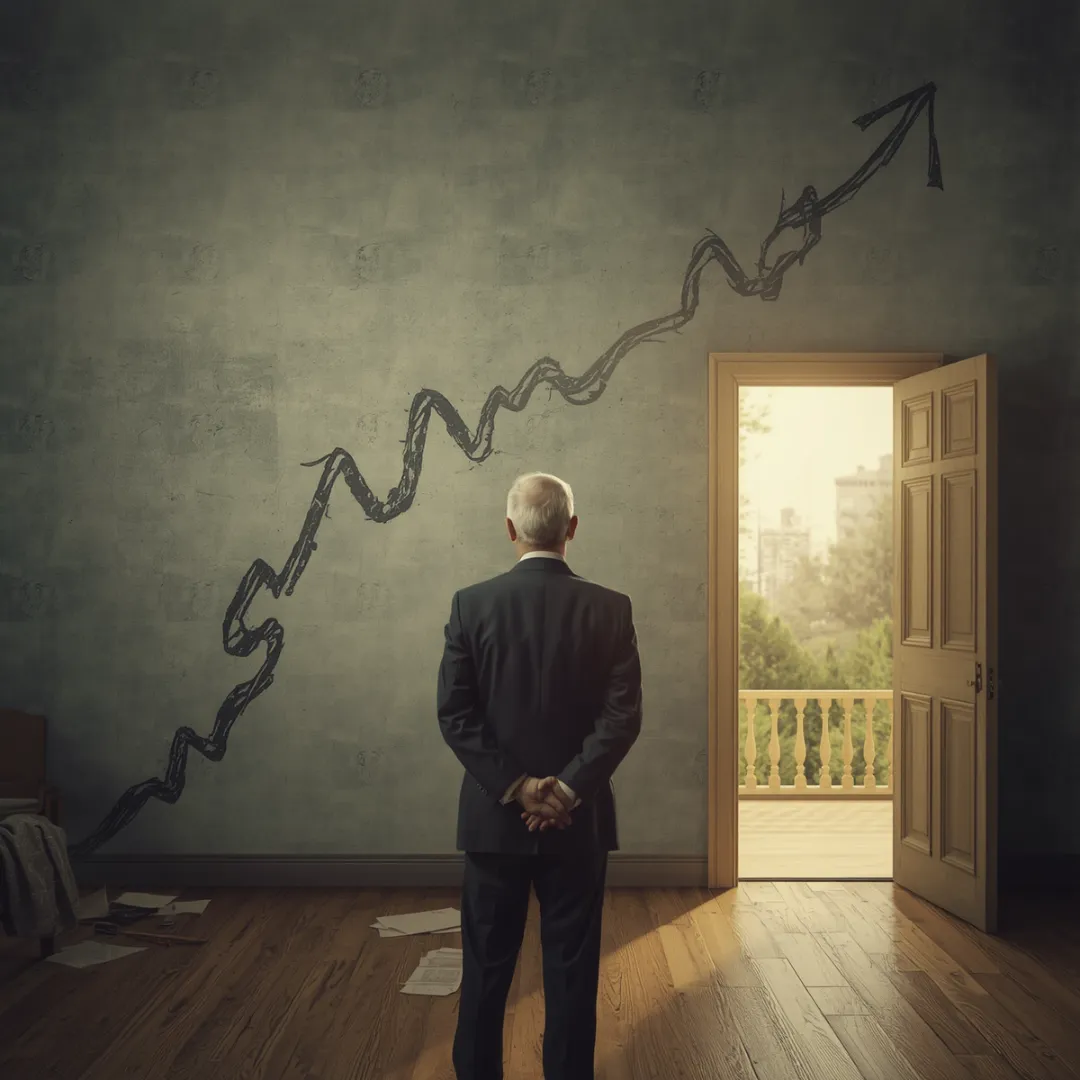
Here’s something I’ve never actually done. I’ve never sat down and drawn my life. Not the tidy version I tell at parties. The real one. The crooked one.
If I drew mine, it’d be a mess. A bunch of squirrely circles going in loops, some spinning left to right, some right to left. Two steps forward, then two steps back.
I suspect most of our lives look like that.
So let me ask you something. Stop pretending your life climbed in a straight line.
Draw the real shape instead, loops and all.
What would that picture tell you?
You know, I don’t have a clean answer for you. I’m a seeker on this, same as you.
But I’ve got a story that might help.
Let me paint you a picture.
A bazillion years ago, I ran a food service company. For a while, I thought I was on a roll, and I was. Just not the roll I imagined.
I was rolling backward and calling it forward.
The numbers looked incredible on paper. Seventy-five thousand in sales our first year. One point six million by year three. Two and a half million by year five.
That kind of growth feels like flying.
Here’s the trouble with feeling like you’re flying.
Sometimes you’re falling and don’t know it yet.
Then reality walked in and sat down in my life.
One day, I went through my controller’s desk. I found a pile of unpaid bills stuffed inside. He’d embezzled about two hundred thousand dollars from me while I was busy feeling successful.
My face went red. I exploded. The whole office stayed out of my way.
That didn’t knock me back two steps.
It knocked me back fifteen.
My suppliers wanted to put me out of business. My bank wanted to shut the doors for good.
Bankruptcy looked like the only door left.
And I get it if you’ve felt something like that.
But here’s what I’ve learned since that day.
We almost never have just one choice.
We usually have more than one-- than we think.
So I called my suppliers with a question: “Would you rather I go bankrupt and collect nothing, or would you let me pay over five years?”
Guess what they chose?
They chose to keep me in business.
One honest question changed the whole shape.
Then I found a new bank. I asked what they actually cared about.
“Cash flow,” they said.
And ours was strong.
Just like that, we had a bank again.
None of this was a straight line. We fought through it for three long years.
Susan Bradley would call that stretch passage.
Then just as we saw the light, a salmonella outbreak hit my company.
My commissary manager swapped beef for turkey. We mishandled the turkey and salmonella got in. Several of our customers got sick.
That’s the part that still hurts.
This wasn’t one step back.
It was twenty.
Handle it wrong, and we were done as a business.
But here’s the strange part
We knew almost exactly what to do, not because I’m smart, but because we’d rehearsed it in advance.
Months earlier, we asked a hard question: What scenario could actually kill this company?
A food safety outbreak was near the top, so we already had a rough plan when it hit.
We weren’t starting from zero.
That’s a skill you can steal from me.
Name what could kill you, then plan for it. Play the nightmare out on paper first.
It becomes a plan instead of a panic.
You know, scenario planning is a gift.
Sometimes you plan for things that never happen. Sometimes you plan for something you swear won’t happen, and then it does, and you’re ready.
The planning is the only reason we survived.
By nineteen ninety-five, when I sold the company, we did six and a half million dollars in sales. We had ninety employees. We were one of the best food service companies in the country.
We went from the edge of bankruptcy to that.
So here’s what I actually believe now.
Real progress isn’t a straight line forward.
Most of the time, it’s two steps forward, then one step back.
And sometimes it can even be ten steps, fifteen steps, or even twenty steps back.
We love the story to be clean. Real life doesn’t hand you that story.
The good years taught me almost nothing.
The crooked years taught me how to think.
The loops aren’t the embarrassing part.
The loops are where wisdom lives.
And here’s the thing: it’s not always business.
Most of the time, it’s a life story.
Years back, I got my first cancer diagnosis. It sent me into a full tailspin.
Instead of staying off the internet, we read, and it said I had a twenty percent chance of survival. Twenty percent chance of living.
That’s what it said.
That didn’t set me back a few steps.
That set me back twenty-five.
I was stuck, deep in passage. No map.
Same crooked line as the food company.
Different decade, different fear, same shape.
The loops aren’t a business problem.
They’re a being alive problem
Now let me turn this back to you.
I bet you’ve got a crooked line too.
Business, health, marriage, some slow-motion loss, something that doubled back when you expected forward.
Most of us carry a shape we’ve never looked at.
So try something this week.
Grab a napkin. Draw your real line.
Mark where it climbed.
Mark where it fell.
Then find the very tip of it.
That dot is you right now.
Ask yourself where it wants to go next.
Let me tell you what mine is.
It’s in a pretty good place these days.
I stopped taking twenty steps back.
With that first diagnosis I read and froze. I don’t do that anymore.
Now I research the right way, and I sit in quiet before I move.
What used to cost me twenty steps now costs me about five, and five steps back I can handle.
I bet you can too.
So I’ll leave you with one last thought.
The pen is still in your hand, so draw the real shape, look at it honestly, then ask what the next stroke wants to be.
You know, it is what it is, but we’re not on the committee that says we figure it out alone.
So let’s figure it out together, and I’ll see you the next time
