
Who Shows Up at the End
The guest list for your deathbed isn’t made at the end. It’s built on ordinary Tuesdays.
Here’s an uncomfortable exercise I ran on myself.
I tried to name who would actually show up at my deathbed. Not who I’d invite in theory. Who would genuinely come, drop what they’re doing, and sit with me. The list was shorter than I wanted it to be.
And here’s the part that stung. It wasn’t short because people are unkind. It was short because a guest list like that isn’t assembled at the end. It gets built, or not built, over decades. It gets built on ordinary Tuesdays. On the Tuesdays when I either tended a relationship or let it quietly go cold.
I’ve done a poor job of tending. I’ll own that right up front.
The day always wins
Let me show you exactly how it happens. Because it’s not dramatic. It’s almost boring.
I think about calling someone. A person I used to be close to. There’s a little warm pull toward it. And then, right on cue, the second thought arrives.
The second thought says: they probably don’t want to hear from me. It’s been too long. They’ve moved on with their life. Who am I to interrupt their day?
Then the third thought shows up, and it’s sneakier. It says this call is going to take time. Real time. Thirty minutes, maybe an hour. And I look at my day. I look at what’s left of it.
The day wins. It always wins. I go do something else.
That’s the whole mechanism. Fear, then time, then escape. I’ve run that loop a thousand times. And every time I run it, one more Tuesday goes by untended.
I’ve always been the one who reaches
Now I want to tell you something I’ve only recently admitted to myself.
I have been the initiator my entire life. If I want a relationship with someone, I’m the one who has to start it. I have to make the call. I have to suggest the coffee. I have to keep the thread alive.
I sat and tried to remember the last time someone reached out to me first. Just reached out, with no reason, because they wanted to see me. I came up nearly empty.
There’s one exception. My neighbor asked me to get coffee. One neighbor, one coffee. That’s the recent list.
I’m not saying this to feel sorry for myself. I’m saying it because it changes the story I’ve been telling. This isn’t only about me being lazy or distracted. There’s a real weariness underneath it. I’m a little tired of always being the one who reaches. And honestly, I’m a little scared of reaching out and finding nobody reaches back.
So I stop reaching. And the silence I’m afraid of? I build it myself.
There’s a trap hidden in this weariness, and I want to name it. The trap is keeping score. Some quiet part of me is waiting for them to call first. As if the relationship is a debt and it’s their turn to pay.
But that scoreboard has never once worked in my favor. I wait, they wait, and nothing happens. The friendship just sits there, starving, while two proud people each wait for the other. Eventually one of us moves away or dies. And the call never gets made.
If I want the garden, I have to give up the scoreboard. I have to reach even when it isn’t “my turn.” Especially then.
What I’m actually afraid of
Let’s be honest about the fear, because it deserves a closer look.
The fear isn’t really about the phone. The phone is easy. The fear is what the phone might tell me.
If I call and they’re delighted, wonderful. But maybe the call is flat. Maybe it’s polite and thin. Then I’ve learned something I didn’t want to know. I’ve learned the garden really did die.
So not calling protects me. As long as I don’t call, the relationship still exists in some frozen, hopeful state. It’s Schrödinger’s friendship. Alive and dead at the same time, as long as I never look.
That’s a coward’s comfort, and I know it. But it’s comfortable, which is the whole problem.
The thing I can control, and the thing I can’t
I’ve been thinking a lot about how I want to die. That may sound morbid. To me it doesn’t.
My plan is to control my own exit as much as a person can. Maybe physician-assisted death, if it comes to that. Maybe I simply stop eating and let go. Maybe it’s natural. It’s early to say, and I’m holding those options loosely.
After I’m gone, the rest belongs to my wife and my two kids. The service, the body, all of it. Those decisions are theirs, and I’m at peace with that.
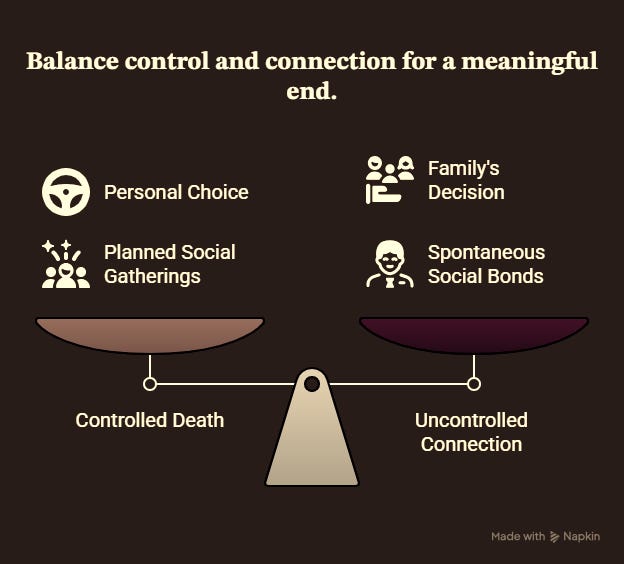
But here’s the tension that keeps catching me. I can control how I die. I have real say over that. What I can’t control at the end is whether I die connected or alone.
That one isn’t decided on the deathbed. That one is decided now. It’s decided on all these ordinary Tuesdays I keep letting slip. You can plan a good death down to the details. You cannot plan a full room. A full room is grown, slowly, years in advance.
I don’t want a party. Let me be clear about that. I’m not looking for a celebration or a crowd or a big send-off.
What I want is a few good friends. People I’ve had real conversations with. Conversations about life, about what happens after, about how to live well while we still can. That’s the room I want. A small one, full of depth.
Let me describe that room a little more. Because the details matter to me.
I picture two or three people who actually know me. Not the surface version. The real one, doubts and all. We’ve argued about big questions and stayed friends anyway. We’ve sat in silence and it wasn’t awkward.
Those are the friendships you can’t fake at the last minute. You can’t call a stranger in your final week and get that. The depth comes from years of small deposits. A hundred ordinary talks that slowly become one real bond.
And right now I’m not on track to have it. That’s the plain truth of where I stand.
Why the gardens matter
There’s an old bit of wisdom that goes something like this. The best time to plant a tree was twenty years ago. The second best time is today.
Relationships are the same. They’re gardens. You don’t plant a seed on Friday and harvest on Saturday. You till, you water, you show up when nothing’s blooming. You do it for years without a payoff. And then one day, right when you need it most, the garden feeds you.
The cruel part is the lag. The work happens now. The reward happens later. Much later. So the whole thing runs on faith. And on a kind of patience I’ve never been great at.
I want the harvest. Of course I do. I want the full room and the deep talks. But I’ve been skipping the tilling. You don’t get one without the other. Nobody does.
Wisdom, if it’s anything, is understanding that gap. It’s knowing the payoff is real even when you can’t see it yet. It’s tilling the soil on a Tuesday anyway. Even when the day is screaming at you to do something more urgent.
I think that’s the part I’ve gotten wrong for decades. I treated relationships like they’d keep without maintenance. Like a friendship was a thing you earned once and then owned forever. It isn’t. Nothing living works that way.
A garden you ignore doesn’t stay frozen. It goes to weeds. Slowly, quietly, with no single dramatic moment. You look up one day and the plot you loved is gone. And you can’t quite point to the week it happened.
That’s how I lost touch with people. Not in a fight. Not in a falling-out. Just in a slow, weedy silence I never chose out loud.
The story I’m afraid people tell about me
Here’s a thought that’s hard to sit with.
I imagine people talking about me somewhere. And the sentence I hear goes: “Josh is a nice enough guy. He just never reaches out.”
That’s it. That’s the epitaph I’m writing with my inaction. Nice guy. Never reaches out.
I don’t want that to be the summary. It’s not that I don’t care about people. I care a lot. It’s that caring stayed a feeling and never became a phone call. And a feeling nobody acts on is invisible. It might as well not exist.
The people I’ve drifted from don’t know I still think of them. How would they? I never told them. I let the day win, over and over. My caring stayed locked inside my own head. And in there, it does nobody any good.
Loneliness has a long fuse
Let me tell you what I think is really at stake here.
I’m in decent shape right now. I’ve got my wife. I’ve got a routine. The loneliness isn’t loud yet. It’s a low hum in the background, easy to ignore.
But loneliness has a long fuse. It gets lit years before it goes off. And it tends to go off in your 80s and 90s, if you make it that far. That’s exactly when you can’t easily build new friendships from scratch.
If I coast now, I know how the movie ends. It ends with me in my 80s, healthy enough, and almost entirely alone. Maybe my wife, if I’m lucky and she’s still here. And that’s it.
That’s not a death I want. Loneliness at the end isn’t just sad. For a lot of older people it becomes a genuine threat to health. It’s not a soft problem. It’s a real one.
So the question isn’t whether I have time. The question is whether I’ll use it before the fuse burns down.
And here’s the cruel timing of it. The years when I most need friends are the years when they’re hardest to make. In your 80s, your circle shrinks whether you like it or not. People move. People pass. Health slows everyone down.
You can’t plant a full garden at 85. The soil for that gets worked decades earlier. The people who’ll comfort me at the end are people I’d have to tend right now. Today. This week.
That’s the whole uncomfortable point. My future company is being decided by my present laziness. The old me is quietly robbing the older me. And the older me won’t get a vote.
Why I still don’t do it
You’d think naming all this would fix it. It doesn’t. Not by itself.
I know the problem clearly. I think about the problem often. I can write two thousand words about the problem, apparently. And then I close the laptop and don’t make the call.
That’s the maddening gap between insight and action. Understanding a thing changes nothing until you actually move. I’ve got the understanding down cold. It’s the moving I keep dodging.
So I’ve stopped trusting myself to just “try harder.” Trying harder is what I’ve done for years, and here I am. If willpower were the answer, I’d have solved this already. I need a different door.
Maybe the honest move is to stop waiting to feel ready. I keep hoping the fear will lift first, and then I’ll act. It never lifts. That’s not how fear works.
The action has to come first. The nerve shows up after you’ve already dialed, not before. I’ve had this backwards for years. I’ve been waiting at a door that only unlocks from the other side.
A door I can actually walk through
Here’s where I’ve landed, at least to start.
The cold call to an old friend is the hardest possible first move. It’s got all the fear built right in. So maybe I don’t start there. Maybe I start somewhere gentler.
This week I’m going to look into continuing education at UVM. They have programs that mix seniors and regular students. Multi-generational, shared rooms, shared subjects. I want to get involved in something like that.
Notice what that does. It doesn’t ask me to reopen an old wound. It asks me to plant a new garden instead. New people, side by side, around a shared thing. The relationship grows out of the activity itself. I don’t have to manufacture it out of thin air.
That feels doable. And doable beats heroic every time. A move I’ll actually make is worth more than a grand plan I’ll dodge.
Years ago I heard Bill Walton speak, and I got to ask him one question. I asked what the best Grateful Dead show he ever saw was. He looked at me like I had three heads. Then he said, “The next one.”
I felt like a fool. But his answer has stuck with me ever since. Why look back when you can look forward? Whatever comes next holds the lesson.
So I’m applying it here. I can’t un-lose the friendships I let go weedy. That garden is what it is. But the next one is still open ground. The next connection is the one I get to plant on purpose.
The old friends aren’t off the table. I still have seven or eight people I owe a real reach-out. An email, maybe, asking for a time to talk. That’s more my speed than a cold call. I’ll get there. But I’m going to start with the door that’s already open a crack.
What I’m telling you, and telling myself
So here’s where I’ve come out.
I can’t control much about the end. But I can control the tilling. I can plant now for a harvest I won’t see for years. That’s the whole deal.
If you recognize yourself in any of this, take the honest look I took. Ask who’d really show up for you. If the list is thinner than you’d like, don’t panic. Just remember it’s not finished. It’s still being written, on the ordinary days, by what you do next.
The second best time to plant is today. It’s always today.
Will I pick up the phone? Honestly, I don’t know. But I’ll think about it. And if I think about it long enough, maybe thinking finally tips over into doing.
That’s not a triumphant ending. It’s an honest one. And for now, honest is the best I’ve got.
The next one is the reach I actually make. So let me go make it, and let me know what you think about all of this in the comments below.

Facebook
LinkedIn
Youtube