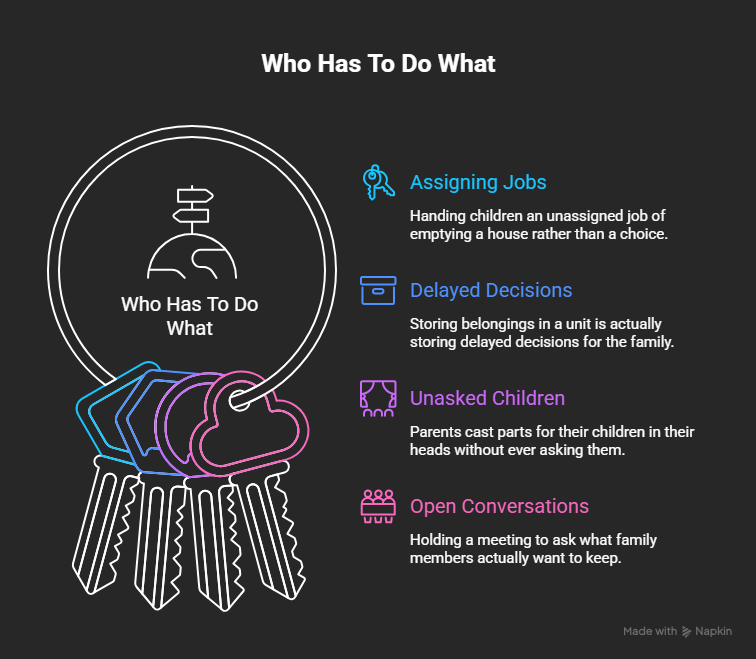
Who Has To Do What
Everybody plans who gets what. Almost nobody plans the other one.
I found out I've been calling something "generous" when it was really just me leaving the room.
Here's the thing I've been telling myself for a couple of years now. When I'm gone, my kids should get to decide what happens. The service, the house, the stuff, all of it. I thought that was a gift. I thought I was being unusually clever about it, honestly. Hand them the freedom instead of a set of orders.
I've been reading what people write about this at two in the morning. And I've changed my mind completely.
I wasn't being clever. I was being thoughtless. If I'm going to be accurate about it, I was being a little bit mean.
Before I go further, one thing needs to be said plainly. Everything here is mine and mine alone. I haven't had this conversation with Suzanne. I haven't had it with my son or my daughter. Nobody in my family has agreed to a word of this, and some of them may read it here first. That's uncomfortable, and it's also the honest position I'm writing from.
What I got wrong about the word "decide"
"You decide" sounds like freedom. Sit with it for a minute, and it stops sounding that way.
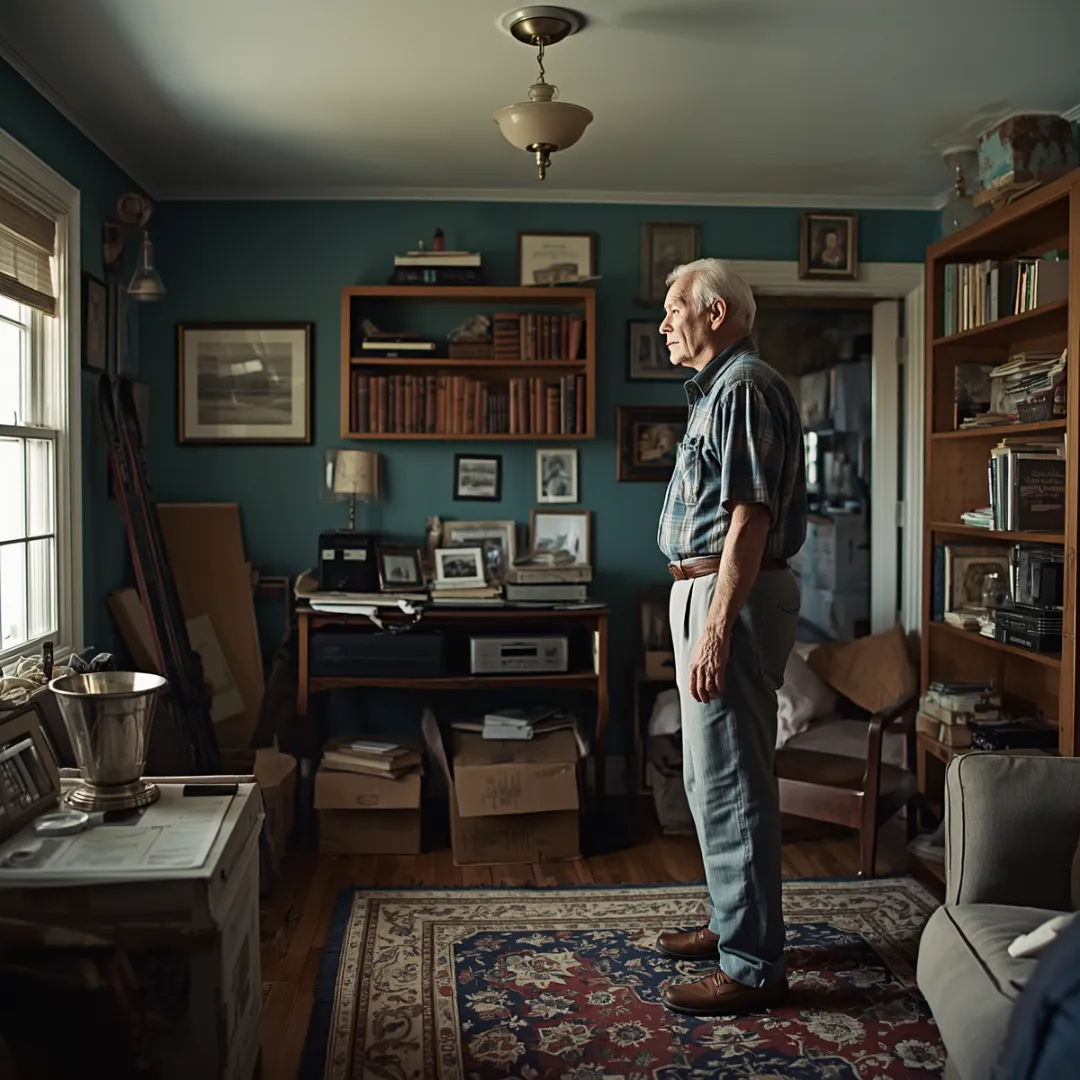
What I actually handed my children was an unassigned job. Not a choice — a job. Somebody has to empty a house in Vermont. Somebody has to decide whether it even goes on the market, or whether one of them wants to move up here and live in it. Somebody has to figure out what happens to the bikes, skis, ski boots, and television sets.
All of it is in my trust. My trust is very clear about the house and the accounts, and completely silent about who drives the truck.
Here's the distinction I keep coming back to, and it's the whole piece for me. The conversation everybody has is about who gets what. The conversation almost nobody has is about who has to do what.
I'm not worried about who gets what. Frankly, I'm not sure my family wants much of my stuff, and I don't think most families do. The other one keeps me up.
What it actually costs when nobody decides
I went looking for what happens to people on the receiving end of my kind of generosity. There's a Facebook group with seventy-nine thousand members devoted to clearing out your own belongings before you die, and its opening line could have been written by me: would it be a burden on your family to go through your belongings when you pass from this earth?
Somebody in there described what her family did after her grandmother died. They needed the house emptied, so they rented a storage unit and filled it. Climate-controlled, a hundred and forty-one dollars a month. Life was busy. They paid it for two years, then went through it and kept one bedroom set.
Her words for what that unit was actually holding stopped me cold. It was storing their delayed decisions. Not furniture. Decisions. Twenty-four months of rent to avoid a conversation nobody had had while grandmother was alive.
That's the bill for "you decide," and somebody in my family would be paying it.
The part that isn't about money at all
The worst thing I read was a woman writing anonymously in a caregivers' group, asking strangers how to protect herself from her own brothers and sisters. She'd taken care of her mother for two years and never asked for a dime. Her mother wanted to leave her the house. She said no. Her siblings, who by her account do nothing, decided she'd talked their mother into it and started accusing her.
One line from her post stayed with me all week. They only want to talk about the money they're going to get. They never ask how Mom's doing.
Look at what happened there. The mother tried to be fair. She tried to reward the daughter doing the work. That attempt at fairness is the exact thing that's going to blow the family apart after she dies.
Good intentions are not a plan. That's what I keep running into.
The room I walked into
I should be honest about what happened when I went looking for agreement.
There's a thread of old people answering a younger man who asked why so many of them leave a mess behind. He was blunt about it. He called it selfish and uncaring, which is roughly what I'd been calling myself.
He had to come back and edit his own post afterward. His words: some folks are spicy about this topic.
The one that got me was a seventy-five-year-old woman. She'd cleaned out her own father's house, so she knows exactly what she's handing to somebody else. Here's her answer.
You have so much less energy as time goes on. And frankly, our date of death is nowhere posted, so will I die 5 years, 10 years, 15 years, or 20 years from now? I cleaned out my father's house after he died. You're young with all that energy; grab a pitchfork and start shoveling.
I've read that a dozen times and I can't beat it.
What she's actually saying
Because look at it. Sorting is not free. It gets paid for out of whatever time she has left, and nobody has told her how much that is. She did the job once for her father, and she's not spending her seventies doing it again in advance for somebody else.
Then I found the thing she's actually refusing to do. A woman posted the night before somebody came to take her piano away to be destroyed. Nobody wants pianos anymore. Her kids don't want it. She didn't want to leave it as a problem for them. Her words: I have a lot of emotional attachment to the piano, so I'm finding it hard to let it go, especially knowing it's going to be wrecked. But it's time to let it go.
Nobody writes about that part. Doing this well doesn't mean leaving less behind. It means arranging the destruction of things you love, on purpose, and then living in the house afterward.
I own a large stereo that I love, but nobody wants. She's me, one step down the road, standing in the room the day before.
So the seventy-five-year-old isn't being lazy. She's declining to spend her seventies taking apart the things she likes having around. I don't have a rebuttal. I have a preference, and I should be honest: it's a preference, not a principle. I'd rather spend some of my time now than hand all of it over later. But I'm seventy-three with two cancers, which means I'm making that trade with a shorter runway than she has, and I genuinely don't know if I'm choosing well.
My track record here is not good
I've made a version of this mistake before. I gave my wealth management practice to two advisors for nothing — told them I was leaving, handed over the keys, and went. At least one of them experienced it as me not holding up my end. From where he stood, I didn't hand something over. I put it down and walked away.
So when I catch myself saying "I'll let the kids decide," I have to ask an uncomfortable question. Is that respect for their judgment, or is it just the thing I do?
Nobody has been asked
Here's where it stands in my house, which is to say, nowhere.
My daughter is in the Boston area with a full-time job. My son is on the West Coast with military retirement, Social Security coming, and gig work he controls. Between the two of them, he's the one with time and cash flow. Living three thousand miles away doesn't disqualify him.
Neither of them knows any of this. Neither has been asked. I've run the whole thing in my head and cast the parts without telling the actors.
Why they'd never bring it up
And there's a reason they'd never raise it themselves. Somebody in that same thread of old people explained the mechanism in one sentence. It skips a generation. The people who've had to do it tidy up. The people who didn't have to deal with it don't know how to tidy up.
Nobody arrives at this from theory. They arrive at it from having done it once, for somebody else, and swearing they won't pass it along. My children have never cleared out anybody's house. They have no idea what they'd be agreeing to, which is exactly why this conversation can't start on their end of it.
The two of them in the same house
And if you want my honest guess about what the cleanout does to the two of them, I don't think it brings them closer. They see the world differently. My son would go wholesale — dumpster, done, move on. My daughter would go through it one item at a time, deciding what stays.
Neither approach is wrong. Put them in the same house on the same weekend, and I'd expect friction, not healing.
There's one thing I'd ask them for. Please don't put it in storage. Once it goes into storage, it never comes out. That hundred and forty-one dollars a month is somebody paying rent on an unmade decision. If you don't want it, find it a good home. There are people who'd use the bikes.
Twenty thousand pictures
Here's the one that's been working on me, and it isn't a problem I can solve with a document.
There are more than twenty thousand photographs on my computer. When our television isn't playing anything, the screensaver runs them, a hundred or two hundred at a time. Suzanne and I sit and watch them. It's the best thing in the house.
Everything about the access is handled. The will is in three places, and we use a password-protected program that the family can sign in to access all of it. On the logistics, I've done the work. So the pictures aren't locked. Anyone can walk in and open them.
That turns out to be a different, harder problem.
A story from the other direction
I read about a man whose brother died suddenly, leaving two teenage daughters and twenty-five years of family photographs behind an encryption nobody could break. Eighteen months on, they're still locked out, and the company genuinely can't help. What surprised me was the comment section — a lot of people took the dead man's side. He wanted privacy, they said.
Those daughters would give a great deal for what my kids already have. Full access, no barrier, nothing to break.
And nobody has ever told me they want them.
That's not a complaint about my children. I've never asked. Those photographs aren't really mine anyway — that's their childhood in there, their life every bit as much as it is ours. I've been running a screensaver of their lives and assuming it means something to somebody besides me. Maybe it does. I have no evidence either way, because I've never opened my mouth about it.
An unopened file is not so different from a locked one. That's what I keep landing on.
One box
There's a writer I came across who was sorting through a box of family letters, ordinary correspondence from Ontario farms a hundred years ago, dull when written and now the only family history anybody has. She asked her son what he'd want to keep.
His entire answer was: one box, Mum.
He didn't refuse, and he didn't hand her a blank check. He named a size. I've been chewing on that for days, because it's answerable. It's not morbid, it doesn't require anybody to discuss my death, and whatever number comes back is real information.
Then I tried to answer it myself. If my kids get one box, what's in it? It sure isn't my stuff. It'd be the writing — my journals, these posts, the books.
But I had the question backward, and it took me a while to see it.
I was asking what I want to leave them. The real question is what they want in the box.
We assume the parents run this. I'm not sure that's true anymore. I think the kids run it, if we let them — and the letting is the whole job.
What happens when you actually ask
Here's where my dread ran into some evidence, and the evidence won.
Almost everywhere I looked, people were either dreading this conversation or regretting they never had it. Then I got into that group of seventy-nine thousand, and found people who've actually run it. Their reports don't match what I've been picturing at all.
One woman held what she called a death meeting — all three children, spouses included, everybody asked what they'd want. Her account stopped me. I was so surprised by their choices. Nothing of any real value. Her son and his husband asked for the dress she wears every year for Pride, which they intend to display on a mannequin, and some old shoes. One daughter wanted the Folio books, the other the vinyl. She typed it up and filed it with the will.
Then this. It wasn't at all depressing, and we had such a laugh over it all.
Another woman, not quite sixty, did the same. Antique rifles to the son, an old standing radio to one daughter, the genealogy papers to the other. Her comment was two words. Glad I asked.
I couldn't find anybody in there reporting a meeting that blew up. That doesn't mean it can't happen. It does mean I've been assuming the worst with no basis for it.
The part that stung
Look at what those kids picked. A dress. Old shoes. A radio. Not one thing worth anything, in any of the accounts I read. The valuables went unclaimed and had to be handled separately.
That's the stereo again, from the other side of the table — and it's better news than I'd been telling myself. My kids will probably want something. It just won't be the expensive thing, and it may be something I'd never have guessed.
Somebody else described how her parents handled the mechanics, and it's so plain it's almost funny. A list of what they wanted to give away, typed into a spreadsheet, shared with all eleven of them. Everybody puts their name next to what they want. First come, first served, with a deadline.
Eleven siblings. No fight.
What that really buys isn't fairness. It gets who-gets-what off the table in an afternoon, so the room is free for the conversation I actually care about.
One exception
I've said in print that I don't believe in hiding things. Hidden things get found, and being found is usually worse than being told.
I have private journals. They're critical of people in my extended family. There's material in there about my kids that I wouldn't want them reading.
I've been telling myself I'll destroy them before I die. And I've been framing that as protecting myself, which I now think is the wrong way around.
The most-answered thing I came across in that whole seventy-nine-thousand-member group wasn't about furniture or money. It was a woman who'd been helping a close friend clear out a parent's house and found photographs nobody was meant to see. Her post was mostly a plea. Please purge, or put your intimate pictures in a safe, clearly marked. We grown children do not need that visual whilst grieving.
Five hundred and fifty-seven people responded to that. More than anything else in the archive.
She's not talking about my journals, but she may as well be. The problem was never that my kids would think less of me. It's when they'd be reading it — in the middle of the worst week of their lives, in a room they're trying to empty, holding something I left where they'd find it.
Which brings me back to I'll destroy them before I die, and the assumption sitting underneath it. That sentence assumes I get notice. It assumes I go out slowly, from something with a long tail, with time to sort my papers and burn what needs burning. Not a heart attack on a Tuesday.
I think most of us believe that about ourselves. For some of us it's even true.
A woman who wasn't arguing
Somebody else in those threads wasn't making a case at all. She was just reporting. Her husband was killed by a road-raging driver at forty-nine. Hunting for his passwords, she said, was a nightmare. He'd accumulated a pile of expensive toys that became hers to deal with.
Her closing line is the one I keep hearing. It's not easy to dispose of a loved one's belongings, much less your own, when you think you're going to live forever.
Forty-nine years old, and a stranger's steering wheel set the timetable.
So the man writing the essay about not leaving a mess has a set of documents he's planning to deal with later, on a schedule he doesn't control. I don't have that resolved. I'm not going to pretend I do by the end of this piece.
What I'm actually going to do
We're going to have a conversation. Not a document — a conversation. Me, Suzanne, my son, my daughter. Three things I want to say early in it.
The money is there. If they'd rather not do this themselves, the estate pays. Fifty thousand, a hundred thousand to empty the house and get it sold — fine. Hand the whole thing to the trust company, and it's a much bigger number, and that's still available. It's only money, and sometimes money matters less than time. Their time is worth something.
The cost gets split down the middle, and I want that written into the trust. Not because I think they'd fight about it, but because I don't want it to be available to fight about. Nobody gets to say "you're spending my money on that."
And none of it is permanent. We decide something this year and revisit it next year. Things change, people change, decisions change. That matters for me to understand, and I suspect it matters more for them. Nobody's signing anything in blood.
Where this actually leaves me
There's a real chance they hear all of it and shrug. "We don't care. You decide, you handle it." If that's the answer, that's the answer — we write the instructions, we hire the third party, and they inherit less money for the privilege.
I'm honestly agnostic. I hate the word "should," and I don't have a "should" here. My sister has a phrase for what happens after we're gone that I've started using: we're not on that committee.
What I can't get comfortable with is the timing. This is not a fast process; I'm seventy-three with two cancers, and I'm the one carrying it. I don't know if I get to finish. And I've come to believe that even if I do, there will be loose ends no matter how many meetings I run.
Twenty thousand photographs nobody has asked for. A box of journals I keep meaning to burn. A woman I've never met, telling me to hand my children a pitchfork. Another one watching her piano get carried out the door. Two adults who don't yet know I've been assigning them work in my head.
I'll let you know how the first conversation goes. I'd rather report on it than predict it.
Your turn
If somebody left you this job, I want to hear it. What did you actually inherit — the stuff, or the work? Did they think they were doing you a favor? Did it feel like one?
And if you're on my side of it: have you asked anybody yet? Or is it all still running in your head, cast and blocked, with the actors never told?
I read every comment. That's my favorite part of this.
Hey, this is Josh. You're on the Long Strange Trip. I'm glad you're here.

Facebook
LinkedIn
Youtube