
When the Mission Ends: What My Son Taught Me About the Hardest Transition Most People Never Talk About
A conversation with Sam Patrick — 20+ years Army, 160th SOAR, and now helping veterans find their footing again
I have to be honest with you about why I did this episode.
Sam Patrick is my son. I watched him serve for over twenty years , much of it in special forces, a big chunk of that with the 160th Special Operations Aviation Regiment. If you know anything about the military, you know the 160th. They're called the Night Stalkers. They don't fly in daylight if they can help it. They trained for years to do things that most people will never know happened. They were the helicopter unit on the Bin Laden raid. They are, by any measure, among the most elite aviators who have ever put on a uniform.
And when Sam separated from the Army, he struggled.
Not in the way that makes headlines. He wasn't in crisis. He was functional, capable, and by all outside appearances, doing fine. But there was a fog. A quiet restlessness. A gap between who he had been for twenty-plus years and who he was supposed to be now.
That is what pushed me to sit down with him for this episode. Not to celebrate his service , though it absolutely deserves celebrating. But because what he went through after service is something a lot of people are going through right now, and most of them are doing it alone, quietly, without a map.
And here's what I keep thinking about as I process our conversation: this is not just a military story. Not by a long shot.
The Hardest Part Isn't What You Think It Is
Here's the thing nobody tells you before you separate from service: the job is not the hard part.
For someone like Sam , a Night Stalker with two decades of leadership, high-stakes decision-making, and real operational experience , getting hired is not the challenge. Employers love veterans. They love the discipline, the work ethic, the ability to function under pressure. The resume looks impressive even to people who don't fully understand what they're reading.
The hard part is everything underneath the job.
Who are you when no one's calling you by your rank? What do you do at 0600 when there's no formation, no mission brief, no team counting on you? What happens to your sense of self when the thing that defined you for twenty years , the title, the unit, the brotherhood, the purpose just stops?
That question doesn't get asked enough. And that silence is expensive.
About 200,000 service members leave the military every year. Many do okay. But a meaningful number of them spend the first year or two after separation in a fog they can't quite name. They're not broken. They're not weak. They're dealing with something genuinely hard: a complete identity reset happening at full speed, all at once, in a world that has no idea what they left behind.
For special operations veterans, that fog can be even thicker. Because from the outside, everyone assumes you're fine. You're an elite operator. You've handled harder things. What's a job search compared to a combat deployment?
Everything, it turns out. Because this problem is personal, not operational.
The Paradox of High Performance
Here's a pattern I've noticed across a lot of high-performing people and Sam's story fits it perfectly.
The same traits that make someone exceptional in a structured, high-stakes environment can work against them in an unstructured transition. The confidence that helped you lead teams through impossible situations can make you skip the self-reflection that transition actually requires. The speed that made you effective in the field can make you grab the first high-paying job just to stop the discomfort of not having a clear mission.
Sam saw this with his peers. Guys who were genuinely extraordinary, people who had done things most civilians can't even imagine, treating their transition like a checklist. Click through the TAP classes. Update the resume. Take the first decent offer. Get busy. Stay moving.
And then six months in, they'd be miserable. Or numb. Or both.
It's like throwing a tarp over a leaking roof. It covers the problem for a while. But the water still gets in.
The military gives you rails. Healthcare, housing, structure, schedules, uniforms, a team that depends on you, and a mission that matters. When all of that disappears at once, it doesn't just leave a hole in your career. It leaves a hole in your identity.
And here's what I want to say directly to anyone reading this who isn't a veteran: you already know this feeling. Maybe not from leaving the military, but from leaving a company you helped build. Or stepping down from a leadership role that consumed your life for a decade. Or selling a business you poured everything into. The specifics are different. The emotional architecture is remarkably similar.
Loss of identity. Loss of structure. Loss of tribe. Pressure to figure out the next move before you've even processed the last one.
If that sounds familiar , this article is for you too.
The Identity Earthquake Nobody Warns You About
When Sam and I talked about this, one phrase stuck with me. He said something along the lines of: for most of my adult life, the group came first. That's not a complaint. That's the culture, and it's a good culture. But it leaves you rusty at answering basic personal questions.
Questions like:
What actually matters to me now? Not the mission. Not the unit. Me.
What kind of life do I want day to day?
What work feels meaningful when there's no enemy to defeat?
Who am I when I'm not defined by what I do?
Those aren't soft questions. They're the foundation of every smart next move. And most high performers — whether they're Night Stalkers or Fortune 500 executives — are genuinely out of practice at answering them.
The people who navigate transition well tend to slow down and wrestle with these questions early. Not because it's comfortable. It's not. But because jumping to the next role before you understand what you're looking for is just expensive trial and error. And the cost isn't just financial. It's your time, your energy, your family's patience, and your confidence.
Five Things That Actually Move the Needle
Sam now spends meaningful time helping veterans work through exactly this — and what he's found mirrors what the research shows. There are a handful of moves that consistently separate the people who land well from the ones who spend years feeling stuck.
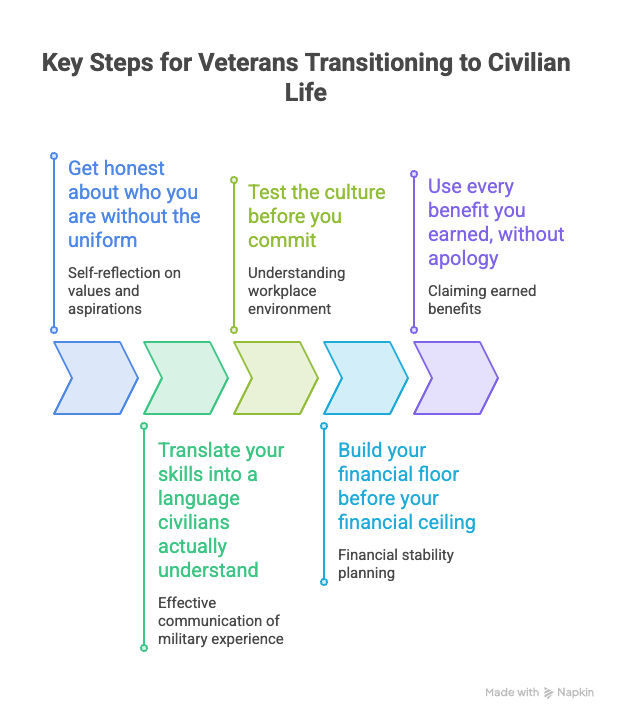
First: get honest about who you are without the uniform.
Not who the military made you. Who you are. Your values. Your energy and stress tolerance. Your financial needs. What you want your family life to look like. What kind of work makes you feel alive versus what kind drains you by noon? This work feels slow. It is slow. It's also the foundation on which everything else is built.
Second: translate your skills into a language civilians actually understand.
Military terminology is its own language. When you say you led a 12-man ODA, coordinated air assets, and advised partner forces in a denied area — civilians hear impressive-sounding words they can't connect to their hiring decision. What they need to hear is: you managed a high-stakes team under pressure, made critical decisions with incomplete information, and got results in environments where failure was not acceptable. Same experience. Completely different message. This is also true for executives. All industries have jargon, and the less of it you use, the easier it is for others to understand you.
Third: test the culture before you commit.
A salary can look great on paper and still be a trap. One of the most common mistakes Sam sees veterans make is taking a job because the money is right — without spending any time understanding what the daily culture actually feels like. Volunteer. Shadow someone. Find veterans already working there and have a real conversation. Think of it like reconnaissance. You're not just asking what it pays. You're asking whether you can live in this environment for years without losing your mind.
Fourth: build your financial floor before your financial ceiling.
The pension, disability compensation, or savings you've built create breathing room — but only if you don't immediately expand your lifestyle to consume it. Set your baseline first. Know what you actually need to live well and feel stable. Then choose your next opportunity from a position of control rather than pressure. A lower starting salary with sustainable conditions almost always beats a high salary that traps you in a role that's slowly grinding you down.
Fifth: use every benefit you earned, without apology.
This one drives Sam a little crazy because he sees it constantly. Veterans are talking themselves out of claiming benefits because someone else had it worse. Because they feel like they shouldn't need help. Because the paperwork is annoying and they'd rather just push through.
That mindset leaves real money, real support, and real years of stability on the table. If you earned a benefit through your service, using it is not a weakness. It's smart. It's what the benefit is there for.
What the Family Is Going Through Too
I want to say something directly to the spouses and families of veterans in transition, because this is something Sam and I talked about, and I don't want to skip over it.
You are not a bystander in this process. You are in it with them.
Roles shift. Schedules change. The person who was gone a lot is suddenly home all the time — which sounds like a gift, and in many ways it is, but it also comes with an adjustment that nobody warned you about. The veteran may look fine on the outside and still be dealing with an identity reset that's hard to put into words. That's not a personal rejection. That's the fog.
The most important thing I can tell you is: talk early and often. Don't wait until the pressure builds. Keep expectations clear and realistic. And understand that the transition isn't just about finding a job. It's about finding a new sense of self, and that takes longer than a few weeks of job searching.
The Bigger Lesson — And Why I Think It Applies to You
Here's where I want to bring this home, because I think there's a thread in Sam's story that goes well beyond the military community.
A lot of the people who follow this newsletter are business owners, executives, and entrepreneurs. You are high performers. You are used to operating in structured environments with clear stakes. You lead teams. You solve hard problems under pressure. You have built your identity — whether you fully realize it or not , around your role.
What happens when that role ends?
What happens when you sell the business, step down, restructure, or simply reach a point where the version of yourself that built the thing isn't the version that needs to carry it forward?
The identity earthquake hits the same way. The loss of structure and tribe hits the same way. The temptation to stay busy instead of getting reflective hits the same way.
What Sam's experience taught me and what I keep coming back to — is that the highest performers are often the least prepared for transitions precisely because they've been too good at the previous chapter. The very strengths that got them there can become blinders when the landscape changes.
The people who land well — veterans, executives, founders, it doesn't matter — tend to share a few traits. They start earlier than they want to. They get honest about identity and purpose before they get tactical about resumes and salaries. They use mentors and peers who can offer an outside perspective. They keep spending under control so they can choose from strength rather than desperation. And they stay persistent with systems and support even when those systems are imperfect and frustrating.
They treat the transition like a campaign plan — not a last-minute scramble.
What Sam Is Doing Now
Sam is now actively involved in helping transitioning service members navigate this exact terrain — the personal and professional rebuild that military transition really requires. The work matters to him because he lived it, and because he saw too many peers drift through it alone.
If you're a veteran in transition or if you know someone who is, I'd encourage you to reach out to the organizations doing this work seriously. Groups like The Special Operators Transition Foundation, Your Grateful Nation, ACP Mentoring, and The Honor Foundation are doing real work to help people build the next chapter with support, not just a checklist.
And if you took anything from this post that resonated beyond the military context, if any piece of Sam's story hit you in a place that had nothing to do with the Army, I'd genuinely love to hear what that was. Send me a note. Share this with someone who needs it.
The mission changes. But the person who ran it is still worth investing in.
This article is based on my podcast conversation with Sam Patrick — Army veteran, Night Stalker, and someone who's given a lot of his adult life to things that matter. I'm proud of the service, but I'm prouder of the man. Thanks for sitting down with me, Sam.
If this resonated with you, share it with someone in transition — military or otherwise. And if you're not subscribed yet, join the newsletter below. Every week, I talk to people doing hard, meaningful work and try to pull out the lessons worth keeping.


Facebook
LinkedIn
Youtube