When Life Keeps Throwing Punches: What I'm Learning About Building Real Resilience
We throw around the word “resilience” like it’s some kind of superpower you’re either born with or you’re not. Like it’s this fixed thing where tough people bounce back and the rest of us just... don’t.
But after 73 years of living – including the past couple where cancer, brain bleeds, and losing activities I love have become my new normal – I’m learning that’s complete BS.
Resilience isn’t about being tough or positive or refusing to acknowledge when things suck. It’s messier than that. Way messier.
And honestly? I’m still figuring it out as I go.
The Resilience Lie We’ve All Been Sold
Here’s what most people think resilience means: you get knocked down, you get right back up, dust yourself off, and keep going like nothing happened.
That’s not resilience. That’s denial with good PR.
Real resilience – the kind I’m trying to build while dealing with two cancers – looks a lot more like stumbling forward while admitting you have no idea what you’re doing.
Some days I wake up with decent energy and think, “Okay, maybe I can handle this.” Other days I wake up already exhausted and wonder how the hell I’m going to make it through breakfast.
Both of those days require resilience. Just different kinds.
The myth says resilient people don’t struggle. The reality is that resilient people struggle constantly – they’ve just learned to keep moving through the struggle instead of waiting for it to end before they take action. (and sometimes it never ends.)
What Actually Happens When Your Body Stops Taking Orders
I had this whole vision of how my 70s would go.
Skiing every winter. Long bike rides all summer. Staying active and engaged. Sure, I’d slow down a bit, but the essential me – the guy who’s always been physical and outdoorsy – that would stay the same.
Then reality showed up with other plans.
Two cancers. A brain bleed. Treatment that leaves me wiped out for days. And the slow, painful realization that skiing this year isn’t just difficult – it’s now impossible.
Let me tell you what that actually means.
For most of my adult life, I’ve skied 20-30 times every winter. That’s not just a hobby – it’s been my identity, my reason to get outside, my way of staying connected to Vermont winters that would otherwise feel endless and dark.
Skiing gave structure to my weeks. It gave me something to look forward to. It gave me that feeling of moving through space with skill and control, of pushing myself physically, of being capable.
Now? I’m staring at a Vermont winter with no skiing. And I have to figure out what to do with all that time – the time I would have spent on the mountain, the energy I would have poured into the sport, the identity I wrapped around being “a skier.”
And here’s the kicker: I don’t have a good answer yet about what comes next.
I know what I don’t want. I don’t want to spend those hours sitting in front of a screen, mindlessly consuming content to pass the time. That’s not living – that’s just existing until something better comes along.
But what do I actually want instead? What fills the hole that skiing leaves behind?
I’m still figuring that out. And that uncertainty is part of what resilience has to hold.
The “It Is What It Is” Philosophy
I say this phrase a lot: “It is what it is.”
Some people hear that and think I’m being defeatist. Like I’m just giving up or resigning myself to whatever happens.
But that’s not what it means at all.
“It is what it is” means I’m done arguing with reality.
I have cancer. That’s not up for debate. I’ll never be able to ski. Fighting that fact won’t change it. Some days I’m too tired to do much of anything. Pretending otherwise just makes me more exhausted.
This isn’t resignation. It’s clarity.
Because once you stop wasting energy fighting what actually is, you can start working with it instead of against it.
It acknowledges what’s true, then asks: “Okay, given what is, what now?”
That’s where resilience lives. Not in denial or toxic positivity, but in clear-eyed acceptance followed by practical adaptation.
Learning When to Push and When to Wait
Here’s something that’s been building my resilience muscle in ways I never expected: learning to sit back when everything in me wants to push forward.
My PSA is higher than it should be. For those who don’t know, that’s a marker for prostate cancer activity. Higher numbers generally mean something’s happening that shouldn’t be.
And I have no answers as to why.
My radiologist wants to watch and wait. Monitor it. See what happens over time before making any moves.
This goes against every instinct I have.
I’m a doer. I’m someone who spent decades in business solving problems, taking action, and making things happen. When something’s wrong, you fix it. You don’t just sit there watching it stay wrong.
But that’s exactly what I’m being asked to do. Wait. Watch. Sit with the uncertainty of not knowing what those numbers mean or what to do about them.
Sometimes the most resilient thing you can do is nothing.
Not because you’re giving up or being passive. But because you’re strong enough to sit in the discomfort of not knowing, without forcing action just to make yourself feel better.
That’s a completely different muscle from the one I’ve been building my whole life. The “push through, make it happen, take control” muscle is well-developed. The “sit back, trust the process, be okay with ambiguity” muscle? That one’s been atrophying for years.
Resilience isn’t just about forward motion. Sometimes it’s about having the strength to stay still when every part of you wants to run.
When Even the Experts Are Confused
Here’s something that really tests your resilience: when the people who are supposed to have answers don’t have them either.
I’ve got two cancers. Prostate cancer and Mantle Cell Lymphoma. Having both simultaneously is rare enough that even the doctors at Dana Farber – one of the best cancer centers in the country – aren’t entirely sure how to handle it.
They rarely see this combination. There’s not a lot of data. There’s no clear playbook.
And then there’s this weird thing happening with my lymphoma: it’s shrinking. For no apparent reason. Without treatment.
My doctors don’t have good answers for why. They can speculate, but they don’t really know. Which means I definitely don’t know where I stand today or what any of this means for my future.
Talk about building your resilience muscle.
I’m sitting in this space of complete unknowing. Not the kind where answers are coming soon. The kind where medical science itself doesn’t have clear answers about what’s happening in my body.
Because I could spend every moment obsessing over what I don’t know. I could spiral into anxiety about all the possible scenarios. I could demand more tests, more answers, more certainty, even when none exists.
Or I can accept that I’m in genuinely unknowable territory and learn to live there without letting it destroy me.
That’s the work. Not figuring out the medical mystery – I can’t do that. The work is figuring out how to keep living a meaningful life while carrying this enormous uncertainty.
Some days I’m better at it than others.
The Mental Game: Staying Present
Want to know what takes more energy than dealing with cancer?
Dealing with all the thoughts about cancer.
Your brain is incredibly good at taking one difficult reality and spinning it into a thousand terrifying futures.
You start with: “I’m tired today.”
Then your brain goes: “What if this fatigue never gets better? What if treatment doesn’t work? What if I keep declining? What if...”
This is what I call future-tripping. And it’s completely normal and also completely exhausting.
Here’s what I’m learning: I can’t actually know what’s coming.
What I can do – and what I’m working on every single day – is stay present with what’s actually true right now.
Today, I’m managing. Today, I have some energy. Today, I can write and think and have conversations with people I love. Today, this moment, I’m okay.
This is where meditation helps me. Not in some mystical, transformative way. In a very practical way.
When I catch myself future-tripping – and I catch myself a lot – meditation gives me a tool to come back to the present moment. To notice I’m spiraling and choose to redirect my attention to what’s actually here, right now.
It also keeps me from getting frustrated or losing my temper in situations where anger wouldn’t do any good. When you’re dealing with health issues, there are a thousand small frustrations every day.
I could let all of that set me off. And sometimes it does. But meditation has given me a little more space between the trigger and my reaction. Just enough space to choose how I want to respond instead of just reacting automatically.
That’s resilience, too. Not controlling your circumstances, but developing some control over how you meet them.
What You Can Control vs. What You Can’t
When health takes away a lot of your control, it’s easy to feel completely helpless.
But here’s what I’m discovering: there’s always something you can control, even when you can’t control the big things.
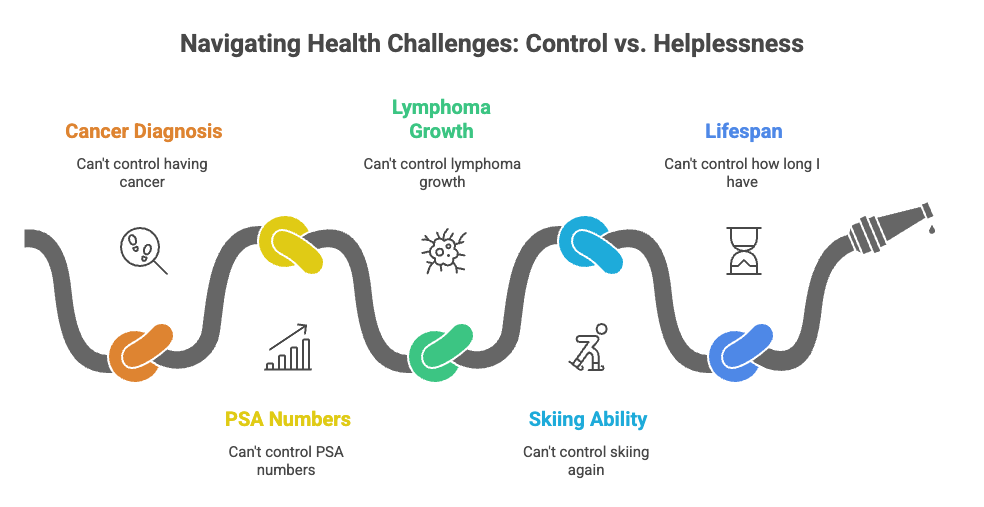
I can’t control having cancer. But I can control how I respond to it.
I can’t control my PSA numbers. But I can control showing up for monitoring appointments.
I can’t control whether my lymphoma keeps shrinking or starts growing again. But I can control focusing on today instead of obsessing about unknowable futures.
I can’t control whether I’ll ever ski again. But I can control whether I spend this winter finding something meaningful to do.
I can’t control how long I have. But I can control what I do with the time I’ve got.
This distinction matters because focusing on what you can’t control creates helplessness and anxiety. Focusing on what you can control creates agency and purpose.
Even if that control is smaller than you want. Even if it’s just choosing how you show up today.
That’s still something. And sometimes something is enough.
The Weird Gift Hiding in the Struggle
Here’s something nobody tells you about facing serious health challenges: constraints can actually clarify what matters.
When you have unlimited energy and options, it’s easy to scatter yourself across everything. When your capacity is limited, you’re forced to choose.
What actually matters? What do you want to spend your limited energy on?
For me, this has meant letting go of a lot of “should dos” and getting clearer about what I actually care about.
I should probably be networking more for business. But honestly? I’d rather spend that energy writing or having real conversations with people I care about.
This isn’t giving up. This is getting clear about priorities.
And sometimes it takes losing capacity to figure out what really deserves your limited resources.
Accepting Without Approving
Here’s an important distinction: accepting reality doesn’t mean you approve of it or like it or think it’s fair.
I accept that I have cancer. I don’t approve of it. I’d much rather not have it. It’s definitely not fair or what I wanted for this phase of my life.
But arguing with the reality of it doesn’t change anything. It just makes me more miserable.
Acceptance means: This is true. This is what I’m working with. Fighting against the fact of it won’t make it not true.
From that acceptance, I can make better decisions. I can focus my energy on things I can actually influence rather than wasting it on wishing things were different.
A lot of people resist acceptance because they think it means giving up. But there’s a huge difference between fighting the disease and fighting the reality of having the disease.
Accept what is. Then decide how to respond to what is.
Resilience Is a Muscle You Build Yourself
Here’s something I’ve learned that might sound harsh: no one else can build your resilience for you.
Support helps. Love helps. Good medical care definitely helps. But the actual work of developing resilience – of learning to bend instead of break, of adapting to new realities, of staying present with difficulty – that’s something you have to do yourself.
At 3 a.m. when I can’t sleep because my mind is racing through all the unknowns? That’s when I have to do the work myself. When I wake up exhausted and have to decide how to approach the day? That’s my call to make. When my PSA numbers come back higher than expected, and I have to sit with not knowing what that means? Nobody can do that for me.
Resilience is like any other muscle. You build it through use. Through showing up for the hard moments and doing the work even when you don’t want to.
Other people can encourage you. They can believe in you. But they can’t build the muscle for you.
You have to do the reps yourself.
And honestly? Some days I don’t want to. Some days I’m tired of building this muscle. But that’s not how it works. So I keep showing up. Keep practicing. Keep doing the reps even when I’m exhausted.
Because the alternative – letting the challenges break me instead of bend me – that’s worse.
What I’m Still Learning
Let me be really clear about something: I don’t have resilience mastered.
Some days I handle things with grace. Other days I’m angry, scared, and completely overwhelmed. Both of those are okay.
Building resilience isn’t about becoming some zen master who never struggles. It’s about developing the flexibility to adapt when life demands it, even when adaptation is the last thing you want to do.
It’s about sitting with uncertainty without letting it paralyze you.
It’s about grieving what’s lost while staying open to what’s still possible.
It’s about learning when to push and when to wait.
This is ongoing work. Not a destination I’ll reach someday. Not a skill I’ll perfect and then be done with.
It’s a practice. And some days I’m better at it than others.
Right now, I’m sitting in a lot of unknowns. I don’t know what my elevated PSA means. I don’t know why my lymphoma is shrinking. I know I won’t ski again. I don’t know what comes next.
Two years ago, that level of uncertainty would have driven me crazy. Now? I’m learning to live here. In the not knowing.
Some days that feels manageable. Other days it feels impossible.
Both are part of building resilience.
So here’s my question for you: What are you building resilience around right now? What’s demanding more flexibility than you knew you had?
I’d love to hear your stories in the comments. Not the polished versions. The messy, “I’m still figuring this out” versions.
Because that’s where the real learning happens – in the honest middle of it, not the cleaned-up aftermath.
Let’s figure this out together.

Facebook
LinkedIn
Youtube