
What Scares You Is Probably the Thing You Need Most
A conversation with risk expert Susan Schramm that hit closer to home than I expected
I’ve been having a theory lately.
Well, I’m always having theories. Ask anyone who’s sat across from me for more than twenty minutes. But this one’s been with me for a while, and a recent conversation with someone who thinks about risk for a living helped me put words to it.
The theory is this: most of us are not actually afraid of the thing we say we’re afraid of. We’re afraid of the last time we tried something like it — and what happened to us when it didn’t work.
That’s the real story underneath risk. And it’s a much more interesting story than the one we usually tell ourselves.
I’ve spent decades telling people that risk is really just opportunity in disguise. I’ve built businesses around that idea. I’ve coached business owners to stop flinching and start experimenting. I’ve given plenty of talks about fail fast, fail cheap. And I’ve meant every word of it.
But I’ll be honest with you — because that’s what we do here on The Long Strange Trip. At 73, sitting with my own dual cancer diagnosis, the concept of risk has gotten a lot more personal than it used to be. Life handed me an actual test, not a theoretical one, and I got to find out what I actually believe versus what I say I believe.
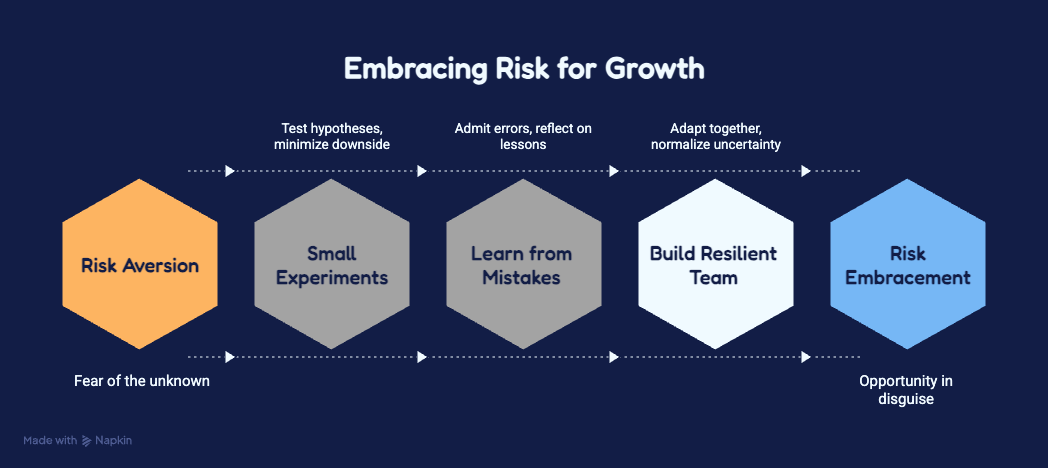
What I found: I still think risk is opportunity. I just understand now that the real risk isn’t in the action. It’s in the inaction. It’s spending whatever time you have left waiting for a certainty that’s never coming — staying in the comfortable story that you’ve already figured this out.
You haven’t. I haven’t. None of us has. And honestly? That’s kind of the whole point.
That’s what made my recent conversation with Susan Schramm on The Long Strange Trip hit so hard. Susan is a risk strategist who literally wrote the book on it — Fast Track Your Big Idea: Navigate Risk, Move People to Action, and Avoid Your Strategy Going Off Course. She works with companies, nonprofits, startups, and everything in between — helping figure out why genuinely great ideas get stuck, and how to actually move people to take action instead of just talking about it.
What I didn’t expect was that a conversation about business strategy would end up being one of the most personal conversations I’ve had on this podcast. Because Susan didn’t just talk about risk in boardrooms. She talked about it in the places we all actually carry it — in our bodies, in our memories, in the moments when someone told us we weren’t quite good enough.
That’s the thing about risk. It’s never really about the decision in front of you. It’s almost always about the decisions you made ten, twenty, forty years ago — and whether you ever got to call them experiments instead of failures.
The Word “Risk” and What It Does to Your Brain
Try a little experiment right now. When you hear the word risk, what’s the first thing that pops into your head?
When Susan asked me that, I said “opportunity.” She laughed — because, as she pointed out, that’s exactly what entrepreneurs say. For most people, the word risk triggers something much more primal than opportunity. It triggers danger. Caution. The feeling of standing at the edge of something with no handrail.
And here’s the thing: your brain isn’t broken when it does that. It’s doing exactly what it was designed to do.
Susan defines risk simply and cleanly: it’s unknowns. Some unknowns are good. Some are bad. But they all have one thing in common — your brain doesn’t have a plan for them yet. And when your brain doesn’t have a plan, it panics. Not metaphorically. Literally. The protective part of your nervous system kicks in and says, abort mission, go back to what’s familiar, do not do the new thing.
This is why change and risk are so deeply linked. Any time you move from what you know toward what you don’t know, your brain treats the transition like a threat. And if that sounds exhausting — it is. Because what it means is that every single major life transition you’ll ever face, every reinvention, every new chapter, is going to come with a brain that’s working overtime to talk you out of it.
The question isn’t how to turn that off. You can’t. The question is how to work with it instead of against it.
I asked Susan which comes first — change aversion or risk aversion. She said she honestly wasn’t sure they were separable. What she does know is that when people face something unknown, the very first thing that happens is evaluation: how will this affect me? That’s where the risk-reward calculation kicks in. And for most of us, it kicks in with a heavy thumb on the risk side of the scale, because of everything we’ve been taught to believe about what happens when things go wrong.
What Your Parents Accidentally Taught You About Risk
Here’s the thread in this conversation I can’t stop pulling on.
Susan told a story about being in ninth grade, getting a solo part in a play, walking out onto that stage in front of everyone — and going completely blank. The music kept going. The silence stretched. And then she made a dramatic recovery, improvised an ending, and got a great ovation. But her grandfather, who was in the audience, was mortified. Couldn’t handle it. Even though Susan landed it, even though the crowd came with her, his visible embarrassment stayed with her.
I have my own version. First public talk I ever gave, I was 24 years old, speaking at a vending conference out in Reno, Nevada. At the end of it, my father pulled me aside. He said, “That was pretty good. But one thing — don’t tell jokes. You’re not funny.”
Now. I have since been told, by a fair number of people, that I’m actually reasonably funny. That’s beside the point.
The point is: in both of those moments, neither Susan nor I stopped to ask whose embarrassment we were actually experiencing. We just took it on. We walked away with a story about ourselves — I failed, I’m not funny, I can’t pull it off — without ever realizing that the adults around us were dealing with their own discomfort, their own fear of being associated with imperfection. It wasn’t really about us at all.
But children don’t know that. And honestly, most adults never figure it out either.
Susan said something late in our conversation that I keep coming back to: there’s a difference between “a mistake was made” and “I am a failure.” That gap — between the action and the identity — is where most of our risk aversion actually lives. We’re not really afraid of the thing going wrong. We’re afraid of becoming the person who got it wrong. The one who doesn’t have what it takes. The one who the room is embarrassed by.
I spent a good chunk of my adult life — much of it in therapy and some of it in the kind of internal work that doesn’t have a name yet — figuring out that distinction. It doesn’t come easy. But it changes everything.
Fail Fast, Fail Cheap — and the Bicycle
One of the things I appreciate most about Susan is that she’s not asking anyone to take a reckless leap. She’s not a “just jump, and the net will appear” person. She’s a strategist, which means she cares about how you approach risk, not just whether you do.
She used a metaphor that I love: learning to ride a bicycle. Nobody just gets on a bike and zooms away. There is an obvious, accepted, step-by-step process. You wobble. You fall. You grab onto someone’s hand or the back of the seat. You try again. With every small experiment, you build a little more confidence, a little more muscle memory.
I’ve been calling that “fail fast, fail cheap” for years. The idea is simple: instead of making one giant bet and putting everything on it, you run a series of small experiments. Test something. See what happens. If it doesn’t work, you back out before it costs you much. The downside is small. The learning is real. And your nervous system doesn’t have to treat every attempt like a life-or-death moment, because you’ve made sure it genuinely isn’t.
This is, by the way, the actual truth about most successful business owners — and most people who’ve navigated major life transitions well. People assume they’re huge risk takers. They’re not. They’re small-experiment people. They test hypotheses. They iterate. They minimize downside while maximizing what they can learn. The big spectacular swings that fail are usually taken by people who skipped the bicycle phase entirely — who went straight from “I have a big idea” to “I’m betting everything on it.”
Susan talks about this in the context of launching new initiatives inside organizations. She helps teams identify what she calls the “minimum viable step” — the smallest possible move you can make to learn something real. It’s the same principle, whether you’re launching a product, starting a business, changing careers at 55, or figuring out what retirement actually means when you don’t want to just stop.
But here’s the part that trips people up: the experiments only work if you’re genuinely willing to look at what they teach you. And that’s where most people get stuck — because looking at what went wrong means admitting something went wrong, and we’ve spent decades learning to be very, very afraid of that.
Making Mistakes Pay Something Back
When I was running my food service vending company, at around year six or seven, I had a moment of reckoning. I’d been yelling at people when they made mistakes. The “why did you do that” approach. I’m not proud of it. And I started to realize it wasn’t working — not just because it was bad management, but because I’d started reading Buckminster Fuller and going through some personal work, and I was beginning to understand the difference between blaming others and actually taking responsibility.
So I tried something different. Instead of asking “why did you do that?” when someone made a mistake, I started asking, “What did you learn?”
The first several times, people said, “I don’t know.” And I’d say, “Okay — if you did know, what would you say?” Still nothing. So I went to a third level that sounds almost ridiculous, but works every single time: “I want you to make up an answer. Whether it’s true or not, I honestly don’t care. Just make something up.”
And they would. And what they made up was almost always exactly what they’d learned, because the act of making something up forced them to actually reflect on what happened instead of just defending against being blamed.
Over seven or eight years, that one shift changed the entire culture of our company. When someone made a mistake, they’d admit it — and then immediately, without being asked, say “here’s what I think I learned.” The blame game disappeared. Not because we mandated it. Because the reward for learning turned out to be better than the reward for self-protection.
Susan shared a parallel story from a major corporate leadership meeting — a room full of senior people with dashboards full of red, all convinced they’d personally failed. The leader stopped the meeting and said something radical: if we don’t learn from these mistakes, we don’t get a return on our investment in them. Then he went first. Shared his mistake. Shared what he learned. Proposed the rule going forward. And the room transformed. People stopped defending and started thinking like scientists.
W. Edwards Deming — the quality control guru who gave us lean manufacturing and basically everything that made the Japanese industry work after World War II — had a saying I’ve never forgotten: it’s not the employee’s fault. It’s the manager’s fault. And most likely, you have a bad system. Fix the system. Make mistakes, okay. Build a culture where learning from things that didn’t work is the actual goal. Do that, and you will have an organization — and a life — that’s genuinely capable of getting better instead of just trying to look like it never got worse.
Resilience Is Not a Solo Sport
Here’s the piece of this conversation that genuinely surprised me.
When I raised resilience as a prerequisite for leading through change — which I’ve always believed — Susan pushed back gently and well. She said: Yes, resilience matters enormously. But you can’t sustain it alone. And the goal shouldn’t be to become more resilient than everyone around you. The goal should be to build a team — and a life — that’s resilient together.
What she means is this: the most durable organizations, and I’d argue the most durable lives, are the ones where the people around you are also scanning for what’s changing, also comfortable with the fact that every plan is really just a hypothesis, also able to say “okay, so what do we do now?” without first needing six months to process that the old plan isn’t working.
Boston Consulting Group talks about the “scanning gene” — some companies have it, most don’t. The ones who do aren’t blindsided by disruption because they’ve built that kind of forward-looking attention into how they operate. Not as a quarterly exercise. As a daily way of being. They’ve normalized uncertainty. They’ve made adapting a skill they practice rather than a crisis they survive.
I think about this now in the context of my own life. One of the unexpected gifts of my cancer diagnosis — and I’m still sorting through what the gifts actually are — has been an accelerated clarity about who the truly resilient people in my world are. Not the people who’ve never struggled. The people who can hold uncertainty without collapsing. Who can say, “I have no idea what’s coming, and I’m going to be okay anyway.” Who don’t need to pretend they have a plan when they don’t.
That’s what I want more of. In the people I spend time with. In how I approach the time I have. In how I think about the work I’m still doing and why it matters.
The Long Strange Trip
I called this podcast The Long Strange Trip on purpose. Not just because there’s something resonant about that phrase, but because it’s actually what this stage of life feels like from the inside. You think by your seventies you’ll have the big stuff figured out. The questions answered. The map is drawn. They’re not. If anything, the questions get bigger, and the map gets less reliable, because the stakes are finally real in a way they just weren’t when you were younger.
What Susan gave me in this conversation is a framework I’ll keep coming back to. Risk is unknowns. Your brain will always try to protect you from them, and the protection is often the bigger danger. Small experiments beat big bets. Mistakes are data, not verdicts on who you are. And you cannot sustain any of this alone — so build your team, choose your people, and make resilience something you practice together.
I’m not an expert on risk. I’m a seeker — a fellow traveler who keeps learning things the hard way and then telling you about it, because that’s what I’ve got. That’s the job.
But I will say this: whatever transition you’re sitting in the middle of right now — the career reinvention, the retirement that doesn’t feel like retirement, the health scare, the relationship that’s quietly shifting, the question you keep postponing — the risk of doing nothing is real. It just doesn’t announce itself the same way. It’s quiet. It sneaks up on you. And by the time you feel it, you’ve already spent years not taking the bicycle for a ride.
So maybe it’s worth asking, just like Susan does with every client she works with: what’s the risk of not changing?
I have a feeling the answer might surprise you.
Go deeper on this one.
The full conversation with Susan Schramm is up now on The Long Strange Trip — and it’s worth your time. She gets into the specifics of how different people carry risk differently, what it looks like to actually build a team that can adapt together, and why the people who frustrate you most (”Debbie Downer in accounting” was her phrase, not mine) might actually be your greatest asset if you know how to listen to them.
Find it wherever you listen to podcasts, or head to [TheLongStrangeTrip.com] to listen and subscribe.
And I’d love to know: what’s a risk you’ve been sitting on? Something small. Something that your brain has a plan for stopping every time you get close to it. Drop it in the comments. You might be surprised how much company you have.
Susan Schramm is a risk strategist and author of Fast Track Your Big Idea: Navigate Risk, Move People to Action, and Avoid Your Strategy Going Off Course. You can hear our full conversation on The Long Strange Trip wherever you get your podcasts.

Facebook
LinkedIn
Youtube