The Wisdom Nobody Teaches You: What a 17-Page Family Plan Revealed About Learning From Life
Here’s something nobody talks about when they hand out advice.
Most of what passes for wisdom is just people telling you what worked for them and assuming it’ll work for you too.
Real wisdom? That’s different. Real wisdom comes from recognizing patterns across time and contexts. From making mistakes and actually learning from them. From understanding that most questions have multiple answers, and your job is to find the one that fits your situation.
Let me tell you about two journeys toward wisdom. One is mine. The other belongs to Bruce, a lawyer who figured out something most successful people never do.
When Life Becomes Your Teacher
I spent decades thinking I was pretty smart about life.
Built businesses. Made money. Gave advice to other business owners. Had frameworks and systems and opinions about how things should work.
Then I got diagnosed with two aggressive cancers simultaneously. Had a brain bleed. Lost the ability to do activities that had defined me for most of my adult life.
Suddenly, all my clever frameworks felt pretty hollow.
Here’s what I’ve learned about wisdom. You don’t really have it until life tests it. Until circumstances force you to figure out whether what you thought you knew actually works when things fall apart.
My cancer diagnosis didn’t give me wisdom. But it created the conditions for me to finally start learning.
The wisdom wasn’t in accepting my diagnosis gracefully or having some profound insight about mortality. The wisdom was in recognizing that I didn’t know how this would go. That certainty was a luxury I no longer had. That “I don’t know” might be the most honest answer I could give.
My 95-year-old uncle constantly asks me to predict world events. I’ve grown comfortable saying those three words: “I don’t know.”
That phrase used to feel like failure. As a young business owner, I thought having all the answers was the mark of success. I was the poster child for business arrogance.
Now I understand that acknowledging uncertainty isn’t a weakness. It’s wisdom.
The Lawyer Who Learned Different
Now let me tell you about Bruce and the wisdom he gained in a completely different way.
Bruce grew up with an abusive alcoholic father. Left home at sixteen. No books in his house. Spent much of fourth and fifth grade sitting alone in the hallway at school.
By any normal measure, he shouldn’t have become wise. He should have been bitter. Damaged. Limited by his past.
Instead, he somehow turned into the kind of person who reads a book a week. Who chaired peer groups for business owners. Who approaches every situation with genuine curiosity rather than assumptions.
Here’s the wisdom Bruce gained early that took me decades to figure out.
He learned that his father’s way wasn’t the only way. That success in business didn’t have to mean failure at home. That patterns could be broken if you were intentional about it.
But here’s what’s fascinating. He didn’t just think those things. He wrote them down.
When his legal practice was taking off, and his name was about to go on the door, Bruce did something I’ve rarely seen. He stopped trying to write a normal business plan.
He wrote a 17-page business plan for his family instead.
Think about the wisdom in that decision.
Most of us separate our professional planning from our personal lives. We treat business as the domain of strategy and our families as the domain of... hope? Love? Luck?
Bruce recognized a pattern. The same discipline that made him successful in business could make him successful at home. But only if he applied it intentionally.
What Wisdom Actually Looks Like
Here’s what I’ve come to believe about wisdom.
Wisdom isn’t just knowledge. Any 25-year-old with internet access can accumulate knowledge.
Wisdom isn’t just expertise in a specific domain. You can be an expert in your field and still lack wisdom.
Wisdom is pattern recognition across contexts and time.
It’s the ability to see what matters versus what’s noise. It’s understanding that most “revolutionary new ideas” are actually old ideas repackaged. It’s knowing which battles are worth fighting and which ones aren’t.
Bruce demonstrated this kind of wisdom in how he approached his family relationships.
He had two kids. His son Jeff would tell you anything if you just asked. Open, talkative, easy to connect with.
His daughter Naomi was different. She shared when she was ready, not when adults wanted her to.
The unwise approach? Treat both kids the same way. Apply one parenting philosophy to both. Get frustrated when the same approach produces different results.
Bruce’s wisdom? Recognize the pattern. Different people need different approaches. Build your strategy around their wiring, not yours.
So he created side-by-side time in the car with Naomi. He learned to drop everything when she walked in and actually wanted to talk. When the window shut, he backed off.
That’s wisdom. Not following a parenting book. Not applying one-size-fits-all advice. Paying attention to what actually works with this specific person in front of you.
Learning to Ask Better Questions
Here’s something Bruce taught me about wisdom without ever saying it directly.
The wisest people don’t have all the answers. They ask better questions.
Bruce spent years leading planning retreats for businesses. He could have easily positioned himself as the expert with the solutions in his home. Instead, he used those same skills to keep asking his spouse questions.
What was good about this week for you? What felt heavy or off? What would you like more of and less of from me?
These aren’t complicated questions. But they’re wise questions. They assume he doesn’t already know. They create space for learning. They treat his marriage as something that requires ongoing attention rather than a problem to solve once and move on.
I’m trying to learn this approach now. Instead of assuming I know how my treatment will go or what I should be doing, I’m asking different questions.
What’s actually true right now versus what I’m worried might be true? What can I control in this situation versus what’s outside my control? What would it look like to work with my current reality instead of fighting it?
These questions don’t give me certainty. But they give me something more valuable. They give me a framework for learning as I go.
That’s what wisdom does. It doesn’t eliminate uncertainty. It helps you navigate uncertainty without falling apart.
The Wisdom of Boundaries
Here’s a piece of wisdom that sounds simple, but most people never learn.
You can’t protect what you don’t define.
Bruce understood this at a level most business owners never reach. He didn’t just value his family. He defined exactly what that meant in practice.
Weekly breakfast or lunch date with his wife. A weekend retreat every six weeks. Daily walks together. Specific strategies for each child. Friday nights off for family dinner.
Then he tracked himself. Business commitments: 92%. Family commitments: 100%.
The wisdom here isn’t in the specific activities. The wisdom is in recognizing that vague values don’t protect anything. “Family is important to me” is a nice sentiment. It doesn’t change your behavior.
But “I will never reschedule family dinner for a business meeting” is a boundary. It has teeth. It forces real choices.
I’m learning this lesson late. For years, I told myself health was important. Exercise mattered. Rest was essential.
But I didn’t define what those meant. So when business demanded more time, health got pushed aside. When stress mounted, exercise disappeared. When I was tired, I pushed through anyway.
Now I’m being forced to define boundaries around my energy. Some days I can work for a few hours. Some days I can’t. I’m learning to work with whatever I actually have rather than what I think I should have.
That’s wisdom gained through necessity. But Bruce gained the same wisdom through intention decades earlier.
The Pattern of Transitions
Here’s another piece of wisdom I’m learning now that Bruce seemed to understand instinctively.
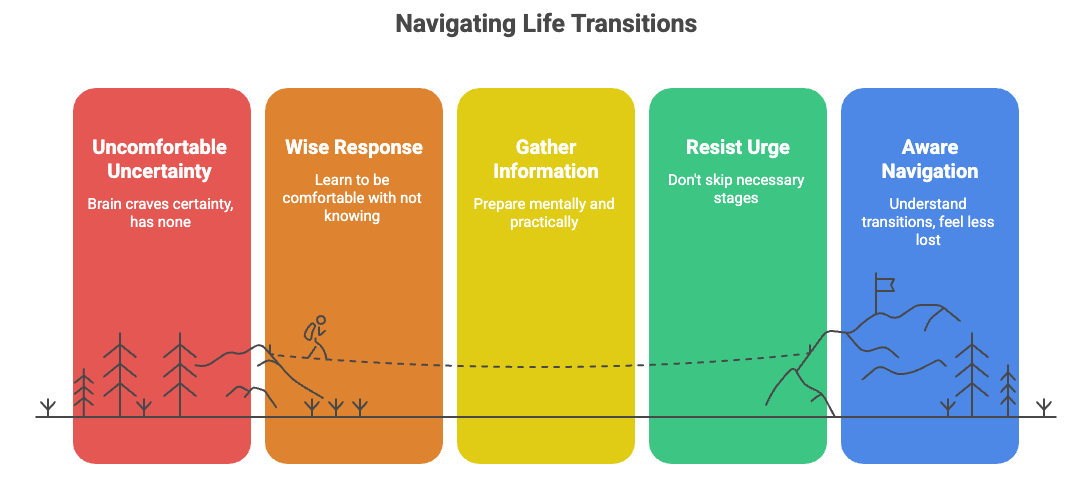
Life is a constant transition. The question isn’t whether you’ll face change. The question is whether you’ve learned how to navigate it.
I’m in what Susan Bradley calls “anticipation” right now with my cancer treatment. I know something significant is coming, but I have more questions than answers.
This stage feels uncomfortable as hell. Your brain craves certainty, and you have none. You’re suspended between your old life and your new reality.
The unwise response? Try to force certainty. Make premature decisions just to escape uncertainty. Pretend you know more than you do.
The wise response? Learn to be comfortable with not knowing. Gather information without obsessing. Prepare mentally and practically for what might be coming. Resist the urge to skip stages you actually need to go through.
Bruce navigated multiple major life transitions. Leaving home at sixteen. Building a law practice. Becoming a father. Losing his wife. Each one required different wisdom.
But here’s the pattern he recognized that I’m just starting to see. Transitions have stages. Each stage has its own work. You can’t skip them. You can only go through them with varying degrees of awareness.
That recognition alone is wisdom. It doesn’t make transitions easy. But it helps you understand what’s happening instead of just feeling lost.
Wisdom That Comes From Doing the Work
Here’s something important about wisdom that nobody likes to hear.
You can’t shortcut it. You can’t download it from a book or a podcast, or a brilliant advisor. You have to earn it through actually living.
Bruce grew up with no books. Spent time alone in hallways. Had every reason to be limited by his circumstances.
But he did something most people don’t. He kept learning. Kept reading. Kept asking questions. Kept examining his own patterns and assumptions.
He turned curiosity into a practice. Not just curiosity about his field, but curiosity about himself, his relationships, his choices.
That’s where wisdom lives. Not in having all the answers but in staying curious about the questions.
I’m 73 years old. I’ve been in business for over 40 years. I’ve advised hundreds of business owners. And I’m still learning basic lessons about how to live.
Some people might see that as failure. I’m starting to see it as wisdom. The recognition that I’ll never be done learning. That every phase of life has new lessons. That “I don’t know” creates space for discovery.
The Wisdom of Small Rituals
Here’s a piece of wisdom from Bruce that blew my mind when I first heard it.
He had a transition ritual. Every night on the way home from his law practice, he stopped at a park by a lake. Sat in his car or on a bench. Meditated for fifteen or twenty minutes.
Only then did he drive the last few minutes home.
That simple ritual was the line between work Bruce and home Bruce. It gave him space to let go of the day’s stress before walking through his front door.
The wisdom here is profound. Bruce recognized a pattern that most of us miss. Without a deliberate transition, we carry work energy directly into our homes. We slam the laptop shut, and five minutes later, we’re at the dinner table with our minds still spinning.
Then we wonder why our families feel like we’re not really present.
Bruce’s ritual wasn’t complicated. It didn’t require special equipment or training. It just required recognizing that transitions matter. The gap between contexts is where you either shift intentionally or carry baggage forward.
I’m trying to build my own version of this now. Not for work-to-home transitions, but for good-energy-day to bad-energy-day transitions. For treatment days versus recovery days.
The specific ritual matters less than the recognition that you need one. That’s the wisdom.
Learning From Others Without Copying Them
Here’s another thing I’m learning about wisdom.
You can learn from others’ experiences without copying their solutions.
Bruce’s 17-page family plan worked for him. It fit his personality, his career, his specific family dynamics.
I’m not going to write a 17-page family plan. That’s not my style. My kids are grown. My situation is different.
But I can learn from the principle behind it. The wisdom that says: define what matters, write it down, build systems that protect it.
My version might look different. Maybe it’s a daily journal practice. Maybe it’s quarterly reviews with my partner. Maybe it’s monthly check-ins about what’s working and what’s not.
The wisdom isn’t in the specific format. The wisdom is in the recognition that intention matters. That vague values don’t change behavior. That you have to translate what matters into actual practices.
This is where many people get wisdom wrong. They read about someone else’s success and try to copy the surface-level tactics without understanding the underlying principles.
Bruce didn’t invent family planning. He didn’t discover some secret nobody else knew. He just applied basic business planning principles to his personal life with unusual rigor.
That’s transferable wisdom. Not his specific 17 pages, but the approach of bringing intentionality to the things that matter most.
The Wisdom of Long-Term Thinking
Here’s something that separates wisdom from cleverness.
Wisdom thinks in decades, not quarters.
Bruce kept his family practices going for years. Not just when the kids were young, and it was cute. Not just when things were going well, and it was easy.
He maintained weekly dates with his wife for decades. He showed up for his grandkids with the same intentionality he’d shown for his own kids. Even after his wife died, he carried forward the structure they’d built together.
That’s wisdom. Understanding that some things matter more than convenience. That consistency over time creates something that sporadic intensity never can.
I see this pattern in my own life now. The business wins I was most proud of in the moment? Most of them don’t matter much in retrospect. The relationships I invested in? Those are what actually sustained me when things got hard.
Wisdom means understanding that some investments only pay off over decades. That quick wins might feel good, but they don’t build much. That the boring work of showing up consistently matters more than the exciting work of starting new things.
What I’m Still Learning
Let me be clear about something. I’m writing this as a student, not a teacher.
I don’t have wisdom figured out. I’m still making mistakes. Still learning. Still discovering patterns I missed before.
The difference now is that I recognize that’s the point. Wisdom isn’t a destination you reach. It’s a practice you maintain.
Bruce demonstrated this. He’s in his 70s now. Still reading a book a week. Still starting businesses. Still approaching conversations with genuine curiosity rather than assumptions.
That’s what wisdom looks like in practice. Not having all the answers. Staying curious about the questions.
I’m trying to approach my health challenges the same way. Not as a problem to solve once and move on, but as an ongoing source of learning about myself, about resilience, about what actually matters.
Some days I learn something valuable. Other days, I just survive. Both count.
Where Wisdom Actually Lives
Here’s what I’ve come to believe about wisdom.
It lives in the gap between what you know and what you’re willing to admit you don’t know.
It lives in recognizing patterns without assuming every pattern applies to every situation.
It lives in learning from experience without being limited by it.
It lives in asking better questions rather than having all the answers.
Bruce gained wisdom by recognizing he didn’t want to repeat his father’s patterns. By applying business discipline to family life. By treating relationships as worthy of the same intentionality he brought to his practice.
I’m gaining wisdom by recognizing that control is mostly an illusion. That “I don’t know” opens doors that certainty closes. That working with reality produces better results than fighting it.
Your path to wisdom will look different. It has to. That’s the nature of wisdom. It’s personal, earned, and contextual.
But here’s what I think transfers across all our different journeys.
Wisdom requires paying attention. Not just to what happens, but to the patterns beneath what happens.
Wisdom requires humility. The recognition that you could be wrong. That there’s always more to learn.
Wisdom requires intention. The willingness to examine your assumptions, your choices, your patterns.
And wisdom requires time. You can’t rush it. You can only stay curious and let life teach you.
What about you? What’s a piece of hard-earned wisdom you’ve gained recently? What patterns are you just starting to recognize? I’m still learning, and I’d love to hear what life is teaching you.

Facebook
LinkedIn
Youtube