
The 130-Day Confession: What I Finally Learned About Vacations at 73
I spent forty years preaching one thing and doing another.
And the evidence? It was right there on a spreadsheet. For everyone in my company to see.
Let me back up.
The Story I Told Myself
Here’s the story I told myself about vacations for most of my adult life.
I can only afford to be gone for a week. Maybe less. Who’s going to handle things while I’m away? What if a customer calls and I’m not there? What if something falls apart?
I believed that story completely. For decades.
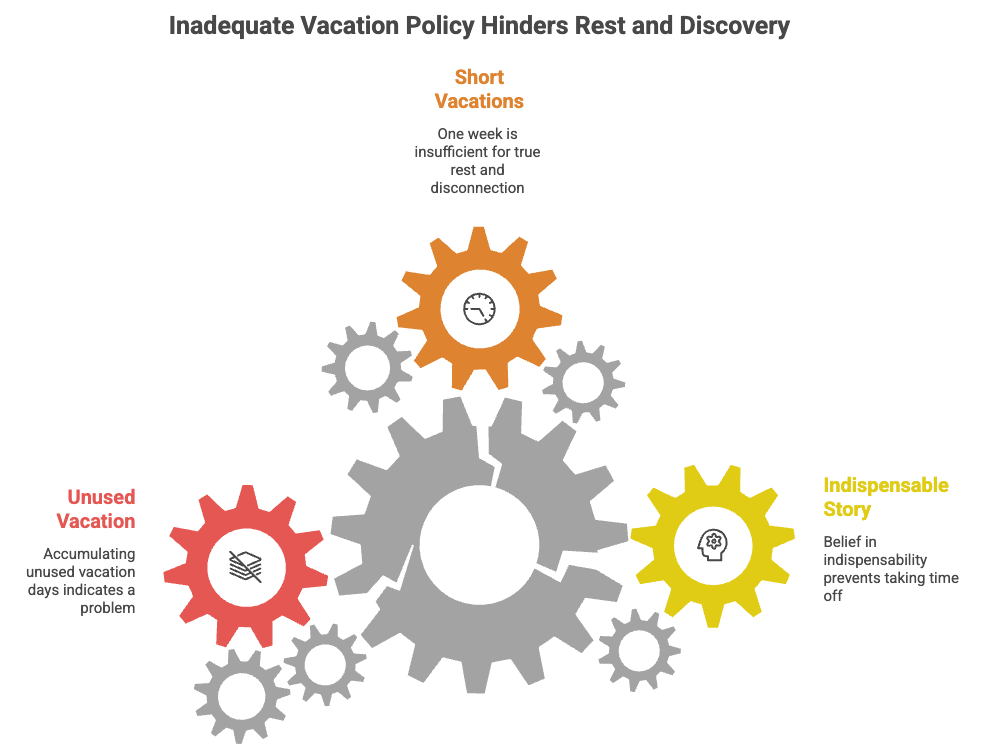
Here’s the thing I’ve come to understand about that story — it wasn’t really about the business. It was about identity. The business needed me because I needed to be needed. I was the indispensable guy. The one who kept it all running. And honestly? That felt pretty good.
Except it wasn’t good. It was exhausting. I just didn’t know it yet.
Every year I’d take my one week. Come back half-rested, already thinking about everything that had piled up. By Wednesday, after I returned, it was like I’d never left. The grind just resumed.
And I kept doing that. Year after year after year. Without ever asking whether one week was actually enough. Without ever wondering if my vacation policy was working — for me or for anyone else.
The Spreadsheet That Humiliated Me
In the early 1980s, about ten years into running my food service company, something awkward happened.
We started publishing vacation, sick time, and bereavement time for the whole company. Standard transparency stuff.
And there it was. Right at the top of the list.
130 days of accrued vacation.
Mine.
One hundred and thirty days sitting there, unspent, while I was the same guy who’d chase team members out the door when they hit 30 or 40 days. I practically lectured people. “Take some time off. The business will survive. Trust your team.”
Good advice.
Advice I never took myself.
It was embarrassing enough that I asked my controller to quietly take me off the list. Which, now that I think about it, is probably one of the least self-aware things I’ve ever done. Hiding the evidence rather than changing the behavior.
I didn’t change the behavior for another thirty-plus years.
Day Three in Europe
Two years ago, Suzanne and I went to Northern Europe and Scandinavia for 17 days.
That was the first time in my 71 years I’d taken a vacation longer than one week. I want to let that sit for a moment.
Seventy-one years old. First extended vacation. Ever.
And I’m not proud of that.
The first week felt like every other vacation I’d taken. A day or two to settle in. Start to relax. And then — right around day three of any normal week-long trip — my brain would start doing the math. Four days left. Better make them count. Start thinking about the flight home.
Except this time, on day three, something completely different happened.
We were wandering around the port in Oslo. No agenda. Nowhere we had to be. And across the water, I noticed a building that didn’t look like anything I’d seen before. Angular, dramatic, almost like it was rising out of the harbor itself. We had no idea what it was.
Turns out it was the Oslo Opera House. One of the most architecturally remarkable buildings I’ve ever encountered. And they were giving tours.
Here’s the old version of me. The one-week vacation version. He would have kept walking. We don’t have time for that. There’s so much else to see. We’ll look it up later.
Except I didn’t say that. Because we did have time. We had fourteen days left.
So we took the tour.
And it turned out to be one of the most interesting experiences of the entire trip. The building, the history, the way the whole thing was designed to invite the public in — it was genuinely extraordinary. Something I would have walked right past if I’d been counting down to a departure.
That moment — standing in the Oslo Opera House because for once I wasn’t in a hurry — was when I understood something had shifted. I wasn’t performing a vacation. I was actually on one.
I remember thinking, somewhere in those two weeks, that I’d also stopped thinking about writing articles. About what posts were due. About the content calendar. Not because I was forcing myself not to. But because there was room for something else to be there instead. The trip had filled up that space.
I wonder now whether that would have been true back when I was running the food service company. Maybe the business anxiety was too deep, too loud. Maybe two weeks away back then would have been its own kind of stress. But I suspect — and this is just a guess — that somewhere around day three to five, the same thing would have happened. The mental chatter would have settled. The business would have started to feel smaller. And I might have come back with something I never came back with in forty years of one-week vacations.
I might have come back actually rested.
This Past Spring: Eighteen Days
This past spring, Suzanne and I went to Europe again. Eighteen days this time.
And I can tell you now, after two of these longer trips, that one week of vacation and two weeks of vacation are not the same experience with more days added. They’re genuinely different things.
One week, I’m mostly managing the transition. Arriving, starting to decompress, and then almost immediately starting to reattach. My brain doesn’t fully let go because it knows the leash is short. It’ll be back in the harness soon enough.
Two weeks? Something different happens around day three or four. The mental chatter settles. The background noise of obligation — the one I’d been carrying so long I’d stopped noticing it — goes quiet.
I came back from both trips genuinely different. Clearer. More present. Ready in a way that one week never once produced in four decades of trying.
Which made me wonder, with some genuine embarrassment: what was I doing all those years?
The Case for Two Weeks — What I Suspect Is True
I want to be careful here. I’m not a researcher. I’m not an expert in workplace psychology or organizational behavior. I’m a 73-year-old guy who just figured out something about vacations that I probably should have figured out at 40.
So take what follows as the observations of a curious student, not a definitive prescription.
Here’s what I suspect happens when a business owner takes two consecutive weeks away rather than one.
In the first week, the team is still checking in. The owner is still checking in. The invisible umbilical cord is still very much attached. Questions come through. Decisions get delayed until the boss weighs in. Everyone’s in a holding pattern.
In the second week, something shifts. The team realizes they actually have to decide things. And most of the time — not all of the time, but most — they decide things pretty well. They discover capabilities they didn’t know they had because the safety net was never far enough away to test them.
When the owner comes back, the team is a little different. They’ve handled things. They know they can.
And the owner? If they actually disconnected — really disconnected, like I did when I stopped thinking about articles and started just being somewhere in Scandinavia — they come back with a perspective they can’t get any other way.
Here’s the thing about perspective. You can’t manufacture it from inside the daily grind. You can’t think your way to it in a weekend. Distance creates it. Time creates it. The particular kind of silence that only comes when you’ve stopped listening for the next fire to put out.
Two weeks buys you that silence in a way one week simply doesn’t.
I also suspect — and again, this is a suspicion, not a fact — that two consecutive mandatory weeks off for everyone in a company would surface some interesting problems. What happens when a key person is gone, and nobody knows how to do their job? That’s not a vacation problem. That’s a systems problem that the vacation just made visible. The vacation is doing you a favor by exposing it.
If a business can’t function for two weeks without any one person — including the owner — that’s worth knowing. That’s actually important information.
The Hypocrisy I Lived For Forty Years
Let me come back to that spreadsheet for a minute.
I genuinely believed I was doing my team a favor by pushing them to take their vacation time. I thought I understood rest, renewal, and the importance of stepping away. I quoted it like a philosophy.
And I had 130 days of unused vacation.
What I understand now, looking back, is that I wasn’t just being a hypocrite. I was modeling something destructive. I was teaching everyone around me — through behavior, not words — that the real rule was that work came first. That the truly committed person didn’t really take time off. That vacation was for people who weren’t quite as serious about the business as I was.
That’s a terrible lesson. And I taught it for decades.
I don’t know what those 130 unused days cost me. I don’t know what I missed, what I failed to notice, what creative thinking never happened because my brain never got the space to do it. I don’t know what version of myself might have shown up for my family during those vacations I truncated or skipped entirely.
I suspect the cost was higher than I want to admit.
What Day Three Taught Me About the Rest of Life
Here’s the part I keep turning over.
When I realized on day three in Oslo that we had fourteen days left, I didn’t just relax. Something else happened.
I started noticing things I normally rush past.
The particular quality of light on a Scandinavian afternoon. The way a conversation with Suzanne goes when neither of us is thinking about what comes next. The strange freedom of being in a place where nobody knows me, where I have no role to perform, where I’m just a guy wandering around a harbor in a city that’s been there for centuries and will be there long after I’m gone.
And walking into a building, I nearly passed by. Spending two hours inside it. Coming out and thinking: I almost missed that.
That feeling — I’ve been trying to find a word for it. The closest I’ve come is proportionality. Things felt their actual size. Problems that normally loom large looked small from that distance. The genuinely important things — being present, paying attention, not rushing — those felt large.
And I thought: what if I could carry some of this back?
Not all of it. I’m not naive enough to think two weeks in Europe permanently rewires forty years of conditioning. But some of it. Enough to ask better questions about how I’m spending my time. Enough to notice when I’m in performance mode versus actually present.
That seems worth something.
It also made me wonder about the years I spent running the food service company. Not with regret exactly — more with genuine curiosity. How many Oslo Opera Houses did I walk past? How many things worth investigating did I bypass because I’d already decided there wasn’t time? Not just on vacations. In regular life. In regular weeks. How much did the constant forward motion — which serves you so well in building something — cost in terms of what I never stopped to see?
I don’t have an answer to that. I’m just sitting with the question.
Two Questions I’m Still Sitting With
So here’s where I am.
At 73, having just returned from my second extended vacation ever, I have more questions than answers. Which feels about right for someone who keeps insisting he’s a student, not an expert.
The first question I’m sitting with: what’s my vacation policy, and do I actually follow it? I mean, really follow it. Not “I took five days last summer.” I mean fully away, fully disconnected, actually present somewhere else.
Because my experience — and I can only speak to my own — is that there’s a version of rest that one week simply can’t reach. Something that requires more time than that to develop. Something that only showed up for me somewhere around day three in Oslo, when I stopped counting down and started looking around.
The second question: what would actually happen if everyone in a company — the owner included — took two real, consecutive, fully-disconnected weeks off every year? Not as a thought experiment. As a genuine question, I don’t have a complete answer to.
I told myself the indispensable story for forty years. I had 130 days of unused vacation as evidence of how convincingly I told it.
And then I went to Scandinavia, wandered into a building I almost walked past, and started wondering what else I’d been too busy to investigate.
That was the beginning of something. I’m still figuring out what.
One More Thing
I want to be honest about something.
This article is as much for me as it is for anyone reading it. I’m not standing somewhere elevated, having figured this out. I’m the guy who just discovered at 73 that extended vacations are genuinely different from short ones. But here’s what I’ve come to believe about late learning: it still counts. You still get to use it. The fact that I could have known this forty years ago doesn’t make it less useful now.
And maybe that’s the point of this whole long, strange trip. You learn what you learn when you learn it. The question is whether you pay attention when it finally arrives.
I’m paying attention now.
I’d love to hear how this lands for you. Have you ever taken two real weeks off in a row? What happened when you did — or what story are you still telling yourself about why you can’t? How have vacations of different lengths actually affected you?
We’re all seekers on this trip. Let’s figure it out together.
Josh Patrick is the founder of The Long Strange Trip, a platform exploring the three transitions every business owner faces: how we work, how we leave, and how we face what comes after.


Facebook
LinkedIn
Youtube