Two Steps Forward…Fifteen Steps Back
I spent years pretending my life was a straight climb. It never was. Yours probably isn’t either — and the real shape has something to tell you.
When I was young, I thought life was a ladder. You climb. You work harder. You arrive somewhere. Nobody warned me the ladder was a lie.
My life never once went straight up. It looped. It doubled back. It broke.
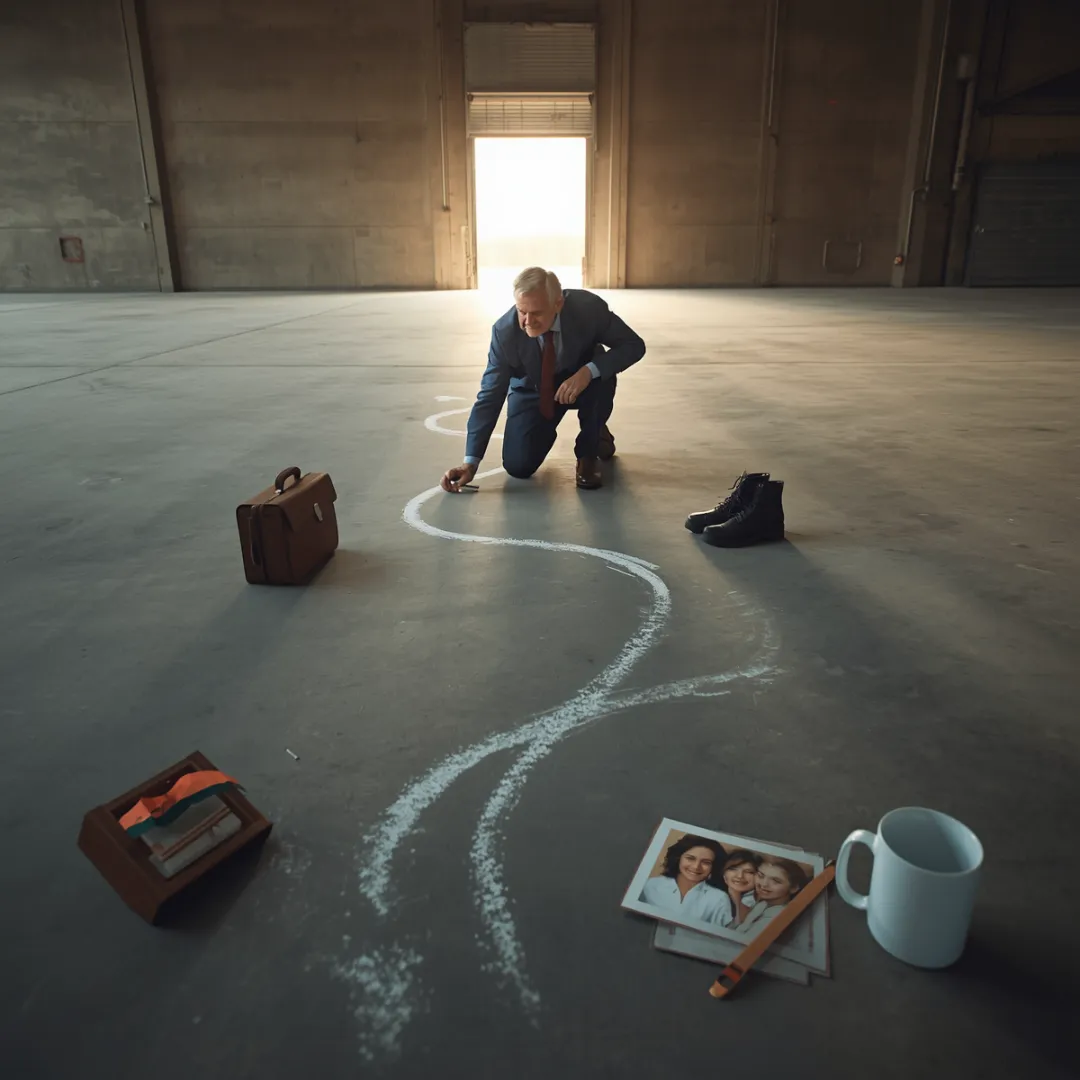
Here’s something I’ve never actually done. I’ve never sat down and drawn my life. Not the tidy version I tell at parties. The real one. The crooked one.
And lately I think that drawing matters. Picture it for a second. If I drew mine, it’d be a mess.
A bunch of squirly circles, going in loops. Some spinning left to right. Some right to left. Two steps forward, then two steps back. One step back, then one step forward.
I suspect most of our lives look like that. Whatever yours is, I’ll bet it isn’t straight.
We draw the ladder because it’s flattering. A clean climb says we knew what we were doing. The real shape says something braver. It says we got lost and found our way anyway. That’s a better story, and it’s the true one.
The Question I Keep Sitting With
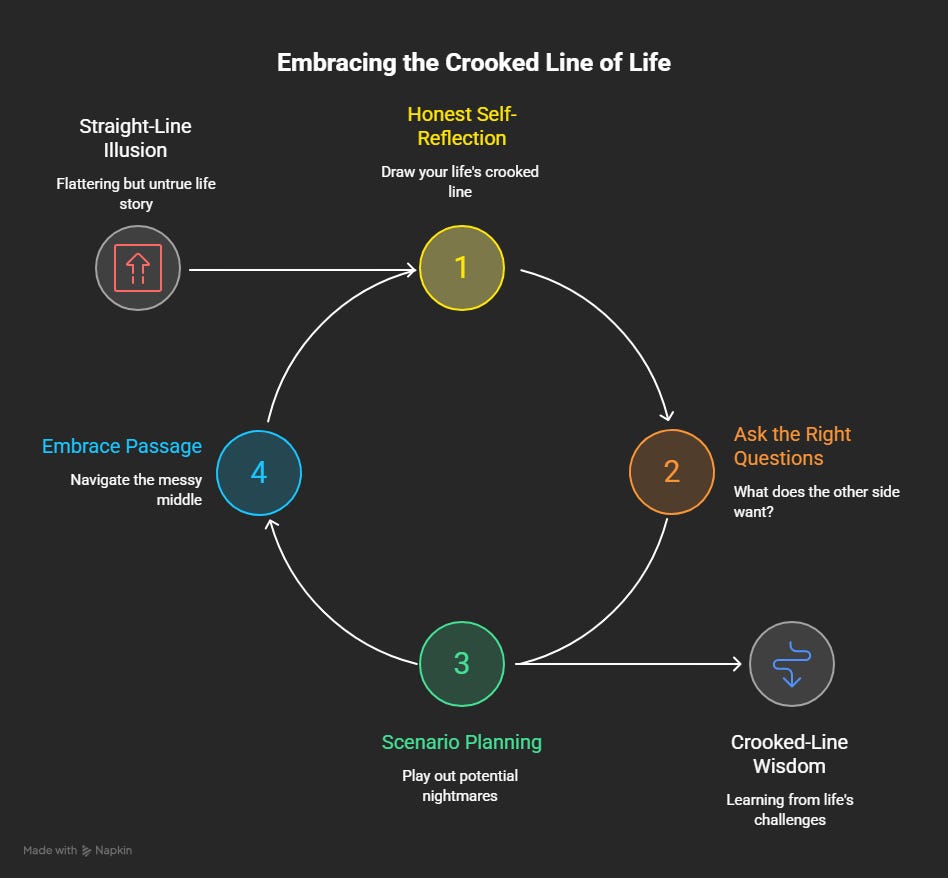
So let me ask you something. Stop pretending your life climbed in a straight line. Draw the real shape instead, loops and all. What would that picture actually tell you? Where would it say you are right now?
I don’t have a clean answer for you. I’m a seeker on this, same as you. But I’ve got a story that might help. It’s about the crookedest line I ever lived. Let me paint you a picture.
The Line That Looked Like Up
A bazillion years ago, I ran a food company. For a while, I thought I was on a roll. And I was. Just not the roll I imagined. I was rolling backward and calling it forward.
The numbers looked incredible on paper. Year one, we did seventy-five thousand in sales. Year three, we hit one-point-six million. Year five, two-and-a-half million. That kind of growth feels like flying.
Here’s the trouble with feeling like you’re flying. Sometimes you’re falling and don’t know it yet. I thought the line went straight up. The shape underneath was something else entirely. I just couldn’t see it from inside.
And that’s the thing about a straight-line story. It feels great right up until it doesn’t. You mistake speed for direction. You mistake motion for progress. I did exactly that, for years.
The $200,000 I Never Saw Coming
Then reality walked in and sat down. I was more than ninety days behind on bills. That was bad. What came next was worse.
One day I went through my controller’s desk. I found a pile of unpaid bills stuffed inside. Every one of them was over ninety days old. He’d embezzled around two hundred thousand dollars. From me, while I was busy feeling successful.
My face went red. I exploded. The whole office learned to stay out of my way. And I mean really stay out of my way.
That didn’t knock me back two steps. It knocked me back fifteen, maybe more. I was standing right at the edge of bankruptcy. My suppliers wanted to put me out of business. My bank wanted to shut the doors for good.
There was no playbook for that morning. Nobody hands you a manual for this stuff. Bankruptcy looked like the only door left. I stood there feeling the whole thing come apart. And I get it if you’ve felt that way.
That feeling is its own kind of teacher. It strips away the story you were telling. The clean climb. The wunderkind. The roll.
All of it, gone in a single conversation. What’s left is just you and the mess.
There’s Always More Than One Choice
Here’s what I’ve learned since that day. We almost never have just one choice. We usually have more than we think. That was true then, even when it didn’t feel true. So I decided to stop going backward.
I called my suppliers with a question. Would you rather I go bankrupt and collect nothing? Or would you term out what I owe you? Let me pay you over five years, go cash-on-delivery. You’d still have a good customer at the end.
Guess what they chose. They chose to term out the debt. They let me stay in business. One honest question changed the whole shape.
Then there was the bank. The old bank was completely done with me. So I went out and found a new one. But first I asked them a smarter question. How do you decide to take on a customer?
The new bank cared about cash flow. So I looked hard at ours. Our debt-to-equity ratio was fourteen to one. That’s horrible. Genuinely horrible.
But our interest coverage told a different story. For every dollar of interest, we had fifteen behind it. Fifteen to one. That’s real coverage. And just like that, we had a bank again.
None of this was clever. It was just refusing to accept one door. I asked the question everyone forgets to ask. Not “how do I survive this?” But “what does the other side actually want?”
That’s a small shift that changes everything. Panic looks at your own closing walls. Curiosity looks at the whole board. The straight-line thinker sees one path shutting. The crooked-line thinker goes looking for another.
I only found the other paths because I looked. Not because I was smart. Because I’d stopped assuming the line was set.
Three Years in the Messy Middle
None of this was a straight line. It was crooked, and it stayed crooked. We fought through it for three long years. Susan Bradley would call that stretch “passage.” It’s the messy middle where nothing feels solid.
If you’ve read me before, you know the four stages. Anticipation. The ending. Passage. The new beginning.
Passage is the one that eats people alive. It’s the part where you’re in it. But you have no idea how it ends.
The world felt upside down back then. Honestly, I felt upside down too. Some days we saw a little light. Most days we just put one foot down. Then came the next rupture.
The Salmonella I Almost Didn’t Survive
We were finally seeing the end of the tunnel. Then my commissary manager tried to help. He swapped ground turkey for ground beef. You can probably guess how that went. We mishandled the turkey, and salmonella got in.
It got into our food. Then into our customers. Several people got sick. That’s the part that still hurts.
This wasn’t one step back. It was twenty. Handle it wrong, and we were finished. No business, no company, nothing left.
Here’s the strange part of this story. We knew almost exactly what to do. Not because I’m smart. Because we’d rehearsed it. I’d played out this exact nightmare in advance.
I call that living with anticipation. We’d asked a hard question months earlier. What scenario could actually kill this company? A food-safety outbreak sat near the top. So we’d already built a rough plan.
When it hit, we weren’t starting from zero. That’s a skill you can steal from me. Sit down and name what could kill you. Not to scare yourself. To prepare yourself.
Play the nightmare out on paper first. Then it’s a plan, not a panic.
In my world, scenario planning is a gift. Sometimes you plan for things that never happen. Sometimes you plan for something you swear won’t. And then it does, and you’re ready. That’s the whole point of the exercise.
That planning is the only reason we made it. Instead of dying, the company kept going. By 1995 we did six-and-a-half million in sales. Ninety employees, one of the best in the country. From the edge of bankruptcy to that.
What the Crooked Line Taught Me
So here’s what I actually believe now. Real progress isn’t a straight line forward. Most of the time it’s two steps forward. Then one step back. Sometimes ten steps back.
Once in a while, five forward and none back. We’d love the story to be clean. Start here, climb steadily, arrive over there. Real life doesn’t hand you that story. It hands you loops and ruptures and doubling back.
And I think that’s the point, not the flaw. Look at my food company one more time. The line that looked like triumph was hiding a fall.
The line that looked like a death sentence taught me the most. The embezzlement. The salmonella. The bankruptcy scare. That’s where I learned everything worth knowing.
The good years taught me almost nothing. The crooked years taught me how to think. Ask the honest question. Find the other choice. Play out the nightmare before it shows up.
None of that came from the straight parts. Not one bit of it.
And It’s Not Always Business
Here’s the thing I really want you to hear. The crooked line isn’t just a work story. Most of the time, it’s a life story. Mine got a lot more personal.
Years back, I got my first cancer diagnosis. It sent me into a full tailspin. I did the thing you’re told not to do. Instead of staying off the internet, we read. And it said I had a twenty percent chance.
Twenty percent of living. That’s what it said. That didn’t set me back a few steps. It set me back twenty-five.
I was in a tizzy. I had no idea what to do. I was completely stuck, and I mean stuck. I was deep in passage with no map. No idea where to go or what came next.
Same shape as the food company, decades later. A line that looked like it might just end. The rupture you never see coming.
And here’s what I want you to notice. The business version and the health version are the same crooked line. Different decade. Different fear. Same shape.
That’s why I think this matters for all of us. The loops aren’t a business problem. They’re a being-alive problem.
The Story We Tell Isn’t the Story We Lived
Here’s a habit I catch myself in. I still tell the ladder version out loud. The clean climb. The tidy arrival. Even now, even after all of this.
It’s a hard habit to put down. We do this because straight lines sound like winning. Crooked lines sound like we messed up. So we sand off the loops for company. We hide the part where we fell fifteen steps.
And we lose the truest part of the story. Because the loops aren’t the embarrassing part. The loops are where the wisdom actually lives.
Sand them off, and you sand off the lesson. You keep the highlight reel. You lose the education.
You Haven’t Drawn Yours Either
Now let me turn this back to you. I’d bet you’ve got a crooked line too. Business, health, marriage, some slow-motion loss. Something that doubled back when you expected forward. Most of us carry a shape we’ve never looked at.
Maybe it was a business that nearly went under. Maybe it was a diagnosis you didn’t see coming. Maybe it was a slow loss — a knee, a role, a name. Some ruptures arrive loud, in a single phone call. Others show up quietly, over years.
And I get it. Looking at that shape is hard. It means admitting the climb wasn’t clean. It means feeling the falls all over again.
Nobody wants to sit with the loops. I don’t always want to either. But here’s what I keep noticing about myself. The years I’d most like to skip made me who I am.
The shape isn’t something to be ashamed of. The shape is the whole point.
How You Might Actually Draw It
So maybe the real work is simple. Get honest about the shape you actually lived. Not the one that sounds good at dinner. The looping, spiraling, broken-open real one.
You don’t need to be an artist for this. Grab a napkin. Draw a rough line of your life. Mark where it climbed. Mark where it fell.
Circle the ruptures. Circle the doubling-back. Then look at what your hand drew.
Ask yourself a few honest questions. Where does my line double back the most? Which rupture taught me more than any success? And where’s the pen sitting right now? Not where I wish it were, but where it actually is.
Naming Where You Are on the Line
Once you’ve drawn it, do one more thing. Find the very tip of the line. That dot is you, today, right now.
And here’s the useful part. That dot is sitting in one of four places. Maybe you’re in anticipation, something coming but not here. You feel the weather change. The storm’s still offshore.
Maybe you’re in the ending. The old thing is over. The title’s gone, the role’s gone. You’re grieving it.
Maybe you’re deep in passage, the messy middle. Nothing feels solid, and you can’t see the far side. Or maybe you’ve reached a new beginning. Something new is starting, even if it’s strange.
Naming that spot is half the work. You can’t pick a tool without knowing where you stand. Anticipation asks you to play “what if.” Passage asks you to run small, cheap experiments. Each stage needs a different move.
The drawing shows you which one you’re in. And here’s the honest catch. These stages don’t sit in a tidy row.
You’ll think you’ve reached the new beginning. Then the ground shifts and yanks you back. Most days I’m in three of them at once. That’s not you doing it wrong. That’s just what a real line looks like.
Loops on top of loops. Name the spot anyway, it helps. Then you’re working with the shape, not against it.
Where My Pen Is Right Now
So let me answer my own question. Where’s the dot at the tip of my line? It’s in a pretty good place. I’ve stopped taking twenty steps backward.
Remember that first cancer diagnosis? Back then I read, panicked, and froze. I don’t do that anymore.
Now I know how to research the right way. And I know how to sit in quiet first. I gather what’s real. Then I get still. Only then do I make a move.
The things that used to cost me twenty steps now cost me about five. And five steps back, I can handle. That’s the whole shift, if you want it. Same ruptures. A steadier hand on the pen.
The Next One
I keep two words in my pocket these days. I got them by accident, years ago. I went to hear Bill Walton speak. Afterward I ran into him in the men’s room. I had one shot at a brilliant question.
Instead I asked something pretty dumb. “What’s the best Grateful Dead show you ever saw?” He looked at me like I had three heads. He said two words. “The next one.”
Then he walked out. I stood there with my face going red. But his answer wasn’t dumb. It was brilliant.
Why stare backward when you can look ahead? Whatever comes next has something in it. It can be interesting, even when it’s hard.
So that’s how I meet each turn now. The next one. The next loop. The next rupture. I don’t expect a barrel of laughs.
I know there’ll be hard stretches ahead. But the next one leads somewhere, if I stay open. Your line isn’t finished either. The pen is still in your hand.
So draw the real shape. Look at it honestly. Then ask what the next stroke wants to be. I’d love to hear what you find.
It is what it is. But we’re not on the committee that says we figure it out alone. So let’s figure it out together.
Tell me about your crooked line in the comments. I’ll go first next time.

Facebook
LinkedIn
Youtube