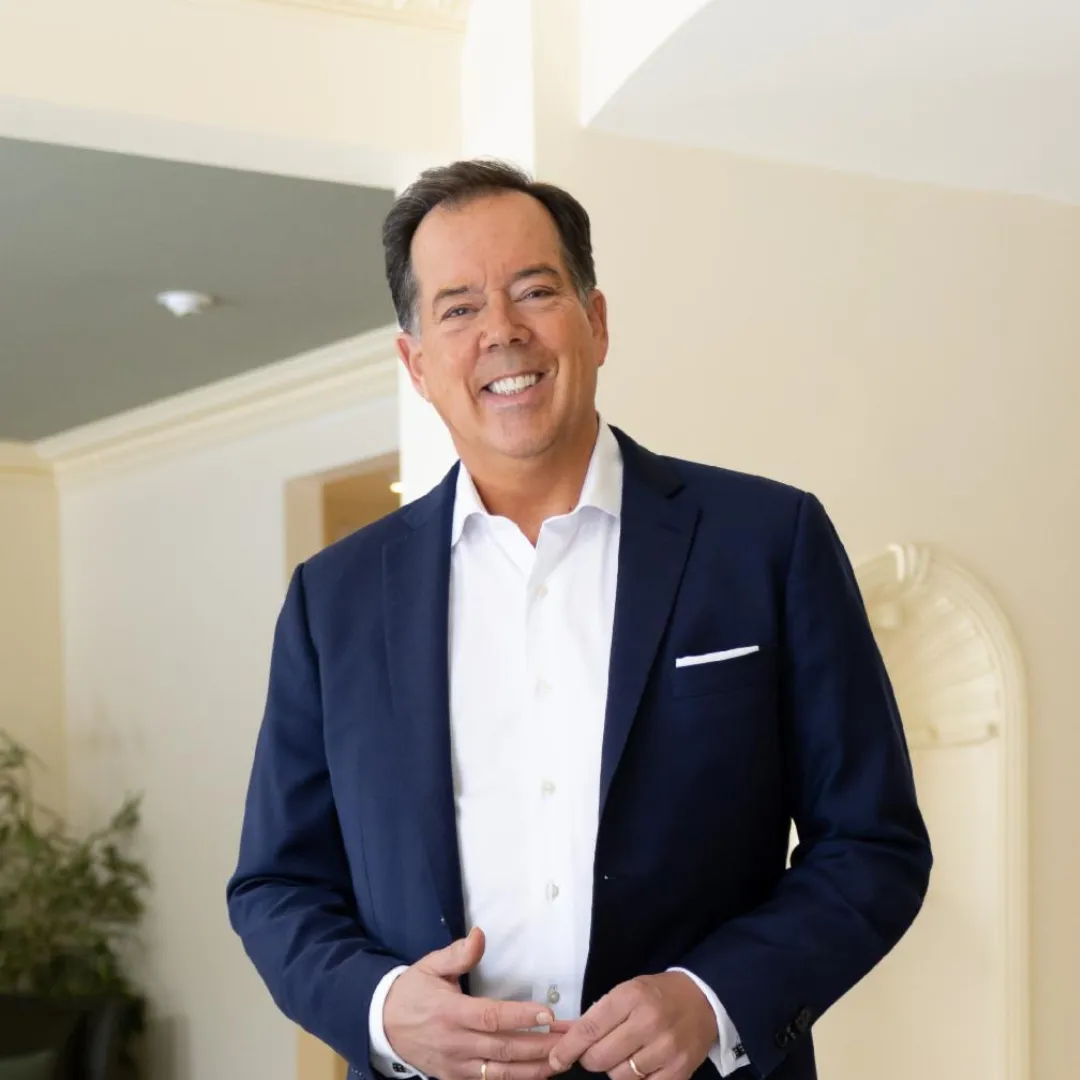
The Long Strange Trip Episode 28: Why Inheritance Tears Families Apart — And How to Prevent It | Tom Deans
About the Episode:
Wisdom isn't just about what we know. It's about what we're willing to question, explore, and pass on.
I've been thinking a lot about what we actually leave behind. We tend to think about money, businesses, houses, and investments. But what about the things we've learned along the way?
I sat down on The Long Strange Trip with Tom Deans to talk about family wealth, inheritance, and some of the conversations most families would rather avoid.
Death is a big one.
Most of us don't like talking about it, even though we know it's going to happen. And when we avoid those conversations, we can leave our families with a lot more than just financial decisions to sort out. We can leave confusion, resentment, and conflict.
Tom helped me look at estate planning differently. It's not just about deciding who gets what. It's about relationships. It's about communication. And it's about making sure we're passing on wisdom along with whatever wealth we've managed to build.
Tom has written three books exploring these ideas, and our conversation got me thinking about a question we don't ask nearly enough:
What are we really leaving behind?
Maybe the answer isn't just what's in our bank accounts or the things we own.
Maybe it's the wisdom we've gained, the mistakes we've made, and the conversations we're willing to have while we're still here.
Transcription:
🎙️ INTRO (Josh)
00:00 – 01:15
Welcome to The Long Strange Trip. I'm Josh, the host of the show. We're going to dig into six areas together, finding real work-life integration instead of that brutal 95/5 split too many business owners live with. We're going to approach retirement as an actual reinvention rather than just stopping work, and we're facing death honestly and avoiding PTSD around death.
We're also building resilience when life throws us curve balls, we're sharing wisdom across generations, and finally, we're understanding the patterns that show up in all our transitions. I'm not coming at this as an expert. I'm a fellow traveler figuring this stuff out in real time, especially now as I navigate my own dual cancer diagnosis at 73.
Welcome to The Long Strange Trip. I'm glad you're here
🗣️ Josh
01:16 – 02:15
How are you today? This is Josh Patrick, and we're- I'm with an old friend, Tom Deans, today, and you're at the Long Strange Trip podcast. instead of me doing inc- any sort of introduction, well, just know that Tom is one of the smartest guys I know. He's written three unbelievable books, and we'll probably be talking about them, but we are talking about... Well, at least we're gonna start talking about wisdom today. So let's bring Tom on. Hey, Tom. How are you today?
🗣️ Tom
02:16 – 02:23
Josh, fantastic. Uh, yeah, happy Monday. Here we go
🗣️ Josh
02:24 – 02:28
Yeah. Yeah. So, so where do you wanna start?
🗣️ Tom
02:29 – 02:30
Let's start at the beginning.
🗣️ Josh
02:31 – 02:32
Okay.
🗣️ Tom
02:33 – 04:35
Um, you know, y- you, you referenced the notion of wisdom, and I think, um, as someone who came to the world of writing quite late, I was 45 when I wrote my first book, um, I, I, I reflect on wh- well, like, why? There's better things to do. They're hard to do. They're hard to do well. Uh, like, why did I do that?
And I think when you boil it all down, it really is a search for wisdom, which is very different from a, a search for answers to questions. The wisdom, there's a piece to wisdom that feels a little bit mystical. It feels a little bit untethered to the temporal world, and I, I think that is why I wrote. In fact, I, I like to say that anyone who writes a decent book is trying to convince themself of an idea, not their readers.
Like, those are good books. You feel that tension in the author's voice on the pages trying to resolve an issue, and I think that's really what wisdom reflects, when you can really noodle that and write a book and then find that answer to that, at a, that elusive question. So in my case, it was, in the first book, how do you transition a family business?
And why do we give our businesses to our children for free without asking them to risk something of themselves? Um, and so I try to, I try to resolve that question. That I felt like produced a little bit of wisdom for my readers
🗣️ Josh
04:36 – 05:25
Your second book created a lot of wisdom for your readers and a roadmap for how to handle families and inheritance, which I found and I've used myself, frankly, with my family, and it has been extraordinarily useful for me. and the title of the book is Willing Wisdom. So there we are
🗣️ Tom
05:26 – 07:10
I, and I love the double entendre of that title, Willing Wisdom. So some people pick it up and they go, "Oh, this is gonna teach me how to write a wise will." And other people pick it up and they go, "Willing wisdom. How do I transition something more valuable than money to my children? How do I transition my hard-earned wisdom?"
I, I'm fascinated by how people view that title, and it was quite purposeful to create that, that double meaning. But I, I certainly lean to the latter, which is how do we transition something, um, more enduring, more valuable than just money to our children? And it turns out that that, that was an important question to ask and help resolve on the pages of the book.
I think people certainly now who are leaving a record amount of wealth to their children, um, over $3 billion a day is inherited in America. 3 billion with a B. I mean, that's just, it's a, just a massive amount of money. And then when you consider that 125 million Americans don't have a will. Take those two numbers, 3 billion a day inherited, 125 million without a will.
That is a picture of chaos
🗣️ Josh
07:11 – 07:32
And, and take it even further, how many families ever talk about the wealth they have with their children before they die?
🗣️ Tom
07:33 – 09:10
Well, you wouldn't wanna do that, Josh, because if you talk about, uh, aging and dying, I don't know if you know this, studies show that you will die immediately. C- can you hear how absurd that sounds? Listen, we laugh at superstition, but it is breathtaking how much of it there is in our culture. There are...
That's why 125 million. It's the number one reason why 125 million Americans don't have a will. If I go to my lawyer, give them instructions, they draft the will, sign the will, bring it home, I'm gonna die. I'm just asking for trouble. So let's just leave... If I leave death alone, death will leave me alone, is the logic
🗣️ Josh
09:11 – 10:00
Well, that actually is one of the areas that we, we cover here on The Long Strange Trip is, I call it death without PTSD, and the nice way of saying it is how to have a good death. But the truth is we're gonna die, and we need to be thinking about how we wanna die what circumstances we wanna have with the options that might be available to us at that time. Excuse me.
🗣️ Tom
10:01 – 10:55
Yeah
Ca- Canada has a, an assisted, physicians, um, death ordinance across the country. There are many states in the United States have it now. It's not used very much in Vermont, which surprised me when I was doing a little bit of research about that. The truth is really don't wanna actually make the right plans at the right time to do the right thing
🗣️ Tom
10:56 – 13:00
Yeah, and of course what is really peculiar is that the people who are in denial, and there's a great book called The Denial of Death, but, uh, uh, people who are in denial of this certainty, um, pay the ultimate price. And, and I've been arguing, you know, in the case of estate planning, 125 million people without a will, people think, "Well, that's really unfortunate.
The beneficiaries of those estates are gonna pay a big price because there's gonna be lots of confusion and chaos." But I'm quick to remind people that estate planning is also very much about the living. When we go in for a will, we actually come out with two other bonus documents. We come out with a power of attorney for finance and a power of attorney for healthcare, which gives family direction to make good decisions on our, on our behalf when we lose capacity.
I argue that estate planning is very much about the living, and that point has been lost on, obviously lost on 125 million people who think that estate planning just answers the question, who gets my stuff when I'm not here?
🗣️ Josh
13:01 – 13:18
It's also that I'll get around to it. You know, it's
🗣️ Tom
13:19 – 13:23
Oh, yeah.
🗣️ Josh
13:24 – 13:28
to it. You know,
🗣️ Tom
13:29 – 15:05
Oh, yeah. And, and Josh, you know, you wouldn't wanna spend, like, $500 on a will to bring clarity and predictability and transparency to the orderly transition of a $100 million estate. You wouldn't wanna spend $500 to do that now, would you? Seriously, the wealthiest people in the country are the most disorganized.
And it doesn't surprise me. It doesn't surprise me. I'll tell you why. They've got more stuff.
🗣️ Josh
15:06 – 15:08
Ja
🗣️ Tom
15:09 – 16:05
They've got their stuff spread out, not just across the country, but around the globe. They got a vacations home here, they got art there, they got this there. They've got more stuff and more decisions to make. The easiest thing to do is to say, " Tomorrow."
🗣️ Josh
16:06 – 16:08
Ja
🗣️ Tom
16:09 – 17:20
And what they leave behind is, I'll tell you right now, there is... If there's any litigation lawyers listening today, they're the only people smiling. They are mopping the floor with wealthy families, with actually moderately wealthy families. Just the chaos, uh, they are g- they are getting very wealthy.
There's one piece of data in my newest book, The Happy Inheritor, that I had to, um, that I had to curate. The number didn't exist. I had to actually interview, uh, dozens of litigation lawyers, um, and, and that number that I was looking for is the cost, the cost, the legal cost to get to a one-day trial when there's been no will and you've got children left fighting over, say, a vacation home or a family business or you name it.
The cost per person to get to a one-day trial in America is $500,000 per child. Now, you got three kids, you got four lawyers. Remember, the estate's got a lawyer. You got four lawyers at 500,000. You got $2 million in legal fees to get to a one-day trial It's, it
🗣️ Josh
17:21 – 17:42
to believe. I mean, if someone's worth $100 million, that's a relatively small number. But if you're worth $10 million, that's a huge number
🗣️ Tom
17:43 – 19:05
That's a huge number. Absolutely huge number. Um, what we also know is that of that 3 billion that will be inherited today, most of it is illiquid. It's not 300- $3 billion of cash that the executor of the estate just, you know, takes out a checkbook and chops it up equally among three or four kids. No. It's, it's illiquid.
It's sitting in the retained earnings of family businesses. It's sitting in vacation homes, and cars, and all the kinds of ... And jewelry. All the kinds of things that have emotional attachment that are going to create tremendous ruptures inside family systems every single day
🗣️ Josh
19:06 – 19:35
So What's the... Having a will or actually having trusts is more like it, and it's not gonna be $500. It might be $50,000 for a very wealthy family, but that's still peanuts compared to what $2 million is
🗣️ Tom
19:36 – 22:10
Oh, I'll tell you why estate planning is in such appalling shape right now in the country. And by the way, it's the same all around the world. It's the same in Canada, it's the same in Europe. The amount of estate planning dysfunction is at a global all-time high, and it's, and it's not an accident. It's, it's, it's not a coincidence.
What we have now is a phenomenal reckoning of a record amount of wealth being created by a particular generation, and that is the baby boomers born between 1948 and 1964. They were the most parsimonious, which is code for cheap, generation. They were the cheapest generation, but they were also highly educated and deeply, deeply committed to entrepreneurship.
But more than anything They were a generation whose attitudes toward money were shaped by a prior generation that witnessed the most horrific 50 years in the previous century, from 1900 to 1950, was just nothing but bloodshed and horror. Those people... I mean, think of it, right? If you were born in 1900 and you turned 18, you went to the First World War.
You survive that, you come back to Kentucky. What's waiting for you? The Spanish flu, which doesn't attack old people, it attacks young people. You survive that, you got about eight good years in the Roaring '20s. Although I'm quick to remind people it was during Prohibition, so it wasn't that much fun. And then, then 1929, the Great Depression begins.
It only ends in 1939 because of the Second World War, where another 65 million people lose their lives. Listen, if you were born in 1900 and you were lucky enough to see your 45th birthday, you weren't standing around going, "Gee, I wonder what the world owes me." You were just grateful to be alive. Those people had children.
They had baby boomers. Beginning in 1948, they started to have kids, and when those kids came of age, those parents scared the living shit out of those people. They... I know what I'm talking about. I'm, I was born in 1964, the tail end of the, of the boomer generation. Like, my parents and grandparents told me the stories of what they endured, and so they said, "You need to get an education.
You need to work." And guess what? We did. We worked, we saved, we invested. And guess what, Josh? We're turning 77 now, and we're loaded. We are l- we don't even know how to spend what we have. And so we've got a record amount of wealth, but here's the problem. We are approaching estate planning exactly the way our parents and grandparents did.
We're also repeating what they did. And I'll give you a hint on what the central foundational idea was for our parents and our grandparents when it came to estate planning. The central key tool was to wrap the subject in silence. You wrap your money in silence. And so, listen, it wasn't a problem for our parents.
They left an estate worth $14,000 to be divided between seven kids. No one was litigating over $2,000. Now they're leaving 14 million or 1.4 million. The amount of wealth that we're transitioning now, it's not our parents' estate. It's bigger and more complex. What got us here is not gonna take us where we need to go as a civil society.
It is not gonna work. So our parents, many of them didn't have wills. It just wasn't a priority. Now it is
🗣️ Josh
22:11 – 23:35
So the, the other issue here, which I think is just as important and almost completely ignored, is the family dynamics of what you want your family to look like after you're gone. this is a, a major part of what you've written about your book, which is, I call After the Will, which is how do I keep my kids from fighting even though they don't really like each other? You know, that, that... There's a lot of, an awful lot of families, you know, just because you happen to be siblings doesn't mean you have to like each other. You might
🗣️ Tom
23:36 – 23:39
Mm-hmm.
🗣️ Josh
23:40 – 23:42
each other,
🗣️ Tom
23:43 – 23:45
Yeah
🗣️ Josh
23:46 – 25:10
but there's a pretty good chance there's gonna be at least one or two that don't like each other and are willing to stick the knife in the back. And in my experience and my belief, and I think this is just a really important thing about passing wisdom on, you need to have open conversations about life after me. You know, for example, here's my, my strategy in my family, which is, I think, a little bit unique. I control my life up until I'm dead. Once I'm dead, my wife, who will probably survive me, and my two children get to decide what to do with me, how to do it, but they have to do it cooperatively. It can't be done as, you know, "I want this to happen to Dad and I wanna have this memorial." We need to be talking about it, and they need, and they, and they need to talk about it before I'm dead, not after I'm dead
🗣️ Tom
25:11 – 27:35
I, I like that. I, I have a slight wrinkle to that. I would say, I would phrase it, I have complete control of my affairs until the moment I don't, and that may be death, but it is increasingly incapacitation. One-third of Americans over the age of 65 are presenting some degree of cognitive decline. W- So I'm in control.
I may still be very much alive, but not in control, and so my documents are going to really empower someone to make decisions on my behalf, in my best interest. Well, how is that gonna happen? By going to an, a, a lawyer, getting these drafted, and then squirreling them away in a vault, in a safety deposit box where no one can see them?
No. As you rightly point out, the smartest, most successful families get these documents executed. They take them to a family meeting. They share them and talk about them, not once, repeatedly, so that when life unfolds, and it always does, people are ready. They're ready for the most obvious and predictable day in our lives, the day that we do lose control
🗣️ Josh
27:36 – 28:25
Yes. A- the other piece of that, which it sort of gets into my death without PTSD thing, is that we can pretty much our death except for d- dementia. And from what I understand, the Swiss do a pretty good job with that. maybe the world might be wanting to take some look at what the Swiss are handling and force the older generation who has cognitive, you know, problems to go through the whole horrible end of Alzheimer's or, you know, other forms of dementia.
🗣️ Tom
28:26 – 30:35
I- I just
Oh, yeah. I, I don't understand it either. I think everyone seems to view estate planning as, as I said, answering the question. They, they view it as a financial document. Estate planning is really about reducing taxes and, uh, dividing your assets among your, your beneficiaries. Listen, that's the easy part.
The big benefit of estate planning is those two bonus documents that you get when you come out of a lawyer's office. In addition to the will, you're getting that power of attorney for finance, which I, which I mentioned, but you're also getting that healthcare directive. That is that power of attorney for healthcare, whatever it is, whatever...
It's called different thing, a living will. It's called different things in dir- different jurisdiction, but it is a document that helps a family avoid playing the game in hospital hallways. And trust me, it's a game the whole...
🗣️ Josh
30:36 – 30:38
it
🗣️ Tom
30:39 – 32:10
It's the game a whole family can play. It's a game the whole family will play, and that game is called plug/unplug.
And if that document doesn't exist, well, good luck. You tell me how, in the absence of that document and family meetings where you discuss this document and what its intent is and what you hope people do and how they can serve you when you lose capacity, you tell me how a group of siblings are gonna pick the right second or the right minute or the right hour or the right day to pull the plug and discontinue your life.
Someone in that family is going to feel that someone had their way, that someone moved too quick, or someone didn't move fast enough, and parents suffered. You tell me how families are gonna get that right. We, we often set our family up to fail, to d- to be divided because of our own ambivalence towards this idea of dying and death
🗣️ Josh
32:11 – 32:35
I agree with that 100%. So let's move on to your third book, 'cause you've told me you think it's your most important book. What's the, what's your thesis?
🗣️ Tom
32:36 – 36:00
Well, there's two big major parts to this book. First of all, it is the third and final book in the trilogy. It really represents, I think, a real maturity in my worldview of family wealth and it moving between generations. And, and I, and I'm gonna confess that I really wrote this book Out of a lot of frustration.
I've, I mean, you know my story. I mean, I'm a full-time author and speaker. I've d- delivered over 2,000 keynote speeches in 29 countries. I, I have worked tirelessly on this subject to help inform people about the urgency to talk and plan collaboratively with family members. And yet, you know, the longer I do this, the worse things are.
W- I mean, there's 15 million Canadians without a will. It used to be 12.5 million when I started, now it's 15 million. It used to be 115 million Americans without a will, now it's 125 million. Like, it's getting worse. The more I work, the more I fly around and give speeches, m- my wife has suggested that I really stop doing what I'm doing.
It's getting worse. And I am so... I don't like wasting ti- I don't like wasting time at all, and I, I truly wanted to dig a little bit deeper to understand really why is it that smart people continue to do really stupid things. And, and I th- and it was really a chance encounter, uh, on a flight between Toronto and Vancouver where I sat beside, quite coincidentally, a, a clinical psychologist.
She asked me what I did. I told her, and you know that clinical psychologists are good at asking questions. And she kept drilling, and she's really detecting my frustration. I'm thinking, "Yeah, well, you know, like, I'm... It's going in the wrong direction." Anyway, she kinda laughs at me and she goes, "You know, you do realize there is about 20% of the population that will never do any of the stuff that, that you write about, family meetings, the importance of, you know, having good, open, honest conversations about money, preparing heirs."
And I'm like, "What are you talking about? 20%? Like, what, why?" She goes, "Well..." And then she, she gives me a master class at 33,000 feet, a master class on the 10 personality disorders that are alive and well, and arguably getting bigger, um, you know, from schizoid to, uh, borderline personality, but she really zeroes in on one, the fastest and largest cohort of the personality disorders listed in the Diagnostic and Statistical Manual, the DSM-5, which is what clinicians use to diagnose people with mental health problems.
And she zer- really zeroes in on narcissism, and she s- and she gives me a master class on that particular personality disorder. And there it was. That, there was the answer that I, I mean, I j- I'm not a clinical psychologist. I was, wasn't thinking in those terms. But that really led to a lot of research and a, and a real c- a really great book that s- sim- simplifies this personality d- is cruel.
These are cruel people. These are peop- and the, the covert narcissist is really hard to spot. They're charming and lovely and successful, and they're performative as all hell. Like, they can talk about the importance of family all day long and never, ever write a will. So there was my answer. So I o- the first half of the book, fir- first third of the book really deals, gives people a good understanding of how to spot these people, particularly if you've got one in your family.
Chances are you do in your extended family. Statistically, you would. And certainly they're everywhere. They're dentists, they're lawyers, they're teachers, they're, they're, they're in respected professions, and I give people the tools to help spot these people. Why did I do this in the context of generational wealth planning or estate planning?
Simply because these people don't build families, they destroy them. They separate family members from each other. They use their wealth to control, uh, their children. They, there are, they do unspeakable... They have unspeakable cruelty when it comes to family members. And if you're... And, and really the cautionary tale is if you have one of these people in your family, my, my, my advice is simply, it's not complicated.
Run. Run. They will not stop. They are, they are unrelenting. And so they will, they'll lead to marital breakdowns in the next generation, uh, particularly if you're enmeshed with a cruel parent, a, a narcissistic, covert parent. Um, they'll, they'll lead you to be estranged from your own children. They triangulate.
They're, like, total breakdown in family. So I really wanted to out them. Um, I felt that that was important. There's a whole generation, Josh, that aren't saving for their own retirement because they think their inheritance is a slam dunk, and they're gonna find out in their f- they're gonna find out in their 50s and 60s that, that they're removed from a will So, um, Leona Helmsley, the Queen of Mean, the real estate magnate in New York was a, is a perfect example.
I just n- did not have the word to describe her as a covert narcissist. But, you know, the Queen of Mean left $19 million to her dog, Trouble, and cut her children, grandchildren out of her will. So that book, The Happy Inheritor, really focuses on... It's the first book that connects personality disorders to financial, personal financial planning and estate planning.
No one's tackled this. No, everyone just kind of wanted to leave the whole subject of personality disorders alone. So I'm very proud of the book. It's a very different book. And then as I flip the page on the problematic people in family systems, and then I really focus on healthy families, and healthy families that do one thing and one thing better than any other, uh, any other family.
And that is they, they really rely on their advisors for facilitated family meetings, annual at least, and they use, they use trusted advisors to deepen family relationships, using their surplus wealth to deepen family relationships. Like, these are deeply kind and empathetic matriarchs and patriarchs who want their wealth to do good.
They want their... They start from the position, "How do I, how do I build a family that works well when I'm not here?" That's where they start estate planning
🗣️ Josh
36:01 – 37:10
That's, that's a great question to ask, by the way. And I wish we had a whole lot more time to go into it, you know what's coming, Tom. We've unfortunately run out of time, and you and I have had conver- I mean, we did a pre-interview, which I don't know why we needed to do one, but we did. And I think we talked for a little bit over an hour, and we could have gone for three or four.
And you still promise that when you get to Montreal, gonna let me know so we can get together and have dinner, and then
🗣️ Tom
37:11 – 37:13
Absolutely.
🗣️ Josh
37:14 – 37:20
or four hours.
🗣️ Tom
37:21 – 37:23
Can't wait
🗣️ Josh
37:24 – 37:48
So it was really fun. So Tom, um, I know you're just speaking and writing and you don't do consulting, but you... Do you ever have conversations with folks that might wanna talk to you?
🗣️ Tom
37:49 – 37:58
Oh, I, yeah, but I just don't, I don't charge for it. I,
🗣️ Josh
37:59 – 38:08
Okay.
🗣️ Josh
38:09 – 38:15
this is really
con- if somebody wanted to find you, how would they find you?
🗣️ Tom
38:16 – 39:05
Yeah, so go to my, just my, my name, thomaswilliamdeans.com. Don't forget the S on the end of Deans. I get Dean a lot. Thomaswilliamdeans.com is gonna get you to my website where you can get all of my books. Uh, shipping is free. Please do not order my books on, on Amazon. I'll tell you why. There's a lot of resellers that are selling used books that are as new.
They're not new. They're underlined, they're dog-eared. That's not me. So you want a new book, uh, best price and the fastest shipping, and it's free right off my website, thomaswilliamdeans.com. Takes a day or two to get a book, and, uh, I promise you the book is better than the movie.
🗣️ Josh
39:06 – 39:14
Which doesn't exist, but that's okay.
🗣️ Tom
39:15 – 39:18
Exactly.
🗣️ Josh
39:19 – 40:25
So I've got two things I'd like you to do. First is I've asked this every single podcast I've ever done for almost 500 episodes now of various ones I've done over the years, is please go to wherever you're listening to this or watching it and give us an honest rating and review. If you love it, give me five stars.
If you hate it, give me one star. And yes, I will cry a little bit, but I'll probably get over it. And the second thing is Tom is a great guest, and you could be a great guest yourself. need to have a conversation about whether this podcast might be right for you. It's really easy. Just send me an email, [email protected]. That's the number two, and solution is singular, not like Deans, but it is singular, . com, [email protected]. Send me an email. We'll have a talk, and we'll see if this is right for you. this is Josh Patrick. We're with Tom Deans. You're at the Long Strange Trip podcast. Thanks a lot for stopping by. I hope to see here, see you here next week.
🎙️ OUTRO (Josh)
40:26 – 41:10
Thanks for spending this time with me today. I really appreciate you being part of this journey. I'd be grateful if you'd leave an honest rating and review. It helps other people find these conversations, lets me know what's landing with you and what isn't. If you love the show, give us five stars, and if you hate it, give it one star and I'll just cry a little bit.
Keep asking the hard questions. Keep being honest about what's difficult. And remember, we're all just trying to figure this out together. I'll talk to you next time on The Long Strange Trip. Thanks for stopping by.
