
The Hidden Currency of Loss: What We Gain When We Let Go
I’ve been thinking about loss a lot lately. Not in that heavy, philosophical way that makes you want to close the browser tab, but in a real, lived-experience kind of way that’s been following me around like a ball and chain.
The thing about loss is that we’re terrible at talking about it honestly(especially me). We either make it too heavy—all doom and gloom—or we rush to the silver lining so fast we practically trip over ourselves getting there. “When one door closes, another opens!” Sure, but sometimes you need to sit in that closed-door hallway for a minute, or for me, several years, and figure out what the hell just happened.
Here’s what I’m learning: loss isn’t just about subtraction. It’s more like a forced trade you didn’t know you were making. You lose something—sometimes something you really loved—but you almost always gain something too. The gains are just sneakier. They show up later, wearing different clothes, and you have to actually pay attention to spot them.
The Losses That Changed Everything
My first big loss came about eighteen years ago during my first trip through cancer world. I lost the ability to play tennis. Now, if you’re not a tennis person, that might not sound like much. But tennis wasn’t just exercise for me—it was my thing. It was where I competed, where I pushed myself, where I felt most alive. Losing that felt like losing a piece of my identity. And, more importantly, it was a big part of my social structure.
Four years ago, I started getting ulcers in my feet. Suddenly, skiing and biking—two more things I loved—went into the “maybe never again” column. For three years, I watched ski seasons come and go. I watched friends post pictures from bike trips. And I sat there, literally and figuratively, trying to figure out what my life looked like without these activities that had defined so much of who I was.
Last year, when I tried to ski, I had no leg strength. It was a total unmitigated disaster. The kind where you realize halfway down the mountain that you’re not the person you used to be, and maybe you never will be again.
But here’s the interesting part—I didn’t give up entirely. I started working with kettlebells and an indoor bike to build strength differently. I went back to a less aggressive boot. I’m planning to try less aggressive skis this season. I’m learning that maybe the point isn’t to be the person I was, but to figure out who I can be now.
Then came the most recent loss: live music. This one surprised me with how much it hurt. Between the volume, the uncomfortable venues, and bass guitars that seem determined to shatter my eardrums, the joy of being in a crowd watching a band just... evaporated.
For someone who’s spent decades following music, building friendships around shows, planning trips around tour schedules, this loss felt personal. It felt like another piece of “me” had been filed away in the archive of “things Josh used to do.”
But that’s not where the story ends.
The Losses I Chose
Here’s something I don’t talk about as much: some losses I actually chose. I left my wealth management business—the contacts, the identity, the rhythm of that world. Then I left my consulting business and most of those colleagues, too. To be more accurate, my wealth management business and my consulting practice left me.
Here’s the truth about chosen losses: they don’t hurt less just because you made the choice. Sometimes they hurt more because you can’t blame anyone but yourself. You can’t point to cancer or foot ulcers or aging ears. You have to own it.
And owning it when you’re in passage—that space between what was and what will be—is uncomfortable as hell. You’ve lost the contacts from your old world, but you haven’t yet gained the contacts in your new one. You’ve lost the identity of being “that guy who does X,” but you haven’t yet built the identity of being “that guy who does Y.”
Passage is always a hard place to hang out. Nobody talks about this part. They talk about the decision to change, and they talk about the success after change, but they skip right over the part where you’re just... floating. Waiting. Hoping you made the right call.
What I’ve Been Getting Wrong About Loss
For the longest time, I only wrote about loss from one angle. I focused on what disappeared, what I couldn’t do anymore, who I wasn’t anymore. And yeah, that’s part of the story. But it’s not the whole story.
With loss, there’s almost always gain too. I need to focus on both sides, because honestly, for my own happiness— for my own survival—focusing on what I’ve gained versus what I’ve lost makes more sense.
This isn’t toxic positivity. This isn’t “everything happens for a reason” bumper sticker wisdom. This is just practical reality: if you only focus on the subtraction side of the equation, you miss the whole other column of the ledger.
The Gains I Didn’t See Coming
Let’s start with the obvious one: I can’t go to live music venues anymore, but technology has turned my living room into a concert hall. With services like Nugs.net, I can watch and hear live music from bands I love and discover new ones I never would have stumbled across at a random Tuesday night show.
I control the volume. I pause when I need to. I can watch from my couch, where my feet don’t hurt and my ears don’t ring for three days afterward. Is it the same as being in a crowd of people all moving to the same beat? No. But is it still good? Yeah. It’s actually pretty damn good.
And here’s the thing I didn’t expect: I’m discovering more new music now than I did when I was going to shows regularly. Because I’m not limited by who’s touring through town or which friends can make which show. I’m free to explore in a way I never was before.
The business losses? Those hurt for a long time. But they created space for something I didn’t know I needed: The Long Strange Trip.
This project wouldn’t exist if I hadn’t lost those businesses. I wouldn’t have had the time, the mental space, or, honestly, the desperation to try something completely different. When you’re comfortable, you don’t innovate. When you’re comfortable, you don’t take risks. When you’re comfortable, you keep doing the same thing you’ve always done.
Loss makes you uncomfortable. And discomfort—as much as we all hate it—is where change happens.
The Long Strange Trip: A Gain Disguised as Work
The Long Strange Trip started as an investigation into six areas of life that I thought mattered: sustainability (in business and life), profit, free time, relationships, expertise, and legacy. What I didn’t realize when I started was that it was also an investigation into who I was becoming after losing who I had been.
Here’s what I’m learning through this project: resilience isn’t about bouncing back to who you were. That’s not resilience—that’s just stubbornness. Real resilience is about figuring out who you need to become in response to what’s happened.
Loss is everywhere when you start looking for it. But so are the gains.
What Loss Is Teaching Me About Resilience
I’m starting to think that loss is actually a major subset of resilience. Because you can’t be resilient if you’ve never lost anything. You can only be resilient in response to loss.
The people I respect most aren’t the ones who’ve never failed or lost anything. They’re the ones who’ve lost a lot and still figured out how to keep going. They’re the ones who’ve looked at what disappeared and asked, “Okay, what do I do with this space?”
Because that’s the other thing about loss: it creates space. Empty space, sure. Uncomfortable space. But space nonetheless. And what you do with that space—whether you fill it with bitterness or curiosity, whether you close it off or explore it—that determines what comes next.
The Hard Truth About Gains
Here’s the thing about the gains that come from loss: they’re usually different in kind from what you lost. You don’t lose tennis and gain tennis back. You lose tennis and gain... something else. Something you wouldn’t have had room for if tennis were still taking up that space in your life.
This is hard to accept. We want equivalent exchanges. We want fair trades. We want to lose one thing and gain that exact thing back, just maybe in a slightly different form.
But life doesn’t work that way. Life works more like a weird barter system where you trade your record collection for a musical instrument, even though you never asked for a musical instrument and you’re not even sure you like instruments in the first place, but now you have this instrument, so you might as well learn to play it.
The gains don’t replace what you lost. They can’t. But they can be valuable in their own right if you let them be.
The Passage I’m Still Walking Through
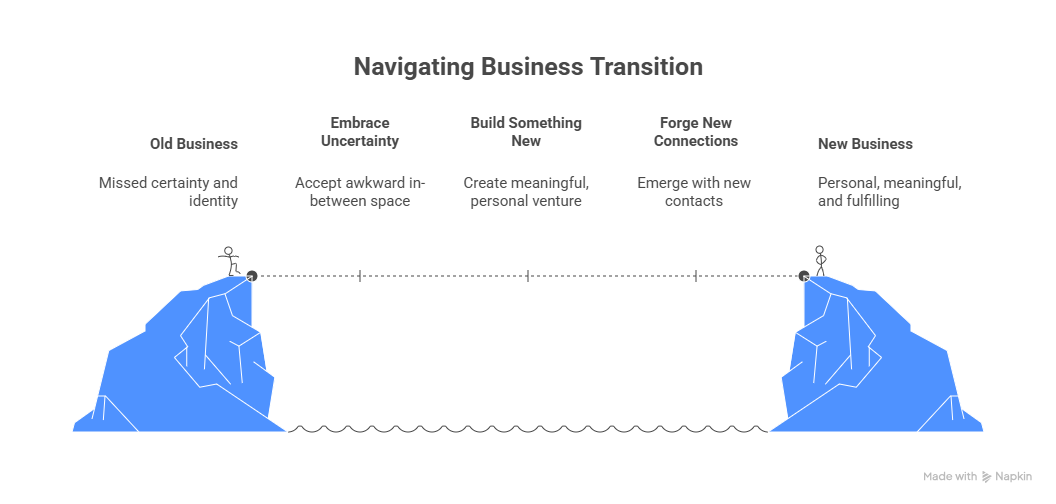
I’m in the middle of a passage right now—from what was to what will be. The messy middle I mentioned earlier. And honestly, some days it sucks.
I miss my old businesses sometimes. I miss the certainty of knowing what I did and who I was. I miss being able to answer “What do you do?” without launching into a complicated explanation that makes people’s eyes glaze over.
But I’m also building something new. Something that matters to me in ways those old businesses eventually didn’t. Something that feels like it’s actually mine, not just a business I’m running.
The contacts from my old world are fading. The new contacts are still emerging. And in between is this awkward space where I’m not quite sure who I am or where I belong.
But I’m learning to be okay with that. Not necessarily happy about it, but okay with it. Because this is just part of the trade. You don’t get the new thing without giving up the old thing. You don’t get the space without first experiencing the loss.
What I’m Looking For Next
Loss and resilience—these are topics I want to spend more time investigating. I’m looking for people to join me on the podcast to talk about this. People who’ve experienced real loss and figured out how to find the gains hidden inside it. People who can talk honestly about the messy middle without rushing to the silver lining.
Because I think there’s something valuable in sitting with loss long enough to really understand it. Not wallowing in it, but not sprinting past it either. Just looking at it clearly and asking, “Okay, what’s actually happening here? What did I lose? What am I gaining? And who am I becoming through this trade?” If this sounds like something you want to do, click on this link and set a time for us to talk.
The Both/And of Loss and Gain
What I’m learning—slowly, sometimes painfully—is that loss and gain aren’t opposites. They’re more like two sides of the same experience. You can’t have one without the other. Every loss contains seeds of gain. Every gain requires some kind of loss.
The key is paying attention to both. Acknowledging what hurt. Acknowledging what disappeared. But also watching for what’s emerging. What’s becoming possible now that wasn’t possible before. What new identity or passion or project is trying to take root in that empty space.
This doesn’t make loss easier. It doesn’t make it hurt less. But it makes it mean something different. It turns loss from just subtraction into a more complex equation—one where you’re not just losing, you’re also becoming.
And maybe that’s the real gain hidden in all of this: not just the specific things I’ve found to replace what I lost, but the understanding that loss itself is part of growth. That you can’t become who you’re meant to be next without losing who you were before.
The Long Strange Trip continues. The losses keep coming. But so do the gains—if I’m paying attention. And I’m learning to pay attention.
Let me know in the comments what you think about loss.

Facebook
LinkedIn
Youtube