
The Transition You Can See Coming
What I've learned about planning for the endings you already know are headed your way.
My oncologist sat across from me and told me something I already knew but hadn’t really let myself sit with: cancer doesn’t announce its exit date. You live with uncertainty. You plan anyway.
I drove home from that appointment with the Grateful Dead playing — “Truckin’,” of all things, which felt either like the universe has a sense of humor or like my Nugs.net algorithm has gotten very on the nose.
Not because the word is clinical and clean and gave me something to hide behind — though I’ll admit that’s a perk. But because it’s the most honest word I know for what happens when one chapter ends and another begins, whether you’re ready or not. And what struck me on that drive is something I’ve watched happen to dozens of people over the course of my life, and something I’ve been guilty of myself:
We wait.
We know something is coming. We can see it. We could prepare. And we wait, because preparing feels like admitting it’s real.
The Grateful Dead, famously, did not wait. They played through every transition — every key change, every detour, every night when the wheels were clearly coming off — because they’d internalized something most of us haven’t: the only way out is through, and you might as well play while you’re going.
That’s the thing about anticipation — the word for that first stage of transition, when you can see the ending moving toward you on the horizon — is that it’s actually a gift. A genuinely underused gift. Most people treat it like a warning label and look away.
The Four Stages Nobody Teaches You
Susan Bradley is the founder of the Financial Transitionist Institute — divorce, death, retirement, sudden money, the whole terrain. She’s one of the clearest thinkers I’ve encountered on how these passages actually work. Bill Bridges wrote about it before her, calling the middle section “the neutral zone.” Between the two of them, they’ve mapped something that most of us stumble through blind.
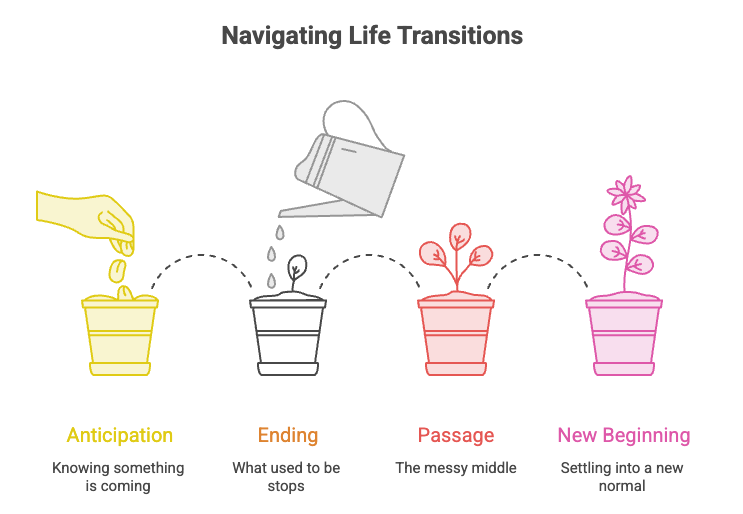
Here’s how I think about the four stages:
Anticipation is when you know something is coming. The retirement date is on the calendar. The prognosis is in the chart. The company sale is in due diligence. You’re not in it yet, but you can see it. This stage is the most underused window any of us will ever get, because it’s the only time you have the luxury of thinking clearly before the floor drops out.
Ending is when what used to be stops. The last day of work. The funeral. The wire transfer. The move. This is the thing people think of when they think of transitions, but by the time you get here, the really important preparation window has already closed. If you used your anticipation well, ending is still hard — endings are supposed to be hard — but it’s not disorienting. You knew it was coming. You did some thinking. You have some idea of what comes next. If you didn’t use anticipation well, ending can feel like being blindsided by something you actually saw from miles away.
Passage is what Susan Bradley calls passage, and Bill Bridges calls the neutral zone. I just call it the messy middle, because that’s what it is. Your old identity doesn’t fit anymore, and the new one hasn’t formed yet. You don’t know which way is up. Most people, if they’re honest, could describe weeks or months of their life that belong in this category — where they were technically going through the motions of their days but genuinely unsure of what they were building toward. This is the stage where people make their worst decisions, because they’re trying to escape the discomfort rather than move through it. It’s also, incidentally, the stage where people buy boats. I say this without judgment. I’ve watched it happen to very smart men. The boat never helps.
New beginning is the other side. Not the absence of difficulty. But the settling into a new normal. The butterfly-out-of-the-chrysalis moment, if you’re comfortable with that kind of metaphor. I’m 73 and have cancer, so I’m somewhat suspicious of the tidiness of the metaphor — but the underlying thing is real. There is a point where the new life starts to feel like a life rather than an improvisation.
The thing is: most of us skip from anticipation straight to shock, because we didn’t use the first stage for what it’s actually for.
The Clearest Example I Have Right Now
My wife and I have been watching a family member move through the final stage of a serious illness. I won’t say more than that — this isn’t my story to tell in full. But I will say that being in the anticipation stage of that kind of transition is one of the hardest emotional positions a person can be in.
You know something is coming. You love the person. You don’t want to plan for the ending because planning feels like wishing for it. So you wait.
Here’s what I’ve learned from watching it up close, and from the version of this I’ve had to do around my own health: waiting doesn’t protect the person you love. It only protects you from the discomfort of thinking clearly about hard things. And that protection comes at a cost.
The cost is paid in the passage stage — in the months after the ending, when you’re trying to figure out how to be in a world that has changed in ways you knew were coming. That’s when the people who did the thinking during anticipation have something to stand on. And the people who waited are starting from zero with no ground under their feet.
I don’t say this to be harsh. I understand the impulse completely. I’ve felt it. I sat on my own diagnosis for longer than I should have before I really let myself think about what it meant for the shape of my life going forward.
But hard things don’t get easier by being avoided. They just get more expensive.
What Scenario Planning Actually Looks Like
Here’s where I want to get practical for a minute, because I think “plan for transitions” can sound impossibly vague.
Scenario planning is the specific tool I’ve found most useful. The idea is simple: you’re probably going to go down the road you’re on right now. But what happens if a curveball shows up? Do you have a plan for that? Not a detailed, twelve-step crisis manual — just a clear enough picture that when the curveball comes, you’re not starting from total confusion.
I ran a food service company for a lot of years. [Josh — insert the specific story here: the moment when a curveball hit and having a scenario plan saved the business. What was the situation? What was the plan you had in place? What would have happened without it?] The short version is: we had a scenario on paper for exactly the kind of crisis that materialized. Not because I was prescient. Because we’d asked ourselves, a year earlier, “what happens if X happens?” — and written down a rough answer. When X happened, we weren’t starting from zero. We were starting from a rough draft.
The same principle applies to the personal transitions we’re talking about.
If you have a parent or a spouse who is ill, some of the anticipation-stage work looks like this: What will my life actually look like after they’re gone? Where will I live? Who will I lean on? What will my days feel like? What have I been putting off that I’ll wish I’d done while I had time?
These aren’t questions you have to answer completely. They’re questions you have to start asking. Because the asking is what builds the cognitive and emotional infrastructure you’ll need when the ending comes.
The Health Version
I’ll tell you what I’m doing around my own situation, since I brought it up and you deserve more than a vague gesture.
I track my health carefully. Not obsessively — I’m not turning my remaining years into a hypochondria project — but intentionally. I pay attention. I try to think, with some regularity, about what might be coming and what I want to be true about how I handle it.
Some of that is practical. Who knows what? Who makes decisions if I can’t? What do I want my days to look like if my capacity changes?
Some of it is relational. Am I having the conversations I need to be having? Am I telling people what they mean to me while I can tell them? Am I building the memories that are actually going to matter?
And some of it is just acceptance work , which sounds soft but isn’t. It’s the practice of actually letting yourself sit with what’s coming, rather than flinching away from it every time it comes up. You can’t plan for something you won’t look at.
The anticipation stage, done honestly, is mostly looking at things you’d rather not look at. That’s the work. It’s not pleasant. It’s also the only work that actually prepares you for what’s coming.
The Counterintuitive Thing About Grief
Here’s something I’ve noticed in myself and in the people I’ve watched move through hard transitions: the people who avoid anticipation don’t avoid grief. They just delay it.
You don’t get to skip the messy middle. You can only show up to it with better or worse preparation. The person who spent the anticipation stage looking away, who refused to think about the ending, who kept saying “we’ll cross that bridge when we come to it”, arrives at the passage stage exhausted and disoriented, without any of the small preparations that could have made the crossing slightly less brutal.
The person who did the work in anticipation arrives at the same passage stage. Still hard. Still messy. But they’ve got a rough map. They know what some of the decision points are. They’ve maybe even made some peace with the fact that this transition is happening.
Susan Bradley talks about this in terms of financial decisions made under duress. The research is sobering: people in the passage stage of a major transition make significantly worse financial decisions than they would otherwise, because the emotional and cognitive bandwidth is nearly fully consumed by the transition itself. The people who protect themselves from that aren’t the ones who were smarter or luckier. They’re the ones who did the financial planning in the anticipation stage, before the pressure was on.
The same logic applies to every other kind of decision.
What I’m Still Figuring Out
I want to be honest with you about the limits of what I know here.
I know that anticipation is a gift and that I’ve wasted it before. I know that planning before you need the plan is almost always better than planning after. I know that the messy middle is unavoidable — you go through it, not around it — but that you can arrive better prepared.
What I’m less sure about is how to talk somebody into doing this work before they feel ready. Because the truth is, no one feels ready. The whole reason people avoid anticipation is that it forces them to confront things that hurt. And telling somebody that confronting painful things will ultimately hurt less than avoiding them is, I’ve found, about as effective as telling someone that a cold swimming pool is refreshing once you’re in it.
You know it’s true. You still have to get yourself to jump. And if you’re over 65, “jump” is probably a strong word. Ease yourself down the ladder. Same principle.
The Dead used to play three-hour shows with no setlist. People thought they were being spontaneous. They weren’t , they’d spent decades building the muscle memory, the trust, the vocabulary with each other. What looked like improvisation was actually preparation so deep it became instinct. That’s what good anticipation does. It doesn’t make the transition feel scripted. It gives you the chops to play through whatever actually shows up.
I don’t have a clean answer for that. What I’ve found in my own life is that the times I’ve actually done anticipation well — when I’ve let myself look at hard things and do some thinking before the ending came — it was because somebody I trusted was having the conversation with me. Not pushing. Just asking the questions in a way that made it feel safe to answer.
If that’s a role you can play for someone in your life right now — for a spouse, a parent, a friend who’s got something hard coming that they’re refusing to look at — that might be the most useful thing you do this year.
Not to hand them a plan. Just to sit with them and ask the questions.
The Last Thing
Here’s what I keep coming back to. We talk a lot about being present, about living in the now. And I believe in that. The present is where life actually happens.
But the present includes the reality that certain futures are coming. Pretending they aren’t doesn’t make you more present — it just means you’re going to be blindsided later in ways you could have softened now.
Anticipation isn’t the opposite of living fully. It’s the practice of taking what you can see clearly and deciding to use it rather than flinch from it.
I’ve got cancer. I have a family member I love who is moving toward the end of their life. I’m 73, which means the transition math is different than it was at 50.
And I’m trying , imperfectly, inconsistently, to use the time I have in anticipation to actually anticipate. To look at the hard things. To ask the questions. To have the conversations.
It is, I can confirm, uncomfortable.
It is also, I’m increasingly sure, the right thing to do.
What stage of a transition are you in right now? And what did you do , or wish you’d done, during anticipation that made a difference? Drop it in the comments. The Long Strange Trip is a conversation, and this is one of those topics where I’m genuinely more interested in what you know than in what I think I know.
Let’s figure it out together.

Facebook
LinkedIn
Youtube