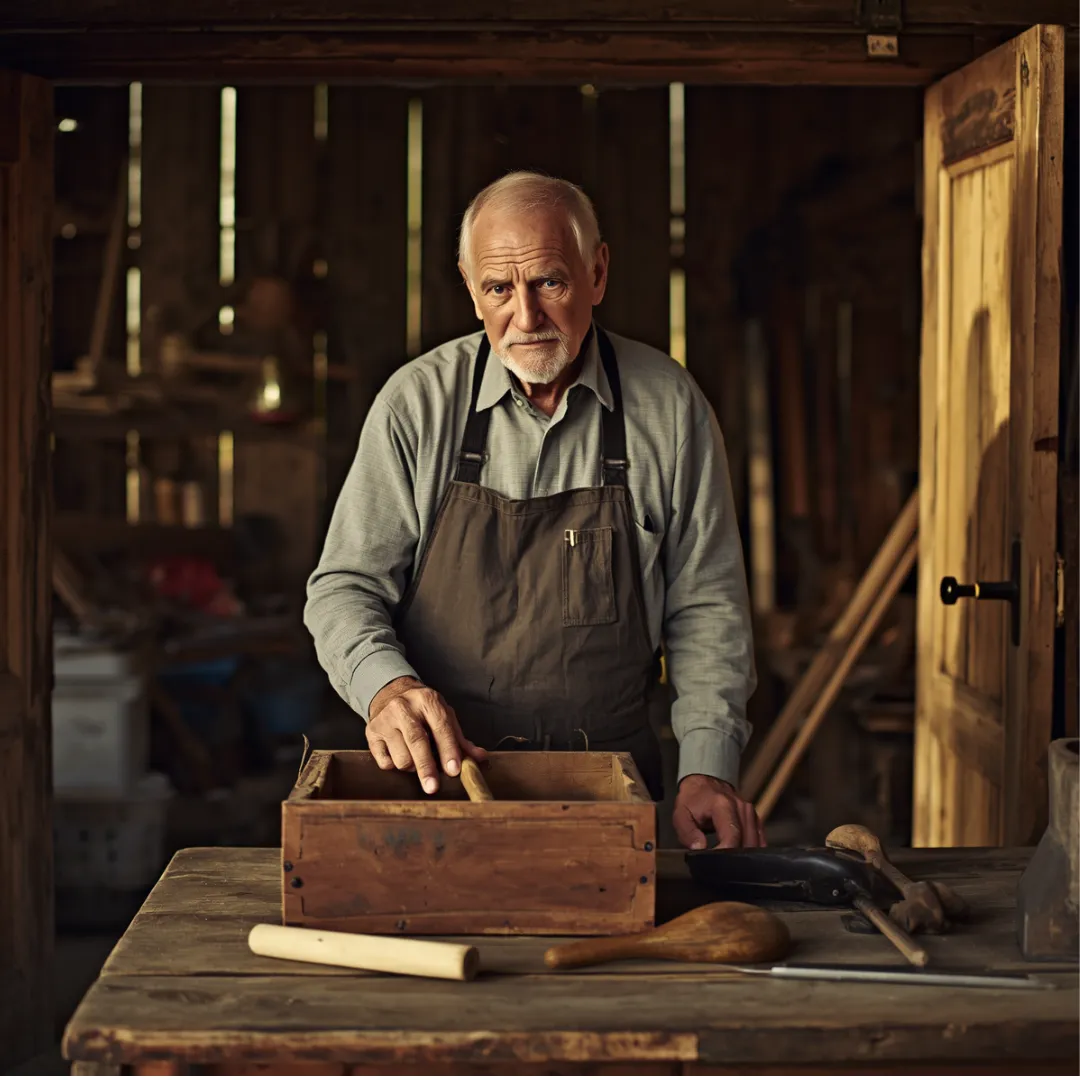
The Tools I Never Chose
Bruce Feiler says we hit thirty to forty disruptors in a life. Here's what I reach for when mine show up. And why, in my seventies, I finally traded in the tools I inherited.
When your life comes apart, what do you reach for? I don’t mean what you tell people. I mean the real thing. The move your hand makes before your brain gets a vote.
I asked myself that not long ago. The answer wasn’t pretty. That’s why I’m writing this.
Bruce Feiler says we hit 30 to 40 disruptors in a lifetime. Do the math. That’s a big transition every twelve to eighteen months. Over and over, for as long as we’re here.
What stopped me cold wasn’t the number. It was something else. Our toolkit for these things never got upgraded. We grab the same old tools for a brand-new problem, year after year. Then we wonder why it feels so hard every time.
So I got honest with myself. What do I really reach for when things fall apart? The answer came in three moves. Work harder. Control more. Tell nobody.
Here’s the part that got me. Every one of those tools was my father’s first.
Where the tools came from
My dad ran a wholesale tobacco business. It was hard work in the best of times. Cash was short almost always. When money got tight, he didn’t try a new idea. He just went in earlier and stayed later.
And our family paid the price for it. A kid notices that. He notices it long before he has the words.
That was the whole toolkit. Outwork the problem. Grip everything you can control. Never let anyone see the strain.
Here’s the thing about a toolkit like that. Nobody hands it to you in a box. You absorb it, the way a kid absorbs an accent. You don’t decide to talk that way. You just grow up hearing it until it’s the only way your mouth knows how to move.
I never chose those three tools. I never once questioned them. I carried them into my business, my marriage, my health scares.
Then I looked at them honestly. And I’m not sure a single one still works. Maybe they never did. Maybe they just kept my father busy enough that he didn’t have to feel how scared he was.
So let me ask you something. Whose tools do you reach for when life shifts? Did you choose them? Or did somebody hand them to you, before you knew any better?
Working harder never worked
Let me make a confession. It took me most of my life to say it out loud. Working harder never once solved a transition for me. Not one time. It never got me through the hard part.
All it ever did was make me tired. It let me tell myself I was doing something. I did it anyway, for years. Not because it worked, but because I had no other ideas. It was the only tool in the drawer.
And when your only tool is “push harder,” every problem becomes a wall. The first crack of light came at work. We started getting serious about Total Quality Management.
For the first time, I saw something new. There might be other ways to get from point A to point B. Not more force on the same straight line. Different moves. Smaller ones.
It sounds obvious when I say it. But knowing a thing and feeling it are different. That was the day it moved from my head to my bones.
Here’s what I believe now. A transition isn’t a wall you push through. It’s a passage you move through. And you don’t muscle through a passage. You feel your way, one step at a time.
That takes resilience, not brute force. You make the change from within. Not by grinding against it from without.
The tools I use instead
So here are the tools I reach for now. They replaced my father’s three. Fair warning first. I’m not all-knowing on this. Not even close.
A lot of what I use I learned from Susan Bradley at the Sudden Money Institute. The rest I’m still figuring out, right alongside you. So take what helps. Leave what doesn’t. And please, add your own.
The first tool is the simplest. For a “work harder” guy, it was also the hardest. When I know I’m in a transition, I pause. I let it sit. I let myself be right where I am.
I don’t rush to fix it. I don’t rush to name it. That pause used to feel like weakness. It felt like the thing my father would be ashamed of. Now I think it’s the whole game.
There’s an old line I love. When the student is ready, the teacher appears. I’ve learned something about that teacher. He can’t show up if you’re moving too fast. The pause is what makes you ready.
I have a small practice that helps. Some folks pick three words for a year. I pick one word a day. Sometimes it serves me for a day, sometimes for weeks. For a long stretch, my word was “ambiguous.”
That’s exactly how everything felt. My health felt ambiguous. My next steps felt ambiguous. The whole road felt ambiguous. I learned to sit inside that, instead of forcing a false certainty just to feel better.
Name the stage you’re in
After the pause, the right tool depends on the stage. Which part of the transition am I in? Naming that stage is half the work. You can’t pick the right tool if you won’t admit where you stand.
One honest warning first. These stages are not a tidy staircase. We’d love to climb neatly from one to the next. Real life doesn’t work that way. The stages stack on top of each other.
You think you’ve reached the new normal. Then the ground shifts and yanks you back. Most of the time I’m not in one transition. I’m in three at once, each one leaning on the others.
So here’s what I reach for in each stage. As we go, ask yourself one thing. Which stage am I really in? And am I naming it, or avoiding it?
Anticipation
Something is coming, but it’s not here yet. You feel the weather change. The storm is still offshore. Here I use a tool I call “what if.” What would happen if this happens, or if that happens?
The last time my life fell apart, that was the question I needed. Just “what if,” run out across a few scenarios. This is not worrying. Worry spins in place and burns fuel. “What if” gives that anxious energy somewhere to go.
You’re not predicting the future. You’re drawing a few maps. Then whichever road it is, you’ve already walked a version of it.
The ending
Nobody warns you about this stage. It’s the loneliest one. An ending is when what you had is gone. Who you were isn’t true anymore. The title’s gone, the role’s gone.
The identity you wore for thirty years is hanging in a closet that isn’t yours. Here I sit back and ask a question. What would I like my future to look like? And notice something important. I’m not making any decisions. I’m just asking.
The ending is not the place to decide. It’s the place to wonder. This is where a hard question shows up. “If I’m no longer a business owner, who am I?” It sits down next to you and won’t leave.
You don’t have to answer it today. You just have to be brave enough to ask. Susan Bradley calls this a liminal space. The old thing is gone, and the new thing hasn’t shown up yet.
It’s uncomfortable by design. Two years ago I’d have run from it. Today I can almost sit in it and be okay.
The passage
Now we hit the messy middle. Everything is confusing. Nothing feels solid. This is the time for experiments. I call it “fail fast, fail cheap.”
I learned it the hard way. In the early 1980s, we had a salmonella outbreak in our company. That is deep in the passage. Nothing certain, no playbook, decisions flying at us last-minute.
But something saved us. We had done some scenario planning ahead of time. We’d already played our “what if” games. So we weren’t starting from zero. We already had ideas for experiments.
We ran a lot of small ones. And we felt our way to the other side. It wasn’t one heroic push. It was a string of small, cheap tries.
Here’s what most people get wrong about “fail fast.” I got it wrong too. One experiment flopped badly. It was our first try at repeat service calls. I framed the problem as big as I could, and that’s backward.
Fail fast doesn’t mean swing for the fences. It means go small. The wins taught me the same thing. We had snack machines with forty different items, and I had a hunch that was too many.
So we didn’t cut it to ten overnight. We went from forty to thirty-eight. Then thirty-five. Then thirty. We kept shrinking it until we only needed fourteen.
Small step, small step, small step. Each step was cheap. If one flopped, we could back right out. That’s the whole art of the passage. Go with proof from small experiments, not one big bet fueled by force.
Here’s my rule of thumb now. If an experiment can’t run in about a week, it’s too big. Make it smaller. So let me ask you. What would you try, if you let yourself fail that cheap?
And here’s a quiet truth. You’ll give up on far more than you keep. Most experiments won’t stick. That’s not failure. That’s the process doing its job.
The new beginning
Finally, the sun comes back out. The hard part is behind you. You’re moving into the new thing. And this stage asks for a tool. It’s the one I’ve been worst at my whole life.
Learn to accept the new beginning. Don’t fight it. I have a long, embarrassing history here. I argue with the new beginning that shows up. I wish it were a different one.
I compare it to the one I thought I was owed. Anything but letting the good thing be good. So let me tell you where I am today, as honestly as I can. Right now, I’m not fighting. For the first time in a long while, I’m grateful.
I’m appreciating the new beginning I landed in. And it turned into this. The whole Long Strange Trip project. The thing you’re reading right now.
Same four stages I’ve walked a dozen times. Same handful of tools. The only difference is simple. This time, when the new beginning came, I didn’t put up my fists. I let it be good.
The next one
I keep two words in my pocket for whatever comes next. The next one. I got them by accident. Years ago I went to hear Bill Walton speak.
Afterward I ran into him in the men’s room. I had one shot at a brilliant question. Instead I asked something dumb. “What’s the best Grateful Dead concert you ever saw?”
He looked at me like I had three heads. He said two words. “The next one.” Then he walked out. I stood there with my face going red.
But his answer wasn’t dumb. It was brilliant. Why look back when you can look forward? Whatever comes next has lessons in it. It can be interesting, even when it’s hard.
So now I meet each transition with those two words. The next one. The next one will be an adventure. I don’t expect a barrel of laughs, and I know there’ll be hard stretches. But the next one leads somewhere interesting, as long as I stay open to it.
That’s the trade I’ve finally made, later than I’d like to admit. Out with work harder, control more, tell nobody. In with pause, name it, ask, experiment, accept. Tools I actually chose this time. Not the ones that came with the tobacco business.
So let me leave you with one question. It’s the same one I had to sit with. The last time your life came apart, what did you reach for? And now that you’ve seen it in the light, would you trade any of it in?
I’d genuinely like to know. It is what it is. But we’re not on the committee that says we figure it out alone.

Facebook
LinkedIn
Youtube