The Slow Goodbye: What I’m Learning About Loss That Nobody Talks About
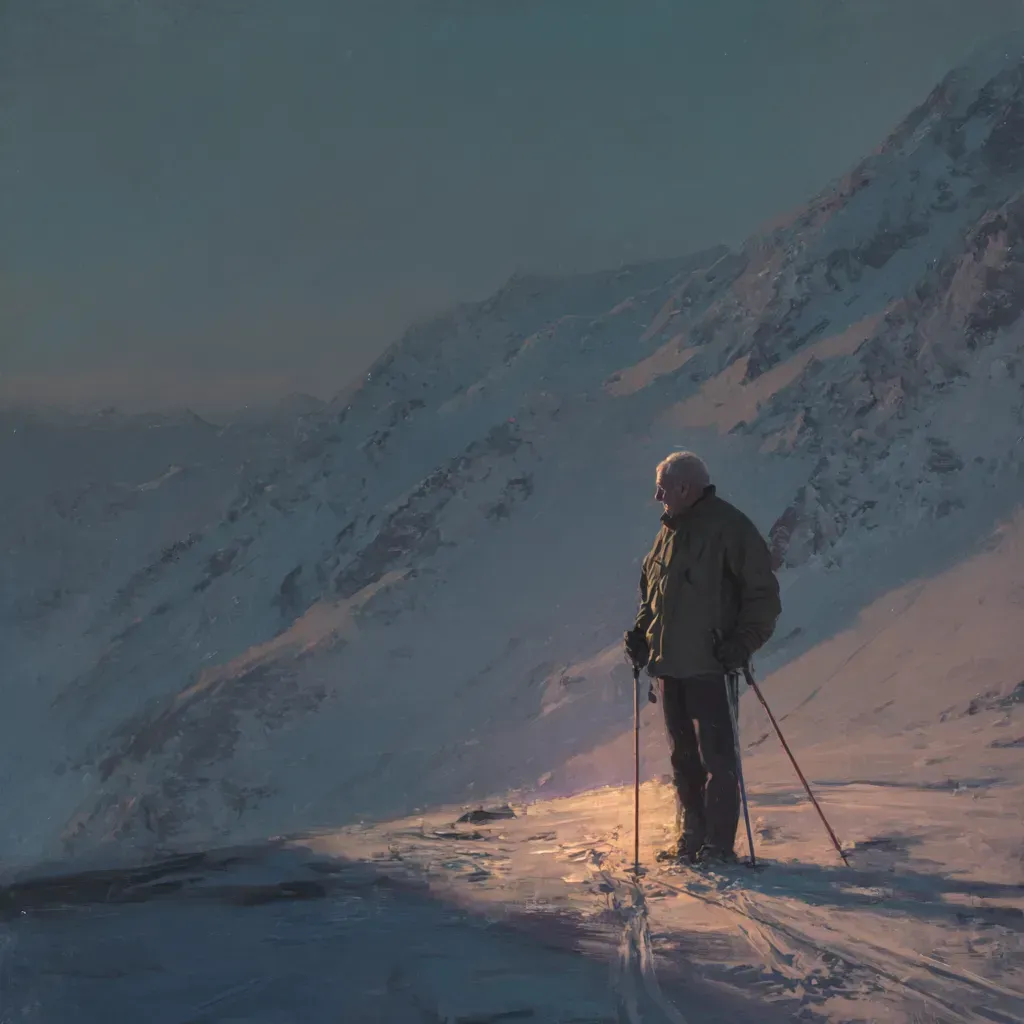
Yesterday, I had to admit something I’ve been avoiding for three years: I’m done skiing.
Not “taking a break from skiing.” Not “skiing differently.” Done.
And here’s what’s messing with me – it wasn’t a single moment of loss. It was this slow, stubborn, painful process of watching something I loved slip away while I kept insisting I could get it back.
Three years ago, foot ulcers made it dangerous to ski. I told myself it was temporary.
Last year, I blamed weak legs and bought new equipment. Surely that would fix it.
Yesterday, I finally got it: my feet can’t make the micro-adjustments anymore. Without those tiny corrections, skiing isn’t just hard – it’s dangerous. And no amount of stubbornness changes that reality.
I’m sitting here wondering: is this how loss actually works as we age? Not the dramatic, sudden kind – but this slow-motion goodbye where you keep showing up to something that’s already gone?
The Pattern I’m Starting to See
I’m noticing this same slow-motion loss pattern with other things that used to define me.
Live music was another slow goodbye. First, I blamed the sound mixing at venues. Then I got frustrated that every show requires standing for hours. Finally, I had to admit that live music – something I’ve loved for decades – has just become too uncomfortable to enjoy.
I spent years trying to force it back to being what it was. Changing venues. Changing how I approached shows. Trying to recapture something that was already gone.
Tennis left my life eighteen years ago when peripheral neuropathy showed up with my first cancer diagnosis. But I didn’t accept that loss for years. I kept thinking my energy would come back. That I’d recover and get back on the court.
I didn’t. Another thing I was too stubborn to let go of when it was clearly time.
The Coping Strategies That Didn’t Work (And Why I Kept Using Them)
Looking back, I can see exactly what I was doing. I was running experiments to prove I could still do these things. But here’s the weird part – they were designed to fail small, so I wouldn’t have to face the big truth, and the small experiments kept me from having a huge letdown when I finally learned the end had come.
The belief strategy: For the longest time, I just believed harder. If I couldn’t ski well, it was because I didn’t believe enough. If live music wasn’t enjoyable, I just needed to adjust my attitude. If I was too tired for tennis, I needed to push through.
This worked for a while. Not because it changed anything about my physical capacity, but because it let me avoid admitting what was actually happening.
I’d tell myself, “Next time will be better. I just need to want it more.”
Except next time wasn’t better. It was usually worse.
The small experiment approach: Instead of going all-in on trying to reclaim these activities, I’d do small tests. The bunny hill instead of a black diamond. One concert instead of a whole festival run.
At the time, I thought I was being smart. Testing the waters. Seeing what was still possible.
But looking back, I can see what was really happening: I was protecting myself from the full weight of the loss. If I only tried a little bit and failed, it didn’t hurt as much as going all-in and discovering I couldn’t do it anymore.
These small experiments let me stay in denial longer. Each failed attempt was small enough that I could explain it away. The conditions weren’t right. I wasn’t feeling great that day. I needed better equipment.
It took me years to connect the dots and see the pattern: I was done. I just wasn’t ready to know I was done.
The Truth I Knew But Wouldn’t Admit
Here’s something that’s been bothering me as I write this: somewhere deep down, I knew years ago that these things were over.
With skiing, I probably knew three years ago when the foot ulcers started. With live music, I knew two years ago when I started making excuses not to go to shows I used to love. With tennis, I knew within months of my first cancer diagnosis that my body wasn’t coming back the same way.
But my subconscious knew something my conscious mind refused to accept.
So I kept running these little experiments. Kept trying. Kept believing. Not because I genuinely thought things would change, but because I wasn’t ready to face what I already knew.
That’s the thing about slow-motion loss that I’m just now understanding: it’s not that you don’t know. It’s that you’re not ready to know what you know.
The knowing happens way before the accepting. And the gap between those two things? That’s where all this stubborn experimentation lives.
Who Am I If I’m Not A Skier?
But here’s where this gets really uncomfortable for me. This isn’t just about losing activities I enjoyed. It’s about losing pieces of how I understand who I am in the world.
For literally my entire conscious life, I’ve been a skier.
Not someone who skis occasionally. A skier. It’s been part of my identity since I was a kid. Living in Upstate New York made sense because I ski. Many of my social connections were built around skiing. My relationship with winter, with the outdoors, with physical challenge – all of it was wrapped up in being a skier.
When someone asked what I did for fun, “skiing” was always in the first sentence.
Now what?
I’m a guy who used to ski. A former skier? Someone who lives in Vermont but doesn’t do the one thing Vermont is famous for?
It sounds dramatic, I know. It’s just an activity, right? People lose hobbies all the time.
But it doesn’t feel like just a hobby. It feels like losing a piece of myself that I don’t know how to replace.
And it’s not just skiing.
The Business Owner Identity Crisis I Didn’t Expect
I’ve been going through something similar with my business identity, and I’m just now seeing the connection between these two losses.
For over forty years, I was “the business owner.” The guy people came to for advice. The decision-maker. The person who built something from nothing and kept it running.
That shaped everything I understood about myself. My value in the world. My purpose. My daily structure. My sense of who I was.
When I stepped back from active business ownership, I thought I was prepared. I had enough money. I had interests outside of work. I wouldn’t be one of those people who completely fall apart without their business identity.
Except I wasn’t prepared at all.
Because losing that identity didn’t happen in one clean moment when I sold or stepped back. It’s been this slow erosion. The phone is ringing less often. People are not asking my opinion anymore. Realizing that the business problems I used to solve all day aren’t mine to solve anymore.
And just like with skiing, I kept running small experiments to prove I was still “the business owner.”
I’d offer advice nobody asked for. I’d stay connected to business communities. I’d position myself as someone who’s still in the game, just playing differently.
But slowly, that identity has been slipping away. And I’m left with the same uncomfortable question: who am I if I’m not the business owner anymore?
The Identity Reconstruction Nobody Prepares You For
Here’s what I’m learning: you can’t just swap out one identity for another like changing clothes.
I can’t go from “I’m a skier” to “I’m a cyclist” and have that feel the same. Even if I took up cycling seriously, it wouldn’t carry the same weight, the same history, the same sense of self.
I can’t go from “I’m a business owner” to “I’m a retiree” without losing something fundamental about how I see myself.
Because these identities weren’t just labels. They were built over decades. They shaped my days, my relationships, my sense of purpose, my understanding of my place in the world.
When you lose an identity that’s been central to who you are for most of your life, you don’t just need a new hobby or a new role. You need to reconstruct your entire sense of self.
And nobody tells you how to do that.
All the advice about retirement focuses on financial planning. Have you saved enough? Can you maintain your lifestyle?
Nobody asks: Have you figured out who you’ll be when you’re not defined by your career anymore?
All the advice about aging focuses on staying active. Keep moving, find new hobbies, stay engaged.
Nobody asks: what do you do when the activities that defined you become impossible, and everything else feels like a pale substitute?
The Grief That Doesn’t Follow The Script
I thought grief was supposed to have stages. Denial, anger, bargaining, depression, acceptance. Linear. Predictable.
But this grief doesn’t work that way.
I cycle through all of those stages in a single day. Sometimes in a single hour.
I’ll accept that skiing is done, feel okay about it, and even be optimistic about finding new things. Then two hours later, I’m angry that my body won’t cooperate. Then I’m bargaining – maybe if I try different equipment, maybe if I just do easier runs, maybe if I build more strength.
And underneath all of it is this persistent depression that’s not dramatic or overwhelming, but just... there. This low-grade sadness about losing pieces of myself faster than I can figure out how to rebuild.
The acceptance everyone talks about? I don’t think it’s a stage you reach and then you’re done. I think it’s something you have to keep choosing, over and over, even when other parts of you are still fighting it.
What I’m Actually Grieving
I’m starting to understand that what I’m grieving isn’t really the activities themselves.
I’m grieving:
The person I used to be. The guy who could ski hard all day, who had the energy for live music until 2am, who could play tennis for hours without thinking about it. That person is gone, and I miss him.
The future I thought I’d have. I had this vision of my 70s where I’d still be active and engaged in all these ways. That future doesn’t exist anymore, and I’m grieving the loss of that imagined life.
The sense of capability. These activities made me feel capable, strong, and skilled. Losing them means losing that feeling, and I don’t know how to get it back in other ways.
The connections these activities created. My skiing buddies. The community at live shows. The tennis club. Those connections are harder to maintain when I’m not doing the activity that brought us together. Not only do I lose the physical ability, but I also lose the community and the result: Loneliness.
When you understand what you’re actually grieving, the loss makes more sense. It’s not just “I can’t ski anymore.” It’s “I’m losing pieces of my identity, my future, my sense of self, and my place in the world.”
That’s a lot heavier than losing a hobby.
Why This Gets Harder As We Age
I’ve been sitting with this question: Does loss get harder as we age?
And I think the answer is yes, but not for the reason I expected.
It’s not that the losses themselves are bigger or more painful. It’s that the time and capacity for replacement are running out.
When I was 30, and something ended, I had decades ahead to find new things, build new identities, create new patterns. The future was wide open.
At 73, the list of things I can start doing is getting shorter. My energy is more limited. My physical capacity is declining. The runway for building something new and making it central to my identity is just... shorter.
So each loss feels heavier because I’m less confident I can replace it with something equally meaningful.
And maybe that’s why I held onto skiing so stubbornly. Not just because I loved it, but because I couldn’t see what would replace it. Better to keep trying to force something that’s gone than to face an empty space I don’t know how to fill.
The Questions I’m Sitting With
I have more questions than answers right now. But here’s what I’m wrestling with:
How do you know when to stop trying? When does persistence become denial? When does hope become stubbornness? I still don’t know. I only figured it out with skiing by accepting my body wouldn’t cooperate anymore.
What does identity reconstruction actually look like? I know intellectually that I need to build a sense of self that isn’t dependent on being a skier or a business owner. But practically, how do you do that? What does that work actually look like day to day?
How do you grieve something while still living your life? I can’t just stop everything and process this grief until it’s done. Life keeps moving. So how do you hold the grief alongside everything else?
Is there a version of acceptance that doesn’t feel like giving up? Because right now, accepting that skiing is done feels like defeat. Like I failed to figure out how to keep doing something I love. I know that’s not rational, but that’s how it feels.
Why does writing this help? Seriously. Why does putting these thoughts into words and sharing them with strangers help me process this? I don’t have a good answer, but it does.
What I’m Learning (Even If I Don’t Like It)
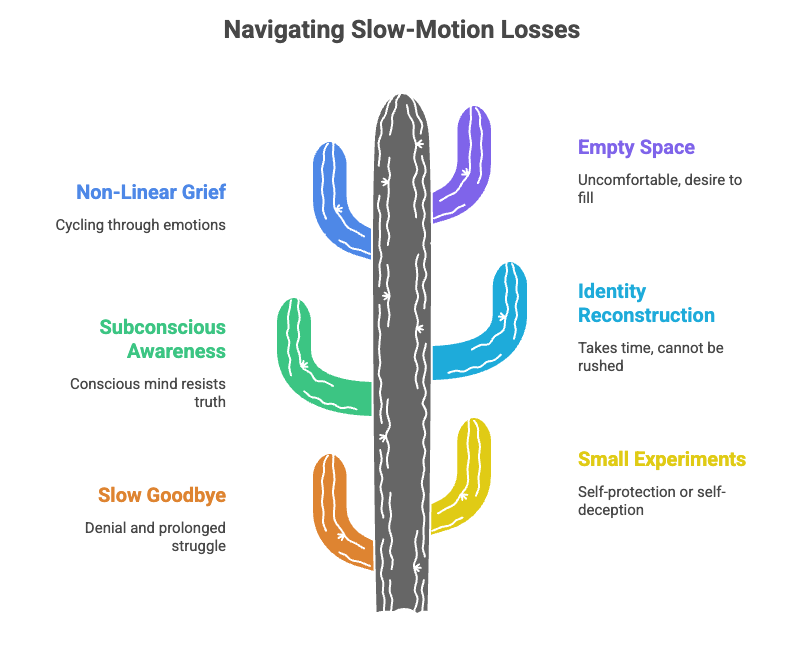
Here’s what I’m starting to understand about these slow-motion losses, even though I’m still in the middle of living them:
The slow goodbye might be harder than the sudden one. If skiing had ended in one dramatic injury, maybe I could have processed it and moved on. But this three-year fade? It kept me in denial, kept me trying, kept me from fully facing what was happening until I’d exhausted every explanation.
Small experiments can be self-protection or self-deception. I thought I was being smart by testing things gradually. But I was also protecting myself from the full weight of the truth. Those small failures were easier to explain away than one big definitive loss.
Your subconscious knows before you’re ready to know. I knew years ago that these things were ending. But I wasn’t ready to accept it, so I kept my conscious mind busy with experiments and explanations while my subconscious held the truth.
Identity reconstruction takes time you can’t rush. You can’t just decide to be someone new. It’s a slow process of trying things, seeing what fits, letting go of what doesn’t. And it happens on its own timeline, not yours.
Grief doesn’t follow a neat path. The stages aren’t linear. You cycle through them. You revisit them. And that’s apparently normal, even though it feels messy and frustrating.
Sometimes you have to sit in the empty space. Right now, I’m in this gap between who I was and who I’m becoming. It’s uncomfortable. I want to fill it quickly. But maybe the work is just sitting here for a while, not knowing, not having it figured out.
Where I Am Right Now
I’m in the messy middle of this loss. I’ve accepted skiing is done, but I haven’t figured out what comes next or who I am without it. I’m grieving something that’s been gone for a while but that I only recently stopped fighting.
And I’m learning that this is what resilience actually looks like sometimes. Not bouncing back quickly. Not having it figured out. Not replacing one thing with another seamlessly.
Just sitting with the discomfort of not knowing who you are anymore. Letting the old identities slip away, even though you haven’t built new ones yet. Trusting that something will emerge even though you can’t see what it is.
It is what it is. Even when “what it is” kind of sucks.
Your Turn
I’m curious whether any of this resonates with you.
Have you navigated these slow-motion losses? The kind where something you loved gradually becomes impossible, and you spend years trying to get it back before finally accepting it’s gone?
What did that look like for you? How did you know when to stop trying? Did you go through the same kind of small experiments, the same stubborn belief that you could fix it?
And the identity piece – when you lost something that defined who you were, how did you rebuild? What did that reconstruction actually look like?
I’m asking because I genuinely don’t know. I’m figuring this out as I go, and I’d love to hear how others have navigated this territory.
Share your story in the comments. What have you lost slowly? How did you finally let go? And who did you become on the other side?
Because right now, I’m just here. In it. Not enjoying it, but not trying to rush through it either.
Let’s figure this out together.

Facebook
LinkedIn
Youtube