
The Hug Deficit: What We Lose When We Stop Touching Each Other
My father hugged me once in my entire life.
I was 21 years old. I’d just survived a burglary where I should have died. And in that moment—standing there, still shaking, still processing that I was alive—my father wrapped his arms around me.
One hug. In 21 years.
I’m 73 now, and I’ve been thinking a lot about hugs lately. Real hugs, I mean. Not the wet noodle kind where you sort of lean in, pat someone’s back twice, and pull away as quickly as possible. I’m talking about the hugs where you can feel the love oozing out. The kind that actually mean something.
They’re rare. Rarer than they should be.
And I’m wondering why.
The Wet Noodle Phenomenon
Let me paint you a picture you’ve probably lived.
You see someone you care about. Maybe a friend you haven’t seen in months. Maybe a family member at a gathering. You move toward each other for a hug, and... it’s awkward. Bodies barely touch. Arms hover uncertainly. Someone pats someone else’s shoulder blade. The whole thing lasts maybe two seconds.
You both step back, having performed the ritual of connection without actually connecting.
This is what I call the wet noodle hug. It’s everywhere. And it’s driving me crazy.
Here’s what I’ve noticed: we know physical contact matters. The research is clear—human touch reduces stress, lowers blood pressure, releases oxytocin, and strengthens our immune systems. Touch is literally medicine.
And yet most of us are touch-starved, going through our days with minimal genuine physical connection to other humans.
Why?
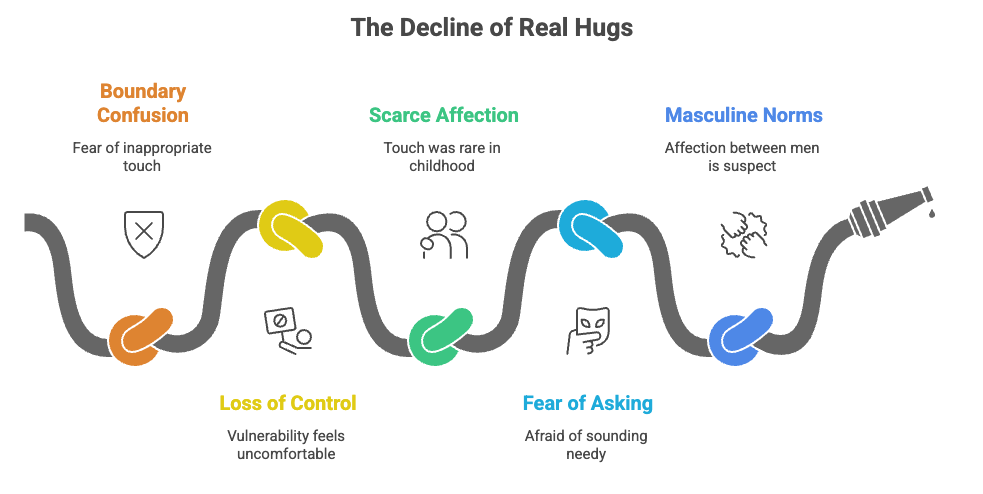
Five Reasons We’ve Lost the Art of Real Hugs
I’ve been sitting with this question, observing the patterns, asking people about their experiences. Here’s what I’m seeing:
1. We’ve confused appropriate boundaries with emotional distance.
The #MeToo movement happened for real reasons. People—mostly women—were being violated, harassed, and made uncomfortable by unwanted touch. The response was necessary and overdue.
But here’s the complicated part: in our effort to establish clear boundaries around inappropriate touch, I think we’ve also backed away from appropriate, non-sexual physical connection.
We’re so worried about being inappropriate that we’ve made all touch suspect. A real hug requires letting someone into your physical space, and that vulnerability feels risky when we’re hyperaware of boundaries.
The challenge is knowing the difference between a genuine, non-sexualized hug and something else entirely. And rather than navigate that complexity, many of us just default to the wet noodle. It’s safer. Less risky. Also, less human.
2. Real hugs require giving up control.
Think about what a genuine hug actually requires. You have to open yourself physically. Let someone close. Be still with them for more than a perfunctory second or two. Trust them with your body and your space.
That’s vulnerability. And most of us—especially those of us who’ve spent decades being competent, in control, and self-sufficient—aren’t particularly good at vulnerability.
A real hug is a small surrender. You can’t control exactly how long it lasts or how it feels. You have to let the other person in and trust the moment.
For people who’ve built their lives around being in control, that surrender feels uncomfortable. The wet noodle hug lets us maintain the illusion of connection while keeping our guard up.
3. We learned early that touch was scarce.
My father’s generation didn’t hug. Or maybe it was just my father. Either way, I learned young that physical affection was rare and conditional.
One hug in 21 years teaches you something: that touch is reserved for extreme circumstances. That real physical connection isn’t part of normal life. That you should expect distance, not closeness.
I’m not unique in this. Many of us grew up in families where hugs were rare or perfunctory. Where “I love you” was implied but never said. Where physical affection felt awkward or forced.
We learned these patterns young. And even when we consciously decide to do things differently—I made that decision with my own kids about ten or fifteen years ago—the old patterns are still there, shaping how comfortable we are with genuine physical connection.
4. We’re afraid of asking for what we need.
Here’s something I’ve never done: directly asked someone for a real hug.
I want to. Sometimes I desperately want to say, “Can we have an actual hug? Not the quick pat thing, but a real one?” But I don’t know how to ask without sounding weird or needy or putting the other person on the defensive.
So I hope for the best. I initiate hugs and hope the other person will meet me there. Sometimes they do. Often they don’t.
This fear of asking for what we need—it’s not just about hugs. It’s about connection generally. We’re terrified of being seen as too much, too needy, too vulnerable. So we perform the socially acceptable version of connection and wonder why we feel so alone.
5. Men are particularly bad at this.
I’ve noticed something: women generally hug better than men.
I don’t know if this is nature or nurture or both. But in my observation, women are more comfortable with genuine physical affection. They hug each other. They hug their friends. They know how to give and receive real hugs.
Men? We struggle.
I spent decades in the business world, where the standard greeting was a firm handshake. I rebelled against that—I’d rather get a hug than shake hands any day. But the pushback was real. People literally pushed away.
I have a few male friends who know how to give a proper hug. But they’re the exception. Most men I know do the back-pat, pull-away-quickly version. Or the side-hug that keeps maximum distance between bodies.
We’ve been taught that physical affection between men is suspect. That real tenderness is weakness. That we should be self-sufficient and not need comfort from others.
It’s costing us.
What Cancer Taught Me About Touch
Here’s when this all became urgent for me: cancer.
Two aggressive cancers diagnosed simultaneously. Brain bleeds. Treatment protocols. Uncertainty about the future. Losing yet another toe to amputation.
And suddenly, hugs weren’t just nice. They became essential.
I don’t know if it’s facing mortality or going through the physical toll of treatment or just the sheer weight of navigating a scary medical journey. But I find myself needing physical contact more than I did before.
Real hugs help. They ground me. They remind me I’m not alone in this. They offer a kind of comfort that words can’t.
When my kids visit and give me real hugs—the kind where we actually hold each other for more than two seconds—it makes my day. When my partner gives me a genuine embrace, something settles in me. A good hug can stay with me for days.
It’s medicine. Not metaphorically. Actually.
Research shows that physical touch releases oxytocin, which reduces stress and anxiety. It lowers cortisol levels. It can actually boost immune function. For someone going through cancer treatment, these aren’t small things.
Hugs don’t cure cancer. But they make treatment easier. They help with the fear. They provide comfort that medical interventions can’t touch.
I wonder if my kids know they’re giving me something medicine can’t provide. I wonder if that’s part of why those hugs feel so important now—because everyone involved understands, even if we don’t say it, that these moments matter more when time feels uncertain.
The Cost of the Hug Deficit
So what are we losing when we stick to wet noodle hugs?
Connection. Real, embodied connection with other humans. The kind that reminds us we’re not isolated individuals but part of a larger human family.
Comfort. The physical reassurance that we’re okay, that we’re not alone, that someone else is willing to be present with us in our vulnerability.
Health. The actual, measurable health benefits of human touch. Lower stress. Better immune function. Reduced anxiety and depression.
Presence. A real hug requires being present with another person. Not thinking about what’s next. Not maintaining professional distance. Just being there, body to body, human to human.
I think about that one hug from my father. The only time he let his guard down enough to hold me like he meant it. What would my childhood have been like with more of those? What would my relationship with him have been like?
I think about all the wet noodle hugs I’ve given and received over the decades. All the moments where genuine connection was possible, but we both backed away from it.
And I think about the people I know who are desperately lonely despite being surrounded by others. Who perform connection without experiencing it. Who’ve forgotten—or never learned—how to receive comfort from another human being.
The hug deficit is real. And it’s costing us more than we realize.
The Question I’m Sitting With
Here’s where I get stuck: How do we ask for what we need?
I don’t know how to say to someone, “I need a real hug, not the wet noodle type,” without feeling like I’m making them uncomfortable or putting them on the spot.
Especially with people I don’t know well. Acquaintances. Colleagues. People where the relationship exists in that weird middle space between stranger and close friend.
The vulnerability required to ask directly for a genuine hug feels enormous. Like I’m admitting neediness. Like I’m asking for too much.
So I don’t ask. I just hope. And often, I’m disappointed.
But here’s what I’m wondering: What if the asking is part of what we need to practice? What if naming our need for physical connection is itself an act of courage that could shift something?
I haven’t tried this yet. The experiment seems high-risk, low-reward. What if I ask and they say no? What if it makes things weird? What if I’m asking something of them that they’re not capable of giving?
But maybe that’s the point. Maybe we’re all waiting for permission to need each other. To admit that we’re not self-sufficient islands. To acknowledge that we need touch, comfort, and physical presence from other humans.
What I’m Noticing About the People Who Do It Well
I mentioned that my kids give good hugs. So does my partner. I have a few friends—mostly women, a couple of men—who know how to hug like they mean it.
What do they have in common?
They’re not afraid of being present. They don’t rush the moment. They’re comfortable with vulnerability—both their own and yours.
They’ve somehow avoided learning, or they’ve unlearned, that physical affection is risky, inappropriate, or too much.
They understand, maybe instinctively, that a hug is a small gift. A moment of genuine human connection in a world that often feels disconnected.
And here’s what I notice: the people who give real hugs often need them too. It’s not a one-way transaction. They’re offering something they also need to receive.
Maybe that’s the secret. Recognizing that we’re all starving for genuine connection. That when we offer a real hug, we’re not imposing on someone—we’re offering them something they probably need as much as we do.
The Hero’s Journey of a Hug
There’s something archetypal about this journey we’re on with physical touch.
We start in the ordinary world where wet noodle hugs are the norm. Where we’ve learned to protect ourselves with distance and brevity.
Then something happens—a crisis, an illness, a loss—and we cross the threshold. Suddenly, the old ways don’t work anymore. We need something more.
We face trials: the awkwardness, the fear of being inappropriate, the vulnerability of admitting we need comfort. We have to learn new skills: how to be present, how to receive touch, how to give it genuinely.
There are allies on this journey: the people who already know how to hug well. The friends who meet us where we are. The family members who understand without us having to explain.
And there’s the ultimate test: Can we ask for what we need? Can we admit we’re not self-sufficient? Can we risk the vulnerability of saying, “I need a real hug”?
I don’t know yet if I’ll pass that test. It feels like too big a hill to climb.
But here’s what I’m learning: the journey toward genuine connection—physical and otherwise—is a return home. Back to something we knew as infants but forgot along the way. Back to the truth that we’re meant to touch and be touched. That isolation isn’t strength. That we need each other.
The Questions I Want You to Sit With
I don’t have answers here. I’m a fellow seeker, figuring this out as I go.
But I have questions. And I think they’re worth sitting with:
What’s your relationship with physical touch? When was the last time you gave or received a real hug? How often does it happen? How often do you want it to happen?
What did you learn about physical affection growing up? Did your family hug? Touch? Express affection physically? Or did you learn, like I did, that touch was scarce and conditional?
What stops you from asking for the connection you need? Is it fear of being inappropriate? Worry about making someone uncomfortable? Belief that you should be self-sufficient?
Who in your life gives good hugs? And have you told them how much it matters?
What would change if you started giving real hugs instead of wet noodle ones? Not with everyone, not in every context. But with the people you actually care about?
What would it cost you to be more vulnerable about your need for physical connection? And what might you gain?
For the men reading this: When was the last time you hugged another man and meant it? Not the back-pat, pull-away-quickly thing. An actual hug. What stops you from doing it more often?
And here’s the big one: What if your body knows something your mind has forgotten? That you need touch. That isolation is killing you slowly. That genuine physical connection isn’t optional—it’s essential.
Where I’m Landing (For Now)
I’m 73 years old, dealing with cancer, and thinking about hugs a lot.
That sentence would have sounded ridiculous to me a few years ago. Now it feels like one of the most important things I could be paying attention to.
Because here’s what facing mortality teaches you: time is limited. Connection matters. The things we tell ourselves we’ll get to later—like learning to ask for real hugs, like being vulnerable about our needs, like actually touching and being touched by the people we love—those things can’t wait.
One hug from my father in 21 years taught me scarcity.
Decades of wet noodle hugs taught me to expect distance.
Cancer is teaching me that genuine connection—including physical touch—isn’t a luxury. It’s necessary.
I’m still figuring out how to ask for what I need. Still practicing being present enough to give real hugs, not perfunctory ones. Still learning to receive comfort without apologizing for needing it.
It’s not easy. The patterns run deep. The fears are real.
But I’m convinced this matters. Not just for me, but for all of us navigating a world that’s simultaneously more connected and more isolated than ever.
We need each other. Our bodies need each other. Touch isn’t optional.
So maybe start paying attention. Notice when you get a real hug versus a wet noodle one. Notice how long it stays with you when someone holds you like they mean it.
And maybe—when you feel ready, with someone safe—try asking for what you need.
I’m working on it too.
Let’s figure this out together.


Facebook
LinkedIn
Youtube