
The Happiness Delusion: Why “Just One More Deal” Never Fixed Anything
The Chase That Never Ends
I had this thing I’d tell myself for years: “If only I get this next deal.”
That was it. That was my formula for happiness. Close this deal, hit this number, land this client—and then I’d feel satisfied. Then I’d be happy.
Except it never worked that way.
I’d get the deal. Feel a rush of accomplishment. Maybe celebrate for a day or two. And then... nothing. Just this empty feeling and the immediate pivot to: “Okay, what’s next?”
It was like chasing a horizon that kept moving. No matter how fast I ran, I never actually got there.
And here’s the kicker: I didn’t even realize I was doing it. This was just how business worked, right? You set a goal, you hit it, you set a bigger goal. Success was always the next milestone, the next achievement, the next dopamine hit.
But happiness? That wasn’t part of the equation at all.
When Everyone Else Is Cheating
The vending business taught me something I didn’t want to learn: sometimes the only way to “win” is to become someone you don’t want to be.
The “R factor” had been around in our industry for years. It was this feature in the vending software that let companies manipulate sales numbers on client statements. A competitor could promise a facility owner 20% commission, then use the R factor to make it look like they were paying that while actually paying way less. The clients couldn’t tell because the reports looked legitimate.
At first, I ignored it. We had great service, fair prices, and honest numbers. We were doing fine without cheating.
But then all my competitors started using it. And suddenly we weren’t competitive anymore.
I kept telling myself it didn’t matter. We’d win on quality and integrity. The right clients would choose us.
Then came the perfect account. Exactly the type of facility where we excelled. We’d built a great relationship. They told us we had the business. We were about to order equipment.
And then they called back. Our competitor had raised their commission offer to twice what we could afford to pay. We lost the account.
That’s when I knew. I could either adopt the same dishonest practices everyone else was using, or I had to get out of the industry entirely.
There was no middle ground.
The Hardest Conversation
Getting out of the industry meant having the hardest conversation of my business life.
The vending company was originally my father’s business. I’d bought it from him, but it was still his legacy. His name. His relationships.
And I had to tell him I was selling it because I couldn’t compete honestly anymore.
I felt like I was failing him. Like I was weak for not being willing to do what everyone else was doing. Like maybe a better businessman would have found a way to make it work.
But I also knew I couldn’t look at myself in the mirror if I went down that road. I couldn’t build a business on deception, even if everyone else was doing it.
So I sat down with my father and explained the situation. The R factor. The impossible choice. Why I felt we had to sell.
I gave him veto power. If he’d said no, we would have found another way.
He agreed with my reasoning. We sold the business.
But here’s what’s interesting: even making what I believe was the right moral choice, I still hadn’t figured out the happiness piece. I’d avoided doing something that would’ve made me miserable, but I hadn’t actually learned how to build something that would make me happy.
What I Was Missing at Home
You want to know what 5% family time actually looked like?
We’d sit down for dinner—when I managed to be home for it. My wife, my kids, everyone together.
And I was physically there, but I wasn’t actually present.
I almost never asked questions. Never inquired about their day, their challenges, what was going on in their lives. I was too busy running through business problems in my head and thinking about accounts we needed to close. Employees I needed to deal with. Issues that needed solving.
Even when someone would talk to me, I wasn’t really listening. I was already formulating what I’d say next, or I was nodding along while my mind was somewhere else entirely.
My kids learned not to expect much from me during those dinners. They stopped trying to engage me in real conversation because they could tell I wasn’t really there.
And the worst part? I didn’t even realize what I was missing. I thought showing up physically was enough. I thought providing financially was what mattered most.
I was wrong about that. Really wrong.
The Happiness I Just Lost
Here’s something that’s hitting me hard right now: I just lost my ability to ski.
For most of my adult life, skiing has been one of the few things that brought me genuine, uncomplicated happiness. Not the temporary high of closing a deal. Not the fleeting satisfaction of hitting a number. Real, sustained joy.
Getting out on the mountain. The physical challenge. The focus required. The beauty of winter in Vermont. It was where I felt most alive, most myself.
And now it’s gone. Health issues have taken it away.
So now I’m faced with a question I don’t know how to answer: Can I find something else that brings me that same kind of happiness?
Is that even possible? Or was skiing unique—something tied to that specific physical experience, that specific environment, that can’t be replicated?
I’m searching and trying different things. But I’m honestly not sure if I’ll find something that fills that space.
And it’s making me realize how few sources of real happiness I’ve actually cultivated in my life. How much I’ve relied on work achievements for temporary highs and on skiing for sustained joy, without building a broader foundation of things that genuinely make me happy.
The Euphoria That Never Lasted
Let me tell you what those business wins actually felt like.
We’d land a new account or have some positive cash event. And for a day or two, I’d be euphoric. Genuinely high on the accomplishment. This was it—proof that everything was working, that I was succeeding, that the grind was worth it.
Then reality would set in.
The euphoria would fade. I’d realize this win didn’t actually change things that much. We still had all the same challenges. We still needed more growth. There was still the next goal to chase.
And I’d go right back to the grind.
Here’s what I understand now that I didn’t then: I was focused entirely on outcomes, not process. Goals were just numbers to hit. They didn’t bring lasting satisfaction because they weren’t connected to actually enjoying the work itself.
The fun—the real happiness—is in the process. In doing work you care about, with people you respect, in ways that align with who you want to be.
But I missed all of that because I was so fixated on the outcomes. Close the deal. Hit the number. Reach the goal. And then immediately set a new one.
No wonder the wins felt hollow. I was optimizing for the wrong thing entirely.
What I’d Tell My Younger Self
If I could sit down with 35-year-old Josh, here’s what I’d say:
Find a way to reset before you walk in the door at home.
Not just physically coming home. Actually transitioning from work mode to dad mode. Maybe that means sitting in your car for five minutes before going inside. Maybe it’s a walk around the block. Maybe it’s a specific ritual that helps you let go of business thinking.
Whatever it takes, figure out how to leave work at work so you can actually be present with your kids.
And give them 25% of your quality time and attention. Not the leftover 5% when you’ve given everything to the business. Real, focused, present time where you’re actually interested in what’s going on in their lives.
Ask them questions. Listen to their answers. Be curious about their world, not just waiting to impose your wisdom or solve their problems.
Because here’s what you’re going to discover too late: those years when they’re young and actually want your attention? They’re gone before you know it. And you don’t get them back.
The business will always demand more. There will always be another deal to chase, another problem to solve, another goal to hit.
But your kids’ childhoods happen exactly once. You can succeed at every business goal and still completely fail at the thing that actually matters most.
Don’t be that guy. I was that guy, and I regret it deeply.
The Lie We Tell Ourselves
Here’s the core lie that kept this whole cycle going for me: “I’ll be happy when...”
When I hit this revenue number. When I close this deal. When I exit the business. When I have enough money saved. When things settle down.
The problem is that “when” never comes. Because as soon as you hit one milestone, you immediately set another one. The target keeps moving. The finish line is always just a bit further ahead.
This isn’t actually about achievement or ambition. It’s about avoiding the present moment. It’s about deferring happiness to some imaginary future when everything will magically be different.
But that future never arrives. As Buckaroo Bonzai says, “ Wherever you go, there you are.” The same patterns. The same habits. The same inability to be satisfied with what is.
The One-Dimensional Scoreboard
The other massive problem is how we measure success in business.
We’ve basically agreed on one metric: money. How much did you make? What’s your revenue? Your profit margin? Your exit multiple?
Those are the only numbers that count on the scoreboard.
But what about: Did you enjoy building it? Did you treat people well along the way? Did you create something you’re actually proud of? Did you maintain relationships that matter? Did you stay healthy? Did you grow as a person?
None of those show up on the financial statements. So we act like they don’t matter.
But they do matter. They matter a lot. Because you can hit every financial goal and still feel empty. You can build a “successful” business by conventional metrics and still be miserable.
I know because I lived it.
What Happiness Actually Requires
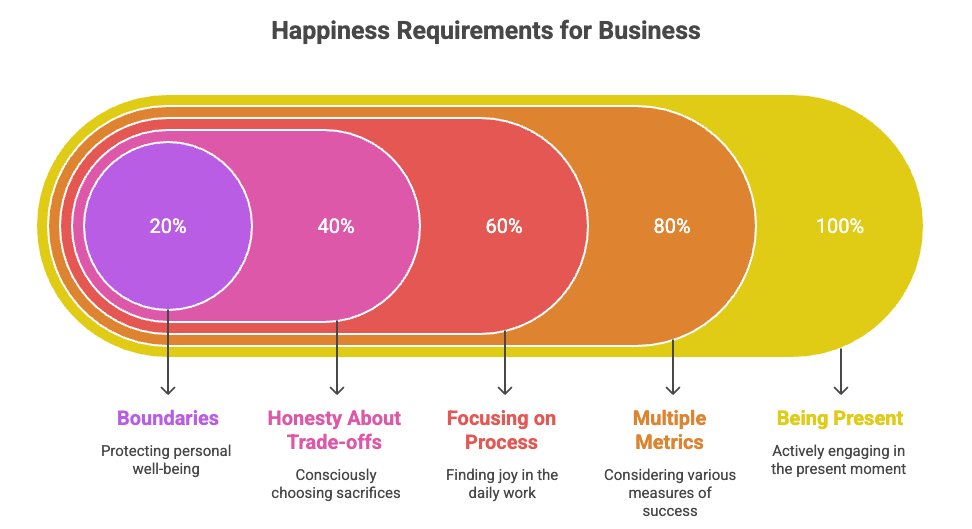
So what would it look like to actually factor happiness into the business equation?
I’m still figuring this out, honestly. At 73, facing cancer again, having just lost skiing, I’m trying to learn lessons I should have learned decades ago.
But here’s what I’m discovering:
It requires being present. Not constantly living in the future where everything will be better “when.” Actually being here, now, and asking: Is what I’m doing today meaningful? Am I enjoying this? Does this align with who I want to be?
It requires multiple metrics. Money matters. I’m not going to pretend it doesn’t. But it can’t be the only thing that matters. You need other measures: quality of relationships, health, personal growth, the impact you’re having, and whether you’re proud of what you’re building.
It requires focusing on process, not just outcomes. The temporary high of achieving a goal fades quickly. But if you can find joy in the actual work—in the daily process of building something—that’s where sustainable happiness lives.
It requires honesty about trade-offs. Building a business requires sacrifice. That’s real. But you get to choose what you’re willing to sacrifice and what you’re not. The problem is that most of us never consciously make that choice. We just default to sacrificing everything that isn’t directly tied to business growth.
It requires boundaries. If you’re giving 95% to business and 5% to everything else, something’s wrong. That’s not balance. That’s addiction. You need actual boundaries that protect the things that make life worth living.
Where I Am Now
I’m 73 years old. I’ve built businesses, made money, made moral choices that cost me financially, faced cancer twice, and I’m still trying to figure out what actually creates lasting satisfaction versus temporary dopamine hits.
Here’s what I know: the “just one more deal” approach never worked. It never made me happy. It just kept me on a treadmill, always chasing, never satisfied.
The euphoria from wins lasted a day or two, then faded completely. Meanwhile, I missed dinner conversations with my kids. I wasn’t present even when I was home. I optimized for outcomes instead of process, and I’m left with regrets about the person I was during those years.
Now I’m searching for new sources of happiness to replace skiing. I’m trying to be more present. I’m asking different questions about what makes life meaningful.
And I’m realizing that the answers I’m looking for now are the same answers I should have been seeking 40 years ago. I just couldn’t see it then because I was too busy chasing the next deal.
What About You?
So here’s what I’m curious about: Where are you on this journey?
Are you still in the “just one more deal” phase, convinced that the next achievement will finally bring satisfaction?
Or have you started asking different questions about what actually makes you happy versus what just gives you temporary wins?
Have you sat down for dinner with your family while your mind was entirely somewhere else? Are you still doing that?
And most importantly: What would it take for you to actually reset before walking in your door at home? To give the people you love more than the exhausted leftovers of your energy?
Because here’s what I’ve learned too late: it’s never too late to start asking better questions. It’s never too late to redefine success in terms that actually include happiness and meaning, not just money.
But it does require being honest with yourself about what you’re really chasing and why.
And that honesty? That’s where the real work begins.
I’m still doing that work. Still figuring it out. Still searching for what brings real happiness instead of just temporary highs.
Want to figure it out together? Let me know what you’re learning in the comments.

Facebook
LinkedIn
Youtube