
The Foxhole Didn't Make Us Friends
I've been the boss my whole career. I'm starting to think that's the problem.
I'm afraid every friend I have is really just a colleague, and I didn't realize it until now.
I read an online post by a woman describing her father. Late sixties, money fine, dissolving in front of her. He'd neglected his body until it adapted to the couch. He was on medication that quieted his anxiety and killed his desire for anything else. He was losing the fine motor control to work a remote or set up a streaming service. Nobody calls him anymore.
I sat with that a long time. Not because I'm afraid of his health. Because of the question underneath it. Have I spent forty years mistaking availability for friendship?
The question I can't outrun
Here's the thing about that daughter's post. She wasn't really writing about loneliness. She was writing about a slow leak nobody noticed until the tank was already empty.
That's what scares me. Not the empty apartment itself. The part where you don't clock it happening. Where you're busy, and connected, and fine, right up until you're not.
So I went looking. Not for comfort. For the actual mechanism. What makes a friendship survive the thing that started it? What makes it just evaporate the moment that thing is gone?
I didn't expect to find an answer in my own history. I found one anyway, and I didn't love it.
I was never in the room where it happens
I should tell you something about myself first, because it changes everything else I'm about to say.
I've been the boss almost my entire working life. And the boss isn't where friendships get made.
I worked at Northwestern Mutual for about a year and a half, early on, right after I sold my foodservice business. I made acquaintances there. Not one friendship. Every business I've run since put me on the other side of a line I didn't draw on purpose.
Nobody wants to hang out with the boss after hours. I understand that completely. I wouldn't have either.
I remember the exact feeling at Northwestern Mutual. Pleasant enough people. Good conversations in the hallway. Not one of them called me on a Saturday, and I never expected them to. That was the deal, and I accepted it without ever naming it.
I've watched it from the other side since, too. My own employees would head out after a shift, and I'd catch the tail end of it walking to my car. Nobody ever said don't come. Nobody had to.
I've wondered, writing this, what it cost the people who worked for me. Not the paycheck. The other thing.
The old me wouldn't have wondered. The old me would have said, "That's the job, and if you wanted a friend, you were in the wrong building."
I've watched it from the other side since, too.
What eighty strangers said, without knowing each other
I went and read through comment threads. Dozens of people, on different forums, years apart, describing the same realization in almost identical language.
"I think the overwhelming consensus is people realize their work 'friends' are not really friends, but are acquaintances."
"I don't have work friends. I have some friends I work with. That is a big difference."
"It was hard realizing that most of the friendships I made through work were actually acquaintances. The thing we had in common was work, and there's no overlap."
One more, from a man twenty years into retirement in a town of two hundred people: "No one asked. Now twenty years later, still no one asks." Not bitter. Just reporting it, the way you'd report the weather.
Nobody sounded devastated writing this. That's what got me. They sounded like people reading an old receipt, a little surprised at the total, but not shocked. Matter-of-fact. A little late.
It arrives after the fact. Once there's nothing left to do about it.
The thing nobody puts on the list
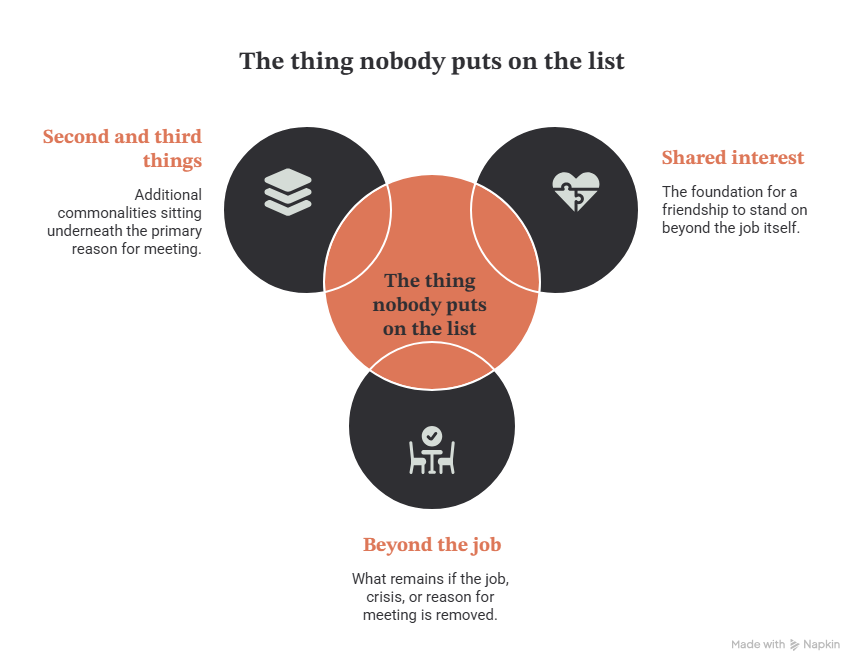
Here's where I think we've been asking the wrong question. Not "did you get a drink with them after work?" Whether you ever shared an actual interest.
Friends have several. Acquaintances have one, and it's usually the job itself. Take the job away, and there's nothing left for the friendship to stand on.
That's a different test than "did you socialize outside work?" You can go to lunch with someone for a decade and still have nothing in common except the building you both showed up to. The socializing was never the thing. The interest was the thing. The socializing just happened to be where you found each other.
I didn't have language for this before I went looking. Now I can't stop noticing it.
It changes the question I ask myself about a relationship. Not "do we get along?" Whether there's a second thing, and a third, sitting underneath the first one. What would we talk about if the job, or the crisis, or the reason we met, got taken off the table tonight?
For a lot of people in my life, I'm not sure I know the answer.
The foxhole
I want to tell you about the worst professional year of my life, because it's the cleanest example I've got.
My food service company had a salmonella outbreak. Real people got sick. Legal exposure, operational chaos, an insurance fight that dragged on for months. I had a general manager who worked very closely with me, and we were in it together, every single day, for what felt like forever.
We took calls at midnight. We sat across the same table from lawyers, from insurers, from customers who had every right to be furious with us. We were, in the most literal sense, in the same foxhole, taking the same fire.
The old me had a line for that year: "It's done. What's next?" No debrief. No looking back. Just the next fire.
I could tell you exactly what his coffee order was that year. I couldn't tell you a single thing he cared about outside that building.
People say a crisis like that forges a bond that lasts. I want to tell you it did. It didn't.
He and I had almost nothing else in common. We were about as different as two people can be. Once the crisis passed, there was nothing left to run the friendship on. We'd survived something together. We hadn't actually shared anything.
I think about that more than I expected to. Two men in the exact same foxhole, and only one of us needed to ask what happens after the war ends.
Two people bonded over the same enemy
That's the part the shared-trauma story leaves out.
When you're both furious at the same terrible boss, or scared of the same disaster, you feel unbelievably close. That closeness is real. I'm not saying it's fake. I'm saying look closely at what it's actually made of.
You're bonded over him. Or over it. Not over each other.
Take the enemy away, and sometimes there's nothing left to talk about. The conversation was never really between the two of you. It was both of you, facing the same direction, at something else.
That's my general manager, exactly. Take away the lawyers and the outbreak, and we'd have sat in a room with nothing to say to each other. We never once tested it, because the crisis never stopped long enough to find out.
I've watched this happen to my daughter, and I'll get to that.
What's still unresolved, right now
I don't want to make this sound like I've got it solved, because I don't. Some of it is happening to me while I write this sentence.
I'm still involved with an organization called the Sudden Money Institute. There are two or three people there who are, right now, somewhere between acquaintance and friend. We've started having more calls, more Zoom conversations, just to talk about things we're both genuinely interested in.
Six months ago those calls were entirely business. Now one of them ends most weeks with us still talking after the actual agenda's done.
I don't know if those become real friendships. I'm hoping they do. I genuinely don't know yet, and I'm trying to sit with not knowing instead of rushing to decide.
What I notice is the shift in what we talk about. It used to be entirely business. Now it drifts. That drift might be the whole tell, and I only recognized it because I went looking for it.
The coffee I keep asking for
There's a man in my life right now I can't file into either box.
I invite him out for coffee fairly often. Sometimes he says yes. Sometimes he doesn't answer at all. We have real shared interests, the kind I'm describing in this piece — enough that when we do sit down, the conversation never once drags.
I've noticed myself checking after I send the text to see if I feel hurt if he doesn't answer. Some days I do. Some days I genuinely don't. I think that's telling me something I haven't fully read yet.
Here's what I've decided about that. Not knowing is honest. I could manufacture an ending here where it resolves into something warm. It hasn't. I'd rather tell you the truth than tell you a better story.
What I noticed and never asked about
My daughter had a group of friends from a genuinely toxic workplace. For a while, they came to her kids' birthday parties. Real presence. Real affection, as far as I could see.
As the years went by, I noticed fewer of them showing up. First one, then another, then a couple more, the way people quietly stop replying to a group thread. She's still friends with some, I think. Occasionally. I don't know how much they actually have in common beyond having survived that place together.
Here's the part that bothers me. I noticed this pattern from a distance over the years and never once brought it up in an actual conversation with her. I collected the data and never asked the question.
I've noticed something in other people's stories about a parent fading. It's never "I wish I'd visited more." It's "I wish I'd asked, while someone was still there to answer."
That's exactly what I did with my own daughter, just from the other chair. I watched a pattern in her life for years. I never once asked her what it felt like from the inside.
I keep thinking about that daughter on the forum, watching her father go quiet one habit at a time. I wonder how much of what she saw she never asked him about either, until there was nobody left to answer.
Suzanne doesn't ride a bike
I want to complicate my own theory before I let it sit too comfortably, because it doesn't fully hold up.
Suzanne is my wife, and she is without question my best friend. We don't share activities. I don’t garden. I don't build the things she builds, and I haven't the faintest interest in trying. She can't ride a bike with me anymore, and most of what fills her days doesn't touch what fills mine.
What we share is almost entirely conversation. Ideas. Psychology. The daily unpacking of whatever's on either of our minds. It's an intellectual friendship, and it runs on almost no shared activity at all.
I've tried to imagine us without that conversation — same house, same schedule, no real talking — and it doesn't hold together at all. Whatever we have, it's not proximity. It's the thing we build together at the table every night.
So the shared interest doesn't have to be a hobby. It just has to be something you both actually want to sit and talk about, out loud, on purpose.
The two meals that matter
I'm alone a lot, and for the most part, I'm genuinely fine with that. I don't think solitude is the thing I'm actually afraid of.
What I don't like is coffee by myself in the morning. Or dinner by myself at night. Almost every single night, unless Suzanne has somewhere to be, we eat together. That's when we really catch up with each other.
That's the part I'd miss if it disappeared. Not aloneness in general. Those two specific times together, and the person sitting across the table from them.
I notice I don't feel that ache with anyone else in my life. Not the coffee version, not the dinner version. That might be the actual difference between a friend and everyone else I know.
Maybe that's the real test, underneath the shared-interest test. Not whether you have people. Whether you have the two meals.
Going back to the apartment
I started this piece with a stranger's father, alone in an untidy apartment, medicated past the point of wanting anything.
I don't think I'm afraid of ending up exactly there. I think I'm afraid of something smaller and more likely. Of coasting on acquaintances I've mislabeled as friends, for years, without the leak ever announcing itself.
Nobody circles a date on the calendar for that one. It just accumulates, the way his did, until a daughter is describing it to strangers online.
I still don't have a good definition
I'd like to draw a clear line between friend and acquaintance. I don't have one, and I've decided not to fake it.
I know the shared-interest test gets me closer than "did you get a drink after work?" I know intensity isn't the same as depth. The foxhole taught me that directly, and it cost me nothing to learn except a friendship I thought I'd had.
But where the actual line sits, between someone I'm friendly with and someone who's actually my friend, I honestly can't draw it for you.
Maybe I'm not supposed to yet.
Where I'd like your help
Have you ever gone looking for a friendship you assumed was solid, only to find an acquaintance standing there instead?
Or the reverse — has something survived that, by every rule I've just laid out, it shouldn't have?
Tell me in the comments. I'm genuinely collecting these, not just being polite about asking.
Hey, this is Josh. You're on the Long Strange Trip. I'm glad you're here.


Facebook
LinkedIn
Youtube