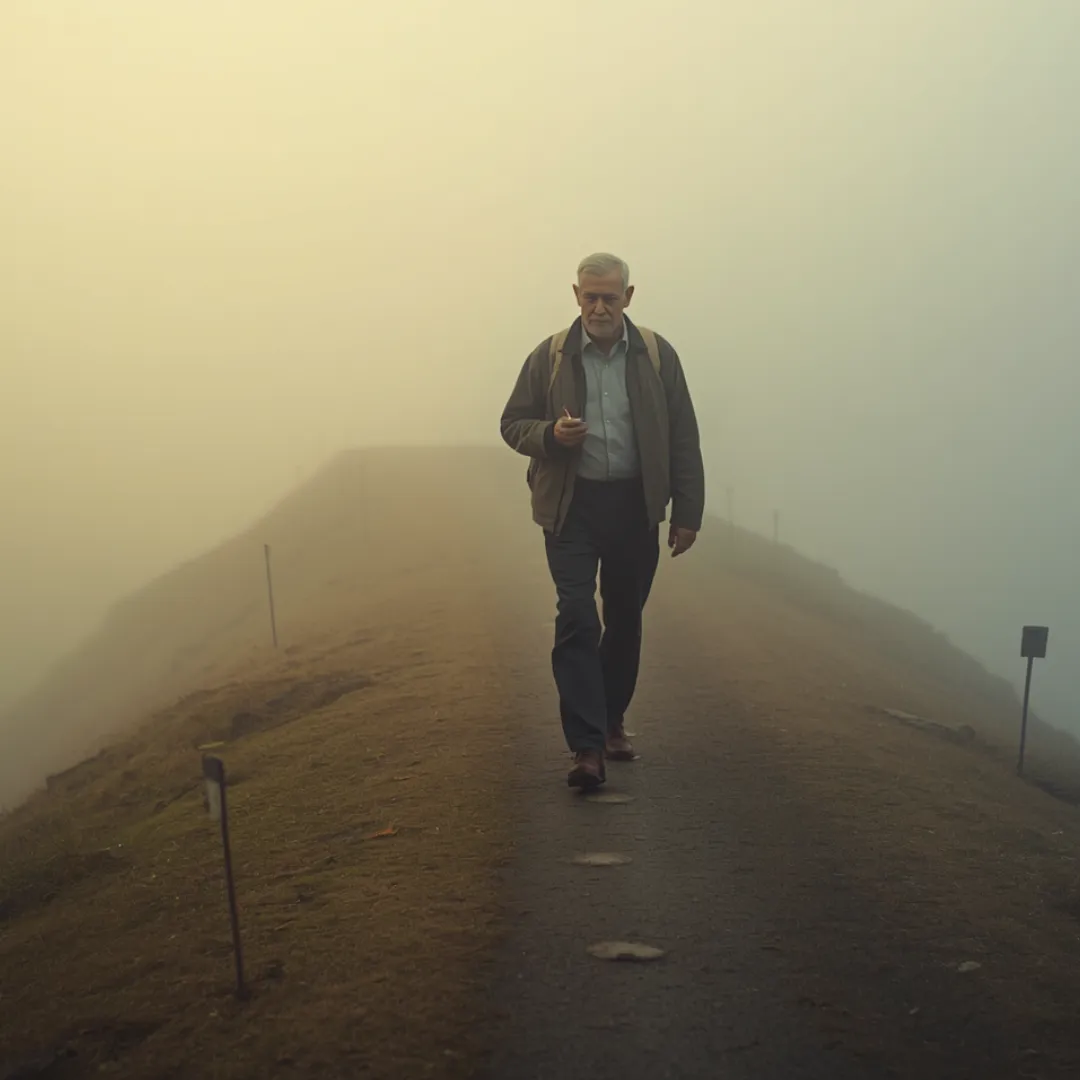
The Fog Is The Point
The anthropologist Victor Turner spent his career arguing the fog isn't the detour. It's where everything actually happens. It took me seventy-some years, two cancers, and one very bad restaurant to believe him.
Let me start with a confession. For most of my life, I couldn’t see the fog at all.
I don’t mean I saw it and pushed through anyway. I mean it was invisible to me. I’d gotten so good at not seeing it that it disappeared. I didn’t even know there was such a thing.
That’s most of a lifetime with a blind spot the size of a truck. And I’m only naming it now, this late in the game.
Here’s what I mean by the fog. It’s that disorienting in-between when a change is happening. The old life is gone. The new one hasn’t shown up yet. You feel stuck, foggy, unsure what to do next.
The anthropologist Victor Turner had a word for it. He called it the liminal. And he spent his whole career arguing something strange.
The fog isn’t the detour, he said. It isn’t the delay between the real parts. The fog is where the real part happens.
I’ll be honest with you. I’m not sure I believe him yet. But every time I’ve tried to rush out of the fog, I’ve regretted it. So maybe he’s onto something I spent decades missing.
The man who couldn’t see it
Let me tell you how blind I really was.
My whole life, I believed action beat reflection. Every single time. A problem showed up, and I solved it. Fast. No pausing.
I thought I could power through anything. And mostly, I did. I just bulldozed straight ahead and called it strength.
There’s a cost to living that way. You don’t feel the fog trying to slow you down. You can’t feel a warning you don’t believe exists.
The restaurant I never should have opened
Let me give you the clearest example I’ve got. Years ago I ran a food service business. We did catering, and catering dies in the winter.
So one summer I had a problem. What do I do with my staff in the slow months? And I did what I always did. I attacked it.
I opened a restaurant called Maggi’s. It was a huge mistake. One of the worst calls I ever made.
Here’s the part that matters. There was no rush. It was early summer. We had three good months of catering work ahead of us.
The fog was right there, trying to slow me down. Trying to make me ask a wiser question. But I couldn’t see it, so I gunned the engine.
Had I let the fog do its job, I’d have seen the truth. This was a gut decision dressed up as a smart one. The fog would have caught it. I didn’t give it the chance.
The Sunday I bused my own family’s table
Let me tell you about one Sunday at Maggi’s. It should have been a wonderful day.
I brought the whole family out for brunch. My mother. My father. My wife. Everyone at one table.
But we were short-staffed that morning. So instead of sitting down with them, I bused tables. I turned into a sweaty mess while my family ate.
The food was good. The service was good. But Josh was running plates instead of being a son and a husband.
My family laughed about it for years. It became a little legend. For me, it was pure embarrassment.
Because it wasn’t a one-off. It was the whole pattern of my life. Work came first. Family came second. Every time.
And here’s the fog piece. I should have been in the fog and wasn’t. I just powered myself through. That’s all there was to it.
I did this several times in my life. Not just Maggi’s. Fast decision after fast decision, each one landing somewhere.
Here’s what a man like me is slow to admit. Those fast decisions don’t just land on you. They land on everybody near you.
When you bulldoze, other people are standing in the path. Family. Partners. The folks who trusted your judgment. They live inside the mess you made in a hurry.
The fog would have protected them too. Not just me. Slowing down isn’t only kind to yourself. It’s kind to everyone downstream of your next move.
The other way to get it wrong
Now, you might think the answer is simple. Just sit in the fog. Wait it out.
I wish it were that easy. Because I’ve watched people fail the other direction.
Back in my early thirties, I knew a lot of folks chasing New Age seminars. They’d go to a weekend workshop and come out changed. Or so they thought.
What actually happened was different. They walked into the fog and never walked out. They got stuck there. Permanently.
They called it “waiting for clarity.” That was the phrase. Waiting for the answer to arrive so they could finally move.
But the answer never came. It never does, when you’re waiting like that. They had real problems in their lives, and the fog became a place to hide.
The fine line
So here’s the trap, and it’s a real one. On the surface, those folks looked reflective. They looked like they were doing the deep work.
They weren’t. They were avoiding their lives with a spiritual excuse.
There’s a fine line here. A razor-thin one. On one side is reflection. On the other is being stuck. And they look almost identical from the outside.
You usually can’t tell from the outside. Both people look quiet. Both look like they’re thinking. The difference lives underneath, where only they can see it.
But there’s a question you can ask yourself. Am I moving, even a little? Or am I demanding the fog hand me an answer first? That question tends to give you an honest read.
What I did that they didn’t
For a long time, I couldn’t have answered that question. Now I think I can. And the answer came from my own trip through the fog.
Let me set the scene. I’d retired. I was wandering around in the wilderness. I was deep in the messy middle, and I knew it.
I respected that fog. Maybe for the first time in my life. I didn’t have a name for it yet, but I sensed I needed to slow down.
Here’s the difference between the New Age crowd and me. I didn’t do nothing. That’s the whole thing right there.
I ran small experiments. Not big swings. Small ones. That’s the trick I’d missed my entire life.
When you’re in the fog, the move isn’t a grand plan. And it isn’t sitting frozen either. It’s a small test. A little swing to see what happens.
The small swings that became a life
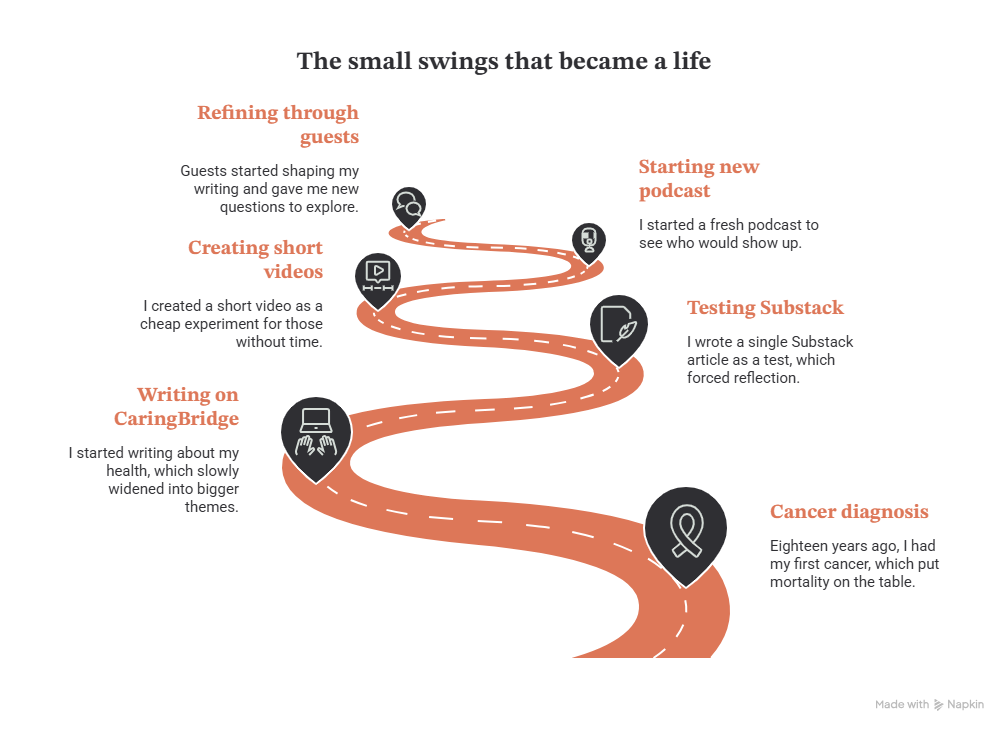
So here’s what my small swings actually looked like. It started with my health.
Eighteen years ago, I had my first cancer. And I’ll tell you the truth about what came before it.
I never thought about mortality. Not once, not seriously. Work crowded everything else out of the room.
Then cancer showed up and put mortality on the table. I couldn’t look away anymore. And since then, I’ve thought about it so much it’s become a friend.
That’s a strange thing to say. But it’s true. Death and I are well acquainted now.
So I started writing. On CaringBridge, of all places. At first I just wrote about my health, plain and simple.
Then something happened. The writing slowly widened. Little by little, it grew into bigger themes. The same themes I chase now on The Long Strange Trip.
That was experiment one. And it worked, so I took another small swing.
I wrote a single Substack article. Just one. Not a grand launch. A test, to see what happened.
Two things came out of it. First, I enjoyed writing it. Second, it gave me something I didn’t expect. It made me reflect.
That’s what writing does for me. It forces reflection. It’s exactly what I’m doing right now, with you.
Then I took the next small step. I noticed my articles ran long. Long on purpose, mind you. It’s long form, and I like it that way.
But some folks don’t have the time. So I thought, why not a short video? Another small swing. Another cheap experiment.
Then I looked at my old podcast. I’d mothballed it. It used to be about business, making more money, working less.
None of that had anything to do with The Long Strange Trip. So I started fresh. A new podcast, just to see who’d show up.
And here’s the beautiful part. The guests started shaping my writing. Their conversations gave me new questions. New things worth exploring in long form.
You see the pattern now. Every one of those was a small experiment. CaringBridge, one article, one video, one podcast. None of them a big bet.
That’s the tell. That’s how you know you’re reflecting and not stuck. Are you running small experiments? Or are you just waiting?
The New Age folks waited. I experimented. Same fog, opposite outcomes.
Reflection makes the action freer
Here’s something I’ve only understood at my age. It flips everything I used to believe.
I thought action was more important than reflection. Now I think it’s the reverse. Reflection comes first, and it makes action easier.
Let me say that more plainly. When you reflect first, the action comes out cleaner. Freer. Less forced.
The whole Long Strange Trip proves it to me. I didn’t force that project into being. I reflected my way toward it, one small swing at a time.
Every article makes me reflect before I act. Reflection isn’t what slows me down. It’s the thing that makes my next move lighter.
Compare that to Maggi’s. No reflection. Just force. A straight line of effort aimed at the wrong target.
The fog was offering me reflection back then. I turned it down. And I paid for it.
So I’ve changed my mind about what strength looks like. It isn’t bulldozing. It’s slowing down enough to think.
And notice what reflection buys you later. When the real decision comes, you’re not starting cold. You’ve already walked a few of the roads in your head.
That’s why the action feels free. You’re not forcing a choice under pressure. You’re stepping into one you’ve already thought through. The fog did that work for you, quietly, while you waited.
What finally let me see it
You might be wondering how a man goes blind for seventy years and then suddenly sees.
I’ve wondered that too. It didn’t happen by accident. Something had to crack the pattern open.
I think it was a few things stacked together. Retirement stripped away all the problems I used to solve. Cancer put mortality right in my face. And age did the quiet rest.
When you retire, the fires go out. There’s nothing left to bulldoze. For a bulldozer, that’s disorienting.
That’s when I finally noticed the fog. Not because I got wise overnight. Because the noise stopped, and there it was.
I even gave it a name recently. That area where you feel stuck but you’re really not. Where you’re reflecting, not avoiding. Naming it helped me respect it.
The fog I’m walking into next
Now let me get to the honest part. The part that’s still unfinished.
I told you about two cancers. Right now, both are behaving. Both are under control, and I’m grateful.
So at the moment, there’s no fog. Life is pretty clear. I don’t have much to reflect on, health-wise.
But I know that can change. If either cancer turns, I’ll be right back in it. Deep in the fog. In passage again.
And here’s where it gets interesting. I’ve already made some preliminary decisions. I’ve thought hard about what I’d do if my health slides.
Now, you could ask me a fair question. Isn’t that just Maggi’s again? Solving the problem before the fog can slow me down?
I’ve sat with that, and I don’t think it is. Here’s why. I know those preliminary decisions might not hold.
When reality hits, everything shifts. The plans I make today may not survive the real thing. I’ve lived long enough to know that.
So I’m not locking in an answer. I’m just doing early reflection. When the fog actually comes, I’ll reflect again, inside it.
And there’s one more difference. A big one. It’s the thing I’m proudest of changing.
In the past, I made these decisions alone. Just me, deciding what I wanted, full stop. I didn’t factor in the people I love.
I don’t want to do that anymore. When the health fog comes, I’ll ask a fuller question. What do I want, and why, and how does it land on the people around me?
That’s the real growth. Not just seeing the fog. Learning to sit in it with other people in mind.
So here’s what I’ve come to
I used to think the fog was a problem. A delay to power through as fast as possible.
I don’t think that anymore. I think the fog might be a good thing. Something we should maybe even celebrate.
The fog keeps you from going fast and breaking things. It stops you from making gut decisions you’ll regret. Maggi’s happened because I had no fog. Or because I refused to see the one I had.
But don’t mistake me. You still have to handle the fog. You can’t just sit in it forever.
You have to make small decisions and keep moving. Otherwise you become stuck, like the New Age crowd. And being stuck is the one thing I can’t stand.
So the trick is holding both. Respect the fog enough to slow down. But run small experiments so you don’t rot in it.
That’s the fine line. Reflect, but don’t hide. Slow down, but don’t stop. Small swings, not big ones, and not none.
Let me leave you where I always seem to land. With a question, and an honest one.
The last time your life got foggy, what did you do? Did you gun the engine like I did at Maggi’s? Did you crawl in and wait forever, like my old friends? Or did you take a few small swings and feel your way through?
I don’t have this fully figured out. I’m still in it, learning as I go. But I’ve stopped fighting the fog. And for the first time, that feels like wisdom instead of weakness.
The next fog is coming. It always is. This time, I plan to let it do its work.

Facebook
LinkedIn
Youtube