
The Empty Page
Freedom without a reason to get up isn't a reward. It's a second job you have to invent.
Nobody warns you that the invention is the whole assignment.
I've been learning this one for two years now. Slowly. In pieces. The way you learn most things that actually matter.
The Blank Page
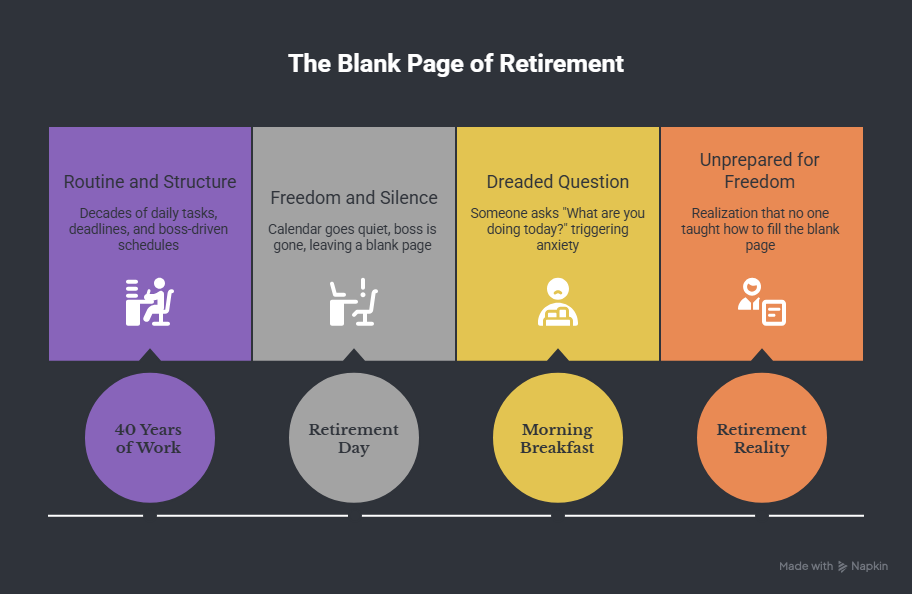
Here's the thing about a blank page. It doesn't scare you because it's empty.
It scares you because nothing is stopping you. No boss. No deadline. No excuse ready to hand. Just you, a cursor, and the blinking.
I've sat down to write plenty of mornings with nothing in my head. Coffee goes cold. The page stays white. Eventually something moves, but it never moves because I forced it.
Retirement is the same page. Different pen, same blinking cursor.
There's a question I've come to dread more than any other. Someone asks what I'm doing today, over breakfast, perfectly innocent. My stomach still tightens a little, most mornings, before I answer.
Forty years, most of us get asked a version of that question by a boss, a client, a calendar. Then one day the calendar goes quiet, and the person across the table asks the question instead. Nobody warns you how much weight it picks up in the silence.
You spend those forty years waiting for someone to hand you the freedom to write your own days. Then one day they hand it to you, and you realize nobody ever taught you what to write.
A Man I Never Met
I heard about a truck driver once. Secondhand, through a friend who'd interviewed him for a podcast.
He'd just retired. Financially, he was fine. He put his head in his hands anyway and said one thing. "Don't ever retire."
It wasn't the money. For forty years, someone else had filled his page for him. A route. A schedule. A load to deliver, every single day, without fail, whether he felt like it or not.
Then the pages stopped coming. Nobody had ever taught him how to fill his own, and it turns out nobody had taught the rest of us either.
I don't know this man. I only have the story secondhand, which means I should hold it loosely. But I believed it the moment I heard it, because I recognized the shape of it immediately. I've heard some version of it from enough other people since that I no longer think of it as his story alone.
CaringBridge, Then One More Thing
I didn't retire so much as get dragged toward the page by cancer.
Years ago, before the current fight, mortality landed on my desk uninvited. I'd spent decades running a food service company, then a wealth management practice, solving problems as soon as they showed up. Cancer doesn't solve like that. It just sits there, patiently, waiting for you to look at it.
I started writing about it anyway. Not for an audience. Just to get it out of my head and onto something outside myself, where I could look at it without it looking back at me quite so hard.
That was CaringBridge. One small swing, nothing more ambitious than that.
I wasn't trying to build anything. I was trying to get through a Tuesday. That turned out to matter later, though I couldn't have told you why at the time.
It worked, so I took another one. I wrote a single Substack article. Just one, to see what would happen if I did.
What Small Actually Means
I liked writing it. So I wrote another.
Then I noticed my articles ran long, and some people don't have the time for long articles. So I tried a short video. Another small swing, another cheap experiment.
Then I dusted off an old podcast I'd mothballed years before and pointed it at something entirely different from what it used to be about.
Somewhere in there, the guests started shaping the writing more than I shaped the show. Someone would say one true thing, almost in passing, and I'd spend the next week turning it over. I didn't plan for that either. Nobody plans for the thing that actually works.
Two years. Four small swings, each one leaning on the one before it. Nobody handed me a blueprint for any of this. I built the page one sentence at a time, the way you write anything you don't yet know how to write.
I'm on the other side of that stretch now. Most days I'm busy sixty, maybe seventy percent of the time. The rest goes to reading, music, sitting still and doing nothing useful at all.
I'm not run ragged. I'm also nowhere near as busy as I was when I ran a business fifty-sixty hours a week. That balance took two years to find. It did not arrive with a retirement party, and nobody should expect it to arrive with theirs either.
The Man Who Wants to Be Pushed
I read a post recently from a man who's already hit his number. Twice over, in fact.
He wrote that he finds himself hoping he gets laid off. So the decision gets made for him, instead of by him.
Another commenter on the same thread said something I keep turning over since. Most people in his position aren't retiring to anything. They're retiring from something, with nothing lined up to take its place.
I read the original post a few times, and something underneath it kept nagging at me. He hasn't sat down and faced his own page yet, is my guess. He wants someone to hand him one, already filled in, the way his job has for thirty years running. Nobody will do that for him. Nobody ever does.
He has the money to walk away tomorrow. Money was never the actual obstacle. It rarely is, once you look closely enough at these stories.
What Self-Reflection Would Have Cost Him
That's not indecision. Indecision looks different from the outside.
This looks more like hoping the world forces his hand, so he never has to ask himself the harder question. What do I actually want written here, once nobody's making me write anything at all?
Not laziness. Fear, wearing a reasonable disguise, the kind that fools the man wearing it too.
I recognize the disguise because I used to wear it myself, in a different costume. For most of my life, a problem showed up, and I solved it immediately, without asking why or whether. It's done. What's next? That's brute force, not resilience, and it works right up until the day there's no problem left to solve and no next in sight.
Brute force doesn't know what to do with an empty page. There's nothing to fix on it. It just sits there, waiting for you to write something you actually mean.
What You Never Find Out
Here's the part I didn't expect when I started this two years ago.
If you never stop long enough to face the page, you never find out things about yourself that were always there, waiting. Not because you're shallow. Because you never had the silence required to notice them.
What would I not have found out about myself if I'd kept the business running another decade? I genuinely don't know. That's the unsettling part. Some questions don't resolve. You just stop expecting them to.
I think this might be the real cost of staying busy forever. Not burnout. Not the vacations you never took. A version of yourself you simply never got introduced to, who was there the whole time, waiting for the noise to stop.
Nobody puts that on the pro-and-con list when they're deciding whether to keep working. I don't think anyone can, until they're already standing in the quiet, wondering who exactly just showed up.
The Mirror in My Son's Mouth
Small example. A recent one, which is exactly why it still stings.
I speak in absolutes. Have for years. "This is how it is," delivered flat, like fact instead of one man's opinion.
A few months ago I heard my son do the exact same thing. My stomach dropped a little. I thought, my God, I've been doing this for decades, and it sounds arrogant coming out of somebody else's mouth.
I didn't know that about myself until I sat down to write about it. The writing found it. I was too busy being right to notice how I sounded while I was right.
These days I'm trying to catch it in real time. Someone's still talking, and I feel the absolute forming before I've even heard them out. I'm not good at catching it yet. I'm better than I was two years ago, which is the only kind of progress I trust anymore.
My Mother Died the Year After She Retired
I found a man online, a stranger, laying out his entire financial picture to ask an internet forum for permission to retire.
He had somewhere north of four million dollars. He still needed strangers to tell him it was allowed.
Buried in his numbers was the real reason, and it wasn't a number at all. His mother died the year after she retired. His father had a stroke at fifty-seven and spent a decade in a nursing home before he finally passed.
He wasn't really asking about money. He was asking whether he'd earned the right to stop before his own clock ran out too. One reply told him, flatly: you could have retired years ago.
I understand that fear better than I'd like to. Two cancers will do that to a man. Some mornings the breakfast question and the mortality question show up together, and I honestly can't tell which one is doing the talking.
Here's what I keep coming back to, though. Using your parents' deaths as a permission slip still means someone else is filling in your page for you. Even a good reason to finally write something isn't the same thing as writing it. At some point the permission slip runs out, and you're back at the blank page anyway, clock or no clock.
One More Year, Ten Times Over
I've seen this pattern show up in the comments more than once, and it's always the same shape.
One more year becomes three. Three becomes ten. We die with our boots on and call it prudence.
One man crossed his own finish line four years ago and decided he wasn't actually done. So he moved the number higher. Then, predictably, he kept moving it again after that, and again after that.
Another story stuck with me more than the spreadsheets did. A hiking friend of someone I read about wanted one more year of work so he could finally afford his dream truck. He retired on schedule anyway, truck or no truck. Years later, he's still driving the old one. The thing he was working for never actually got bought.
If you're the senior partner at a law firm, or the doctor half your patients still ask for by name, this gets more complicated. Leaving early can look like abandonment to the people you're leaving. That's a different weight than fear, and it deserves its own conversation. It's not the one we're having today.
What strikes me about all of it, spreadsheets and trucks alike, is how rarely the extra year is really about the money. The math gets offered up because it's easier to defend than the truth. Nobody wants to write "I'm afraid of the empty page" on a public forum. "I need a bigger cushion" sounds so much more respectable.
Going Backward on Purpose
Some people solve the fog by going back to work. I understand the pull completely.
But going back isn't the cure it looks like from the outside. Susan Bradley has spent her career sitting with people mid-transition, and she talks about four stages the way you'd talk about weather you'd lived through — anticipation, an ending, the fog, and eventually a new normal. Go back to work, and you haven't skipped the hard part. You've stepped backward, out of the fog, into anticipation again, waiting on some future ending to show up.
That's not failure, for what it's worth. Transitions rarely move in a straight line anyway. One step forward, two steps back, three steps forward again. For some people, moving through that slowly is the only way they can move through it at all.
Still worth naming plainly, though. Going back to work isn't crossing the threshold. It's postponing it, one more year at a time, with better company than you had the first time around.
I don't say any of this to talk anyone out of going back. Some people need the runway a second time, and that's fair. Just don't file it under solved. File it under postponed. That's the whole point of standing here writing this at all.
The Page Doesn't Fill Itself
I still don't have a five-step plan for any of this. I don't think one exists, and I'd be suspicious of anyone selling you one.
What I have instead is two years, four small swings, and a version of myself I only met because I finally sat down and looked.
The page is still blank most mornings, if I'm honest about it. The breakfast question still lands a little heavy sometimes. I've just gotten less afraid of that particular kind of blank than I used to be.
It's a long, strange trip from a truck driver's kitchen table to a hiking friend's old truck to my own kitchen table, but somehow it's all the same page. I didn't expect that when I started writing this.
What's on your page right now? I'd genuinely like to know. Tell me in the comments.
Hey, this is Josh. You're on the Long Strange Trip. I'm glad you're here.

Facebook
LinkedIn
Youtube