
The Door Marked Responsible
Why the path that shrinks your life almost never looks like the one that does
Most of the worst decisions of my life arrived dressed as the responsible thing to do.
That’s the part nobody warns you about. You expect the bad choices to show up with a warning label — the obvious vice, the reckless bet. They don’t. They come wearing a tie, with a plan and a spreadsheet and a perfectly good reason why this time is different.
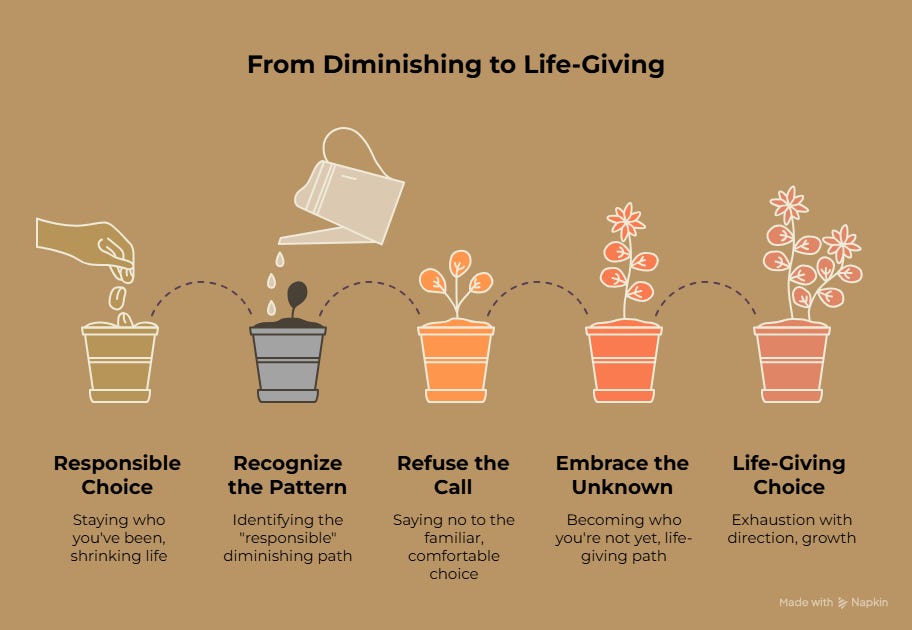
I’ve been reading Ben Katt’s The Way Home, built on the old hero’s-journey bones, and he draws one line I can’t put down. Some paths give you life. Some take it. And the same fork can hold both — two doors, side by side, pointing opposite ways. From where you’re standing, they look nearly identical. One asks you to stay who you’ve already been. The other asks you to become who you’re not yet. And the door that shrinks you a little more every month almost always wears the costume marked responsible.
Let me tell you how I learned that. It cost me a restaurant.
The Most Responsible Mistake I Ever Made
I had a catering crew and a Vermont winter bearing down on me. Catering dries up when the snow comes. I had good people I didn’t want to lose, a problem to solve, and a lifetime of training that said you solve problems by building more operations.
So I opened a restaurant. A place to park the crew for the winter. Keep them busy, keep them paid, have everybody ready when spring rolls around.
Read that again. A place to park the crew. That is about the most responsible-sounding thing a business owner can say out loud. Taking care of my people. Thinking ahead. Being the guy with the plan.
What I did not do — and this is the part that still makes me wince — was ten minutes of arithmetic. Covers, ticket average, food cost, rent, and labor. I could have run it on a napkin while the coffee dripped, and known before I signed a thing that the place couldn’t carry its own weight. The numbers weren’t hiding. They were sitting in plain sight, waiting for anybody willing to write them down.
I didn’t write them down. I was too busy being responsible.
So we opened, and for a stretch, it was fun and games. Then reality showed up the way it always does. Quietly. Then all at once. We bled cash. Every month. I’d sit with the books after close, watch the same story write itself, and the next morning go back in and work harder. Work harder. Sell harder. Lean on the crew. None of it touched the actual problem, because the actual problem was a number I’d refused to write on a napkin a year before.
Let me do the math now, the way I wouldn’t then. Fifty thousand dollars. That’s what the restaurant lost in a single year — to keep my catering crew busy through one Vermont winter. And here’s the number underneath the number. The whole point was to hold on to those people. The next year, we had to lay some of them off anyway. I spent fifty grand and a year of midnights to avoid the exact outcome I got regardless. The responsible plan didn’t even buy me the thing it was supposedly responsible for.
Here’s the cruel part. Keeping that place breathing felt virtuous. In at six, out at midnight, refusing to quit on my people — that’s the stuff we hand ourselves medals for. It looked like grit. It looked like loyalty. It was me refusing to look at something I already half-knew, dressed up in a chef’s coat.
That’s the diminishing path in its natural habitat. It rarely feels like giving up. It almost always feels like holding on. The thing that’s killing you and the thing you’re proudest of are, more often than we’d like, the very same thing.
The Refusal of the Call
Katt’s frame finally let me see what I’d been doing. In the old story, the first thing that happens is a call to adventure — something inviting you out of the world you know into one you don’t. And the very next thing, every time, in every telling, is the refusal of the call. The hero says no. Too risky. Bad timing. I’ve got responsibilities. Let me handle this other thing first, and then, maybe.
The refusal isn’t the villain’s move. It’s the most human one there is. Almost everybody refuses the call before they answer it. That’s why the myths built it right into the structure instead of treating it as a failure of nerve — saying no is the natural first reaction to being asked to become someone new.
Katt’s idea is that midlife itself is a call. The structures you built in the first half — the title, the company, the identity you wore like a good suit — start asking to be set down so something truer can grow in their place. It rarely arrives as a thunderclap. It arrives as restlessness. A Sunday-night dread. A sense that the thing that used to fit has started to chafe.
My restaurant was a refusal of the call. The call asked me to step out of the operation and into a different kind of life. I answered by building more of exactly what I already was — the food-service guy who solves every problem with more food service. I walked straight through the door marked stay who you’ve been and told myself I was being prudent. Told my wife I was being prudent. I had a whole vocabulary built around the word.
Katt writes about a woman who comes home from a three-month sabbatical and finds she physically cannot walk back into the corporate life that had defined her for years. Same fork, from the other side. The door marked stay is right there — familiar, paying well, her badge still working, everybody expecting her Monday. And she can’t make her feet carry her through it. The distance let her see the door for what it was, and the responsible-looking choice stopped looking responsible. It just looked small. The people around her almost certainly called it a breakdown — she had everything and she’s throwing it away. It wasn’t. It was the call, refusing to be refused twice.
How to Tell the Doors Apart
Here’s the objection I can feel you building, because I built it too. Fine, Josh. The becoming thing is hard and scary and exhausting. The restaurant was hard and scary and exhausting. If both wear me out, how am I supposed to know which door is which?
Fair question. And tiredness is the wrong measuring stick, because it hands you the wrong answer.
Building The Long Strange Trip — the conversations, the podcast, sitting across from people closer to the end than they’d like to be — wears me out plenty. Cancer at 73 is exhausting in ways I don’t have polite words for. Life-giving has never once meant easy.
The difference isn’t difficulty. It’s direction.
The restaurant drained me toward nothing. A dead end I’d already done the math on, if only I’d had the nerve. Every hour I poured in vanished into a hole that was never going to fill, and some part of me knew it — which is exactly why the exhaustion tasted so sour. The new work drains me too. And it drains me toward something. Toward more of who I’m actually becoming. The tank runs dry either way. What matters is whether it’s emptying into a hole or onto a road.
Depletion versus direction. That’s the test that survives contact with a real Tuesday. Diminishing tired is heavy, resentful, faintly ashamed. Life-giving tired is clean — you’re wrung out, and you’d do it again tomorrow. So when you’re at the fork and both doors look hard, quit asking which one is easier. Ask which exhaustion is taking you somewhere.
You Don’t Pass This Test Once
I’d love to tell you I learned all this, crossed the threshold, and now I live on the life-giving side full time, sipping something cold and watching the sun go down on my hard-won wisdom. That is not how it goes.
The fork isn’t a final exam. It’s a turnstile you pass through again and again. I refused the call with the restaurant — and if I’m honest, for the better part of a decade after, in a dozen smaller ways. Then, eventually, I answered. I stopped being the owner of a business and became the steward of a project that genuinely gives me life. And inside that, there are smaller forks every week. I still pick the responsible-looking diminishing door more often than I’d care to admit. Old reflexes don’t retire just because you do.
The hardest one lately wasn’t in the business at all. It was skiing. My balance is gone — I can’t hold an edge anymore, and a sport I loved my whole life had quietly turned into a way to get badly hurt. The diminishing door there was the proud one. Keep going. Tough it out. Prove the body wrong, the way I’d toughed out everything else. That door had my name carved into it. And for once I didn’t walk through it. I said no to skiing instead of saying no to reality — not the same no, and it took me most of a lifetime to tell them apart. It is what it is. That’s not giving up on the hill. That’s refusing to let the hill be the thing that takes me out.
So I’m not writing this from the far side of having it figured out. I’m a fellow traveler who picked the shrinking door for years, finally picked the other one, and still has to pick again every Monday. The band keeps playing through the changes. You don’t get to stop showing up because you nailed one solo back in 1987. Not a conversion. A practice.
The Part That Took Me Fifteen Years
There’s a harder confession underneath all of this, and the fork is what finally forced me to look at it.
For the first fifteen years I ran my food company, I didn’t only choose the diminishing door for myself. I held it open for everyone who worked for me. When something went wrong, I called my employees the problem — idiots, screw-ups, people who just didn’t get it — when the problem, in damn near every case, I can now stand to look at, was me.
Here’s how it showed up. A customer would call with a complaint, and in the early years, my first question was never what can we learn from this. It was whose fault is this? I went looking for someone to blame before I went looking for what went wrong. People learn fast. What my crew learned was that a complaint meant somebody was about to get yelled at — so the smart move was to keep your head down and pray it wasn’t you. You can’t run a good restaurant on people praying they don’t get noticed. I was teaching fear and calling it standards.
Their door marked stay who you’ve been — I’m the one who nailed it shut. A person can’t grow into who they might become while spending all their energy managing the boss’s moods. I built a whole building full of people doing precisely that, then wondered why the place ran on fear instead of pride. It took me an embarrassing while to see it. No thunderclap morning — just a slow pile-up of evidence I couldn’t argue with. Good people leaving. The same conversations on repeat. The recognition that I was the common denominator in every story I kept complaining about.
And when I finally saw it, the work changed. Different questions started running the place. Not how do I squeeze more out of these people? Instead, what would it take for the people who work here to actually want to be here? Owners set the agenda — that’s the quiet power of the chair, and for fifteen years, I aimed it in exactly the wrong direction. That’s the move the old story is actually about, and the part we keep forgetting. The hero doesn’t cross the threshold to haul treasure home and live happily ever after on a beach. He comes back. The whole point of locating the life-giving door is turning around and holding it open for the people behind you — the exact opposite of what I’d spent fifteen years doing.
My daughter figured this out faster than I did, which is either a comfort or a quiet indictment of her father, probably both. For a while, she worked at a company that paid her well and treated her badly. Good money, and a place that didn’t value the person earning it. That’s a door marked responsible if there ever was one — the salary’s right there on the pay stub, who walks away from that. She did. She left for the company she’s at now, where she’s paid well and treated well. She didn’t trade money for meaning, the way the brave-leap stories frame it. She refused the premise that you have to pick. She walked through the door marked become who you’re not yet without needing to lose a restaurant first. I’m proud of her. And a little jealous of how early she learned the thing it took me decades and a failed dining room to get.
So Here’s What I’m Sitting With
The diminishing path almost never announces itself. It doesn’t look like the obvious wrong turn — the one with flashing lights and a cliff at the end. It looks like the responsible choice. The prudent one. The mature one. The one that takes care of everybody and keeps the lights on and doesn’t spook the horses. That’s the disguise. That’s the whole trick.
Two doors. One asks you to stay who you’ve been. The other asks you to become who you’re not yet. And the arithmetic that tells them apart was never about which is easier. It’s about which exhaustion has a direction. Maybe the ten-minute math I skipped on the restaurant turns out to be the practice after all — not the financial kind, the honest kind. The willingness to write the real numbers on the napkin and look at them straight before you sign.
I don’t have this solved. I have a restaurant-shaped scar, a project I love, a body reminding me daily that the clock is real, and a turnstile I walk through every week — sometimes the right way, sometimes not. I’m not at the finish line. I’m somewhere out on the road, same as you.
So let me ask you what I keep asking myself. Where’s your door marked responsible — the sensible-looking choice that’s quietly shrinking you while you pat yourself on the back for picking it? What’s your version of the restaurant? And what would it actually cost — name the real number — to walk through the other one instead?
Drop it in the comments. Or write to me directly. I’d rather sit in this question with you than pretend I’ve already answered it, because I haven’t, and the people who tell you they have are usually selling something.
What a long strange trip it turns out to be — the part where you finally notice which door you’ve been standing in front of all along, and realize it was never locked.

Facebook
LinkedIn
Youtube