Strength Isn't the Same as Strong
Real resilience is knowing when to stop gritting. Not gritting harder.
I'm 74, I've been through cancer world twice, and frankly, I'm only starting to figure this out now.
This fall I kept running into the same sentence, over and over. "If one more person tells me to be resilient, I'll scream." Different people, different forums, pretty much the same scream. It lands like "stop complaining." Or worse, like "please don't make me look at your pain."
So I wanted to know why. I spent a good chunk of time poking around cancer boards, grief forums and caregiver threads. I read nurses and family doctors who've just about had it with the word. And the truth is, I'm still reading.
A letter I can't shake
One of the first things I found was an open letter by a woman named Kristy Frenken-Francis. She wrote it in This Magazine, a Canadian monthly, and addressed it to everyone who ever called her resilient. When she was young, she said, the word felt like a gold star. Somebody finally saw how hard she was fighting.
Then her mental health crashed. She gritted her teeth and asked for help. And what she got back was basically a pat on the head. Remember, you're resilient. You'll get through this.
She asks who those words are really for. Her hunch is they make the person saying them feel better, because then they don't have to look too closely. And she ends with a line I've probably read a dozen times by now. She knows she's strong, she says. The kindest thing you can tell her is that with you, she doesn't have to be.
I've been called strong, too. Every time, it felt kind of like a lie. I couldn't have told you why until I read her letter.
What people say at 2 a.m.
Over on an Australian breast cancer forum, a woman posted what she flat out called a vent. She was sick of hearing how stoic cancer patients are supposed to be. Talking about side effects felt like bad form, she said, like she was letting the side down. She wasn't whinging. She was being honest.
The replies piled up fast. One woman said she'd come to resent all the praise for how well she was coping. So she started hiding the scared days, even when what she really wanted was a shoulder to cry on.
On a UK cancer forum, a mother of three was recovering from her second major surgery that year. She was done with "brave" and "strong" and "amazing." She wasn't brave, she said. She was trying to survive. Not wanting to die isn't strength. It's normal.
That one stopped me.
The one who holds it together
It turns out there's a whole corner of the internet for "the strong one." You know the person. The one who keeps the family running. A writer on Substack put it in a way I keep chewing on. The problem isn't being strong, she said. It's not feeling safe enough to stop.
Somebody on an Australian mental health forum asked a quiet question I can't get out of my head. Who checks on the person checking on everyone else? In their case, nobody did.
And there's a man on another forum who's still carrying a label from six years ago. Someone called him a quitter, not resilient. He wants to know how long a person has to be down before they earn that.
Not everyone feels this way
Now, I want to be fair here. On that same breast cancer thread, someone pushed back, gently. Stoicism is a coping mechanism like any other, she said. Some quiet people aren't hiding a thing. That's just how they're built.
I think she's right. I honestly don't know how many people feel the weight of "strong." It may not be most of us. But I'd bet it's a lot of us. And mostly they say it where nobody they know is reading.
I looked up the word
Here's what surprised me. "Resilience" didn't start out as a word about people at all. It started in engineering. It's a measure of how hard you can hit a material and still have it spring back. A rubber ball is resilient. So is a steel spring.
Now think about who's doing what in that picture. Something outside does the hitting. The ball's only job is to pop back into its old shape. It doesn't get a choice, it doesn't get a say, and it sure doesn't get to change.
No wonder the word stings. When somebody tells you to be resilient, it's doing exactly what it was built to do. You're the ball. Bounce back, and please do it on schedule.
The people who've had enough
And I'm not the only one who's fed up. There's a family doctor in England, Maria Wasty, who got so sick of the word during the pandemic that she wrote a piece called "Stop talking about resilience!" Frankly, I love that title. Her point was pretty simple. Doctors and nurses got applauded for putting up with a broken system, when what they really needed was somebody to fix it.
Some nurses went even further. The way they see it, resilience training takes a problem with the system and makes it look like your problem. Burn out, and the trouble must be you. A fellow named Bruce Daisley, who talks about work for a living, asks the question I'd ask. If your workplace needs resilience training, what's going on at your workplace?
A smaller word
Then I noticed something smaller, kind of by accident. The people in those forums didn't hate strength. They hated "strong."
Think about it. "You're so strong" is a verdict. Somebody on the outside looks you over and hands you a grade. And a grade comes with a catch. Keep performing, or lose it. One cancer patient on Substack saw right through it. All that warrior talk, she wrote, was as much for her friends as for her. It let them picture her in control instead of suffering.
Strength is a different animal. It's something you have and build and borrow and spend. Nobody gets to pronounce it on you. I've never once heard anybody scold a friend with "you have such strength."
Strength is a noun. Strong is a verdict.
Where I land, for now
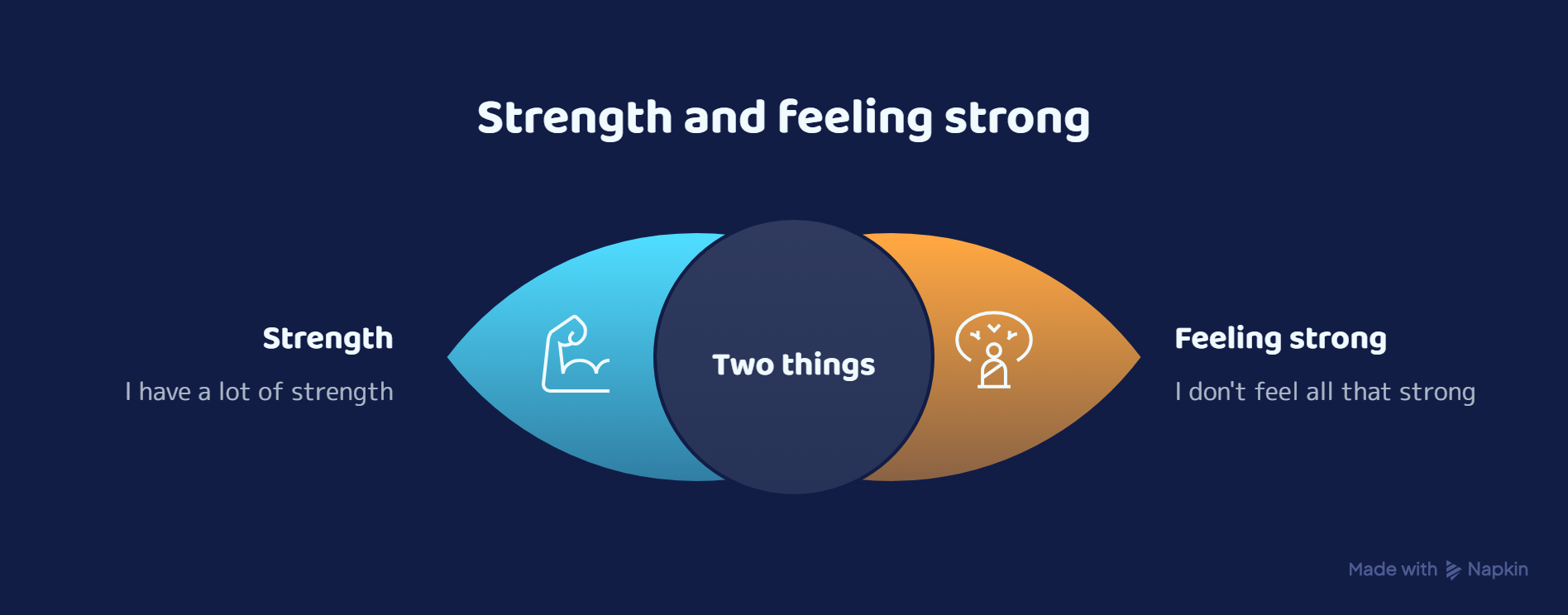
The truth is, I don't feel all that strong. But I do think I have a lot of strength. For years those two sentences sounded like a contradiction to me. Now they sound like two different things.
Did I ever put on a strong act on purpose? Honestly, I don't think so. Maybe I did without noticing. I never once said to myself, "Better look tough, or people will think less of me." But I've sat in enough rooms to know plenty of folks do. I'm not about to tell them they're wrong.
A widow and a horse
There's a widow who runs a small farm and writes on Substack. She says strength is a fallacy. She doesn't have a choice, so where's the strength in that? Then she tells you about a promise she made to her late husband. She's still taking care of his old horse, because she loves him.
I can't tell her what that is. To me it sounds like strength nobody could order her to have. To her it's love and a promise kept. Maybe those aren't so far apart.
Last week, my left eye
So here's what happened last week. I was in the middle of a conversation, and my left eye went blurry. Lines, smears, all sorts of stuff. That's not something you shrug off at 74.
My first thought was a mini-stroke. The symptoms looked an awful lot like one. That was real fear, and it hit me right away.
For most of my life, I knew exactly what to do with a moment like that.
The old me: Push through it. It's done. What's next?
What I did next
Here's the part I'm not proud of. The old me almost won. I finished the conversation and didn't say a word, because I figured it would go away like it had before.
It wasn't until afterward that I stopped pushing. I looked it up, and everything I read said get seen right away. So I called ophthalmology at the University of Vermont Medical Center. They told me to see my optometrist. I called him, and he fit me in that same day.
Suzanne was out running errands. I called and asked if she could drive me. She said, "Of course." No speech, no pep talk. Just of course.
The optometrist told me my retina isn't detached, which was a relief. But there's some fluid in my eye that's sitting where it doesn't belong, and a retina specialist needs to take a look. He sent the referral. So now I'm waiting for a phone call.
What I didn't say
Afterward, I noticed something about what I hadn't said. I never asked, "What do I have to do?" I asked, "What do we need to do?"
Those little words carry a lot of weight. "Have to" is an order from outside, and you carry it by yourself. "Need to" is something you choose. And "we" means somebody's carrying it with you.
I think that shift started with my first cancer diagnosis. It became a team almost overnight. Patient and caregiver first, then a whole crew around us. I didn't plan it that way. It just became how we work.
One call, then the next
I also didn't try to do seven things at once. One call, then the next call, then the car. Each step pretty much showed me the next one.
That's how most of the problems I've actually solved got solved. Small steps, one at a time.
The knee, the toe, the bike
And this isn't the first time my body has made the call for me. Not long ago I fell and banged up my knee, and I couldn't bend it for a month. Then an infection in my foot cost me another toe. That meant weeks off, right when I was trying to get back in shape.
Right now I can't ride my bike because nobody wants any pressure on that eye. And I still can't ski.
I've come back from all of it except the skiing. It just took longer than I wanted, and it came back in pieces, a little at a time.
The restaurant
Every time I've taken a great big step, it's gone badly. Here's my favorite example, mostly because it still makes me wince.
I had a catering division in my food service company, and every winter our catering business pretty much dried up. Winter was about four months away, and I wanted to keep my catering folks together. So, brilliant idea, I ended up running a restaurant called Maggie's.
Maggie's had 50 seats. Fifty seats is tough to make work in the best of times, and it's a lot tougher when you're running it from a distance. And I'd done no due diligence. Not on Maggie's itself, but on what it actually takes to make a restaurant work.
If I'd done that homework, I never would have jumped. But I jumped in with both feet. Once I was in, I'd put so much into it that backing out felt impossible. Nine months later, I got out of the lease. We'd lost $50,000.
The company in Burlington
And Maggie's wasn't the only time. We once bought a company in Burlington, again without doing our homework. What we thought we'd bought just wasn't there.
We'd already written a check for about $250,000. Walking away meant writing that off. So instead we spent another half million or more fixing it, all to support about $400,000 in sales. Frankly, it didn't make a lot of sense. We worked our way through it, but it took a whole lot of small steps to fix one big one.
Nobody calls you strong for making one phone call. But you can stop after each one and still see where you are.
Suzanne, Alan and Peter
I keep saying strength comes from inside, and I still believe that. But some of mine is borrowed, and I'd be lying if I pretended otherwise.
Suzanne, of course. Then there's Alan Newman, a friend of many years. Alan has always been blunt with me. He tells me exactly what he thinks, including what I'm doing that doesn't make any sense. That's not always fun to hear. It's always useful.
Peter Ash is another one. A while back I wrote about something I'd been putting off. Peter wrote back and said I ought to do it now, because it wasn't going to get any better later. That got me moving.
What one researcher found
There's a psychologist named George Bonanno who's spent decades watching how people get through loss and trauma. What he's found is that most of us come through hard things better than we'd guess. And it's not the tough guys who do best. It's the flexible ones. You figure out what this moment needs, and when that doesn't work, you try something else.
So maybe strength lives inside and still gets fed from outside. What matters is who's doing the feeding. Alan and Peter never graded me. They told me the truth and let me decide.
Something I've noticed
I want to say something about my son, and I want to say it carefully. This is an observation I've made, and it may or may not be true. He's told me more than once that what I see isn't what he sees. So this is one father's view, not the facts. Other people may see it differently, too.
What I see is a man who stays very busy. He takes on a lot and keeps pushing through. From where I sit, there isn't much room to stop and ask whether it's right for him.
I recognize it because that was me for decades. I never had time to think, so I never had much reason to. About the only stretch I remember really thinking was my new age years, back in my thirties.
Someday I'd love to talk with him about it. Gently, and only if he wants to. Right now I suspect he'd say no, and that's his call. I might have said no too, at his age.
Looking straight at it
There's one belief I've landed on, and I'm not testing it anymore. Facing death head-on makes you stronger. Not shoving it off to the side for some later date. Looking right at it.
A young cancer survivor wrote about this in Stanford Magazine. People kept telling her she'd survive because she was strong, and that offended her. Because what does that say if she dies? That she was weak? I get why that stung.
For me, dying doesn't make anybody weak. If anything, looking at it squarely is where some of my strength comes from. Nobody handed me that. I had to walk toward it myself.
What I wish someone had said
SANE Australia runs peer support chats for people living with mental illness. In one of them, people were asked what they'd rather hear than "you're so resilient." One answer was about as simple as it gets. Just tell me you're sorry I had to go through that.
Nobody ever said that to me, and boy, I wish they had. "That really sucks, and I'm sorry you have to go through it." That's the whole thing. It's not a grade. It's just somebody keeping you company.
Where I am today
As I write this, I'm still waiting to hear when UVM can see me about my eye. I don't know what it is yet. I don't know what we'll need to do.
There's also the lymphoma. It's growing slowly, so my doctors here and at Dana-Farber say watch and wait. We do nothing, on purpose. The old me would have hated that. Today it makes sense to me.
What I do know is the next small step. And I know Suzanne will be the one driving.
I'm still working out where strong ends and strength begins. So I'll ask you. What's the word you'd use for the thing nobody can order you to have? Tell me in the comments.
Hey, this is Josh. You're on the Long Strange Trip. I'm glad you're here.

Facebook
LinkedIn
Youtube