Such a Long, Long Time to be Gone
My mother and father both spent their last days talking to people who weren't in the room. I've started looking into what that might mean. This is the beginning of that investigation—not the end.
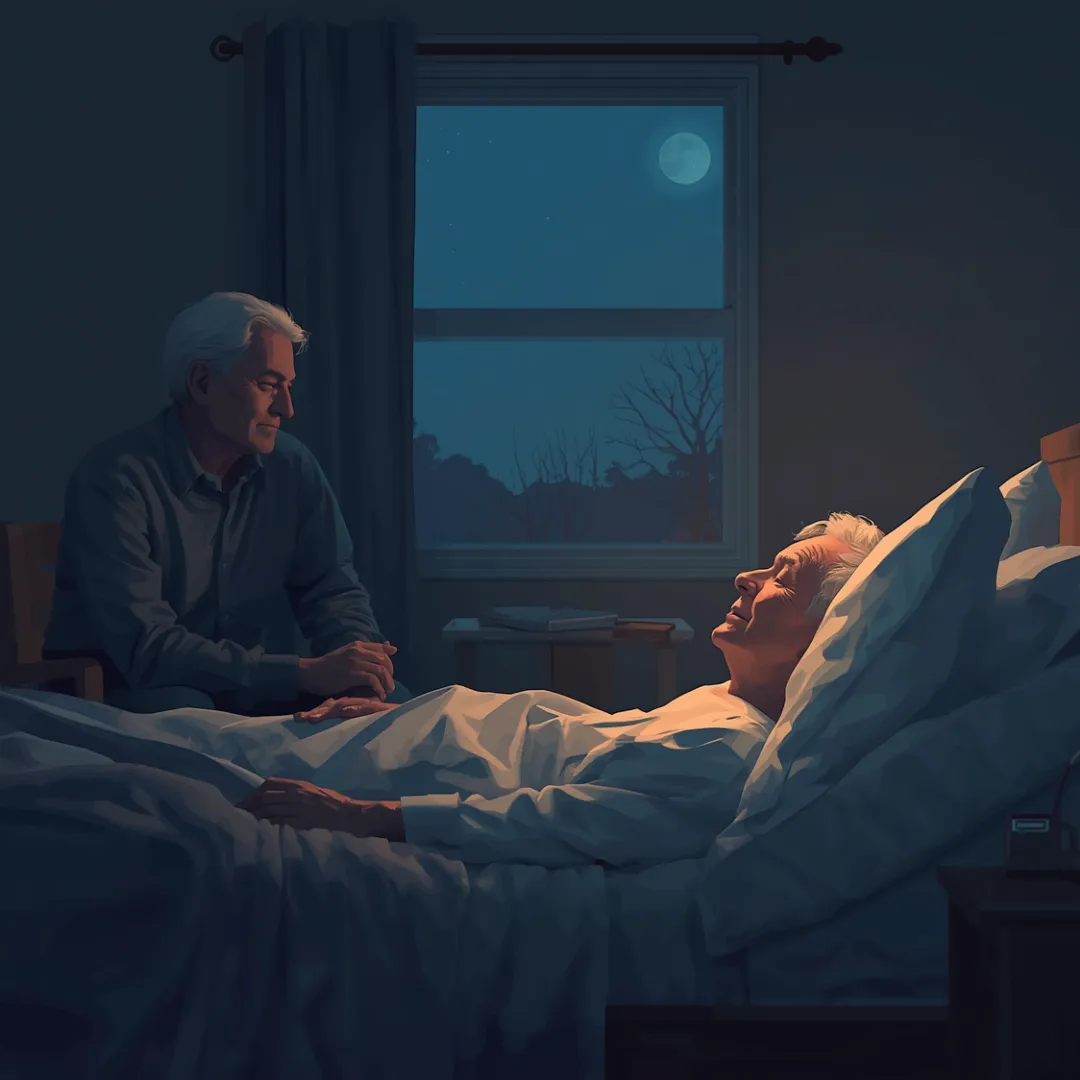
My father spent the last couple of days of his life talking to people who weren’t in the room.
Not confused talk. Not the morphine. He’d look at a spot near the foot of the bed, or off toward the corner, and carry on a conversation. Nodding. Listening. Answering. Like someone had pulled up a chair I couldn’t see.
My mother did the same thing right before she died.
I was in the room for both. And the easy move is to file it under “the brain shutting down” and get on with your day. That’s the clean explanation. The one that keeps your worldview intact.
But I was there. And it didn’t feel like a malfunction. It felt like the opposite. It felt like attention. Like my mother and my father were each looking at something real, and I was the one who couldn’t see it.
So I’ve started to wonder. What if there’s a space between being alive and being dead? Not a wall. A space. A room with a door on each end, where you’re not quite here and not quite gone, and for a little while you can talk to whoever’s waiting on the other side.
I’ve started calling it the liminal space. And I want to tell you up front: I have no idea what I’m talking about.
Let Me Be Clear About What I’m Not
I’m not a doctor. Not a hospice nurse. Not a hypnotherapist or a researcher or a member of any institute with letters after its name.
I’m a 73-year-old guy with a dual cancer diagnosis who sat at two deathbeds and saw the same strange thing happen twice. That’s my entire credential.
So this isn’t a piece where I explain the afterlife to you. I’d be laughed out of the room, and rightly so. It’s a piece where I tell you what I saw, point you toward people who’ve actually done the work, and admit I’m standing at the trailhead with a flashlight and a lot of questions.
I’m a fellow traveler on this one. Maybe more than usual. Where I usually write about transitions I’ve already lived through — selling the business, losing skiing, watching the phone stop ringing — this is a transition I’m walking toward, not away from. The math on my prognosis isn’t kind. I doubt I’ll see 80. So when I poke at what happens in that space between alive and dead, it isn’t a thought experiment.
I’m asking for directions to a place I’m fairly sure I’m headed.
What I Saw
With my father, it started a couple of days out. He’d look toward the corner, and his face would do the thing your face does when you recognize someone. Soften. Open up. And mostly — this is the part I keep coming back to — he seemed to be talking to his mother. My grandmother. Dead for years. There were other faces in the room I couldn’t place. But his mother was the one he kept turning to.
Right before my mother went to the other side, she did the same thing — she seemed to be talking to her mother.
Sit with that a second, because it took me a while to. Two people, dying years apart, in different rooms. Each one, at the threshold, turning toward the woman who’d brought them into the world. Not panic. Recognition.
Now here’s where it gets complicated — and I’ve decided not to clean it up, because cleaning it up would be a lie. My mother adored her mother. So her turning toward her at the end, that fits. That’s the tender version everybody wants.
My father’s story isn’t tender. He and his mother had a love/hate thing his entire life. She was the kind of person who’d charm you senseless the day you met her and turn difficult once she had her hooks in. Eventually, he had to ban her from our house, because she was actively poisoning my relationship with my own mother. That’s how hard she was to be around.
And yet. At the door, the face that softened my father’s was hers.
I don’t know what to do with that. If these moments were just the brain serving up a little comfort on the way out, why would it serve up the difficult one? The mother he’d had to lock out of the house? You’d think a dying mind reaching for a soft landing would conjure someone easier. It didn’t. It conjured the complicated truth of his life.
One more thing worth knowing. Neither of my parents was religious. No church, no end-of-life planning, no spiritual map of any kind. Say the words “liminal space” to either of them, and you’d have gotten a blank look. So whatever they were seeing in those corners, they weren’t seeing what they’d been taught to expect. They had no expectations. That detail matters more to me the longer I sit with it.
When my mother died — forty-three years ago now — I hadn’t given the afterlife a second thought. I filed her talking to her mother under “this is just what dying looks like” and went back to the casseroles and the paperwork. You do that with grief. You put the strange parts in a drawer.
By the time my father was dying, I’d started reading about what actually happens as the body shuts down. The book that opened the drawer was Final Gifts, by two hospice nurses, Maggie Callanan and Patricia Kelley. They’d spent decades at bedsides, and they have a name for what I’d watched both my parents do: Nearing Death Awareness. Reading it, I felt something I hadn’t felt in forty-three years of carrying that memory around. I felt seen.
And since my father’s been gone, I’ve been taking deep dives into this thing I’m calling the liminal space. Because it turns out I’m not the only one who’s seen it. Not by a long shot.
Turns Out This Has a Name
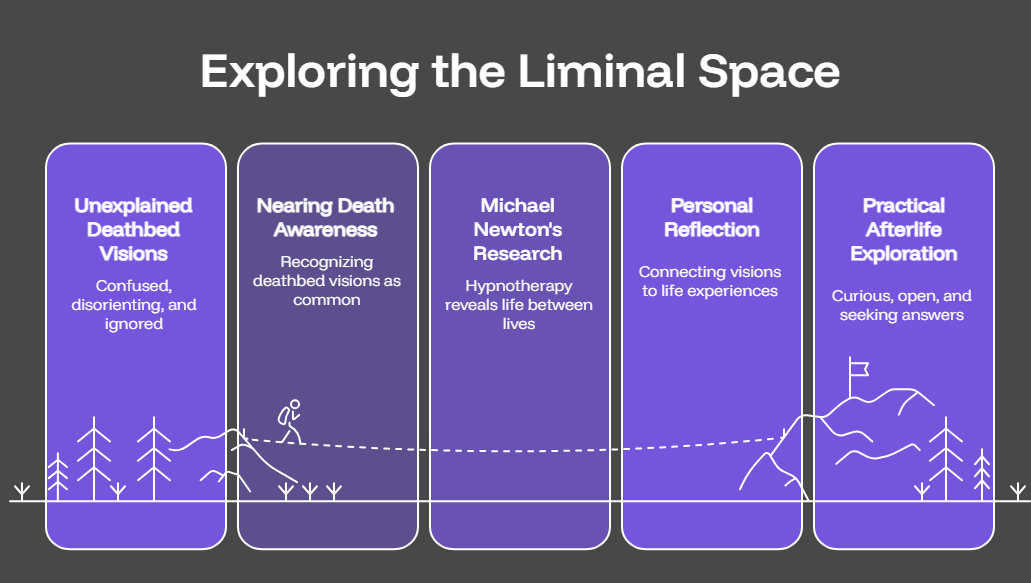
Behind Final Gifts was a whole body of work I’d never known existed. The first thing it taught me is that what I witnessed is common. Common enough to have a name. Researchers call them deathbed visions, or nearing-death awareness.
A dying person, awake and lucid, perceives and talks with people the rest of us can’t see. Usually, deceased loved ones. Very often, those visitors seem to have come for a reason — to help, to accompany, to take them somewhere. And the dying person, far from being scared, tends to be calmed by it.
This isn’t fringe stuff. One study in the Journal of Palliative Medicine found that something like 88 percent of the patients followed experienced these visions. Earlier researchers surveyed thousands of doctors and nurses across the U.S. and India and logged a thousand-plus dying patients who saw apparitions, hundreds who reported visions of an afterlife.
And here’s the detail that stopped me cold: the people who study this for a living mostly don’t think these are hallucinations. Hallucinations tend to be confused, bizarre, disorienting. Deathbed visions are the opposite — clear, specific, coherent. The dying person knows exactly who they’re talking to.
Which is precisely what I saw. Twice. My father wasn’t disoriented when he talked to that corner. He was oriented. Toward something I couldn’t see.
Now — I’m not handing you that 88 percent like it settles anything. It doesn’t. Smart people read the same data and land in different places, and I’m not qualified to referee that fight. What it did for me was smaller and more personal. It told me I hadn’t imagined it. It told me the thing I saw at my parents’ bedsides is a real, documented, repeating human experience. And once you know that, “the brain just shutting down” stops feeling like the whole answer. It starts feeling like one answer that’s awfully convenient.
So the door’s real. The question is what’s on the other side of it.
The Man Who Actually Did the Work
Here I step aside and point at someone who isn’t me: Michael Newton. He didn’t stumble into this at two bedsides. He spent decades in it.
Newton was a certified master hypnotherapist, and by his own account, a skeptic. He did the ordinary kind of clinical hypnosis, then started doing past-life regression, guiding clients into a deep state to surface old memories. And he found something he wasn’t looking for.
When he took clients past a previous life — to the space between that death and the next birth — they didn’t go blank. They described the same place. Independently. People who’d never met, from different backgrounds, with no reason to coordinate, came out of deep hypnosis describing a remarkably consistent experience of what happens between lives. He called it exactly that: life between lives. The liminal space, by another name.
He wrote it up in Journey of Souls and Destiny of Souls. The one I’d point you to is Memories of the Afterlife. What I like about it is that Newton didn’t write it solo and ask you to take his word. He edited it. The cases come from thirty-two different hypnotherapists he’d trained and certified, scattered around the world, each contributing a real case from their files. So it’s not one man with a theory and a flair for storytelling. It’s dozens of practitioners, working separately, reporting the same kind of thing.
I’ve read it. And here’s my honest confession as a reader: I can’t recall a single one of the individual stories well enough to retell it. They’ve blurred. What stayed with me was the shape underneath all of them. Every subject went under deep regression with a different author. Every one of them went somewhere. And while the specifics varied person to person, the fact of there being a between — a place they all visited — didn’t vary. That’s the part that lodged in me and won’t leave.
I want to be careful here. This is hypnosis, not a lab experiment you can run twice under glass. A reasonable person can say the mind under hypnosis is suggestible — that people may be constructing rather than remembering. That’s fair, and I won’t pretend otherwise. But the consistency is hard to wave off. And the man had the credentials, the volume of cases, and the decades I lack. So I’d rather hand you Newton than dress up my two bedside stories as expertise. Read him and decide for yourself.
What Newton’s People Describe
Here’s the rough shape of it, as best a beginner understands it.
The soul leaves the body — and the leaving itself is described as easy, even pleasant. Then there’s a meeting. Newton’s clients consistently describe a spirit guide who’s been with them all along, waiting.
And here’s the part that lit me up, given what I saw: they describe being met by people they knew. Soul groups, Newton called them — clusters of souls who travel together across lifetimes, who know each other, who show up to greet you. The familiar faces.
His mother, showing up to greet my father in the corner of the room. Exactly the way Newton’s clients describe being met by the people who went before them.
There’s more — a life review, gentler than the tribunal you might brace for. A Council of Elders, not prosecutors but wiser beings who walk through your choices with you to help you understand them. And eventually, the planning of a next life: the body, the family, the hard lessons signed up for in advance.
I’m not telling you I believe every piece of that. And yet, when you’ve watched two people you loved spend their final hours talking warmly to someone you couldn’t see — and then read decades of independent accounts describing being greeted by familiar souls in exactly that space — well. The hair on your arms stands up a little. It doesn’t prove anything. It just makes “their brains were misfiring” sound like a smaller story than what might be going on.
Why I’m Bothering With Any of This
I could leave this alone. Plenty of people do. Bringing up the afterlife is a fast way to watch a dinner table go quiet. But death is the ultimate taboo topic, and I’ve made a habit of walking into the rooms everyone else tiptoes past.
I’m not a tourist on this question. I’m closer to the door than most people reading this. And here’s what I’ve noticed about staring down a not-great prognosis: the question of what’s on the other side stops being philosophical and turns practical.
Not in a morbid way. The opposite. These aren’t morbid questions. They’re life-giving ones. If there’s a chance — even a chance — that the people I’ve loved and lost are something more than gone, and that the space between alive and dead is a doorway rather than a wall, that changes how I sit with my own clock running down. It takes some of the terror out. Not all. Some.
And here’s what surprised me most. I’m not scared of death anymore. Careful with that sentence — it’s easy to misread. I’m not wishing for it, not in any hurry; I’d like as much road as I can get. But the raw fear that used to sit in my chest has loosened its grip. The whole subject of dying without dread — what people call a “good death” — has gone from morbid to fascinating.
Measure that against forty-three years ago, when my mother died, and I had no framework, no language, nothing but the casseroles and the drawer. Today I’m more ready for a good death than I’ve ever been. Not because I’ve solved anything. Because I’ve finally started paying attention.
What a long strange trip — and the strangest part might be the stretch nobody can describe to you, because nobody’s come back to file a proper report. So we’re left with breadcrumbs. The deathbed visions. The hypnosis cases. The hair standing up on our arms. And me, a guy with a flashlight, following them.
So Here’s What I Want From You
I’m going to do something I don’t usually do, which is admit that on this one, you might know more than I do.
A lot of people have a story like mine and never say it out loud. Because it sounds crazy. Because they’re afraid of the “well, that’s just the brain” lecture. Because we’ve all agreed, somewhere along the way, to keep the strange parts in the drawer.
Open the drawer.
If you’ve sat at a deathbed and watched someone talk to a person who wasn’t there — tell me. If a dying parent, partner, or friend lit up at a corner of the room and called someone by name, tell me who. If you’ve had your own experience of the space between, through loss or hypnosis or something you’ve never been able to explain — I want to hear it.
Drop it in the comments. Tell me what you saw, or what someone you trust saw. I’m collecting these the way you collect breadcrumbs when you’re trying to find your way through a wood you’ve never walked.
And let me say the quiet part plainly, so nobody mistakes me for a true believer with the answer in his back pocket. As much as I hope this is true — and I hope it more than I can tell you — the jury’s still out for me. I’m investigating, not concluding. Two bedside memories, one book read and half-remembered, a worldview cracked open but not rebuilt. I want it to be real. Wanting isn’t knowing. I’m holding both at once.
I’m a beginner standing at the edge of something genuinely large. A fellow traveler — and on this trip, maybe the least-traveled one in the room. But I’ve started walking. And the company helps.
Such a long, long time to be gone. And a short time to be there. Let’s figure out the part in between, together.
A note on the reading: If any of this catches you, the on-ramp I’d recommend is Final Gifts: Understanding the Special Awareness, Needs, and Communications of the Dying by Maggie Callanan and Patricia Kelley — two hospice nurses, no mysticism required, just decades at the bedside. From there, Michael Newton’s Journey of Souls is where the life-between-lives work starts, and Memories of the Afterlife is the collection of cases I mention above. I’m reading as a curious beginner, not endorsing a doctrine. Take what’s useful, leave the rest.

Facebook
LinkedIn
Youtube