
The Specialist vs. The Generalist: Why You Need Both When Your Business Life Ends
The Problem Nobody Sees Coming
Here's something I've watched happen dozens of times.
A business owner decides to sell. They hire a top M&A advisor, someone who knows how to get the best deal. The specialist does their job well. They structure the deal, negotiate the terms, and handle due diligence.
The deal closes. Everyone celebrates. The specialist gets paid. The business owner has a pile of money in the bank.
Six months later, that same business owner is sitting in their empty home office, staring at a calendar with nothing on it, wondering who the hell they are now that they're not "the business guy."
And I get it. Because here's what nobody tells you: getting the deal done is the easy part. Figuring out what comes after? That's the hard part.
This is where the difference between specialists and generalists matters more than most people realize.
What We're Actually Talking About
Specialists are essential. When you need someone who knows estate planning law inside and out, you don't want a dabbler. When you need someone who can structure a complex business sale, you want the person who's done it hundreds of times.
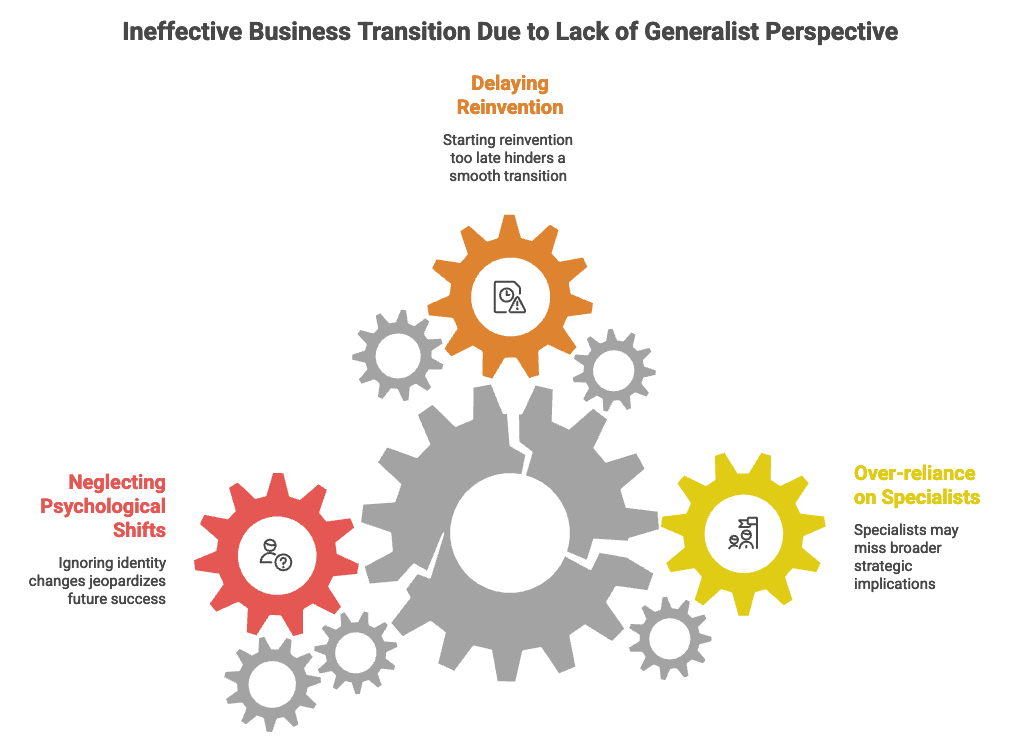
But specialists tend to see things through a narrow lens. Sometimes that means they miss what's going on outside their area.
Generalists work differently. We have areas we're known for – for me, it's succession planning, transitions, and business owner retirement planning. But our knowledge spreads wider. We see the 10,000-foot view. We understand how different pieces connect. We know enough about multiple domains to ask the right questions.
Most good generalists actually have a few areas where they go deep, but they also keep a broad view. It's not about being shallow everywhere. It's about having depth in some places and still being able to see how things fit together.
Think of it this way: a surgeon is the expert who can perform a complex procedure flawlessly. But your general practitioner or nurse practitioner? They're the ones who help you understand what life looks like after surgery, what rehab you'll need, and how this connects to your other health issues.
Both are important, just in different ways.
What Makes a Good Generalist
Here's what separates a good generalist from someone who's just shallow across multiple domains:
A good generalist is always curious about how things connect. I find myself asking, how does this relate to that? What are the effects nobody is talking about? Often, the real insights are in those connections.
You have to keep learning. The world changes, and so do people. I try to keep updating what I know, and I'm not afraid to say, I don't know, but let's try to figure it out.
I'm always reading. Always talking to people in different fields. Always trying to understand patterns that apply across contexts. I'm learning about psychology, transition theory, behavioral economics, and family systems – all of it feeds into seeing what specialists might miss. That’s why we have six areas of investigation at The Long Strange Trip.
Actively looking around corners. What's coming that nobody's prepared for? What are the ripple effects that aren't obvious yet? What problems are being created by the "solution" we're implementing?
The M&A advisor is focused on closing the deal – they're not looking around the corner at the identity crisis that's coming. The estate attorney is focused on tax efficiency – they're not looking around the corner at the family dynamics that will explode when the will is read.
For example, A couple comes in to do estate planning. They want to leave everything equally to their three kids. The attorney can draw up those documents perfectly.
But I'm looking around the corner: One of those kids has been caring for their parents for 5 years. Another lives across the country and visits once a year. The third is struggling financially. "Equal" might be technically fair, but is it actually fair given the context? What conversations need to happen now so this doesn't blow up the family later?
Generalists have to be willing to sit with uncertainty. Specialists often have clear answers in their area, but generalists get used to saying, I don't know, or it depends. Life is messy, and sometimes there just isn't a clear answer.
This is why generalists can be good thinking partners. We're not here to give you the answer. We're here to help you figure out what questions to ask.
The War Nobody Admits Is Happening
Here's where it gets ugly.
Specialists often view generalists as people getting in the way of "getting the deal done." I'm talking about active hostility.
Let me tell you about a deal that haunts me.
A business owner I'd been working with for six months decided to sell. He hired an M&A advisor I'd never worked with before. Top of their field. Impressive track record.
The first meeting, I explained my role: I work with the owner on the transition side – the identity piece, the reinvention work, making sure he's prepared for life after the business. The M&A advisor nodded along but I could see the dismissiveness.
Second meeting, I wasn't invited.
I reached out to the advisor. "I think it would be valuable for me to be in the loop. Sometimes issues come up that affect the owner's readiness—"
The advisor cut me off. "Josh, we need to keep things simple. Too many voices creates confusion. Let's just focus on getting this deal done, and then you can work with him on whatever comes next."
I tried a different angle. "I'm trying to make sure he doesn't get cold feet halfway through—"
"Josh. I've closed over a hundred deals. I know what I'm doing. What I don't need is someone making my client anxious about life after the sale while we're trying to negotiate terms. So with all due respect, let me do my job."
Translation: Stay the hell away from my client.
I tried going directly to the owner. He was caught in the middle. "The advisor says we should just focus on the deal right now. Maybe we can pick up our conversations after everything closes?"
Red flag. Giant red flag.
But what was I supposed to do? The M&A advisor had effectively frozen me out. So I backed off.
The deal progressed. Terms were negotiated. Due diligence happened. Everything was moving toward closing.
Then, about ten days before closing, my phone rang.
It was the owner. In full panic mode.
"I can't do this. I don't know what I'm going to do after this. Who am I if I'm not running this company? What am I going to do with my time? I've been so focused on the deal that I never actually thought about my life after."
We talked for two hours. But you can't do in two hours what should have been happening over six months. You can't build a vision for your next chapter in an emergency phone call ten days before closing.
He pulled out of the deal.
The M&A advisor was furious. They called me, accused me of "poisoning the well" by putting doubts in the owner's head. Never mind that I'd been locked out for months.
"He wasn't serious about selling," the advisor said.
No. He was serious. He was ready. But nobody had helped him prepare for the identity crisis that was coming.
The advisor lost their commission. Six figures, gone. The buyer was pissed. The owner stayed stuck in a business he wanted to leave.
Everybody lost.
And here's what kills me: It didn't have to happen this way.
If that M&A advisor had understood that there's more to getting a deal closed than the technical side – if they'd recognized that the psychological readiness of the seller is just as important as the financial structure – they would have kept me involved.
We could have been working parallel tracks. The advisor handles the transaction. I handle the transition. By the time we got to closing, the owner wouldn't have been stepping into a void.
The deal would have closed. The advisor would have gotten their commission. The owner would have gotten his next chapter.
Instead, the advisor's refusal to admit that their narrow expertise wasn't sufficient cost them a massive commission.
That's the war nobody admits is happening. Specialists viewing generalists as threats rather than as complementary partners. And that territorial protectiveness doesn't just create frustration – it costs deals.
The Deal That Worked
Let me tell you about a different situation.
Another business owner. Another sale process. But this M&A advisor was different.
This advisor actually called me early in the process. "Josh, I've got a client who's selling. I can handle the transaction side. But I need someone to work with him on the transition side. Can you help?"
So while the M&A advisor was structuring the deal, I was working with the owner on reinvention.
What did he care about beyond business? He'd always wanted to teach. He'd been mentoring young entrepreneurs informally for years.
What relationships needed attention? His marriage had taken a beating. His kids were adults now, and he barely knew them.
By the time the deal was ready to close, the owner wasn't just financially ready. He was psychologically ready. He could see what came next. He wasn't stepping off a cliff into nothing – he was stepping into something he'd been building.
The deal closed. Six months later, he was teaching entrepreneurship at a local college, had taken his wife on a month-long trip, and was having regular dinners with his kids.
That's what happens when specialists and generalists work together.
The M&A advisor got their commission. The buyer got the business. The owner got his next chapter.
Everybody won.
The Reinvention Nobody Plans For
Here's the pattern I've seen play out hundreds of times:
Before the transition, people believe they'll adapt easily. "I've got plenty of hobbies." "I'll finally travel." This fantasy is dangerous because it lets you avoid the hard work of preparing for the identity shift.
Three to six months after, reality hits. Your calendar is empty. Your phone doesn't ring. Nobody needs your opinion. The hobbies you thought you'd enjoy feel hollow.
This is when the depression sets in. When you realize "figuring it out" isn't something that just happens naturally.
Then comes desperate scrambling. Golf. Travel. Volunteering. You're filling your calendar with activities, hoping something will stick.
But activities aren't the same as purpose. Being busy isn't the same as being fulfilled.
The real work is identity reconstruction:
What gives you energy that isn't work-related?
What relationships have you neglected?
What does contribution look like without your career?
How do you create structure without external demands?
This isn't a weekend project. This is months or years of genuine exploration.
And here's what breaks my heart: most people try to do it alone. But having a thinking partner – someone who can ask the questions you're not asking yourself – that makes all the difference.
What This Means For You
If you're thinking about selling your business, retiring, or approaching any major life transition:
Get the best specialists you can find. Don't cheap out on your M&A advisor, estate attorney, tax specialist, or financial advisor. These people are crucial.
But also get a thinking partner who sees the bigger picture. Someone who's asking the questions nobody else is asking. Someone who's looking around corners at what's coming.
Don't let your specialist talk you out of the generalist. When your M&A advisor says "Let's not complicate things" or "Let's just focus on the deal first," that's exactly when you need the generalist most.
The specialist who's uncomfortable with you having other advisors is telling you something important about their own limitations.
Start the reinvention process before you need it. Don't wait until ten days before closing to ask yourself what comes after. That's too late. And it might cost you a deal you actually wanted.
Understand that leaving your career requires more than good planning. It requires working through the psychological and identity shifts that are coming. That's the hard stuff that determines whether your next chapter works or falls apart.
And sometimes, it's the hard stuff that determines whether the deal even closes at all.
The Problem Nobody Sees Coming
Here’s something I’ve watched happen dozens of times.
A business owner decides to sell. They hire a top M&A advisor, someone who knows how to get the best deal. The specialist does their job well. They structure the deal, negotiate the terms, and handle due diligence.
The deal closes. Everyone celebrates. The specialist gets paid. The business owner has a pile of money in the bank.
Six months later, that same business owner is sitting in their empty home office, staring at a calendar with nothing on it, wondering who the hell they are now that they’re not “the business guy.”
And I get it. Because here’s what nobody tells you: getting the deal done is the easy part. Figuring out what comes after? That’s the hard part.
This is where the difference between specialists and generalists matters more than most people realize.
What We’re Actually Talking About
Specialists are essential. When you need someone who knows estate planning law inside and out, you don’t want a dabbler. When you need someone who can structure a complex business sale, you want the person who’s done it hundreds of times.
But specialists tend to see things through a narrow lens. Sometimes that means they miss what’s going on outside their area.
Generalists work differently. We have areas we’re known for – for me, it’s succession planning, transitions, and business owner retirement planning. But our knowledge spreads wider. We see the 10,000-foot view. We understand how different pieces connect. We know enough about multiple domains to ask the right questions.
Most good generalists actually have a few areas where they go deep, but they also keep a broad view. It’s not about being shallow everywhere. It’s about having depth in some places and still being able to see how things fit together.
Think of it this way: a surgeon is the expert who can perform a complex procedure flawlessly. But your general practitioner or nurse practitioner? They’re the ones who help you understand what life looks like after surgery, what rehab you’ll need, and how this connects to your other health issues.
Both are important, just in different ways.
What Makes a Good Generalist
Here’s what separates a good generalist from someone who’s just shallow across multiple domains:
A good generalist is always curious about how things connect. I find myself asking, how does this relate to that? What are the effects nobody is talking about? Often, the real insights are in those connections.
You have to keep learning. The world changes, and so do people. I try to keep updating what I know, and I’m not afraid to say, I don’t know, but let’s try to figure it out.
I’m always reading. Always talking to people in different fields. Always trying to understand patterns that apply across contexts. I’m learning about psychology, transition theory, behavioral economics, and family systems – all of it feeds into seeing what specialists might miss. That’s why we have six areas of investigation at The Long Strange Trip.
Actively looking around corners. What’s coming that nobody’s prepared for? What are the ripple effects that aren’t obvious yet? What problems are being created by the “solution” we’re implementing?
The M&A advisor is focused on closing the deal – they’re not looking around the corner at the identity crisis that’s coming. The estate attorney is focused on tax efficiency – they’re not looking around the corner at the family dynamics that will explode when the will is read.
For example, A couple comes in to do estate planning. They want to leave everything equally to their three kids. The attorney can draw up those documents perfectly.
But I’m looking around the corner: One of those kids has been caring for their parents for 5 years. Another lives across the country and visits once a year. The third is struggling financially. “Equal” might be technically fair, but is it actually fair given the context? What conversations need to happen now so this doesn’t blow up the family later?
Generalists have to be willing to sit with uncertainty. Specialists often have clear answers in their area, but generalists get used to saying, I don’t know, or it depends. Life is messy, and sometimes there just isn’t a clear answer.
This is why generalists can be good thinking partners. We’re not here to give you the answer. We’re here to help you figure out what questions to ask.
The War Nobody Admits Is Happening
Here’s where it gets ugly.
Specialists often view generalists as people getting in the way of “getting the deal done.” I’m talking about active hostility.
Let me tell you about a deal that haunts me.
A business owner I’d been working with for six months decided to sell. He hired an M&A advisor I’d never worked with before. Top of their field. Impressive track record.
The first meeting, I explained my role: I work with the owner on the transition side – the identity piece, the reinvention work, making sure he’s prepared for life after the business. The M&A advisor nodded along but I could see the dismissiveness.
Second meeting, I wasn’t invited.
I reached out to the advisor. “I think it would be valuable for me to be in the loop. Sometimes issues come up that affect the owner’s readiness—”
The advisor cut me off. “Josh, we need to keep things simple. Too many voices creates confusion. Let’s just focus on getting this deal done, and then you can work with him on whatever comes next.”
I tried a different angle. “I’m trying to make sure he doesn’t get cold feet halfway through—”
“Josh. I’ve closed over a hundred deals. I know what I’m doing. What I don’t need is someone making my client anxious about life after the sale while we’re trying to negotiate terms. So with all due respect, let me do my job.”
Translation: Stay the hell away from my client.
I tried going directly to the owner. He was caught in the middle. “The advisor says we should just focus on the deal right now. Maybe we can pick up our conversations after everything closes?”
Red flag. Giant red flag.
But what was I supposed to do? The M&A advisor had effectively frozen me out. So I backed off.
The deal progressed. Terms were negotiated. Due diligence happened. Everything was moving toward closing.
Then, about ten days before closing, my phone rang.
It was the owner. In full panic mode.
“I can’t do this. I don’t know what I’m going to do after this. Who am I if I’m not running this company? What am I going to do with my time? I’ve been so focused on the deal that I never actually thought about my life after.”
We talked for two hours. But you can’t do in two hours what should have been happening over six months. You can’t build a vision for your next chapter in an emergency phone call ten days before closing.
He pulled out of the deal.
The M&A advisor was furious. They called me, accused me of “poisoning the well” by putting doubts in the owner’s head. Never mind that I’d been locked out for months.
“He wasn’t serious about selling,” the advisor said.
No. He was serious. He was ready. But nobody had helped him prepare for the identity crisis that was coming.
The advisor lost their commission. Six figures, gone. The buyer was pissed. The owner stayed stuck in a business he wanted to leave.
Everybody lost.
And here’s what kills me: It didn’t have to happen this way.
If that M&A advisor had understood that there’s more to getting a deal closed than the technical side – if they’d recognized that the psychological readiness of the seller is just as important as the financial structure – they would have kept me involved.
We could have been working parallel tracks. The advisor handles the transaction. I handle the transition. By the time we got to closing, the owner wouldn’t have been stepping into a void.
The deal would have closed. The advisor would have gotten their commission. The owner would have gotten his next chapter.
Instead, the advisor’s refusal to admit that their narrow expertise wasn’t sufficient cost them a massive commission.
That’s the war nobody admits is happening. Specialists viewing generalists as threats rather than as complementary partners. And that territorial protectiveness doesn’t just create frustration – it costs deals.
The Deal That Worked
Let me tell you about a different situation.
Another business owner. Another sale process. But this M&A advisor was different.
This advisor actually called me early in the process. “Josh, I’ve got a client who’s selling. I can handle the transaction side. But I need someone to work with him on the transition side. Can you help?”
So while the M&A advisor was structuring the deal, I was working with the owner on reinvention.
What did he care about beyond business? He’d always wanted to teach. He’d been mentoring young entrepreneurs informally for years.
What relationships needed attention? His marriage had taken a beating. His kids were adults now, and he barely knew them.
By the time the deal was ready to close, the owner wasn’t just financially ready. He was psychologically ready. He could see what came next. He wasn’t stepping off a cliff into nothing – he was stepping into something he’d been building.
The deal closed. Six months later, he was teaching entrepreneurship at a local college, had taken his wife on a month-long trip, and was having regular dinners with his kids.
That’s what happens when specialists and generalists work together.
The M&A advisor got their commission. The buyer got the business. The owner got his next chapter.
Everybody won.
The Reinvention Nobody Plans For
Here’s the pattern I’ve seen play out hundreds of times:
Before the transition, people believe they’ll adapt easily. “I’ve got plenty of hobbies.” “I’ll finally travel.” This fantasy is dangerous because it lets you avoid the hard work of preparing for the identity shift.
Three to six months after, reality hits. Your calendar is empty. Your phone doesn’t ring. Nobody needs your opinion. The hobbies you thought you’d enjoy feel hollow.
This is when the depression sets in. When you realize “figuring it out” isn’t something that just happens naturally.
Then comes desperate scrambling. Golf. Travel. Volunteering. You’re filling your calendar with activities, hoping something will stick.
But activities aren’t the same as purpose. Being busy isn’t the same as being fulfilled.
The real work is identity reconstruction:
What gives you energy that isn’t work-related?
What relationships have you neglected?
What does contribution look like without your career?
How do you create structure without external demands?
This isn’t a weekend project. This is months or years of genuine exploration.
And here’s what breaks my heart: most people try to do it alone. But having a thinking partner – someone who can ask the questions you’re not asking yourself – that makes all the difference.
What This Means For You
If you’re thinking about selling your business, retiring, or approaching any major life transition:
Get the best specialists you can find. Don’t cheap out on your M&A advisor, estate attorney, tax specialist, or financial advisor. These people are crucial.
But also get a thinking partner who sees the bigger picture. Someone who’s asking the questions nobody else is asking. Someone who’s looking around corners at what’s coming.
Don’t let your specialist talk you out of the generalist. When your M&A advisor says “Let’s not complicate things” or “Let’s just focus on the deal first,” that’s exactly when you need the generalist most.
The specialist who’s uncomfortable with you having other advisors is telling you something important about their own limitations.
Start the reinvention process before you need it. Don’t wait until ten days before closing to ask yourself what comes after. That’s too late. And it might cost you a deal you actually wanted.
Understand that leaving your career requires more than good planning. It requires working through the psychological and identity shifts that are coming. That’s the hard stuff that determines whether your next chapter works or falls apart.
And sometimes, it’s the hard stuff that determines whether the deal even closes at all.
Let's Figure This Out Together
Here's what I'm genuinely curious about: why do most specialists fight so hard against bringing in generalists?
Is it ego? Fear that someone else might get credit? Genuine belief that the "soft stuff" doesn't matter?
But here's what I know: the specialists who are confident enough to recognize where their expertise ends and someone else's begins – those are the ones whose deals actually close.
The ones who fight to keep generalists out? They're the ones explaining to their firms why a deal they spent six months on fell apart at the last minute.
So I'm curious – if you've gone through a major transition, did you work with both specialists and a thinking partner? Or just specialists?
And if you're a specialist reading this – have you ever had a deal fall apart because nobody was addressing the parts that weren't in your wheelhouse?
Let's figure this out together.
Because life's too short – and too complicated – to navigate major transitions without the right kind of help. And the right kind of help isn't just one or the other.
It's both.
And sometimes, having both is the difference between a deal that closes and a deal that falls apart ten days before the finish line.
Sometimes it's the difference between a specialist earning their commission and a specialist explaining why they didn't.

Facebook
LinkedIn
Youtube