
Right About the Wrong Thing
I knew his idea was dead about sixty seconds in. I kept my mouth shut for six minutes. What I found at the end has been bothering me ever since.
There's a particular silence I've learned to recognize. You say something true in a room full of people. And the conversation closes back over it, like water over a stone.
Nobody argues with you. Nobody agrees either. The next person just starts talking, and the thing you said is simply gone. I'm seventy-three, and I've been on the receiving end of that silence more times than I can count.
Here's what I've been afraid to look at. I've always assumed the room was the problem.
The fourth stage
Let me paint you a picture. I was at the Modern Elder Academy, sitting in a session on transitions. The facilitator was walking through the stages, and he had three.
Most of the literature has three. But Susan Bradley, who runs the Financial Transitionist Institute, adds one in the beginning. She calls it anticipation, and I've come to think it's the most important one.
So I said so. I said, in my experience, there's a fourth, and the fourth is anticipation.
It went right past him. He didn't respond. Not a nod, not a "let's come back to that" — the presentation just continued as though I hadn't spoken.
At the end of the program, he upbraided me for correcting him during his presentation.
Now here's the thing I want you to hold onto, because it took me a long time to get here. I wasn't wrong.
Anticipation is real, and it's everywhere. Business owners anticipate selling for years before they sell. People anticipate a divorce for years before anyone files. Somebody with a chronic illness anticipates their death, and everybody around them anticipates the life that comes after it.
We all get a chance to work with anticipation. And most of the time we ignore it completely and walk straight through.
I've had cancer twice. I know exactly what that stage feels like from the inside. So I wasn't offering a hot take in that room. I was offering a missing piece of a model.
And it didn't matter even slightly.
A woman who'd never met me
Years before that, I was doing advanced training in neurolinguistic programming. The facilitator looked at me — and I want to be precise about the timing here — before I had said one word.
She said, "You're a polarity responder, and I want you to keep yourself under control during this."
I had no idea how she'd decided that. I still don't. I've turned it over for years, and here's where I've landed, and it's not where I expected.
She was wrong about me. I wasn't a polarity responder. I wasn't there to push back on things for the pleasure of pushing back.
But she was right about something, and it took me decades to see it. I had different information that I thought should be brought forward. That part was true.
It was the wrong format and the wrong place for me to do it.
She read the shape of what I was about to do, and she wasn't wrong about the shape.
What I found at two in the morning
I went out reading, the way I do before I write these. Forums, comment sections, the places people talk when it's late and nobody's listening.
I was looking for other people sitting where I sit. What I found instead knocked the piece sideways.
Older people, in thread after thread, describing exactly one injury. A man on Reddit: "I am really getting tired of everyone under 50 treating me like I am stupid." A woman describing handing cash to a grocery cashier who gave the change to her daughter instead — "like when I was 5, and my mom let me pay for my own candy bar."
Somebody remembered a server asking an old man whether "we" were going to eat "our" green beans today. Her line: "She assumed because he had gray hair, he was half-vegetable."
Then I read the other threads. Adult children describing what it's like to get advice from a parent.
A man wrote that he can't tell his father anything without getting a solution. His words: "he gives me basic advice like I'm dumb." Another: "It's almost as if you're insulting their intelligence." A woman whose mother texted her, hours after a conversation about cooking eggs, to tell her which pan to use.
Read those two piles next to each other. Same wound. Same vocabulary. Like I'm dumb. Like a child. Like I'm stupid.
Both generations are describing the identical injury. And they're describing it about each other.
Nobody in either pile has noticed they're saying the same sentence.
My son, talking
I was out visiting my son recently. We got onto politics, and on this particular thing we didn’t agree, and that's fine.
But partway through I stopped hearing the content. Because everything coming out of his mouth was framed as an absolute. Not "here's what I believe." Just flat statements of how things are.
It could have been me talking. Every cadence, every construction. The only difference was that I didn't believe the thing he was saying.
I have said exactly that way more times than I can count.
I didn't tell him. I don't intend to tell him.
And I want to be honest about why, because it isn't restraint. It's that I taught him that. I ran my house the way I ran my business, which was command and control, and everything out of my mouth was an absolute. What you need to do. What you're going to do. What you should do.
There was almost no curiosity in it. I showed very little interest in what my children were doing or why. I was too busy telling them.
So I sat there and watched my own habit come back at me from across a room, and I had nothing to say about it.
Three words in
Let me go back further, because there's a pattern here and I'm slow to see patterns about myself.
My father told me things constantly. Some of it I listened to. Most of it I didn't, and it depended entirely on where my head was and how he was coming at me.
When he was demeaning about it, which was often, I'd be fighting back before he got three words out of his mouth.
Notice what decided it. Not whether he was right. Not whether the information was any good. How he delivered it, and whether I was already braced.
He may have been right half the time. I'll never know, because I stopped listening at word three.
The call I hung up on
Now I'll tell you the part I've been circling.
I have an uncle who's ninety-six years old and sharp as a tack. He also talks in soliloquies. Not paragraphs — soliloquies, running minutes at a stretch, and I mean that literally.
Several months ago we got into it. He was going on about something I thought was frankly ridiculous, and I wanted him to stop so he could hear my response.
He wouldn't stop. I hung up the phone on him.
We didn't speak for a long time after that.
I want to be careful about how I describe what happened there, because the easy version is that he wouldn't listen to me. That's what I told myself for a while.
The truer version is that I wasn't listening to him. I was waiting. There's a difference: waiting has a countdown running.
Six minutes
We're talking again. And recently he called about a business idea.
He started in, and within a minute I knew. The idea wasn't going anywhere. I could see it clearly, and I was, for what it's worth, correct.
Forty years of my life would have had me speaking right then.
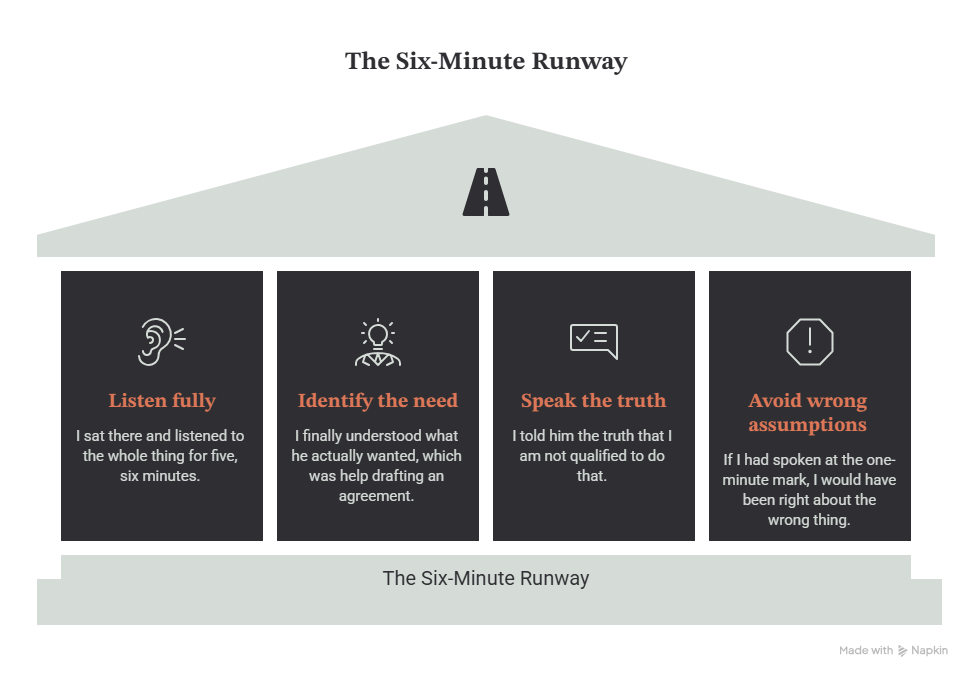
I didn't. I sat there and listened to the whole thing. Five, six minutes of it, which with him is not a small commitment.
And at the end of it I finally understood what he actually wanted. He wanted help drafting an agreement with a potential partner.
That was the question. It was sitting at the end of a six-minute runway.
So I told him the truth. I'm not qualified to do that; I'm not a lawyer, and it'll cost you a couple thousand dollars to have one do it properly. He heard me. He took it in, and we moved on, and there was no fight in it anywhere.
Here's what I can't stop thinking about.
If I'd spoken at the one-minute mark — when I was right, when I knew, when I could see it — I would have answered a question he wasn't asking.
I'd have been right about the wrong thing.
Same man. Same soliloquies. One hang-up and one landing, and nothing changed except where I put my attention
Why it's so hard to stop
I went looking for research, half hoping it would let me off the hook. It didn't.
There's a study by Michael Schaerer and colleagues, published in 2018. Four studies. Giving advice measurably raises the advisor's sense of power.
Here's the part that got me. It did that whether anyone asked for the advice or not. And the boost vanished the moment the advice was rejected.
So the thing I've been calling generosity has been paying me. Every time.
Then there's work by Blaine Landis and colleagues at Cambridge, from 2022. When advice arrives unsolicited, the person receiving it infers the giver had selfish motives — and then uses it less, learns less, and performs worse.
Not because the advice was bad. Because of how it showed up.
And one more, which I think is the honest one. Igor Grossmann and Ethan Kross ran three experiments with nearly seven hundred people. People reason measurably more wisely about somebody else's problem than about their own identical problem.
Which sounds like a point in favor of old men with opinions. Until you get to the part almost nobody quotes.
They tested it in adults aged sixty to eighty and adults aged twenty to forty. The effect was the same size in both.
Age bought no immunity. None.
So all three things are true at once. My read on your situation may genuinely be clearer than yours. The urge to hand it to you is feeding something in me. And I am exactly as foolish about my own life as I was at thirty.
There's no villain in that. There's also no exit.
The question that isn't a question
I've been trying to fix this with permission. Ask first, then speak.
Then I read a comment that took the legs out from under it. A woman writing under a thread about this exact problem: "If you ask, 'Can I give you some advice?' the person is pretty obligated to say yes."
She's right, and I knew it the second I read it. I've asked that question. They always say yes. And they almost never do anything with what comes next.
So it isn't a courtesy. It's a corner.
But there's a version that works, and it took me an embarrassingly long time to find, because it's one word.
Can I give you some advice is about me. Would you like some advice is about them.
That's the whole difference, and people can actually say no to the second one.
The other thing I've changed is that it's smaller and harder. I used to say things flat. If you want somebody to listen, you have to ask them first — delivered as fact, as though the matter were closed.
Now I say I think, or it seems to me. I make the comment something I believe rather than something the world has to believe.
It sounds like nothing. It is not nothing. The first version has no door in it.
Where my own argument falls apart
I'd have this piece nicely tied up, except for one thing.
Not long ago I watched somebody badly undervalue what they do. Nobody asked me. It wasn't my business.
I got aggressive about it. I went round and round with them for a good while, pushing hard, naming people doing the same work for many times the money.
And they came around. It worked.
So which is it? I've just spent two thousand words telling you the absolutes never get in, and then I went in with both hands and got a result.
I have two possible answers and I don't know which one is true. Maybe the law has an exception when the stakes are high enough and the relationship can take it. Or maybe what actually worked wasn't the pushing at all — maybe it was the questions underneath it, and I've been giving the credit to the wrong half.
I genuinely don't know. That one's still open.
The sentence I don't want to print
There's a thing I read that I've been avoiding, and I'd rather put it here than have it find you later.
Under videos where estranged adult children talk about their parents, one comment kept getting voted to the top. "I love when they say they never got an explanation because I guarantee that they have, but they just didn't want to hear it."
Both my kids hold me at arm's length. I've written about that before.
And I've been carrying it as if it were something that happened to me. Reading that sentence, I have to at least consider the other shape. That they told me. That it came in while I was assembling my response, and never made it past the absolutes.
I don't know that it's true. I know I can't rule it out. That's as far as I can honestly take it today.
What I've actually got
Here's the only thing I'd hand anybody, and it's small.
The absolutes never get in. I don't care if you're talking to a seven-year-old or a fifty-year-old or a ninety-six-year-old. If you're speaking in absolutes, the conversation is about you. And if a conversation isn't at least partly about the other person, nothing is ever getting through.
Everything else I've written here, I'm still working on.
The part that keeps me up
Let me leave you with the thing I can't resolve.
I can quote that NLP facilitator word for word. You're a polarity responder, and I want you to keep yourself under control. Decades later, verbatim, no effort required.
And I frequently can't remember what I said three minutes ago. That's not a joke. I go looking for something I told somebody last month, and there's simply nothing there.
The one who speaks forgets. The one who's spoken at remembers.
I've been walking around for fifty years leaving sentences in people I have no memory of saying. Some of them landed. Some of them are still sitting in somebody at two in the morning.
I have no way to know which.
Your turn
I want to hear from you on this one, because I'm not finished with it.
When's the last time you said a true thing and watched the room close over it? And do you know, honestly, whether it was the room or the way you said it?
And if you're the one who talks — when did you last make it all the way to the end of somebody's six minutes?
Drop it in the comments. I read every one.
Hey, this is Josh. You're on the Long Strange Trip. I'm glad you're here.


Facebook
LinkedIn
Youtube