
The Fog Doesn't Read Your Plan
She trained her replacement for six months. I walked out the door the same afternoon. We both got lost anyway.
Mary Lou did everything right.
She spent decades in publishing. Demanding work, the kind that eats you slowly. At 62, she hit the wall everybody warns you about and decided it was time.
She didn't just decide, though. She built a case for herself.
She talked it through with her husband. She sat down with her financial advisor. She spent six months training her own successor, so the place wouldn't fall apart without her.
She had travel plans lined up. A social calendar. A long list of things she'd postponed for thirty years, ready to finally get to.
For a while, it worked exactly like it was supposed to.
Then the Curtain Came Up
That's her phrase, not mine. I came across her story through a researcher named Don Akchin, who interviews retirees for a newsletter called Rethinking Retirement. He's talked to dozens of people going through this. Mary Lou is one of them.
"The curtain came up," she told him, "and suddenly I was completely lost."
She hadn't skipped a step. She'd done the responsible thing at every turn, the thing every article about retiring tells you to do. And somewhere past the honeymoon part, she found out she'd built a very good exit and had no idea who she was once she'd used it.
"I lived and breathed my work," she said. "Who I was without that — I was lost."
I Know That Feeling. I Just Got There a Different Way
Here's the thing. I didn't do any of what Mary Lou did.
I left the wealth management business fast, and I mean fast. A cancer diagnosis will do that. I didn't have a next thing lined up. I hadn't spent six months training anyone. I hadn't built a list of what came after.
I just said, essentially, okay, let's do this, and we'll figure out the rest as it comes.
That's Just How I Move
That's actually how I move. I tend to make decisions fast and then go, without spending much time on what's next. When I closed the food service business, I packed up my own desk and was gone that same afternoon. When I left Northwestern Mutual, same thing — once I decided, I moved.
I'm fine with change. I'm fine with experimenting and not knowing what's coming. Most of the time I think that's a strength.
But if I'm honest, part of it wasn't a philosophy that day. Part of it was that I just didn't think about what came next. It didn't occur to me that I needed to.
Had I thought it through a little more, I probably would've landed where I am now a bit faster. That's a real cost. I'm not going to pretend it wasn't.
The Test I Teach and Didn't Take
Here's what makes that harder to admit. I teach this stuff.
I wrote a book called The Sale Ready Company. Buried in it is a way to test retirement before you commit to it, instead of guessing at it. Go dark for a week. No calls to the office, no email. Live like you're already gone. If that holds, go dark for a month.
Notice what that isn't. It isn't a plan for your days. It's a way of finding out, in small doses, whether you can stand the thing you think you want.
I know it works. I've watched it work for other people.
And when my own diagnosis forced my hand, I didn't run it on myself. Not one week of it. I just left.
The guy who teaches the test skipped the test.
Reducing the fog was never the same as getting rid of it. I don't think it goes away. I'm suspicious of anyone who tells you it does.
Two Different Doors Into the Same Room
Mary Lou planned. I didn't. And we both ended up in the fog.
That's the part I can't stop turning over. If planning well gets you the fog, and not planning at all also gets you the fog, then what was the plan actually buying anyone?
I don't think the answer is "nothing." Mary Lou's plan bought her a soft landing on money and logistics — those things really did go the way she expected. Mine didn't, and I've paid for that in lost time I can't get back.
But neither plan bought either of us out of the fog itself. That part showed up regardless.
A Third Kind of Person I Suspect Is Out There
There's a third door I want to name, even though I can't prove it's there. Call this a guess, because it is one.
I think there's a group of people who did what Mary Lou did — built the real plan, not just the financial one, with activities and purpose spelled out — and the plan itself turned out to be wrong. Not incomplete. Wrong. And they're not talking about it anywhere I can find.
My guess is they're embarrassed. You don't put that much thought into something and then announce, in public, that it didn't work. That's a harder thing to admit than "I forgot to plan." Forgetting is an accident. Building the wrong thing on purpose feels like a verdict on your own judgment.
A Different Kind of Vulnerability
But I don't think the vulnerability that's missing here is only the public kind. I think there's a private version that's worse.
Being vulnerable with the rest of the world is one thing. Being vulnerable with yourself, alone, at your own kitchen table, is another. That's the version where nobody's watching, and you still won't do it — where you catch yourself thinking, this isn't working, and then don't let yourself finish the thought, because finishing it means looking at what your own part in it was.
What's Really Being Protected
I'd bet there's a lot of ego wrapped up in this kind of planning, and I don't mean that as an insult. Planning your own retirement is about you, by definition. You built it. You want to have gotten it right. If it turns out you didn't, that's not a scheduling error. That's your own judgment coming back to look at you.
So people don't examine it, even in private. Not because they're hiding it from anyone else — there's nobody else in the room. They're hiding it from themselves, because looking straight at it would cost them something they'd rather not pay.
If that's you, I don't have a fix. But I'd like this to be a place where you don't have to pretend it worked — not for me, and not for yourself either.
Why Nobody Wants to Say the Plan Didn't Work
There's a name for part of this in behavioral economics — the sunk cost problem, or commitment bias, depending on who's writing the paper. The short version: the more effort you've poured into something, the harder it gets to admit it isn't working. You don't want the effort to have been wasted, so you keep insisting it's fine.
I think this is a much bigger deal in retirement planning than anyone admits.
Picture the people who do this right, by every conventional measure. They build the spreadsheet. They build the bucket list. They build the volunteer schedule, the travel calendar, the whole architecture of the next thirty years. That's not a weekend's work. That's months, sometimes years, of real effort.
Now picture six months into it, some piece of that architecture isn't holding. Admitting that isn't just admitting a scheduling problem. It's admitting the months of work that went into building it might have been the wrong months of work.
Where I Found This Playing Out
I found something close to this pattern in a man named Eric Hughes, who wrote candidly about hitting his retirement number after years of disciplined saving. The number wasn't the problem. Letting go of the mode that got him the number was. His words: "I was stuck in the accumulation phase — buried in the numbers, reluctant to spend, and petrified of red numbers on the spreadsheet."
He'd built a machine that worked. The machine kept running long after its job was done because stopping it felt like admitting that all those years of discipline had to end, and he wasn't ready to say that out loud.
I think the same thing happens with the non-financial plan. People keep doing the volunteer shift that's gone hollow, the hobby that stopped being a hobby, because stopping means admitting the plan wasn't the answer. So instead of stopping, they call it "adjusting," and keep doing something that isn't working, quietly, for a long time.
What I Think We've Got Backwards
Here's my polished little heresy, and I'm not fully sure I believe it yet: maybe the fog isn't proof the plan failed. Maybe it's proof you never needed one to survive it.
I've been reading Jim Collins's newest book, What to Make of a Life: Cliffs, Fog, Fire and the Self-Knowledge Imperative, and he's given language to something I'd only felt before without being able to name.
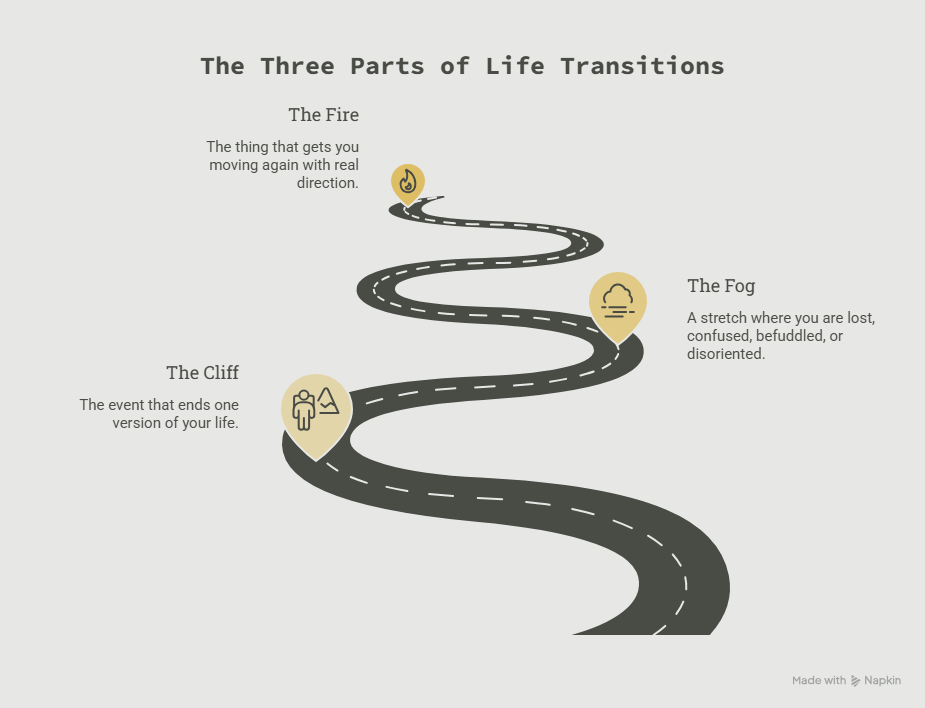
Collins describes retirement, and plenty of other life transitions, in three parts. A cliff — the event that ends one version of your life. Then fog — a stretch where you're, in his words, "lost or confused or befuddled or disoriented." Then, eventually, fire — the thing that gets you moving again with real direction, not just motion.
What stopped me was his insistence that the fog happens to everyone. Not the unprepared. Not the ones who did it wrong. Everyone. Highly accomplished people who've never failed at anything in their lives still walk straight into it.
What He Says to Do Instead
His advice for getting through it isn't to plan your way around it. It's smaller than that. "When you're in the fog," he writes, "don't always make huge irreversible decisions. Sometimes the next small sensible step is enough."
He calls it simplex stepping. One small, sensible, reversible move. Then another. Without needing to see the whole path first.
I didn't have a word for that when I left the business. I just did it — a small experiment, then another, willing to be wrong and cheap about it if I was. I've believed in "fail fast, fail cheap" for years without connecting it to anything as formal as Collins lays out. Turns out I'd been simplex-stepping the whole time. I just didn't know that's what it was called.
What Mary Lou's Fog Might Have Needed
I keep wondering what would've been different for Mary Lou if someone had told her, going in, that the fog wasn't optional — that it wasn't a sign her planning had failed her.
I don't know that it would have shortened her fog. I don't think that's the point. I think it might have kept her from spending part of it convinced something had gone wrong, on top of everything else she was already carrying.
That's the part I want to hand to whoever's reading this at two in the morning, wondering what they missed. You probably didn't miss anything. The fog wasn't a test you failed. It's not graded on how well you prepared for it.
Where I Actually Land, Which Isn't All the Way
I wish I could close this out clean. Tell you the fog passes by month four, or that embracing it instead of fighting it makes it shorter. I don't know that.
What I know is I'm mostly through mine now, and I've got a small next experiment going to see if it holds. I'm not scared of it not working. That part, at least, I got right without trying.
What I still don't know is whether the fog is something you're supposed to get through, or something you're supposed to need — a piece of the reinvention itself, not an obstacle in front of it. I go back and forth.
If you've been in it — planned, unplanned, or planned and it just didn't hold — I'd like to hear which door you came in through.
Hey, this is Josh. You're on the Long Strange Trip. I'm glad you're here.

Facebook
LinkedIn
Youtube