
What Eighteen Rejections Taught Me About Resilience (And Why Moving Every Two Years Might Be The Best Thing That Ever Happened To Jenny)
I've been thinking a lot about resilience lately.
Not the motivational poster kind. The real kind. The kind you don't plan for but somehow discover when life decides to rearrange everything you thought was stable.
Recently, I sat down with Jennie Bellinger, a whole person coach who's navigated more transitions than most people face in a lifetime. What struck me wasn't her success story. It was how many times she had to start over. And how those repetitive fresh starts built something in her that most of us are still trying to figure out.
Here's the thing about resilience: we treat it like it's some innate quality you either have or you don't. Like you're born tough or you're not.
But what if it's actually a skill? What if it's something you build through repeated exposure to change, even when—especially when—that change feels absolutely terrible?
I don't know the answer for sure. But Jennie's story has me rethinking everything I thought I knew about handling life's curveballs.
The Kid Who Never Got To Stay
Jennie's dad was a doctor in the Air Force. That meant moving every two to three years. Different bases. Different schools. Different everything.
"At first, I didn't realize this was different from how other kids grew up," she told me. "It was just normal life for me."
And I get it. When you're a kid, your normal is whatever you're living. You don't have perspective yet.
But here's what that constant moving taught her: people leave. Friendships end. And you can start again anyway.
This was before social media. Before texting. Before any of the ways we stay connected now existed. If Jennie's mom didn't stay connected with another parent, those friendships were usually gone forever. Just... over.
Pack the boxes. Say goodbye. Start at a new school where you know absolutely nobody. Figure out who to sit with at lunch. Learn the unwritten rules. Build friendships knowing you'll probably lose them in two years.
Repeat.
Most of us would look at that childhood and think it sounds hard. Maybe even damaging. All that loss. All those goodbyes. All that instability.
But Jennie sees it differently now. "I feel like it made me and my siblings more capable. We got used to assessing new situations quickly. We learned to start fresh, even when we didn't enjoy it."
That's the paradox of resilience that I'm still trying to wrap my head around. Sometimes the things we think will break us are actually building something we'll need later. Sometimes the struggles we'd never choose for ourselves—or for our kids—are teaching lessons we can't learn any other way.
I've watched this in my own life, though I didn't recognize it until recently. The business challenges I thought were derailing me were often preparing me for something I couldn't see coming. The health scares that felt like pure loss were teaching me things about myself I needed to know.
I'm not saying I'm grateful for cancer. I'm not. But I am noticing that it's forcing me to develop capacities I didn't have before. Capacities I probably wouldn't have developed if everything had stayed comfortable.
What Resilience Actually Looks Like (It's Not What You Think)
I want to push back on how we usually talk about resilience.
We act like resilient people don't feel pain. Like they just bounce back effortlessly. Like, change doesn't hit them as hard as it hits the rest of us mere mortals.
That's complete bullshit.
That's not what I heard from Jennie. And it's definitely not what I've experienced in my own stumbling attempts at resilience.
Resilience isn't about not feeling the loss. It's about feeling it—really feeling it—and moving forward anyway.
Jennie told me about clients going through divorce or career shifts. "Initially, I taught sales tactics," she said. "Then I noticed those didn't help when life fell apart."
Because here's the thing: you can't tactic your way through grief. You can't productivity-hack your way through identity loss. You can't optimize your way out of fundamental life changes.
I've tried. Trust me, I've tried.
When I got my cancer diagnosis, my first instinct was to research everything. Learn all the statistics. Understand all the treatment options. Control what I could control through information.
And that helped. Information is good. Understanding your options matters.
But it didn't touch the deeper fear. It didn't address the grief of losing my sense of physical capability. It didn't solve the identity crisis of moving from "healthy active guy" to "cancer patient."
No amount of research fixes that. No productivity system helps you process the reality that your body isn't cooperating with your plans anymore.
What does help? I'm still figuring that out, honestly.
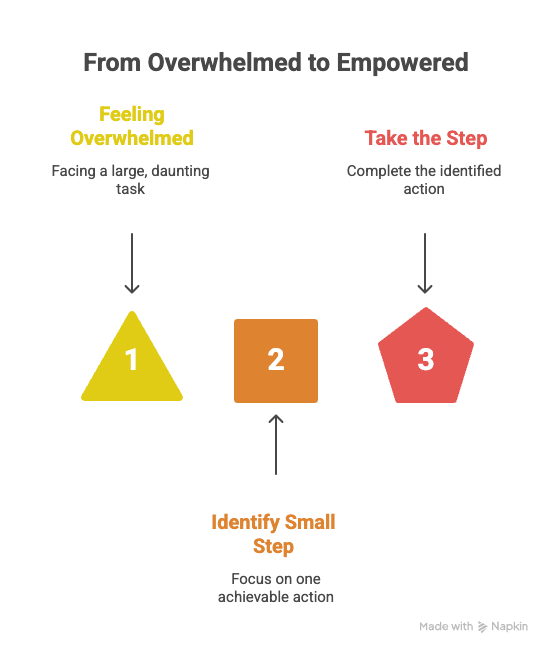
But here's what I'm learning from Jennie and from my own experience: resilience is about developing the capacity to sit with discomfort while still taking the next small step.
That's different from "powering through." That's different from "staying positive." That's about being brutally honest that this is hard, and also deciding you're going to keep going.
It's saying, "I'm scared about treatment," and also showing up for the appointment. It's admitting "I'm grieving the loss of skiing" and also looking for what physical activities might still be possible. It's acknowledging "I have no idea what my future looks like" and also making plans for next week.
Both things are true at the same time.
The hard part—at least for me—is not letting the fear or grief or uncertainty become an excuse to stop moving. Because that's tempting. When everything feels overwhelming, the easiest thing is to just... stop. Stop trying. Stop planning. Stop engaging.
But I've noticed something. The times I've done that, the times I've let myself get completely paralyzed by the difficulty, I end up feeling worse. Not better.
The tiny steps forward, even when they feel pointless, even when I'm not sure they matter—those actually help. Not because they solve everything. But because they remind me I still have some agency. Some choice. Some capacity to influence what happens next.
Jennie put it this way: "You can't control the event, but you can control your next small step."
That's been my mantra lately. When I wake up exhausted from treatment. When I'm frustrated about what I can't do anymore. When I'm anxious about what's coming.
What's my next small step? Not my next big plan. Not my master strategy for handling everything. Just the next small step.
Sometimes that's writing for twenty minutes. Sometimes it's a phone call to a friend. Sometimes it's just getting out of bed and sitting on the deck.
Small. Achievable. Forward.
The Whole Person Problem (And Why Everything's Connected)
As Jennie's business grew, she started noticing something. She was teaching people sales techniques, but their real struggles were deeper.
Way deeper.
"Most of us try to slice our lives into neat pieces," she explained. "We separate work, family, and health. But life transitions involve everything. A job loss affects your mood and your marriage. A health scare shakes your work stability."
Jennie moved toward a "whole person" coaching approach because she realized you can't help someone's business without acknowledging their grief. You can't support their career transition without understanding their identity crisis. You can't address their sales numbers without recognizing their marriage is falling apart.
The resilience we need isn't just professional or just personal. It's integrated. It's about developing the capacity to adapt across all areas of life simultaneously.
And that's really hard, because it means you can't just "fix" one area and expect everything else to stabilize.
I've been trying to figure out what this looks like practically. How do you develop whole-person resilience when you're already stretched thin?
Here's what I'm experimenting with, though I'm not sure it's working yet:
Instead of trying to keep all the balls in the air perfectly, I'm trying to be honest about which ones I'm dropping. With myself and with the people around me.
"I'm dealing with health stuff right now, so my work output is going to be less." "I'm emotionally exhausted today, so I might not be great company." "This transition is kicking my ass, so I need more support than usual."
That feels vulnerable. It feels like admitting weakness.
But I'm starting to think that vulnerability is actually part of resilience, not the opposite of it.
When you pretend everything's fine when it's not, you burn energy maintaining the facade. Energy you need for actually adapting to what's happening. When you're honest about what's hard, people can help. And you can allocate your limited resources more intelligently.
Jennie talks about this with her clients. "If your net is thin, start building," she told me. "It's a valuable resource when times get tough."
But building that net requires admitting you need one. It requires being honest about what's actually happening across all areas of your life.
I'm not naturally good at this. My default is to handle things myself. To not burden people. To keep pushing until I figure it out.
But that approach hasn't served me well during this transition. The times I've actually reached out, admitted I'm struggling, asked for help—those are the times I've felt most supported and least alone.
The whole person approach means acknowledging that your work stress affects your sleep, which affects your health, which affects your relationships, which affects your work stress. It's all connected.
And resilience isn't about being strong in one area. It's about building flexibility across all of them.
The Support Network You Build Before You Need It
One pattern I noticed in Jennie's story: she had people around her. At the jewelry party. In her business. In her coaching practice.
This wasn't accidental.
I asked her about this because I've noticed something painful in my own life. The times I've struggled most with transitions are the times I've tried to handle them alone.
"Strong relationships are vital," Jennie said. "You might need a formal support group or just a good friend. But if your net is thin, start building. It's a valuable resource when times get tough."
This is where I think a lot of us get it backwards. I know I do.
We wait until we're drowning to reach out. We wait until the crisis is crushing us to admit we need help. We wait until we're desperate to start building support networks.
But resilience isn't built in the crisis. It's built before the crisis.
It's the friend you text regularly now who'll be there when things fall apart later. It's the community you invest in during good times that holds you during bad times. It's the therapist you see for maintenance who helps you navigate when things get really hard.
Think about Jennie's story. She didn't wait until she was rejected eighteen times to build relationships. She had people around her throughout. Her sister-in-law invited her to the party. She had family support while she was interviewing. She built a network in her business before she needed to lean on it.
There's this thing that happens when you're going through something hard alone. You start thinking you're the only one. That everyone else has it figured out. That your struggle is unique or shameful or a sign that you're failing.
But when you talk about it, when you let people in, you discover you're not alone. Other people have been here. Other people are here right now. Other people understand in ways you didn't expect.
That doesn't make the transition easy. But it makes it more bearable.
Here's what I'm figuring out: building support before you need it means being vulnerable before you're desperate. It means sharing the small struggles, not just the big crises. It means staying connected during the good times so the relationships are strong when the bad times hit.
I'm not naturally good at this. But I'm practicing. Awkwardly. Imperfectly. But practicing.
What I'm Still Figuring Out
I'll be completely honest with you. I'm not great at this resilience thing yet.
I'm 73 years old, dealing with two cancers, navigating retirement transition, facing the loss of physical activities that have defined me for decades. And some days—a lot of days—I'm really not okay with any of it.
Some days, I want to argue with reality. I want to insist things should be different. I want my old capacity back. I want to ski. I want to ride my bike thirty miles without thinking about it. I want to not be tired all the time.
Some days I'm angry. Some days I'm scared. Some days I just feel lost.
But here's what talking with Jennie reminded me: resilience isn't about not having those days. It's about what you do after them.
It's about the small choice to keep showing up. To take the next small step. To ask for help. To be honest about what's hard while also looking for what's still possible.
Jennie mentioned something early in our conversation that's been sitting with me: "Name the transition you're actually in."
The Questions That Actually Help
Here's what I've learned from my conversation with Jennie and from my own stumbling through transitions:
The question isn't "Am I resilient enough?"
That question just creates anxiety. Because what does "enough" even mean? Enough for what? Compared to whom?
The questions that actually help are different:
What am I trying to protect that still matters?
Where am I treating symptoms instead of the root problem?
Who can I be honest with about this transition?
What small step can I take today?
These questions don't solve everything. But they move me from frozen to active. From victim to participant. From helpless to having some agency.
Let me break these down based on what I'm learning:
What am I trying to protect that still matters?
Sometimes we fight to keep things that don't actually serve us anymore. We cling to identities or routines or expectations because they're familiar, not because they're valuable.
I've been asking myself this about skiing. Am I trying to ski again because it genuinely matters to who I am? Or am I trying to ski because I'm afraid of what it means if I can't?
That's a different question with a different answer.
Where am I treating symptoms instead of the root problem?
This is the one that gets me most. I'm really good at surface fixes. I'll change my schedule or try a new productivity system or adjust my routine. But I won't address the deeper thing that's actually bothering me.
Like when I'm exhausted, my instinct is to try to power through or find energy hacks. But the root problem isn't efficiency. It's that I'm dealing with a disease that causes fatigue. No amount of optimization fixes that. Accepting it and adjusting my expectations might.
Who can I be honest with about this transition?
This question forces me to actually reach out instead of isolating. Because I can't answer it without identifying specific people and then actually being vulnerable with them.
It's uncomfortable. But it's also necessary.
What small step can I take today?
This is my anchor when everything feels too big. Not "how do I solve this whole thing?" Just "what's one small step forward?"
Today, that might be writing this article. Tomorrow, it might be calling a friend. Next week, it might be researching treatment options.
Small. Achievable. Forward.
Where We Go From Here
I don't have this figured out. Neither does Jennie, really. She's still navigating transitions. Still learning. Still discovering new layers of what resilience actually requires.
But here's what I'm taking from our conversation:
Resilience isn't something you either have or don't have. It's something you build through repeated exposure to change. Through learning that you can survive endings. Through discovering you can start again even when you don't want to.
It's built in relationships before you need them. In honest conversations about what's hard. In small steps forward when everything feels overwhelming.
And maybe most importantly: it's built by reframing the question from "Why is this happening to me?" to "Where might this be taking me?"
I'm not saying everything happens for a reason. I don't believe that. Bad things happen. Loss is real. Pain is legitimate.
But I am saying that how we interpret these transitions shapes how we move through them. And sometimes—not always, but sometimes—the detours that feel like disasters are actually redirecting us toward something we couldn't have found on the original path.
Your Turn
I'm curious about your experience with transitions and resilience.
What's a time when you thought something was breaking you, but it ended up building something you needed? Have you had your own version of eighteen rejections that taught you something about persistence?
And where are you right now in your own transitions? What stage are you in? What's the work that stage requires?
Because here's what I'm learning: we're all navigating this stuff. We're all trying to figure out how to stay flexible when everything feels rigid. How to keep moving when everything feels stuck. How to build resilience when we feel like we're barely surviving.
I'm still figuring this out alongside you. Still learning what resilience actually looks like in real life, not in motivational posters.
Still making mistakes. Still having days where I want to give up. Still wondering if I'm doing any of this right.
But also still showing up. Still taking small steps. Still being honest about what's hard while looking for what's possible.
Let's figure it out together.

Facebook
LinkedIn
Youtube