Relief Is Not Betrayal
Relief is not betrayal. It's the body finally exhaling after a long dread.
I wish someone had told me that before I spent years ashamed of my own lungs. When the thing you've been bracing against finally ends, the mind rushes in fast. It convicts you before you've caught your breath. Relief must mean you wanted them gone.
I don't believe that anymore. But I had to go looking to stop believing it.
The drive to Hunter
I was thirty when my mother died. My father didn't go make the arrangements. He told me to.
Hunter is up in the Catskills. I drove there alone to meet relatives I barely knew. I had to sit across from strangers and describe what her funeral should look like.
I was grieving my mother. That part was real, and it was enormous.
But underneath the grief, the whole drive up, there was something else. Anger. At my father, not at her. He was the husband. This was his to carry, not mine.
I didn't say that to anyone. There was nobody to vent to.
At the burial, when it came time to place dirt on the casket, I didn't. I've never been sure why. My best guess, looking back now, is that some part of me was still furious and wouldn't play along.
My father did the opposite. In a Jewish burial, you shovel a spadeful or two, then step back and let the next person take a turn. That's the custom. Restraint is built into it on purpose.
He didn't do that. He kept shoveling, past his turn, past several other people's turns. He looked almost possessed, like the dirt was the only thing he could still control.
I hadn't thought about that day in years. Working on this piece is the first time I've gone back to it since.
Grief passes off what it can't carry
Here's something I only worked out writing this, at seventy-three, that I couldn't have seen at thirty.
I don't think my father handed me the arrangements because he was lazy, or because he thought it was somehow my job as the son. I think he handed them to me because he genuinely couldn't do it.
Whatever was happening in him — grief, guilt, both at once, I honestly don't know, and I'm not going to guess at the particulars here; it left no room for logistics. He needed someone standing nearby who could still function. That happened to be me.
I don't say that to let him off the hook. I resented him for a long, long time, and some of that resentment hasn't fully left. I'm only saying I understand the mechanism better now than I did in the car.
Grief doesn't announce itself politely and wait its turn. It grabs whatever it can't carry and hands it to the nearest person still standing. That person rarely gets asked. They just get handed the job, usually at the exact moment they're least prepared to say no.
I couldn't say no. I was thirty, in shock myself, and he was my father. There wasn't a version of that conversation where I got to hand it back.
The man shoveling dirt as if it owed him something, and the son who couldn't bring himself to shovel any at all. I think that was the same grief, wearing two different faces.
If my father tried to hand me that job today, I don't think I'd take it. I'd tell him this one's his. Go find a hard way to sit in your own grief, instead of driving out of it.
At thirty I didn't have that sentence anywhere in me. At seventy-three I do, and I'm still working out what it cost me not to have it then.
The job instead of the feeling
Here's what I think happened in Hunter, and I think it happens to a lot of us. I wasn't handed a feeling. I was handed a task.
Go make the arrangements. Go talk to the relatives. Go handle it.
Tasks are efficient that way. They arrive dressed as help, and they crowd out whatever was trying to surface underneath them. I didn't get the fog everybody talks about. I got a to-do list instead, at the worst possible moment, and I did it because nobody told me I could say no.
It's done. What's next? That's an old voice of mine, and it showed up early. Forty years before I'd have named it, it was already running the car up to Hunter.
The voice that's writing this now doesn't think that was strength. It thinks a thirty-year-old man got robbed of a few days he needed, and called it handling it.
The caregiver's side of relief
I keep coming back to something I've never actually asked my wife.
Suzanne stood beside me through my first cancer, almost twenty years ago now. I got sick, and I got better, mostly on the ordinary schedule doctors talk about. I eased out of it in stages.
She didn't get stages. One day she was fully inside it — every scan, every phone call, every version of me that walked through the door. For about a year, I was her project, full stop.
She never complained. She never asked for support either, and mostly she didn't get any. Every so often, someone would come sit with me so she could get out of the house for an afternoon. That was the extent of her relief, for a year.
Here's what I got wrong, and only noticed while writing this. I've told people for years that once I was better, she snapped back to her own life almost automatically. That's not true. It took her a long time to move from being my full-time caregiver back to being herself again. There were stages on her end too. I just wasn't the one living through them, so I didn't see them happen.
What strikes me most, looking at it now, is that nobody made her do any of it. Nobody assigned her the job the way my father assigned me for my mother’s funeral. She decided, on her own, that this was hers to carry.
That's internal resilience, as close to a textbook version of it as I've ever watched up close. Nobody outside her told her it was the right thing to do. She simply believed it was, and she did it.
Mine, in Hunter, was the other kind. External. Somebody told me to buck up and get it done, and I did, because I didn't think I had a choice. I'm still not sure "resilience" is the right word for either one of us. It's the word we've got, so it's the one I'll keep using.
A caregiver doesn't taper off a crisis the way a patient does. The job runs at close to 100%, and then it's gone almost overnight, even if the person underneath it takes a year to catch up. I'd bet her relief, when the crisis ended, was bigger than mine ever was. I've never actually asked her that question out loud.
If there was a long illness and, if you’re lucky, there is always a caregiver standing next to you. When the dying finally happens, something in that caregiver exhales too. Nobody hands them permission for that either, and almost nobody asks how long it takes them to stop being someone's project and go back to being themselves.
When the job was the only self left
I went looking at how other people talk about this, and one thing kept coming up that I hadn't expected.
For a lot of caregivers, the hardest part of the ending wasn't losing the person. It was losing the job. Somewhere in the years of it, "caretaker" had become the only self they still recognized.
One woman online put it about as plainly as I've heard it put. She and her husband had cared for his father for years, at real cost to her own body. When it finally became too much, and the decision came to place him somewhere he could get real care, what she said she was grieving wasn't him leaving. It was having to stop being the one holding it all together — because that had quietly become who she was.
That's a different shame than the one everyone talks about. It isn't "did I want them gone." It's closer to: if I'm not carrying this anymore, who exactly am I?
The relief almost nobody will say out loud
There's a rawer version of all this, and I found it by accident, in a thread full of adult children of difficult parents.
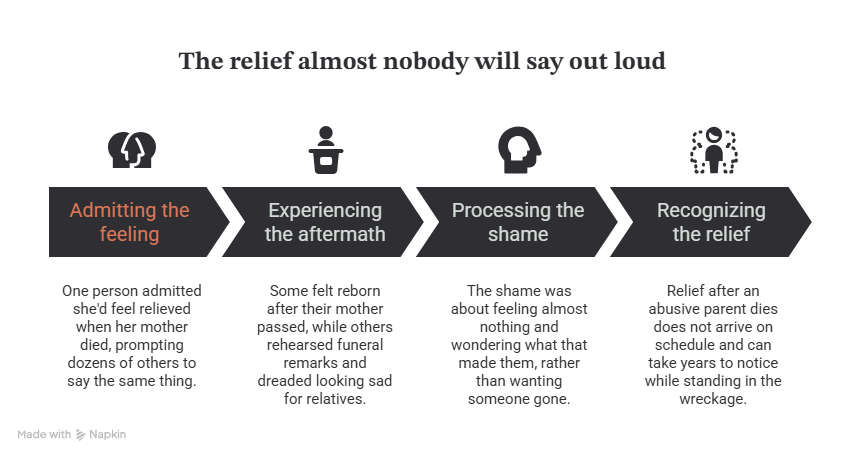
Once one person admitted she'd feel relieved when her mother died, dozens of others said the same thing, in language I don't think they use anywhere else. One described feeling reborn the day her mother finally passed. Another said she was already rehearsing what she'd say at the funeral — that her mother's misery was finally over too — and dreading having to look sad enough for the relatives.
That's not relief tangled up with grief. For some of them, there wasn't much grief left to tangle with. The shame wasn't about wanting someone gone. It was about feeling almost nothing, and wondering what that made them.
I recognize a piece of that, and I'll say it plainly since I'm the one asking everyone else to. There's relief that comes after an abusive parent dies, and I've felt a version of it myself. It doesn't arrive on schedule. It can take years to even notice it's there, because you're still standing in the wreckage trying to figure out which way is up.
The other direction entirely
Not everyone who comes out the other side of a long ordeal finds relief laced with guilt. Some people find something closer to joy, and it surprised me how plainly a few of them said so.
One woman wrote about her mother's death, after years of being the one holding everything together, and didn't hedge it at all. She called it liberation. She said the feeling of having no fucks left to give was real and a wonderful place to build from.
That's not a woman apologizing for what she felt. That's a woman standing up.
I think that's the part of this we don't talk about enough. The fog doesn't only lift into guilt. Sometimes it lifts into a door swinging open, and the person walking through it isn't looking back.
The fog moves both ways
Here's the piece I hadn't considered before this month. We talk about "coming out of the fog" like it's a one-way trip. It isn't.
You can move from the fog forward, into something like anticipation. Or you can move from the fog backward, deeper in than you started. Same ending. Two completely different directions out of it.
For some people, the ending is a door. Relief, then joy, then whatever's next gets to start.
For others, the ending is a trapdoor. Relief shows up first, and then guilt drags them down further than the fog they were already standing in.
I don't think you get to choose which way you go by trying hard enough. I think it depends on what you were carrying, and for whom, and whether anyone ever told you it was allowed to end.
What Frankl was actually saying
Viktor Frankl spent years in concentration camps before he wrote about what was left when everything else got taken. His claim was that once a situation truly cannot be changed, the only thing left to do is change yourself in response to it.
People quote that line as inspiration. I don't think that's what it's for.
I think relief, the honest kind, is what's left over when a meaning you were carrying for someone else finally gets set down. Not the meaning of losing them. The meaning of holding something on their behalf — their care, their comfort, their unfinished business — for however long it took.
That's not the same as wanting the weight in the first place. It's the body noticing, often before the mind catches up, that the weight is gone.
In Hunter, I wasn't carrying my own grief up that mountain. I was running an errand for my father. When it was finally done — the arrangements made, the burial over — some part of me set that down too. I just didn't have a word for it at the time, other than angry.
What I'd say to the thirty-year-old in the car
I can't go back and take that drive for him. I wouldn't want to, honestly — he needed to make it, even furious, even alone.
But I'd like him to know something nobody told him on the way up.
You're allowed to feel two things going up that road. Grief for her. Anger at being handed a job that wasn't yours. Neither one cancels the other out, and neither one means you loved her less.
And when it's over — whichever direction the fog sends you — that's not a verdict on you either. It's just where the weight landed.
I'll hold that much for you, if it helps. That's the only kind of carrying I know how to do from here.
Where did the fog send you — forward, or back down deeper? And if you were the one holding everything together for somebody else, I want to hear what happened to you once the job ended. The comments are open.
Hey, this is Josh. You're on the Long Strange Trip. I'm glad you're here.


Facebook
LinkedIn
Youtube