The Problems We're Actually Investigating (And Why This List Could Go On Forever)
Here’s something I’ve been thinking about.
When I sat down to map out the problems The Long Strange Trip explores, I figured I’d come up with maybe a dozen. Something manageable. Something comprehensive but not overwhelming.
Instead, I came up with eighteen. And I could’ve kept going.
I could’ve added another six problems just about navigating healthcare systems when you’re seriously ill. Three more about rebuilding relationships you damaged during the business-building years. A whole section on financial anxiety that persists even when you have plenty of money.
The list could’ve been thirty problems. Forty. Maybe more.
And here’s what that tells me: we’re walking around with way more unresolved, unaddressed, completely unprepared-for challenges than we’re willing to admit.
Most business advice focuses on one or two problems at a time. Nice and tidy. One problem, one solution, move on.
Except that’s not how life actually works.
When you’re navigating the transition from business ownership to whatever comes next, you’re not dealing with one clean problem. You’re dealing with identity reconstruction while facing mortality while adapting to health changes while trying to figure out how to share wisdom in a culture that thinks you’re outdated.
All at once.
Nobody wants to talk about that level of complexity because it’s overwhelming. It’s easier to pretend we’re dealing with discrete, manageable problems that have clear solutions.
But pretending the problems are simpler than they are doesn’t make them simpler. It just makes us feel like failures when we can’t solve them quickly.
So instead of the sanitized version, I’m sharing what we’re actually investigating. Six major areas. Eighteen significant problems. And honest acknowledgment that this list could be longer – and that’s okay.
Three Problems We Solve in Each Area, and it could be thirteen problems.
1. Work-Life Integration
Problem #1: The “Just Until” Trap You keep telling yourself the 80-hour weeks are temporary. Just until you close this deal. Just until you hire the right person. Just until revenue hits $X million. Except the goalposts keep moving, and “temporary” has turned into years. Meanwhile, your kids are growing up without you, and you’ve missed so many moments you can never get back.
Here’s what we’re investigating: What makes the “just until” trap so seductive, and why do the goalposts keep moving? We’re exploring what it actually takes to stop the cycle – not through willpower or guilt, but by understanding what’s driving the pattern. What would it look like to work consciously instead of reactively?
Problem #2: Bringing Boardroom Energy Home You’ve mastered the intensity, directness, and results-driven approach that makes you successful in business. Then you bring that same energy home and wonder why your spouse feels like an employee and your eight-year-old shuts down when you “give feedback” about their homework.
Here’s what we’re investigating: Why does the same approach that works brilliantly in business destroy connection at home? We’re figuring out what it actually means to develop different modes for different contexts. How do you show up as a parent in ways that are fundamentally different from how you show up as a boss? Can you train yourself to switch modes, or does it require something deeper?
Problem #3: The Leftover 5% Problem. Your family gets whatever energy remains after business demands are met. You’re physically present but mentally somewhere else. Checking your phone during dinner. Thinking about tomorrow’s meeting during your kid’s soccer game. Present in body, absent in mind.
Here’s what we’re investigating: What creates the mental boundary between work and home that actually sticks? We’re exploring how to build systems that protect family time the same way you protect important client meetings. But more than that, how do you actually be present when you’re home? What stops work from colonizing every moment of your life?
2. Retirement Identity
Problem #1: The Identity Void You spent 30-40 years being “the business owner,” “the decision-maker,” “the person everyone comes to for answers.” Then you retire, and you’re... what? Someone with a lot of free time and no clear purpose. The phone stops ringing. Your calendar empties. And you have no idea who you are without your business card.
Here’s what we’re investigating: Can you actually build post-business identity before you retire, or is that like trying to prepare for grief before loss happens? We’re exploring what it means to develop relationships outside of work, interests beyond business, and a sense of self that isn’t solely dependent on what you do. How do you start this identity reconstruction work while you still have the structure of a business to support you?
Problem #2: The Activity Trap. You try to fill the void with golf, travel, volunteering, and grandkids. But if you’ve spent 40 years solving complex problems and leading teams, playing golf four times a week isn’t going to feel like enough. The activities are fine, but they’re not sufficient to replace the intellectual challenge, sense of purpose, and identity you derived from business ownership.
Here’s what we’re investigating: What do you actually need versus what you think you’re supposed to want? We’re digging into the difference between activities and underlying needs. If you need intellectual challenge, purpose, connection, daily structure, and identity – how do you meet those needs in retirement without just recreating your business life?
Problem #3: Comparing the New Normal to the Old Normal. You keep measuring your retirement life against your business life and finding it lacking. Of course it’s different – that’s the point. But you can’t figure out how to build something meaningful within this new reality because you’re too busy mourning what was.
Here’s what we’re investigating: How do you actually make peace with what was while embracing what is? We’re exploring whether retirement is really a transition to a different kind of contribution, or if that’s just something we tell ourselves to feel better. What does integration of all your life phases actually look like in practice?
3. Mortality Planning
Problem #1: The Practical Stuff Nobody Does. You don’t have updated wills, healthcare proxies, or living wills. You haven’t told anyone what kind of medical interventions you want. You have no clear instructions about end-of-life care, funeral preferences, or what should happen to your body. So when something happens, your loved ones are left guessing and fighting while they’re grieving.
Here’s what we’re investigating: Why do we avoid the practical basics when we know they matter? We’re exploring what it actually takes to get this stuff handled – not the logistics (those are straightforward), but the psychological barriers that keep us from doing it. What makes it feel less urgent than planning a vacation?
Problem #2: The Conversation Avoidance. You’ve never talked with your spouse about what kind of medical interventions you’d want if you couldn’t speak for yourself. You haven’t told your kids what matters most about how you’re remembered. You’ve avoided these conversations because they’re uncomfortable, and now everyone’s guessing about what you’d want.
Here’s what we’re investigating: How do you start conversations about death without making them heavy and awful? We’re figuring out what it looks like to talk about mortality regularly, as a normal part of life – not in one big dramatic sit-down. When do you bring it up? How do you frame it? And the deeper question: what actually needs to be said before it’s too late?
Problem #3: Never Actually Facing Your Mortality You intellectually know you’re going to die, but you’ve never actually sat with that reality. So you’re living like you have unlimited time, putting off what matters, avoiding hard conversations, and not making peace with the life you’ve actually lived versus the one you thought you’d live.
Here’s what we’re investigating: What happens when you stop avoiding death and actually look at it straight on? We’re exploring whether facing mortality really does change how you live, or if that’s just something people say. What does it mean to sit with the reality of your death? And what’s the difference between healthy mortality awareness and morbid obsession?
4. Building Resilience
Problem #1: Fighting Reality Instead of Working With It Your body is changing – whether from illness, injury, or aging – and you keep insisting it should be different. You push through fatigue and pay for it later. You compare yourself to who you used to be and feel like a failure. You’re exhausting yourself fighting what is instead of adapting to it.
Here’s what we’re investigating: What’s the difference between accepting reality and giving up? We’re exploring what it actually means to work within your current capacity rather than constantly fighting for capacity you no longer have. How do you build new rhythms that fit your new reality? Where’s the line between acceptance and resignation?
Problem #2: The Grief You’re Not Allowing You’ve lost activities that were central to your identity – maybe skiing, running, working long hours, or just the energy to do what you want when you want. But you’re trying to skip over the grief and jump straight to acceptance. Except that doesn’t work, and now you’re carrying unprocessed loss that’s making everything harder.
Here’s what we’re investigating: How do you grieve what’s lost without getting stuck in it? We’re figuring out what healthy grieving actually looks like when it’s not about death but about loss of capacity or identity. How long is long enough? And the tricky part: how do you grieve while also staying open to what’s still possible?
Problem #3: Catastrophizing About Uncertain Futures. You start with “I’m tired today,” and your brain spirals to “What if this fatigue never gets better? What if I keep declining? What if I can’t do anything I enjoy anymore?” You’re so busy worrying about uncertain futures that you’re missing the present you actually have.
Here’s what we’re investigating: How do you stay present with what’s actually true right now instead of future-tripping? We’re exploring what it takes to develop the capacity to sit with uncertainty without letting it steal today. When is planning for the future prudent, and when is it anxiety masquerading as preparation?
5. Wisdom Sharing
Problem #1: Making Yourself Irrelevant You tell stories that start with “back in my day.” You dismiss new approaches because “we tried that before.” You complain about “kids these days.” And you wonder why nobody wants to hear your perspective. You’re packaging valuable wisdom in ways that make people defensive or dismissive.
Here’s what we’re investigating: What makes wisdom land versus what makes it bounce off? We’re figuring out how to frame experience as perspective rather than prescription. What does it actually look like to connect wisdom to the current context instead of leading with how things used to be? Is it possible to share hard-earned lessons without sounding like you think you know everything?
Problem #2: The Ageism Internalization You’ve started believing the narrative that your experience is outdated. You hold back advice because you don’t want to be “that old guy.” You apologize for your age. You downplay your expertise. You’ve internalized ageism and are contributing to your own irrelevance.
Here’s what we’re investigating: How do you position your experience as valuable without being arrogant about it? We’re exploring what actually improves with age – pattern recognition, perspective on what matters, emotional regulation, long-term thinking – and how to leverage those advantages. When should you share your experience, and when should you keep quiet?
Problem #3: The Generational Communication Gap You’re frustrated because younger people communicate differently, value different things, and don’t seem to respect your experience. They’re frustrated because you seem out of touch and dismissive of new approaches. The generational divide is creating friction that makes wisdom-sharing nearly impossible.
Here’s what we’re investigating: Can you actually bridge the generational gap, or are some differences unbridgeable? We’re figuring out what it looks like to understand their actual challenges rather than the ones you think they should have. How do you create reciprocity where both generations learn from each other when the power dynamic is inherently unequal?
6. Transition Navigation
Problem #1: Not Knowing Where You Are. You’re in a major life transition – cancer diagnosis, business sale, retirement, whatever – and you’re completely disoriented. Some days you feel okay, other days you’re drowning. You’re beating yourself up for not handling it better, not adjusting faster, not being “over it” already. But you don’t even know what stage of transition you’re in, so how could you know what that stage requires?
Here’s what we’re investigating: Does naming your stage actually give you power, or does it just give you a label? We’re exploring the four stages – Anticipation, Ending, Passage, New Beginning – and what each one demands. Can understanding where you are actually change how you experience it? And if you can accurately name your stage, what do you do with that information?
Problem #2: Fighting the Stage You’re In. You’re in Anticipation but trying to force certainty. You’re in Passage but expecting to feel settled. You’re in Ending but refusing to let go. You’re fighting the natural process of transition instead of working with it, and it’s making everything harder.
Here’s what we’re investigating: What does it actually mean to embrace the stage you’re in? We’re figuring out whether you can truly accept that Anticipation is supposed to be uncertain, Passage is supposed to be messy, and Endings require actual grief – or if you always fight it to some degree. Can you stop skipping ahead to New Beginning before you’ve done the work?
Problem #3: The Stacked Transitions Problem You’re not just dealing with one transition. You’ve got multiple transitions happening simultaneously – retiring while dealing with health changes, while facing mortality, while trying to figure out your identity. Each transition affects the others, and you feel completely overwhelmed by the complexity.
Here’s what we’re investigating: How do you navigate when transitions stack and affect each other? We’re exploring whether there are strategies for handling multiple simultaneous transitions, or if you just have to survive them one day at a time. What kind of support actually helps with this level of complexity? And the honest question: can you actually handle all of this, or is asking for that level of resilience unrealistic?
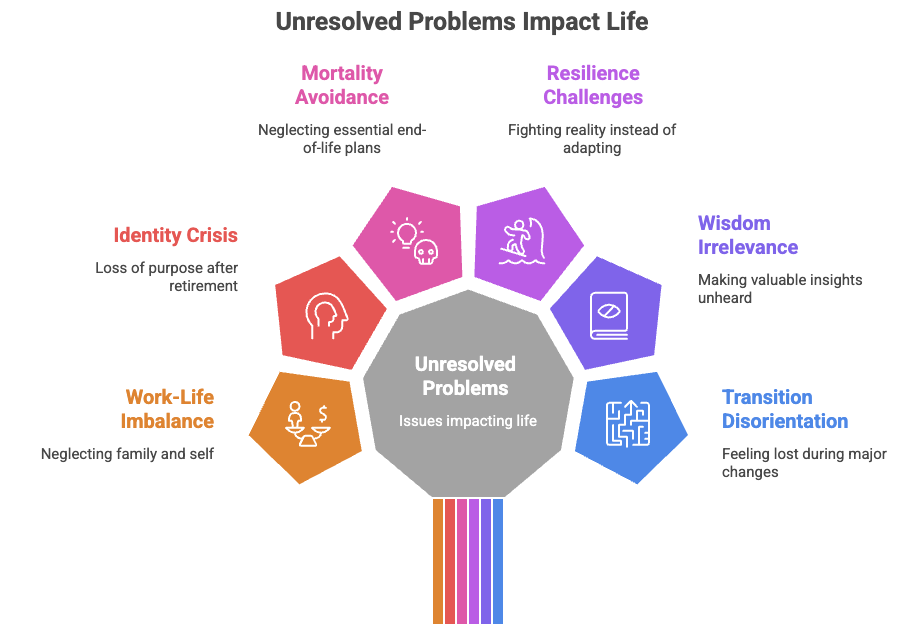
The connecting thread: These aren’t questions we’re going to answer definitively. They’re the real, messy, complicated challenges we’re exploring together.
With honest investigation, shared experiences, and the acknowledgment that we’re all figuring this out as we go.
The more we move into each area of investigation, the more areas tha pop up that need examination. I hope I live long enough to explore each of these areas and learn from those who experience them and are experts in them, knowing there is always more than one way to skin a cat.

Facebook
LinkedIn
Youtube