Old But Not an Elder
I've been waiting for a word I'm not allowed to ask for.
There's something I want, and I'm embarrassed to want it.
I'm seventy-three. I've run businesses and sold them. I've made expensive mistakes and lived past them. And somewhere in the last few years, I started wanting to be called an elder.
Not old. Elder. There's a canyon between those.
I can't say that at a dinner table. It sounds like a man asking to be admired. Which is close enough to true that it stings.
The rule nobody told me about
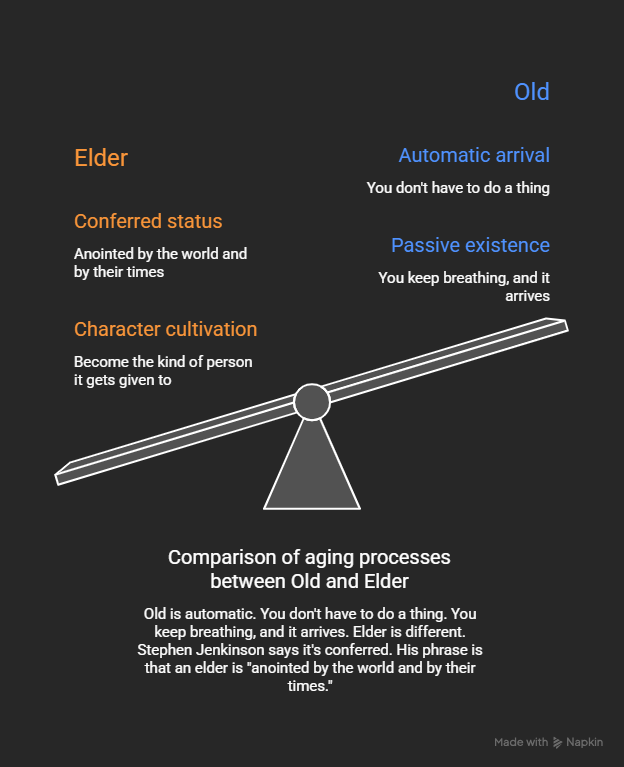
Old is automatic. You don't have to do a thing. You keep breathing, and it arrives.
Elder is different. Stephen Jenkinson says it's conferred. His phrase is that an elder is "anointed by the world and by their times."
Which puts it in a strange category. It may be the one thing a whole life of effort can't get you directly.
You can only become the kind of person it gets given to. Then you wait.
I flagged this in a piece a while back. Said I wasn't ready. I'm still not sure I am.
The people who went ahead and took it
Here's what pushed me back into it.
I went reading comment sections. Two in the morning, when people say the real thing. Looking for anyone sitting where I'm sitting.
I found a man named Mark. Seventy-three. Same as me, to the year.
He wrote that he declared himself an elder. His words: "I refuse to be irrelevant."
Something turned over in my chest when I read that. It wasn't admiration.
I'll give him his due. Refusing to disappear is a real decision. Plenty of men my age make the other one.
But you can do that alone in a room.
Then a woman named Jo-Ann asked what made her an elder rather than just old. Her answer: "Experience, wisdom, self-awareness, no rushing, and the serenity I feel inside."
Look at that list again. Every item is interior. There isn't another human being anywhere in it.
I don't think she's wrong about herself. I think she answered a different question.
Here's where I land. When a man announces he's not old, he's an elder; he's mostly told me he's older.
An elder has wisdom other people actually want. Want. That word is doing all the work.
You can't manufacture somebody else's wanting.
The man I never got around to telling
So I sat with the obvious follow-up. Have I ever conferred it on anyone?
One name came up. Shields Harvey.
Shields was about fifteen years older than me. The most influential man in my working life.
Did I ever tell him what he was?
No. I told him he was my mentor. I'm certain of that. Said it more than once and meant it.
But mentor isn't the word. What he had was elder wisdom. Mentor was the closest thing in my pocket.
Here's the part I didn't expect to find. I couldn't have told him.
I didn't have the concept. Nobody had handed me the word. You can't confer a title you've never heard of.
Then I sold my food service business, and the mentoring part quietly ended.
We stayed in touch for a while. I'd call, tell him what was going on, hear about his life. Every single time, he handed me some gem.
I can't remember one of them. Not one. It was thirty-five years ago.
What I remember is the attention. This was a man I had enormous respect for, and he took me seriously.
That was the whole gift. The gems were just what it came wrapped in.
Then it tapered. Fewer calls, longer gaps, nothing dramatic.
About ten years ago I went to reach him and had nothing current. No working number. No address.
I didn't lose him in a fight. I lost him the way you lose a phone number.
He'd be pushing ninety now. I suspect he's gone.
Something I read that I can't put down
While I was digging, I found a woman's tribute to her dead mentor.
His name was Jim. Her clinical supervisor. Pancreatic cancer took him in early 2020.
She'd started her own practice, a decision he'd shaped, and never told him.
Her line: "I never told Jim about my decision. I don't know why not. I really wish I had."
Then: "Just like I really, really wish I'd visited him when he was sick."
Ordinary regret. Millions of us have one.
Then his family found the tribute. And his daughter left a comment.
She wrote that her father used to mention this woman and her writing. A lot. Because the daughter was a writer too.
Read that again slowly. It took me a minute.
He'd been naming her for years. To his kid. At his own dinner table.
She named him only after he was in the ground.
They both had it. They both withheld it from each other. They both told a third party instead.
Neither one ever knew.
Why we don't say it
I assumed the reason was some mix of cowardice and busyness. That's not it.
Amit Kumar and Nicholas Epley tested it in 2018. They had people write gratitude letters, then predict how they'd land.
The writers were wrong in a consistent direction. They overestimated how awkward it would be. They underestimated how good it would feel to receive.
But here's the finding that got me. What held people back was competence. They weren't afraid of the emotion. They were afraid they wouldn't say it well.
And the recipients barely registered the wording. They registered the warmth.
I've been calling my silence with Shields a failure of nerve. It was closer to a failure of vocabulary.
Which is worse, actually. Nerve you can work on.
The one time I found it happening
In all that reading, I found exactly one person who described being handed it.
She was commenting under an essay about elderhood. Someone had said this to her:
"You're not just an old woman, you're our old woman."
Eleven words. That's the whole thing.
Notice what I noticed. She quoted it exactly. Not the gist — the precise sentence, reproduced word for word.
That's what these things do when they land. They get filed somewhere permanent.
Hundreds of comments. One conferral. And she still had the tape.
A harder one, about my father
Let me say a thing I'd rather not.
My father was old. He was never an elder. Not to me.
He was demanding. He was certain. And I don't believe he had much wisdom to hand anybody.
Most of his decisions came out of the fast part of his brain. Then he used the thinking part to build a case for what he'd already done.
He never took the deep dive. Never went into who he was, what he was, how he got there. I think that's the whole requirement.
An elder isn't somebody who lived a long time. It's somebody who went back and looked at it.
Which is also why I don't think you can be an elder at forty. You can be wise young. You can be an old soul.
But an elder has to have run the route. You need enough road behind you that the examining takes real time.
I don't say this to settle a score. He did what he knew.
I say it because it tells me what the job is. And the job isn't waiting.
The difference I finally have words for
Here's the thing I've been circling for a year, and I think I finally have it.
Old people love to tell you what to do. Elders wait until they're asked.
That's it. That's the whole difference, and it's not a small one.
I've watched old men my entire life walk into rooms and start dispensing. Unprompted. Constantly.
I've been that man. I'm still that man some days.
An elder doesn't volunteer. He sits there with everything he's got and says nothing until somebody wants it. Which makes elders nearly impossible to spot. They're quiet by design.
Now think about what that does to the whole business of getting named.
If an elder never initiates, then he can't ask to be one. He can't even hint.
He just has to be findable, and then wait for the phone.
Which changes what Shields was doing
Here's what I didn't see for thirty-five years. Shields never called me. Not once, that I can recall.
I always initiated. Every time. I'd pick up the phone because I was stuck on something.
I used to think that was just how busy men stayed in touch.
It wasn't. He was following the rule.
He had all of it — the experience, the judgment, the questions that took me apart. And he sat on it until I dialed.
Which means my phone call was the conferring.
Not a sentence. Not a title. The dial tone.
Every time I called that man because I was stuck, I was handing him something. Neither of us ever said a word about it.
And here's the part that hurts
If that's true, the taper wasn't neutral.
By his own rule, Shields couldn't call me. That's not how he worked.
He'd have waited. And I stopped dialing.
I don't think he was sitting by a phone. He had a life. But there's a version of this where a man who never volunteered anything simply stopped being asked.
And he'd have had no move at all. Not one that fit who he was.
That one's going to sit with me a while. I don't have anywhere to put it.
The part where my own argument fell apart
I had this piece pretty well built. Then I checked it against my week.
Because I have been conferred on. Repeatedly. For decades.
There's a client I still serve. Before any decision that could hurt him, he calls me. Not sometimes. Every time.
He called this week. He's looking to buy property and wants to know if it's financially responsible.
So I told him. Not from a spreadsheet. From what I know about his money, and from my own history making purchases that size.
I walked him through how I'd decide it. That's all I had. It's what he wanted.
He calls me his mentor. If the word elder were in his hands, my guess is he'd use it.
Same as I didn't have it for Shields. Now put that next to what I just worked out. The phone ringing is the conferral. It already happened. It keeps happening.
I've been sitting at a full table complaining about the menu.
Nobody uses the word anyway
I don't believe people talk this way. Nobody walks up and says, you're my elder.
They say other things. You were my mentor. You were a good coach. You listened to me.
Every one of those leads to elderhood. None of them says it.
The title gets paid in other currencies. And I've been standing at the window insisting on exact change.
Jenkinson asks why we have more old people than ever and so few elders. I'm no longer sure the shortage is elders.
I think the conferring happens constantly. In questions. In phone calls before big decisions. In a man telling his daughter about a former student.
It happens in a language with no word for it.
There's an old African proverb people love. When an elder dies, a library burns. Everybody quotes the part about the death. Nobody says the next part. The library has hours. You could walk in while it's open.
The three in the morning part
Knowing all of that, I still want the word.
I've been asking whether this newsletter is a bid. Whether writing about wisdom in public is a way of applying for a title you're not permitted to request.
I don't know. I've turned it over a lot.
And I'll tell you my honest expectation. I don't think any of you would name me.
Not because you're withholding. Because most people think an elder has to be someone in the room with you. Somebody whose kitchen you've sat in.
I'm a guy you read. That's a thinner thing.
There's a writer named Michael David Cobb Bowen who put the tension better than I can. Sometimes the best expression of humility is silence, he wrote. But that collides with a responsibility to say that wisdom that relieves suffering.
Shut up, and you're humble. Shut up, and you're also useless. I don't know where that line is. I've been on the wrong side of it in both directions.
What I haven’t have figured out
I don't know if mentor and elder are the same word, just at different ages.
I don't know if one caller is enough, or whether it takes a room.
I don't know whether waiting to be asked is wisdom or just a comfortable way to avoid rejection. Some days it looks like restraint. Some days it looks like hiding.
And I don't know what I'd say to Shields if I could reach him. "You were my elder" is a strange sentence to hand a man near ninety.
Though after reading that study, I suspect I'm wrong about how strange it would be. I suspect that's my problem, not his.
The one thing I'm sure of
I can't get anyone to give me this. That's the rule.
But there's a move in the other direction, and it costs nothing but nerve. I can call somebody. Or I can name them out loud while they can still hear.
That's not a consolation prize. I think it's the actual work.
And I'm not doing it either. Let me show you exactly how badly.
That client who calls before every decision — he's the reason this piece exists. He doesn't know that.
I could tell him. One sentence. I've had all week.
So here's what I'd like from you.
Who's yours? The one you'd call before a decision that could hurt you. Did you ever tell them? And if you didn't. Are they still reachable?
Don't give me their name. Just tell me whether you said it.
And if you haven't called them in a while, consider that they may be waiting. That's what the good ones do.
Comments are open. I'll be reading.
Hey, this is Josh. You're on the Long Strange Trip. I'm glad you're here.

Facebook
LinkedIn
Youtube