Nobody Wants the Stereo
I thought I had my death organized. Then I read what people say at 2 a.m.
I thought I was ahead of this. That's the feeling I want to start with. Not fear. Something closer to the quiet smugness of a man with a folder.
I have a revocable trust. I have opinions about my own memorial. I've written about death more than once in this space. I figured I'd done the homework.
Then I went reading, and I hadn't.
What I went looking for
I went looking for people arguing about wills. That is not what's out there. Not remotely.
There's a grief site with one post about families fighting over possessions. The comments run back to 2017. There are hundreds of them. Almost none are about money.
A woman named Debby wrote that her sister removed every photograph of her from their mother's house. Then left her off the one-year memorial. A woman named Jennifer wrote that her mother-in-law arrived with relatives and started claiming things. The phrase they used was "keep it in the family."
Jennifer was the widow.
A woman named Sonya watched her family strip the house the day after the death. Some of it ended up in the garden. She asked the thread whether that was greed or grief.
Read fifty of these and the subject changes on you. The objects aren't objects. They're a scoreboard. They're how people find out whether they counted.
And the parent was the referee. Once the referee is gone, the whole game gets replayed with no one to call it.
Then it got worse
Then I found the research, and it took the folder right out of my hands.
Sean Morrison is one of the most respected palliative care researchers in the country. He published a paper called "What's Wrong With Advance Care Planning?" His answer is short. Decades of research show it doesn't work.
That's 1,660 studies. Eighty systematic reviews. Roughly $300 million a year. The well-designed trials show no meaningful effect on outcomes.
James Tulsky at Dana-Farber said it plainer. Many educated people believe a document written years ago will protect them. It won't. Morrison's own line stuck to me — advance care planning, he said, is the band-aid that keeps falling off.
Now, I already suspected the paper isn't the thing. I've never believed a document beats a conversation. But I was still behaving like a man who thought the folder counted for something.
The argument I walked into
One more thing from the comment sections, because it caught me directly. There's an argument running through every one of those forums, and both sides hold it hard.
Most people say some version of the same line. Funerals are for the living, not the dead. One woman put it flat: you do what feels right for you; she'll never know.
The smaller group won't budge either. One commenter granted that a funeral is for the living. She still thinks we should control our own. I picked a side in that fight without knowing there was a fight.
And here's the part that unsettled me. The instruction that feels most generous is often the one that does the most damage.
A woman opened a whole thread with it. Her parent wanted no funeral, no obituary, no celebration of life. Her question was simple. I feel like I'm really going to need closure.
Another man's father made him promise. No funeral, definitely nothing Catholic, cremation. Then his sister-in-law announced a large public Catholic Mass, citing a deathbed conversion he wasn't there to see. He was on that forum asking whether he should even show up.
Sparing your family the fuss can be the thing that starts the fight.
What my trust actually covers
Here's what I found when I honestly looked at my own setup. The trust is clear about the house and the accounts. It says nothing about what is inside the house. Nothing is tagged. Nothing is claimed. We have never had the conversation.
I own a stereo. It is large, and it was expensive, and I love it.
Nobody wants the stereo.
That isn't self-pity, it's just accurate. And there is no document anywhere that says who deals with it. Who cleans out the house when Suzanne and I are both gone? Not decided. Who sells it? Not decided. Who drives the truck to Goodwill on a Tuesday? Not decided.
The average estate takes sixteen months to settle. The executor puts in about 570 hours. That's fourteen full-time weeks, unpaid, while grieving. It usually lands on whichever kid lives closest, and I have never asked mine which of them that's going to be.
The thing under the stereo
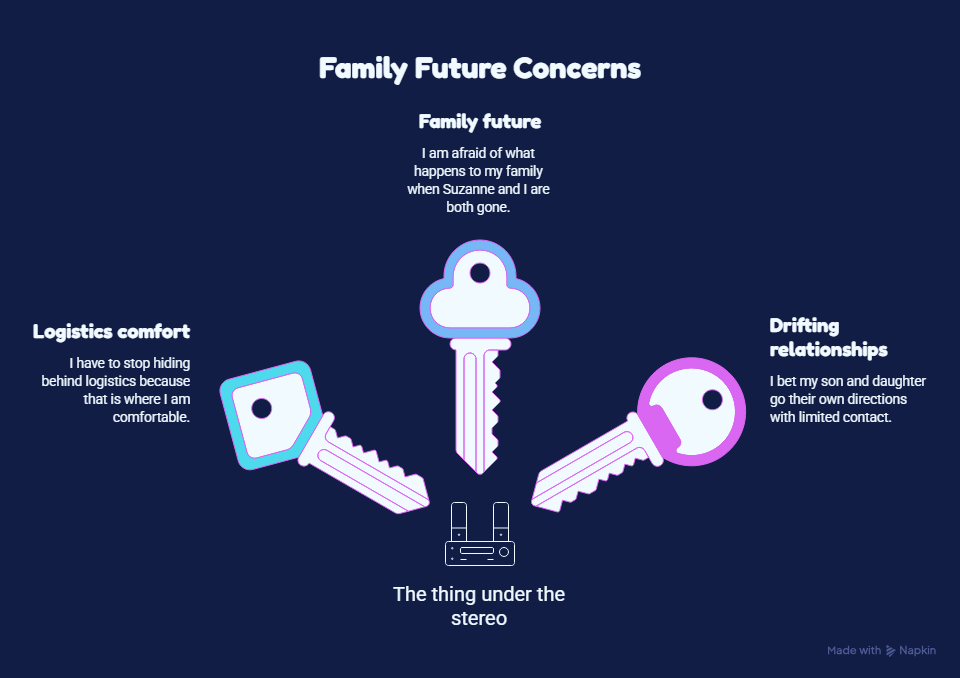
Now I have to stop hiding behind logistics, because logistics is where I'm comfortable. I'm not afraid of the paperwork. Paperwork can be hired out.
What I'm afraid of is what happens to my family when Suzanne and I are both gone. Whether there's still a family at all.
And I owe you an honest bet, so here it is. I'd bet they drift. I'd bet my son and my daughter go their own directions, with limited contact and separate lives. I'd bet their kids barely know each other.
That isn't a forecast about the future. That's a description of right now.
I built this
When my children were six and seven and eight, I treated them like employees. I'm not going to soften that. It's what I did.
I was building a business and I ran the house on the same operating system. Performance, expectations, delivery. Not a lot else. Today we talk rarely, and when we do, it stays on the surface.
My guess is they'll think about me roughly the way I think about my father. Some good in there. A fair amount on the other side.
I built that. I get to live with the consequences. They're going to live with them too. There is no will you can write that fixes that.
My father's hands
Let me tell you about my father, because he's the only real evidence I have. He was an artisan. A potter, a furniture maker, a good watercolorist. Genuinely talented hands.
Neither my sister nor I got any of it. I have the tactical ability of a rock. There's no envy in that. Different people get different talents, and I've made my peace with mine.
But here's what I notice now, at this end of it.
The paintings are gone. I don't know where they went or what happened to them. The furniture is gone too. He built it in his twenties and thirties. By the time he left that house it had been redecorated around three or four times.
What survived is the pottery. My sister has some. My niece has some. My kids have some. Their kids have some. It's going to make at least one more generation without any help from me.
Nobody tagged it. Nobody put it in a trust. Nobody had a family meeting about the pottery. It survived for two reasons. It's really good, and people are attached to it.
And there's a third reason I only saw this week. The paintings got hung and the mugs got used. Many of them are is still in my kitchen.
I'm not sentimental about objects. My daughter is, and Suzanne is, but I'm not. I like my father's pottery because it's practical and good and I drink out of it. That's the whole mechanism, as far as I can tell. The thing that survives is the thing that stays in the rotation.
The memoir I never got
When my father was somewhere around eighty-five, I started pestering him to write a memoir. We have almost no family history. The oral history is thin to the point of useless. Suzanne is even more curious about it than I am, and there's nothing there for either of us to be curious at.
He never wrote it. I asked, he didn't, and then it was too late.
So I'm going to assemble the posts I've written into a book and hand it to them. I want to be careful about what I claim for that, because I know myself.
This Substack is for me first. It's an investigation into things I'm curious about, run by somebody who is not the expert in the room. That's the honest description. Assembling it into a book is different — that one's for them and for me both, and I don't think I have to pick.
My daughter reads regularly. My son does not. I know how that's likely to go. One of them may say this is useful. The other may say, fine, Dad did a thing again. I'll live with either.
And I notice, writing this, that I'm building the exact object I begged my father for and never received. That's either a nice piece of symmetry or the whole point. I can't tell yet.
What I've never said
Here's the part I've never put in public before. I think both my kids hold me at arm's length. That's how it feels from where I stand.
I have never said that to my son. Not once. And to tell you the truth, I'm scared to. I don't know how to get over that fear.
That's a strange sentence for a man to write at seventy-three, in a piece about arranging his own death. I'm not afraid of dying. I've made an uneasy peace with that.
I'm afraid of one conversation with my son.
I did do a version of it once. I wrote both kids a letter. I apologized for how I was as a young father, for what they had to put up with. My son did what he usually does. He said Okay, I'm good; don't need anything more.
My daughter wrote me back three pages. We talked about it. That conversation was real.
So I've already run the experiment. I know what each of them does with an opening. I just haven't run it again.
The other inheritance
There's something else moving down the line that nobody's going to tag. Temperament.
My father passed his to my sister and me. Both my kids can be hard, the way I can be hard. There are things my sister and I still do where the easy move is to say, boy, that's Dad coming out.
But it isn't Dad. It's us, because we haven't done the work to change it.
I'm doing that work right now. I'm in therapy for exactly this. I have no idea how far it goes, or how brave I'm willing to get.
This week I sent the first email to a man I needed to make things right with. I don't know what he'll say. I may hear today, or tomorrow, or never. I'm curious which one it is. That's not a resolved story I'm telling you — it's an open one I'm inside of.
What I'm going to try
So here's the change, and it isn't a five-step plan. We're going to have family meetings. More than one. Me, Suzanne, my son, my daughter, in a room.
We go through the house. Who wants what. Can we tag it? Can the tags go into the trust? Then the unglamorous half. Who cleans out the house. Who sells it. Who's responsible when neither of us is here.
Then the memorial. Not me deciding it. Not me handing it over and walking out, either — that's what I did the first time, and I called it generous. Me in the room while they work it out. Facilitator, not author.
If it gets ugly we bring in a professional. I don't think our estate warrants that expense. I might be wrong.
But the stuff is not really the agenda. The stuff is the ticket into the room. Emotions are what's actually tied up in all of it. What they want. How they feel about each other. What happens to the two of them when we're not the reason they're in the same house at Thanksgiving.
The sentence I'm afraid of
Here's what I'm most afraid of hearing in that meeting.
"I don't care what you guys want to do. Just do it."
That's the one. Not a fight. A shrug.
Because agreement that isn't real agreement becomes a family hassle later. Everybody nods. Nobody means it. Then somebody dies and the nodding comes apart in a lawyer's office.
I can usually tell when somebody's being authentic with me. When it's inauthentic I need to say so out loud, right there, and ask about it. And when it's real I get to ask the better question. That sounds true — what makes you feel that way?
That's the meeting I want. I have no idea whether it's the meeting I'll get.
What I don't know
I don't know if any of this works. It won't repair fifty years in an afternoon. I'm not writing a redemption story and I'd ask you not to read one.
My best guess is my kids still drift. That's their relationship. They build it or they don't. I've had my turn.
What I might be able to do is smaller. I might be able to take away the guessing. Nobody has to wonder what Dad wanted. Nobody has to prove they were loved by claiming a lamp. Maybe that's the entire job. Maybe it isn't close to enough.
And there's a version where the family meeting is just one more clean handoff. Get everybody aligned, get the tags on, get out of the room early. That's my whole pattern. I sold a business and was out of the building in three hours.
I can't tell which one I'm doing yet. I'll know more after the first meeting.
The one I keep circling back to, at odd hours, isn't about the stereo at all.
I wonder who's going to come.
I know a lot of people. A fair number of those relationships are superficial and I'm aware of it. Maybe they're less superficial than I think, and I'll never find out. That's the thing about your own memorial. You've arranged the whole room and you don't get to see who walks in.
Your turn
I want to hear from the people who've been on the other side of this. Did somebody leave you a mess? Did somebody leave you instructions you resented, and did they help anyway?
And if you're the one doing the planning — what's the sentence you haven't said out loud yet? You don't have to say it here. But I'd like to know you've got one.
I read the comments. That's the part of this I really look forward to.
Hey, this is Josh. You're on the Long Strange Trip. I'm glad you're here.

Facebook
LinkedIn
Youtube