Nobody Argues With Me Anymore
I used to think that was respect. Then I started paying attention to what I sound like.
There's a particular kind of quiet that happens in a room.
You say something. Something you think is worth hearing. And the conversation just keeps going, like a car passing a hitchhiker. Nobody was rude. Nobody argued. They drove on by.
I know that quiet well. I've heard more of it as I've gotten older. And for a long time, I had a very comfortable explanation for it.
The story I was telling myself
The story went like this. I'm seventy-three. This culture worships thirty-five.
Nobody wants to hear from a guy with white hair. They've already decided what I'm going to say. It's a great story. It has villains, and it lets me off the hook completely.
The fix that comes with that story is obvious. If they won't listen, talk louder. More conviction. Lead with the credentials so they know who they're ignoring.
I tried that. It made things worse every single time.
That should have told me something years before it did. If the cure makes the disease worse, you've diagnosed the wrong disease.
The room I actually lost
Let me give you the specific one, because the general version is too easy on me.
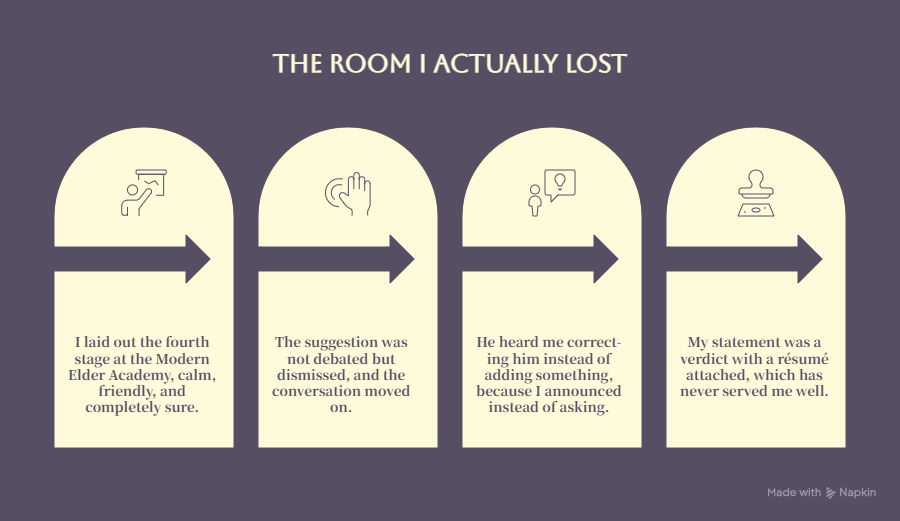
I was at the Modern Elder Academy, in a session on the stages of transition. The framework on the table had three stages. I've spent years watching people go through this, and I think there are four.
So I said so. And I want you to hear exactly how I said it.
"This is something I've learned over the years." Then I laid out the fourth stage. Calm, friendly, completely sure.
It was dismissed. Not debated. Dismissed. The conversation moved on and my fourth stage went in the trash.
The man leading it was maybe fifteen years younger than me. So this wasn't the kid-doesn't-respect-the-elder story I like to tell. That was a peer.
Here's what I've figured out since. He didn't hear me adding something. He heard me correcting him.
Because I didn't ask. I announced. "Here's what I've learned over the years" isn't an offer. It's a verdict with a résumé attached.
I've done that in programs for decades. It has never once served me well.
What I actually sound like
The room isn't tuning out my age. The room is tuning out my absolutes.
Almost everything I say comes out as a settled fact. Not "I've found that" but "that's how it works." Not "here's a possibility" but "here's the thing." I speak in verdicts.
And here's the detail that killed the ageism story for me. Young people who speak in absolutes get ignored too.
I've watched it happen. A thirty-year-old holds forth with total certainty, and the room goes flat. Eyes drift. Same quiet I get.
So it isn't the white hair. It's the certainty.
That was a hard trade. I gave up a story where the culture was doing something to me. I got back one where I'm doing it to myself. The second is worse to live with and far more useful.
Something I noticed at my own table
I want to tell you about a recent conversation with my son.
He was talking. I was quiet. And I started hearing the shape of his sentences instead of the content.
Everyone was an absolute. This is how it is. Those people always do that. That never works. No hedges, no maybe, no door left open.
It sounded awful. I mean that plainly. I wanted him to stop.
And then it landed on me. That was me. Three years ago, word for word, cadence for cadence.
I didn't correct him. Part of that was restraint, which I'd like credit for. Most of it was that I had no standing.
You don't hand somebody a mirror you're still standing in front of.
There's a layer under that one. Where do you think he got it? He grew up watching me. Every dinner table verdict, every settled fact.
I taught him that sounding sure is what a competent man sounds like. Strange thing to notice at seventy-three.
Two in the morning, reading strangers
After that, I went looking for other people saying this out loud.
Not articles. Comment sections. Forum threads nobody's read in three years. The places where people type things at two in the morning that they'd never say at dinner.
It's a rough read. And not the read I expected.
A woman commented on an essay about becoming invisible. She's fifty-two, so she's not the one disappearing yet. She wrote this:
"I think back to my grandmother and mother in a room and us looking on them with fondness rather than as older adults with opinions suitable for discussion."
Read that again. Fondness. Not contempt, not impatience. Fondness.
She loved those women. She simply never considered that they might have an opinion worth arguing with.
That's the thing I'm actually afraid of, and I couldn't have named it before I read her. I'm not afraid of being disliked. I'm afraid of being enjoyed.
Then a retirement forum. A man five years out posted that he felt absolutely useless. That nobody, not even his family, seemed to care anymore.
Another retired man answered him. Here's the whole reply, and it's the most useful sentence I read all week:
"I was in a similar place for about a year, you probably are not pleasant to be around, no offense intended."
No offense intended. He said the unsayable thing, gently, to a peer.
Nobody younger could have said that. From a thirty-year-old it's cruelty. From a man on the same road it's a gift.
I don't know if the first man could hear it. I'd like to think I could.
One more. Liz Scott is seventy-eight, five years up the road from me.
"My grip on certainty has loosened, rigid beliefs have softened, and for me, that is a much more vulnerable place."
A much more vulnerable place. That's the part nobody warns you about.
I've been talking about giving up absolutes like it's a technique. It isn't. Certainty is armor, and taking it off is cold.
She says she finds herself saying "Who knows?" to just about anything now. I'm not there yet. But I can see it from where I'm standing.
A man who never told me anything
Let me tell you about Shields Harvey.
Shields was about fifteen years older than I. He was my elder before I had a word for it. And he never once told me what to do.
What he did was ask questions I couldn't answer. Not clever ones. Why do you think that's true? What would have to change for you to change your mind?
Simple stuff. Devastating in practice.
Most of what I believed, I'd never examined. I'd carried it long enough that it felt like knowledge. Shields found the seams by staying interested after I'd stopped wanting him to.
I'd open my mouth with a ready answer and hear how thin it was on the way out. Then I'd have to say the humbling thing. Let me get back to you.
He was the most influential man in my working life. I cannot recall one piece of advice. I can recall a dozen questions.
The question that does the work
I stole one tool from all of that. It's the only one I use consistently.
When something goes wrong, the instinct is to explain what went wrong. Walk the person back through it until they see it. That feels helpful. It's almost never received that way.
So instead, I ask one question. What did we learn?
Not what did you learn? What did we learn? I was in that room too, and usually I was part of how it broke.
Then comes the part everybody skips. You have to stay with it. The first answer is garbage — a defense with a bow on it. Around the fourth or fifth pass, if nobody's flinched, you get something true.
I usually know the answer by round two. Handing it over would feel generous and would waste the whole thing.
When to ask and when to just say it
Let me complicate my own advice, because questions aren't always the move.
Sometimes people want an answer. Plainly, quickly, no Socratic dance. Turning every exchange into an inquiry is its own kind of arrogance.
What I've landed on is a sequence, not a rule.
Questions come first, and they have one job. Clarification and understanding.
Here's the part I missed for fifty years. Once you have that understanding, you've earned something. You now have permission to say what you think.
That permission isn't automatic. It doesn't come from your age, your title, or your résumé. It gets issued quietly by the person who felt you actually listened.
The Modern Elder Academy room is where I skipped that step. Straight to the statement, no permission in hand.
And one small thing that matters enormously. How you frame the statement changes everything.
"This is how it works" closes the room. "Here's something I find interesting — what if there were four stages?" keeps the door open. Same content, completely different reception.
I'm not being coy when I do that. I mean it. There's always more than one way to solve a problem.
You know the old line about two ears and one mouth. I believe it. I think the ratio's off — my working number is five to one.
And listening isn't silence. Silence is easy, and I fake it beautifully. It means I'm not composing while you talk. That's the whole test, and I pass it maybe a third of the time.
More old people than we've ever had
There's a man named Stephen Jenkinson who's been rattling around my head. He wrote a book called Come of Age, and he asks a question I can't put down.
Why do we have more old people than we've ever had, and so few elders?
That stopped me cold. I'd assumed those were the same thing. That elder is what you get if you just don't die.
Jenkinson says no. It isn't a stage you age into. It's something you do, or don't.
Which means demanding to be heard is dead on arrival. There's a much harder conversation buried in that one, and I'm not ready to have it yet.
For now I'll say the plain part. Most people are just old. I include myself on plenty of days.
The door that didn't open
Here's the one I'm still sitting with. It happened in a doctor's office.
I've been through cancer world twice. My oncologist is a man I owe my life to. Eighteen years ago he built me a protocol that wasn't standard in this country. I trust him completely.
I have lymphoma now. It isn't growing. It will probably grow at some point. Maybe it won't. Nobody knows.
So I asked him a question that mattered to me. Would it make sense to be introduced to a palliative doctor? Not now, necessarily. But before I need one.
It's not an if. It's a when. I just don't know the when.
He pushed back hard. He told me I'm not sick enough. That I'm not in a position to need someone like that.
And that was it. The door closed. We moved on.
He isn't the villain of this story. He's busy, he's excellent, and he was probably trying to reassure me. My radiologist, for what it's worth, spends as little time in the room with me as he can manage. I understand that too.
But I walked out holding a question I'd needed to ask out loud. Here's what stayed with me.
He answered with an absolute. I'm not in that position. Full stop, no door left open. He was so sure that my actual question never got looked at.
I have never felt more precisely what I do to other people.
That's what an absolute does. It doesn't just end a sentence. It ends the conversation the other person was trying to start.
In my two-in-the-morning reading, I found a woman having a version of this with her sleep doctor. She told him her blood pressure spiked after bad nights on the machine.
He said, "I have been doing this for 20 years; you need to listen to me and stop thinking too much."
Here's what she thought. I have been living in this body for 68 years. I win.
Here's what she said. Nothing. Her words: "I did not say that, wish I had."
I read that and felt found out. Same room, same silence, same wish afterward. I could have pushed too. I didn't.
That tells you how much authority a certain voice carries. Even with a man who's spent a year writing about certainty.
And I keep thinking about how small the fix would have been. He didn't have to agree with me. He could have asked one question.
What's got you thinking about that right now? Four seconds.
I'd have told him I'm not frightened; I'm planning. Then we'd have been in a conversation instead of two people talking past each other.
I still want that conversation. I haven't figured out how to get it.
What I don't have figured out
A few things are still open, and I'd rather leave them open than fake a landing.
I don't know what I should have done in that seminar room. The sequence I described works over coffee. With a clock running and thirty people watching, I'm not sure my fourth stage had a version that lands.
I don't know what to do with Jenkinson's harder claim — that the title isn't yours to take, that somebody else has to hand it over. I've been circling that for weeks. It's a whole other piece, and I owe it to you.
And I don't know how to get my doctor to answer my question. That one isn't philosophical.
Here's the one that sits worst. My best elder never told me anything, and I've spent my whole career telling people things.
I know the correction. I'll still walk into a room next week and open with a verdict.
Where I've landed, for now
I spent years believing I wasn't heard because I was old. I wasn't heard because I was certain. Only one of those has a door out.
The door is curiosity. Not the performed kind — people smell that instantly, and it lands worse than plain arrogance. Real interest in what the other person knows.
Even the thirty-year-old. Especially the thirty-year-old. They've lived a life I haven't, in a world I'm reading about secondhand.
Absolutes shut rooms. Possibilities open them. And possibilities are more interesting anyway.
I won't tell you I've become a great listener at seventy-three. I've become a guy who notices, four seconds too late, that he's doing it again. But I catch it sometimes. And in those rooms, people have started talking to me.
Here's what I'd like to know from you. Have you had a room go quiet on you? And if you're honest about it — was it your age, or was it your certainty?
Or tell me about a door that closed on a question you needed to ask. I'm collecting those right now.
Tell me in the comments. I'll be reading. That's the part I'm actually trying to practice.
Hey, this is Josh. You're on the Long Strange Trip. I'm glad you're here.

Facebook
LinkedIn
Youtube