
When “Just One More Deal” Becomes a Prison: My Journey from Dopamine Hits to Actual Happiness
If only I get this next deal.
That used to be my definition of happiness. Land the ferry company contract. Close the big account. Beat out the competition for that prestigious location.
And I get it. That’s how we’re all trained to think, right? Success equals the next win. Happiness comes from achievement. Keep your nose to the grindstone, and the rewards will follow.
Except here’s what nobody tells you: it’s all bullshit.
The dopamine hit from closing a deal lasts maybe three days. A week if you’re lucky. Then you’re right back where you started, asking yourself, “Is that all there is?”
Let me paint you a picture of where this mentality took me.
The Ordinary World: Living for the Next Hit
For years, I ran a vending business. We had machines in facilities all over town. We provided excellent service, fair prices, and honest returns to the property owners who hosted our equipment.
I was good at what I did. I worked long hours. I chased every opportunity. And I kept telling myself I’d be happy when...
When we landed that next account. When we hit that revenue target. When we finally got the recognition we deserved.
The problem? The “when” never arrived. Or rather, it arrived constantly – and it was never enough.
I remember the day we got the contract to serve the snack bars for a ferry company in town. This was the prestigious account we’d been chasing. The kind of win that would make other vendors jealous. The kind of thing you could brag about at industry events.
We got it.
And you know what? It didn’t make any money.
Standing there with this “prestigious” contract in hand, I had this sinking realization: prestige doesn’t put food on the table. The dopamine hit of winning wore off fast when I looked at the actual numbers.
But here’s the thing – I’d been so focused on the chase, on the next deal, on being “successful” in this one narrow dimension, that I’d never stopped to ask whether any of this was making me happy.
Spoiler alert: it wasn’t.
The Call to Adventure: When the Math Stopped Working
We ran an honest business in a dishonest industry.
I’d known for years about what we called the “R factor.” All the major software companies that served the vending industry had built this feature into their programs. It allowed vending companies to claim they were paying property owners 20% commission while actually reducing the reported sales by 75%.
From the client’s perspective, everything looked fine. The statements appeared legitimate. The math seemed to add up.
But it was fraud. Plain and simple.
Our competitors were using it. That’s how they could afford to pay 20% commissions when our actual breakeven was around 8%. They weren’t really paying 20%. They were cheating.
And we weren’t.
Which meant we were getting priced out of every competitive bid. Property owners would look at our honest 8% proposal and our competitor’s fraudulent 20% proposal and choose the bigger number. They had no idea they were being cheated.
For years, I watched this happen. I knew what was going on. I knew we were losing business because we refused to cheat.
And I kept thinking: maybe we can find a way around this. Maybe we can compete on service. Maybe we can find the right niche where honesty still matters.
But the industry had a different answer: if you want to stay in this business, you have to play by its rules.
Refusing the Call: The Moral Dilemma Nobody Talks About
Here’s where I faced a choice I never thought I’d have to make.
I could adopt the R factor. I could start cheating like everyone else. I could keep my business, maintain my “success,” and continue down the path I’d been on for years.
Or I could admit that staying in this industry meant compromising something I wasn’t willing to compromise.
This wasn’t just about business ethics in some abstract sense. This was about looking at myself in the mirror and knowing I was deliberately defrauding people who trusted us.
I kept running the numbers. Trying to find a way to make it work without cheating. Hoping I could somehow square this circle.
But you can’t. The math doesn’t work. Either you cheat, or you leave.
And this is where my definition of success started to crack wide open.
Because success, the way I’d been measuring it, only had one dimension: how much money did we make?
It never asked: Are you doing things you enjoy? Does this work align with who you want to be? Will this path make you happy?
It certainly never asked: Are you willing to become someone you don’t respect in order to keep calling yourself successful?
Meeting the Mentor: The Questions I Should Have Asked Sooner
What would happiness have actually looked like?
That’s the question I never asked myself during those years. I was too busy chasing the next deal, managing the next crisis, proving I could succeed according to someone else’s definition of success.
But let me tell you what I missed while I was chasing that narrow vision of achievement.
I missed basketball games. Concerts. Softball games. Ski meets.
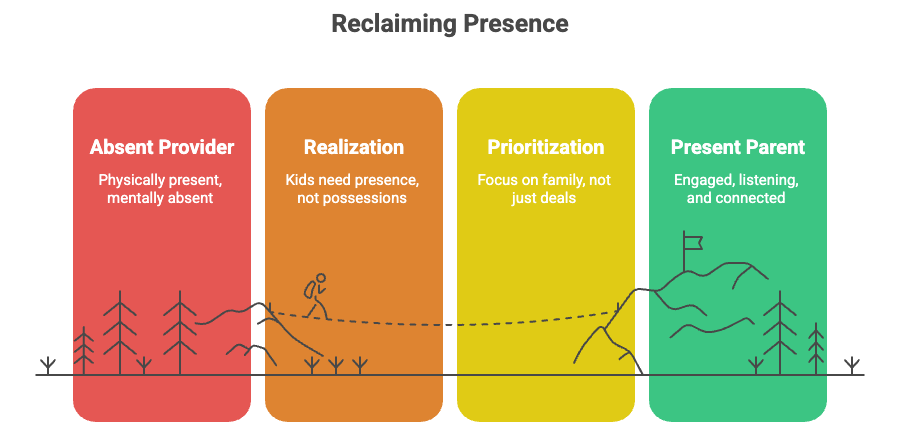
I missed the important dinners at home – and when I was physically present, I was mentally somewhere else. Thinking about business. Running through tomorrow’s challenges. Half-listening to my kids while planning my next move.
I gave my family maybe 5% of my actual attention and energy. The other 95% went to work.
And for what?
For the privilege of working in an industry where success required becoming someone I didn’t want to be?
Here’s what nobody tells you about this pattern: you can spend 30 or 40 years building what you think is success, only to discover you’ve built a beautiful prison.
Crossing the Threshold: Leaving the Only World I Knew
The decision to leave vending wasn’t dramatic. There was no single moment where everything became clear.
It was more like a slow-motion realization that kept building until I couldn’t ignore it anymore.
If I wanted to stay in this industry, I would have to cheat. Period. There was no third option. No clever workaround. No way to compete honestly against companies that were committing fraud.
So I had two real choices: become someone I didn’t respect, or leave.
When you frame it that way, the choice becomes obvious.
But here’s what made it hard: this industry was all I knew. This business was my identity. Walking away meant admitting that years of work, years of building, years of “success” had led me to a dead end.
It meant facing the terrifying question: if I’m not a business owner in this industry, who am I?
Tests, Allies, and Enemies: The Real Cost of Success
Looking back now, I can see the price I paid for chasing success the way I did.
The enemy wasn’t my competitors. It wasn’t even the dishonest industry practices.
The enemy was my own belief that happiness could wait. That family could wait. That being present could wait.
Just one more deal. Just get through this quarter. Just land this account.
Then I’ll focus on what really matters.
Except that moment never comes. There’s always another deal. Always another quarter. Always another reason to defer the things that might actually make you happy.
I spent years telling myself this was temporary. That I was building something for my family’s future. That the sacrifice would be worth it.
But here’s the brutal truth: my kids didn’t need a bigger house or fancier vacations. They needed me. Present. Engaged. Actually listening instead of mentally running through my next business move.
And I wasn’t there.
Not really.
I was sitting at the dinner table thinking about the vending route. I was at the basketball game checking my pager (yeah, I’m that old). I was physically present but emotionally and mentally absent.
That’s not a sacrifice for your family. That’s just absence disguised as providing.
The Ordeal: When Success Feels Like Failure
The real crisis came when I realized I’d spent decades optimizing for the wrong metric.
We measure business success in one dimension: financial performance. Revenue. Profit. Growth rate. Valuation.
And those numbers can look great while your life is falling apart.
I’d been so focused on being “productive” that I never stopped to ask whether I was happy. Whether the work itself brought me any joy. Whether the life I was building was one I actually wanted to live.
The business community doesn’t talk about happiness. We’re supposed to keep our nose to the grindstone. Success comes from suffering. If you’re comfortable, you’re not pushing hard enough.
That was certainly true for me during the early years of every business I was involved in. I never thought about being happy. I only thought about being successful – and success meant those short dopamine hits when I accomplished something.
But that’s not happiness. That’s just addiction to achievement.
Real happiness might have looked like spending more than 5% quality time with my children when they were young. Actually listening to what they were saying instead of waiting for my turn to talk. Finding balance instead of living in constant stress.
Would I have been happier with less financial success but more presence in my own life?
I think the answer is yes.
The Reward: What I Gained by Leaving
Walking away from vending meant walking away from an identity I’d built over years.
But it also meant I could start asking different questions.
Not “How do I win the next deal?” but “What do I actually want to spend my time doing?”
Not “How do I maximize profit?” but “What kind of person do I want to be?”
Not “What will make me successful?” but “What will make me happy?”
These are fundamentally different questions. And they lead to fundamentally different lives.
Here’s what I’ve learned in the years since: happiness isn’t something that happens when you finally achieve enough success. It’s not waiting for you on the other side of the next big win.
Happiness is a practice. A way of being. A choice about what you pay attention to and what you value.
And it’s almost never found by optimizing solely for financial metrics while ignoring everything else that makes life worth living.
The Road Back: Lessons for Those Still in the Grind
If you’re reading this and you’re over 50, still putting your business or career ahead of everything else in your life, let me ask you some questions.
How much longer are you going to tell yourself that happiness can wait?
How many more basketball games, concerts, dinners, or quiet moments with people you love are you going to miss while you chase the next achievement?
When you’re 73 years old, looking back at your life, what do you think you’ll wish you’d done differently?
I can tell you from experience: you’re not going to wish you’d closed a few more deals. You’re not going to wish you’d worked longer hours or sacrificed more of your presence for your productivity.
You’re going to wish you’d been there for the moments that actually mattered.
And here’s the thing: you can’t get those moments back. Your kids are only young once. Your parents won’t be around forever. The people you love need you now, not when business finally slows down.
Because business never slows down. There’s always another crisis. Always another opportunity. Always another reason to defer the things that might actually make you happy.
A Different Definition of Success
I’m not going to pretend I have this all figured out. I’m 73 years old, I’ve been through my share of transitions, and I’m still learning what happiness actually means.
But here’s what I know now that I wish I’d known at 35:
Success measured in only one dimension isn’t success at all. It’s just scorekeeping.
Real success – the kind that might actually lead to happiness – is multidimensional. It includes:
Whether you’re doing work you genuinely enjoy, not just work that pays well.
Whether you’re showing up as the person you want to be, not just the person who closes deals.
Whether you’re present for the people and moments that matter, not just productive in your business.
Whether you’re building a life you actually want to live, not just a resume you can brag about.
Whether you can look at yourself in the mirror and respect the choices you’re making, not just the money you’re earning.
These metrics are harder to track than revenue growth. They don’t fit neatly into spreadsheets. You can’t compare them at networking events or brag about them on LinkedIn.
But they’re what actually matter.
The Ultimate Question: What Will You Choose?
You’re going to face your own version of the choice I faced with vending.
Maybe it won’t be about fraud. Maybe it’ll be about time. Or values. Or what you’re willing to sacrifice in the name of success.
And when you face that choice, you’ll have to decide: What actually matters to me?
Is it the prestige of the next deal – even if that deal doesn’t actually serve you?
Is it maintaining an identity you’ve built around being “successful” in someone else’s terms?
Is it continuing down a path because you’ve already invested so much, even if that path isn’t taking you anywhere you actually want to go?
Or is it something else entirely?
For me, leaving vending wasn’t about giving up on success. It was about redefining what success meant.
Instead of “How much money can I make?” it became “How do I want to spend my limited time and energy?”
Instead of “What will make me look successful?” it became “What will make me actually happy?”
Instead of “What’s the next achievement I can chase?” it became “What kind of life do I want to have lived when I look back on all this?”
The Invitation
I’m not saying you should quit your business or walk away from your career.
I’m saying you should ask yourself some hard questions before another decade passes while you’re waiting to be happy “when...”
When the business is more stable. When you hit that revenue target. When the kids are older. When you finally have time.
That “when” might never come. And even if it does, you’ll have missed years of your actual life while you were waiting for it.
So here’s what I’m inviting you to do:
Stop for a moment. Stop chasing. Stop optimizing. Stop grinding.
And ask yourself: Am I actually happy?
Not “Will I be happy when...” but “Am I happy now?”
If the answer is no – or if you’re not even sure what happiness would look like for you – then maybe it’s time to examine whether you’re optimizing for the right things.
Maybe it’s time to ask whether the path you’re on is actually taking you somewhere you want to go.
Maybe it’s time to consider that real success might look completely different than what you’ve been chasing.
What Now?
I don’t have a five-step program for finding happiness. I don’t have a framework that’ll fix everything.
What I have is this: a life spent chasing the wrong things, followed by a slow realization that there might be a better way.
And an invitation to explore that better way together.
Because here’s the truth: we’re all figuring this out. Nobody has it completely solved. The best any of us can do is share what we’ve learned, ask better questions, and support each other in building lives that might actually make us happy instead of just productive.
So let me ask you:
What would happiness actually look like for you?
Not what you think it should look like. Not what would impress other people. But what would genuinely make you happy?
Are you willing to examine whether your current path is taking you there?
Are you willing to consider that success might mean something completely different from than you’ve been told?
Are you willing to stop waiting and start living before it’s too late?
Let me know in the comments. I’m genuinely curious. Not because I have the answers, but because I’m still asking the questions.
And maybe together, we can figure out what it actually means to build a life worth living instead of just a resume worth bragging about.
It is what it is. But what do we do with what is? That’s where our choice lives.
What’s your relationship with the “just one more deal” mentality? Have you found ways to define success beyond the next dopamine hit? I’d love to hear your thoughts in the comments below.

Facebook
LinkedIn
Youtube