
The Friendship Gap I Didn't See Coming
Why most men crash in retirement, why most women don't, and the question I'm still investigating.
I’m 73. I have cancer. And I’ve been thinking a lot lately about who’d actually pick up if I called at 2 AM.
Not the LinkedIn list. Not the holiday card list. Not the people I’ve sold things to or had a working lunch with twice a year for fifteen years. The 2 AM list. The names I’d punch into the phone if something genuine was going wrong and I needed somebody to talk to.
Four years ago — before any of this got urgent — I tried to make that list.
I got to four names.
Three of them were family.
The fourth was a friend I hadn’t talked to in nearly a year.
My wife, doing the same exercise, would have run out of paper.
I sat with that list for a long time. The first thing I felt wasn’t sadness. It was professional embarrassment — like I’d run an audit on my own life and discovered I’d been keeping the books wrong for thirty years. I’d built businesses, raised kids, accumulated whatever you accumulate by 70, and I had four names.
That gap — between the list my wife would write and the list I actually wrote — is the thing I want to talk about. It’s not just a quirk of how the Patrick household runs. It’s a pattern I’ve watched play out across a couple of generations of business owners. The data backs it up. And nobody is talking about it honestly enough.
Let me try.
Here’s what life sounds like in our house, on any given afternoon.
Her phone is buzzing again. A text from her college friend. Her sister calling. Another friend, then another. Her phone’s been alive like that the whole time we’ve been married. Mine? Not so much.
I used to find all the buzzing kind of annoying. Now I’m starting to think it might save her life.
Here’s the thing nobody told me about retirement — or if they told me, I wasn’t listening. The phone stops ringing for men. Not gradually. Immediately. Sell the business or hand off the corner office, and you go from forty calls a day to four. Three of those are from your dentist. The fourth is your kid making sure you haven’t fallen down the stairs.
For women I’ve watched go through the same thing? The phone keeps ringing.
That asymmetry is doing something I don’t think we’ve talked about honestly.
What I’m Watching Happen
I’ve been around long enough to see a couple of generations of business owners walk away from their companies, and the pattern’s so consistent you can almost set your watch by it.
The men sell. They get the wire, they take the trip, they come home. Three months later they’re calling me asking if I want to grab coffee. Six months later, those coffee invitations are getting weirdly persistent. By month nine, they’re either back consulting because they “missed it,” buying boats they’ll use twice, or starting some half-baked second business that everyone in their life is too polite to talk them out of.
Their wives, in the same nine months, are mostly fine.
Not all of them. I’m not saying every woman sails through retirement, and every man drowns. I’m saying the pattern is loud enough that anyone paying attention can hear it.
The women I’m watching tend to do something specific in those first months. They make lunch dates. They start a class. They take that volunteer role they’ve been promising themselves they’d take. They host things. They keep doing what they were already doing — just with more time for it now. And, they take advantage of social connections outside of business that men never form.
The men do almost none of that.
It is what it is. And yet — what is it, actually?
Let me paint you a picture. Heads up before I do: the guy I’m about to describe isn’t one specific person. He’s a composite of about fifteen guys I’ve watched go through this in the last decade. Names, numbers, all changed. Call him Tom.
Tom ran a $40 million business for thirty-some years. Sold it well. Hit his number, signed the papers, and took his wife to Italy for two weeks. Came home, ready for “the next chapter.” He had it figured out. More golf. More time with the kids. Maybe finally write that book everybody had been telling him to write.
I had lunch with him eight months in.
He hadn’t written a word. The kids were busy with their own lives, the way kids are. The golf was fine — when he could find people to play with, which was harder than he’d expected, because his old foursome had all retired at different times and ended up in different cities. He told me — with that look successful men get when they’re admitting something uncomfortable — that he’d been Googling old college roommates. Just to see what they were up to.
He wasn’t depressed. He was lonely in a way he didn’t know how to name yet, because in his entire adult life, nobody had taught him the word for what was missing. The closest thing he could come up with was bored. Which is what men of our generation say when we mean the people aren’t there.
A version of his first eight months has happened to roughly fifteen guys I personally know.
I’ve never watched it happen, in that exact form, to a many woman.
What the Research Says (And Doesn’t)
I went looking to see if this pattern was just my own selective memory or whether the data backs it up.
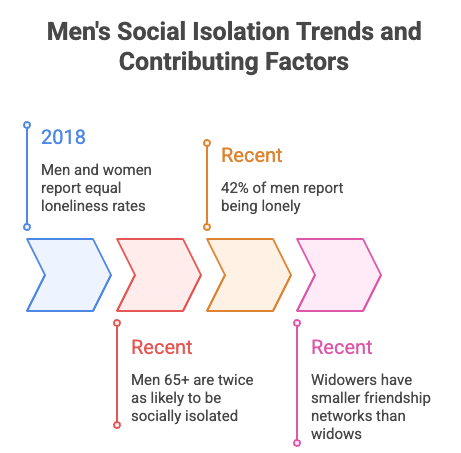
The data backs it up, mostly. Men 65 and older are more than twice as likely to be socially isolated as women. A recent Pew survey found 42 percent of men report being lonely against 37 percent of women — a shift, by the way, from 2018, when those rates were essentially equal. Something has gotten worse for men in particular, and gotten worse fast.
The reasons aren’t a mystery. Men’s social lives, on average, are organized around work. The buddies are work buddies. The lunches are work lunches. The Tuesday night thing is the league, my company sponsors. When the work goes, the structure goes — and the relationships hanging on the structure go with it.
Women, on average, do something different. Their social lives have a separate scaffolding that’s been there the whole time, often built deliberately, often kept up even when it was inconvenient. A friend you call every Sunday for forty years is infrastructure. A walking group that’s been meeting since the kids were in middle school is infrastructure. None of that disappears when you change jobs.
Here’s where the picture gets more complicated, though.
Men, when we do have close friendships, seem to get a lot out of them — disproportionately a lot. The research is interesting on this: men get bigger quality-of-life improvements from a tight social network than women do, while women benefit more from broad social participation. So it’s not that men don’t need or value friendship. It’s that we tend to have less of it, in fewer forms, and we tend to lose what we have all at once.
That last part is the bit nobody is saying clearly enough. Men aren’t just lonelier in retirement. We’re more vulnerable to a single cliff event. The wife dies. The job ends. The hip goes. Pick your transition — there’s a category of guy whose entire connective tissue collapses on the day one of those things happens.
Widowers have smaller friendship networks than widows. Read that one twice. The men who lose their wives — the women who were running their social lives — end up with less, not more.
The Anti-PC Observation Nobody Wants to Make
OK, here’s the part where I’m going to risk saying something the cultural moment doesn’t love hearing.
A lot of married men, my generation especially, have been outsourcing emotional intimacy to our wives for forty years.
She remembers the birthdays. She organizes the dinners. She maintains the friendships — including the ones with the husbands’ college roommates. Ask a guy in his sixties how his best friend from law school is doing, and the honest answer in maybe a third of cases is, “I don’t know — my wife talks to his wife.” The wife is a translator and a maintenance crew and an emotional infrastructure department. We let her be that because it was convenient.
It was convenient.
It was also a deal we didn’t really know we were making, and the bill comes due in retirement.
The retirement crisis for men isn’t a financial crisis. It’s the moment we realize the social network we thought we had was actually our wife’s — and we were guests on it.
I’m not trying to score a culture-war point here. The culture has gotten lazy in both directions on this. The “men just need to do better” crowd never names the structural problem. The “it’s no big deal, of course, men have friends” crowd misses what’s actually happening, which is that a generation of competent, accomplished men is sitting in finished basements at age 68, wondering why nobody calls.
The reason nobody calls is that we never really called them either.
What Women Seem to Know That Men Don’t
I asked my wife and a couple of her friends what they thought they were doing differently.
The answers are interesting because they don’t sound like answers. They sound like puzzlement.
“I just call her.” “We always have lunch in March.” “It’s been on the calendar for twenty years.” “She’s my friend, why wouldn’t I see her?”
It isn’t a strategy to them. It’s a baseline. The work of maintaining a friendship — the calls about nothing in particular, the lunches that aren’t transactional, the showing up because that’s just what you do — is invisible work that gets done because it always got done.
The men I know who are okay in retirement are the men who learned this somewhere. Sometimes from their wives. Sometimes from a recovery program. Sometimes, from getting sick young and realizing how few people they actually had. The mechanism varies. The lesson is the same. Friendship is a practice, not an asset. You don’t get to have it because you used to have it. You get to have it because you keep showing up.
Richard Chandler is one of those guys. I had him on the Long Strange Trip podcast a while back, and what stuck with me wasn’t his framework or strategy. It was the casual way friends and connections kept showing up in our conversation — not as a topic, just as part of the texture. He was in it the way most of the women I know are in it. He’d built that, deliberately, over a long stretch.
Most women in my generation were quietly practicing the whole time.
Most men weren’t.
The other thing I’ve noticed, watching closely, is that women’s friendships have a specific shape men’s don’t. A woman will call her friend to talk about nothing. There’s no agenda. No business. No scheduling efficiency. There are just two people on the phone for forty-five minutes, talking about a TV show, a sister’s divorce, and what they’re making for dinner. Men, by and large, don’t do that. We schedule. We efficient-ify. We have the call when there’s a reason for the call. Then we wonder why we don’t have anybody to talk to about nothing.
The bias toward purpose was probably useful in the years we were running things. It’s approximately catastrophic in retirement, where the purpose evaporates and the muscle for purposeless connection was never built.
The Long Strange Trip metaphor probably belongs here. The band keeps playing through the changes. The trip is the point. You don’t get to skip the maintenance and still expect the bus to arrive.
What I’m Still Investigating
I’ll be honest with you — I’m not fully sure about the picture I just painted.
There’s a version of this story that’s accurate. There’s also a version that flattens women into “naturally relational” stereotypes, the same culture that has been used for decades to keep them carrying invisible loads forever. I want to be careful not to do the second one.
A couple of the women I’ve interviewed for the podcast — Jennie Bellinger and Susan Bradley, both come to mind — are absolutely killing it in their post-50 lives. Big networks, meaningful work, flexible identities. And every one of them has told me a version of the same thing. It took deliberate work. None of it happened by accident. They cultivated it.
So my hypothesis is something like this. Women, on average, were given more cultural permission to invest in friendships that weren’t transactional. Men, on average, were taught that friendship had to either pay or stop. Those are different starting positions — and the gap that shows up in retirement is the compound interest on forty years of small choices.
I don’t know if that’s right. It’s the question I’m sitting with. I want to talk to more men who got this right and more women who didn’t, and figure out where the pattern breaks. If you’ve got a story that contradicts what I’m seeing, I genuinely want to hear it.
So What
Here’s what I want to leave you with — not advice, because the voice of this place is allergic to advice. An observation.
If you’re a man approaching retirement, the question worth sitting with isn’t “what are you going to do all day?” That’s the question the financial planning industry trained you to ask. It’s the wrong question.
The right question is the one I keep coming back to: who’s on your list of four?
If your answer is fewer than five names and three of them share your last name, you’ve got the same homework I had. You’ve got time to do it. Not infinite time — none of us have infinite time, and after the year I’ve had, I’m more aware of that than I’d like to be — though enough.
The good news: this is one of the few problems in retirement that gets better with one decision. You pick up the phone.
The hard news: it’s the decision men of my generation have been deferring our whole lives, and the deferral has a price.
I’ve got a pretty good idea now of who I’d call at 2 AM, and the list is longer than it was four years ago. Not because of a self-help program. Not because of a regimen. Just by picking up the phone. Then, a few weeks later, picking it up again. Then noticing how much better Tuesday felt when I had a thing on Tuesday.
It’s genuinely not complicated. It’s just something most of us never did deliberately.
What a long, strange trip this is turning out to be. The part nobody warned me about wasn’t losing the title. Wasn’t the money question. Wasn’t even the body slowing down.
It was the silence on the phone.
If you’re a man hearing this and thinking, yeah, that’s me — the move is small. Call somebody this week. Not for any reason. Just to call.
If you’re a woman hearing this and thinking I’ve been telling my husband this for twenty years — I’m sorry. We’re slow learners.
And if you’re somewhere in the middle, watching the pattern, sitting with your own version of the four-names exercise — drop a note in the comments. Tell me what you’re seeing. The Long Strange Trip is a conversation, not a lecture. This is one of those topics where the wisdom won’t come from me.
Let’s figure this out together.


Facebook
LinkedIn
Youtube