
The Silence After the Sale: Why Nobody Warns You About What Comes Next
Nobody warns you about the silence.
You spend decades building something. Your phone rings constantly. Your calendar is packed so tight you can't find 20 minutes for lunch. People need you. Decisions need to be made. Fires need putting out.
Then one day it's over. Maybe you sold. Maybe you retired. Maybe your body made the decision for you.
And the next morning you wake up to... nothing.
No emails demanding attention. No staff lining up outside your office. No customers who need to talk to you right now.
Just you. A cup of coffee. And this creeping feeling that you might have made a terrible mistake.
I know this feeling personally. When I left my wealth management business, I figured I'd be fine. After all, I'd spent years teaching other business owners about transitions. I literally wrote about this stuff. Surely it wouldn't hit me.
It hit me like a truck.
My Conversation with Paul Cronin
I sat down recently with Paul Cronin from Touchstone Advisors. Paul's spent years helping business owners sell their companies and – here's the part that makes him different – actually look at what comes after the wire transfer.
What came out of our conversation was one of those "I wish someone had told me this twenty years ago" moments. Because Paul doesn't just talk theory. He's lived it.
His wife gave him an ultimatum about his 45-weeks-a-year travel schedule. Paul's response? He literally spent a weekend in bed processing what that meant. Not sick. Just lying there, staring at the ceiling, trying to figure out who he'd be if he wasn't the guy on the road closing deals.
When he finally left his corporate career, it meant saying goodbye to people he'd known for decades. People who'd been part of his daily life for years.
"It's like a divorce you didn't see coming," Paul told me. "Except nobody sends sympathy cards."
I laughed when he said it. Then I thought about it and stopped laughing.
This Isn't Just About Selling
Here's the thing. Most articles frame this as "seller's remorse" – like it only happens when you cash out. But that's way too narrow.
I've watched this same remorse hit business executives who retire. Business owners who step back. People who hand the reins to the next generation. Even folks who get pushed out by health problems they didn't plan for.
The trigger is different each time. The feeling is remarkably similar.
You go from being essential to being... optional. From being "the person who runs that thing" to being just another person holding a paper cup at the coffee shop.
Paul has a story about this that sticks with me. A CEO who sold his software company for eight figures. This guy went from having someone fetch his coffee every morning to being – as Paul puts it – "seventh in line at the coffee shop."
Seventh in line. Nobody knows his name. Nobody cares about his opinion on the quarterly forecast.
That image gets me every time. Because it's not really about coffee. It's about going from somebody to nobody overnight.
The Three Things That Actually Hurt
Most people think the remorse is about money. Did I get the right price? Did I leave something on the table?
And I get it. That stuff matters.
But here's what I've discovered from my own experience and from talking with Paul: the money part is often the smallest piece of the problem.
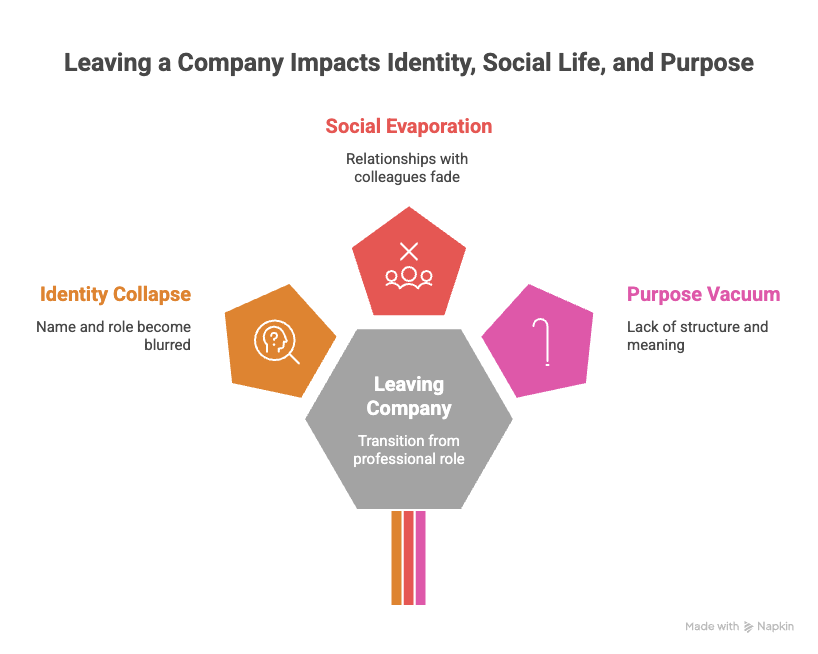
The real pain comes from three places. And they sneak up on you.
First is the identity collapse. For decades, you weren't just a person who happened to work. You were "the person who runs that company" or "the VP who makes things happen." Your name and your role were basically the same word in everyone's mind.
After you leave? That disappears. Sometimes overnight. You introduce yourself at a party and realize you have no idea what to say after "Hi, I'm..."
That moment is genuinely disorienting.
Second is what I'd call the social evaporation. Think about who you spend most of your time with right now. Staff. Vendors. Customers. Your accountant. Your lawyer. That peer group you meet with monthly.
Now imagine most of those relationships fading in about six weeks.
Paul confirmed what I experienced myself – it happens fast. Not because people are cruel. They're just busy with their own lives. Your shared context was the work. Without it, the calls taper off.
This is also true in the other activities you may have. Let’s say you’ve been playing tennis with the same group for twenty years. Then, a physical issue hits, and you can no longer play tennis. All of your tennis buddies, you never hear from them again. Not because they don’t like you, but because you’re off the radar screen.
I've gone through stretches where people who used to call me weekly just... stopped. It's not personal. It still stings.
Third is the purpose vacuum. For years, your days had structure. Problems to solve. People are counting on you. A reason to get out of bed that had nothing to do with the alarm clock.
You leave, you take that trip, you sleep late for a week... and then the question shows up.
Now what?
I'm still wrestling with this one. The Long Strange Trip keeps me busy, but I'd be lying if I said it fills the same space that running a business did. Not even close. Some days I'm energized by the writing and the conversations. Other days, I'm fighting boredom like it's a full-contact sport.
Turns out, the guy who taught other people about transitions isn't immune to them. Who knew? (Well, apparently everyone except me.)
The 95/5 Problem That Sets You Up to Fail
Here's something I've been writing about for a while, and it connects directly to why this remorse hits so hard.
Many business owners – and I'm including myself in this – run their lives on what I call the 95/5 split. About 95 percent of your energy goes to the business. The remaining 5 gets divided among family, friends, health, hobbies, and everything else that supposedly matters.
You tell yourself you'll fix it. Once the business stabilizes. Once you hire the right team. Once you close that next big deal.
Except you rarely fix it. Because there's always another "once."
So when you finally leave, you're not just losing a job or a company. You're losing 95 percent of your entire life's structure, identity, and purpose.
Of course, that hurts. You basically amputated your personality.
Let me paint you a picture. Imagine you spent your whole adult life as a competitive marathon runner. Running was your identity, your social circle, your daily routine, your source of confidence. Then one day, a doctor says, "No more running. Ever."
You'd grieve. You'd be lost. You'd wonder who you are without those miles.
That's what leaving work feels like for many of us. Except instead of running, it's the thing you built with your bare hands over three decades.
What the Deal Industry Won't Tell You
Paul and I talked about something that made me uncomfortable. In a good way.
The people helping you sell your business – bankers, brokers, lawyers – they get paid when the deal closes. They're usually good, honest professionals. But their entire world is oriented around one thing: getting to the finish line.
Questions like "What are you really trying to accomplish by selling?" create friction. They stir up doubts. They slow things down.
So those questions often don't get asked. Or if they do, the answers get a polite nod before everyone pivots back to multiples and tax planning.
Paul put it bluntly: "The deal industry has a closing problem disguised as a service problem. Everyone's focused on getting to the wire transfer. Not many people are focused on what happens to the human being on the other side of it."
The result? You walk out of the closing with a wire confirmation and no clear idea who you're supposed to be tomorrow morning.
It's like jumping out of a plane and deciding you'll figure out the parachute situation on the way down. Bold strategy.
The Cold Feet That Could Save Your Life
Here's something Paul shared that I found fascinating. Almost every owner hits a moment near the finish line where they want to bolt.
Letter of intent signed. Due diligence is mostly done. Purchase agreement in final draft. And one morning you wake up thinking, "Maybe I should walk away."
Deal teams call it cold feet. Many of them try to steamroll right over it.
That can be a big mistake.
Because under those jitters sit real questions that deserve oxygen. Not about multiples or working capital adjustments. About life. About identity. About who you're going to be when the dust settles.
Paul's seen deals fall apart because nobody helped the owner see what came next. The owner got scared. The M&A advisor got frustrated. And a deal that could have closed with the right support died on the table.
Before you bolt – or before you let someone talk you past it – find someone who has zero stake in your closing. A coach. A peer who's already sold. A thinking partner who understands both the money side and the life side.
The right person won't just talk about valuation. They'll ask what leaving will let you say yes to. And what you'll need to grieve.
Purpose and Meaning Aren't the Same Thing
Paul drew a distinction that stopped me mid-sentence.
Purpose is what you do and who you do it with. It's the activity, the contribution, the daily rhythm of making something happen.
Meaning is different. Meaning comes from how you interact with and love other people. It's the depth of your connections, the quality of your presence, the way you show up for the people who matter.
You can have purpose without meaning. Lots of busy people do. And you can have meaning without a clear purpose – though that tends to feel incomplete too.
The goal after leaving work isn't to replace your old purpose with an identical new one. It's to build something that has both.
I'm working on this myself. Some days I think I've found it. Other days I'm not so sure. I think that's probably how it goes for many of us.
A Few Things That Might Help (No Guarantees)
I don't have a perfect framework for this. Anyone who tells you they do is probably selling something. (Definitely a course.)
But here's what I've picked up from Paul, from my own stumbling, and from watching other people go through it.
Ask the uncomfortable question before you leave. Write one sentence: "By leaving my work, what am I really trying to accomplish?" Then force yourself past the obvious answers. The non-money reasons are usually where the important stuff hides.
Build a life outside work before you need one. Pick two or three areas and commit real time. Not someday. Now. Family. Health. Something intellectual that has nothing to do with your business. Volunteering or mentoring. These aren't distractions. They're the foundation of whatever comes next.
Don't panic-build a replacement. I've watched people chase their old life through rebound businesses they weren't even excited about. It's the entrepreneurial equivalent of a rebound relationship. It tends to end poorly.
Expect the boredom. I'm telling you from personal experience – it's real, and it's more unsettling than you'd think. Fighting boredom after decades of intensity is genuinely hard work. The trick is to sit with it long enough to figure out what you actually want, rather than grabbing at the first shiny thing that looks like it might fill the gap.
A Pattern Worth Mentioning
I've noticed something – and Paul has too – that seems worth naming.
Many men tend to build activity-based relationships. Golf. Deal-making. Work trips. Once the shared activity stops, those connections often fade.
Many women tend to maintain stronger local and emotional networks outside of work. That doesn't make their transition painless. It can mean they're less likely to wake up post-exit with nobody to call.
This isn't a rule. There are plenty of exceptions in both directions. The point isn't about who has it harder. The point is simple: if most of your relationships exist primarily because of shared work, those relationships may not survive your departure. Worth thinking about now, while you can still do something about it.
What I'm Still Figuring Out
I want to be honest about something. I'm 73 years old. I'm dealing with my own health challenges. I'm building The Long Strange Trip. And I'm still figuring out what life looks like without the daily intensity of running a business.
Some days I feel clear about my next chapter. Other days, I'm fighting boredom and wondering what the hell I'm doing with my time. Then I remember that I teach this stuff and I still can't get it right myself, which is either deeply ironic or deeply human. Probably both.
Here's what Paul helped me see more clearly: this isn't a problem you solve once. It's an ongoing adjustment. A practice, not a destination.
And those three words I've gotten comfortable with? "I don't know." They used to feel like failure. Now they feel like the beginning of something honest.
Let's Figure This Out Together
The remorse of leaving work isn't a sign that you made a stupid choice. It doesn't mean you're ungrateful for the money or the freedom. It's a very human response to losing a role, a community, and a routine that you spent most of your life building.
The answer isn't to cling to work until your health forces you out. And it's not to pretend the transition is easy when it's not.
The answer – or at least what I'm learning – is to treat leaving work as one chapter in a longer story. Give as much thought to your purpose and meaning as you do to financial planning.
And if the remorse is sitting heavy on your chest right now? You're allowed to grieve what you lost while you build what comes next.
Here's something Paul said that stuck with me: "The worst thing you can do is pretend you're fine. The second worst thing is pretending this feeling is permanent."
Both are true. You're not fine. And this isn't forever. Hold both of those ideas at the same time. It's uncomfortable. It's also honest.
You are not the company you sold or the title you held. You're the person who built those things. And that skill set? It still counts.
It is what it is. But what we do with what is – that's where the interesting stuff happens.
I'd love to hear your experience. Did you leave work and feel remorse? Are you still in it, wondering what comes after? Drop me a note in the comments. Let's have a real conversation about this.
Because we're all figuring this out. We might as well do it together.

Facebook
LinkedIn
Youtube