
The Quest for Wisdom: Why Knowing Everything Taught Me Nothing
The Ordinary World: Living in My Head (And Thinking I Was Smart)
For most of my career, I thought I was smart.
Actually, let me be more honest. I thought I was really smart.
I had accumulated decades of business knowledge. I could quote frameworks, recite best practices, and explain complex financial strategies in my sleep. I’d spent years mastering wealth management, succession planning, and business operations. My expertise went deep – really deep – in specific domains.
And I was convinced that all this knowledge made me wise.
Spoiler alert: I was wrong. Really wrong. Like, embarrassingly wrong.
The Call to Adventure: When Being Smart Isn’t Enough
Here’s what nobody tells you about expertise: you can know everything about your specialty and still have no idea how to help people with their actual problems.
I remember sitting with business owners who had all the technical knowledge they needed. They understood their financials. They knew their market. They had the facts.
But they were stuck.
They couldn’t see the patterns connecting their business challenges to their family dynamics. They didn’t recognize how their relationship with money stemmed from childhood experiences. They missed the ways their leadership style was creating the exact problems they were trying to solve.
And honestly? Neither did I. Not at first.
Because I was operating from knowledge, not wisdom. And there’s a massive difference between the two.
Refusing the Call: My Top-Down Disaster
Let me tell you about one of my early career highlights. And by highlights, I mean disasters.
Early in my business career, I didn’t know what personal responsibility actually meant. I thought it was all about telling others what to do.
You know, leadership.
I’d learned from watching the people I grew up around that a top-down approach to management was the way. The boss knows best. Issue orders. Expect compliance. That’s how you get results.
So that’s what I did.
And I was terrible at it.
I’d walk into situations thinking I had all the answers because I had the knowledge. I’d studied the frameworks. I understood the business principles. I knew what needed to happen.
But here’s what I didn’t know: I didn’t know what was actually happening on the ground. I didn’t understand the real constraints people were dealing with. I had no clue about the dynamics that made my “brilliant solutions” completely unworkable.
My knowledge was narrow. One inch wide, miles deep in business theory and financial strategy.
What I needed was to go wide. To ask questions. To learn from the people actually doing the work.
But that would have required admitting I didn’t have all the answers. And my ego wasn’t ready for that particular adventure.
A Definition That Changed Everything
Eventually, I stumbled across Joanne Lipman’s distinction that finally woke me up:
Knowledge is the accumulation of facts.
Wisdom is the ability to discern what matters and what doesn’t matter.
Read that again. Because I had to read it about seventeen times before it actually sank in.
Knowledge is about collection. Wisdom is about discernment.
For years, I’d been collecting. Facts, frameworks, strategies, techniques. My knowledge went about one inch wide and miles deep. I was a specialist who knew more and more about less and less.
Which sounds impressive until you realize that knowing everything about one thing doesn’t help you see the patterns that actually matter.
What I should have been doing? Going 100 miles wide and a few feet deep. Becoming a generalist who could integrate information, ideas, and theories from disparate sources.
That’s where wisdom lives. Not in the depths of specialized knowledge, but in the ability to see patterns across different domains.
And I get it – this realization kind of sucked. Because it meant admitting that all those years of becoming an expert were... well, not wrong exactly, but definitely insufficient.
Tests, Allies, and Enemies: The NLP Lesson
Here’s another example of me getting this completely wrong.
I learned NLP – Neurolinguistic Programming. Specifically, I learned how to ask better questions using NLP strategies. And I got pretty good at it.
I was so proud of myself. Look at me, using sophisticated questioning techniques. Clearly, I was becoming wise.
Except I wasn’t.
I was learning a technique, not developing wisdom.
I learned how to use NLP strategies for questioning. That’s knowledge. That’s a tool in a toolbox. A very narrow tool for a very specific purpose.
Wisdom would have been learning how to ask better questions across a wide range of issues. Recognizing patterns in human communication. Understanding when to ask versus when to listen. Discerning which questions open up possibilities versus which ones shut down conversation.
See the difference?
The technique was narrow. The wisdom would have been broad.
It’s like the difference between knowing how to use a hammer and understanding how to build a house. The hammer is great. But if that’s all you’ve got, every problem starts looking like a nail.
And I had a lot of hammers. What I didn’t have was the wisdom to know when to put the damn hammer down.
The Ordeal: My Ego Versus Reality
The hardest part of this journey was admitting that all my specialized knowledge wasn’t enough.
I’d spent decades becoming an expert. I’d built credibility through deep expertise. My entire identity was wrapped up in being “the guy who knows.”
People came to me for answers. I gave them answers. This system worked great.
Except when it didn’t.
Which was increasingly often.
I started encountering problems that my specialized knowledge couldn’t solve. Business owners whose technical challenges were actually relationship issues. Succession planning that failed because of unresolved family dynamics. Financial decisions that were driven by emotional patterns from childhood, not rational analysis.
My inch-wide, mile-deep knowledge was useless for these situations.
Not because the knowledge was wrong. But because the problems required integration across multiple domains – psychology, family systems, behavioral economics, leadership, communication patterns.
And I didn’t have that integration. I had expertise in silos.
It’s like showing up to a potluck with seventeen different versions of the same casserole. Sure, you brought a lot. But nobody’s impressed, and you’re not actually contributing to the meal.
The Approach: Bottom-Up Versus My Inflated Ego
Remember that top-down management approach I was so confident about early in my career?
Yeah, that had to go.
The better approach – the one that actually created wisdom – was bottom-up. Asking questions of the people doing the work. Learning from those on the ground. Being curious about what they were seeing that I couldn’t see from my executive perch.
When I started asking several people across different roles and perspectives, something magical happened. I started seeing patterns. Connections. The places where what looked like separate problems were actually different symptoms of the same underlying issue.
That’s when wisdom started to emerge.
Not because I suddenly got smarter. But because I finally got humble enough to ask questions instead of providing answers.
Turns out, wisdom and ego don’t really coexist well. Who knew?
(Everyone. Everyone knew this except me.)
The Reward: Discovering the Aristotelian Method
During the last ten years of my consulting career, I stumbled into what I called the Aristotelian method of management.
This sounds fancier than it actually is. I called it Aristotelian because Aristotle was known for using questions as his primary teaching tool. The Socratic method gets all the attention, but Aristotle understood that asking questions was how you helped people think, not just recite answers.
That’s what I was after. Not providing solutions, but asking questions that helped people see their own situations differently.
Instead of diving deep into specialized solutions, I started asking questions across a broad range of topics. Not to show off my knowledge, but to look for patterns.
How does this business challenge connect to your family relationships?
What money scripts are driving this decision?
Where do you see this same pattern showing up in different areas of your life?
What matters most here, and what’s just noise?
This approach required me to know something about a lot of different things. Psychology. Family systems. Behavioral patterns. Communication styles. Leadership dynamics. Even philosophy and how people find meaning.
None of it was expert-level knowledge. But together? It created something more valuable than expertise.
It created the ability to see patterns across domains. To recognize that a “business problem” was often a communication problem, or an identity problem, or a relationship problem, wearing a business suit.
That’s wisdom.
Or at least, it’s the beginning of wisdom. Because here’s what I’ve learned: wisdom isn’t something you achieve and then have forever. It’s something you develop through constant practice, constant questioning, constant willingness to see things differently.
The Road Back: What This Looks Like in Practice
Let me paint you a picture of how this actually worked.
A client came to me with what looked like a straightforward succession planning challenge. They needed to transition ownership to the next generation.
The old me – the knowledge specialist with all the answers – would have pulled out the technical frameworks. We’d discuss ownership structures, tax strategies, legal considerations, and financial projections.
And we did discuss those things. But that’s not where the real work happened.
The real work was recognizing the pattern: this business owner couldn’t let go because their entire identity was wrapped up in being “the boss.” Their kids were ready to take over, but the owner kept undermining their authority because stepping back felt like dying.
That insight didn’t come from deep expertise in succession planning. It came from being able to see patterns across psychology, identity development, family systems, and life transitions.
Wisdom allowed me to ask: “What are you actually afraid of losing here? And how can we honor what the business has meant to you while creating space for what comes next?”
Those aren’t technical questions. They’re wisdom questions.
And they only became possible when I stopped trying to be the smartest person in the room and started trying to be the most curious person in the room.
Return with the Elixir: What I’ve Learned About Becoming Wise
Here’s what I’ve learned about the difference between knowledge and wisdom:
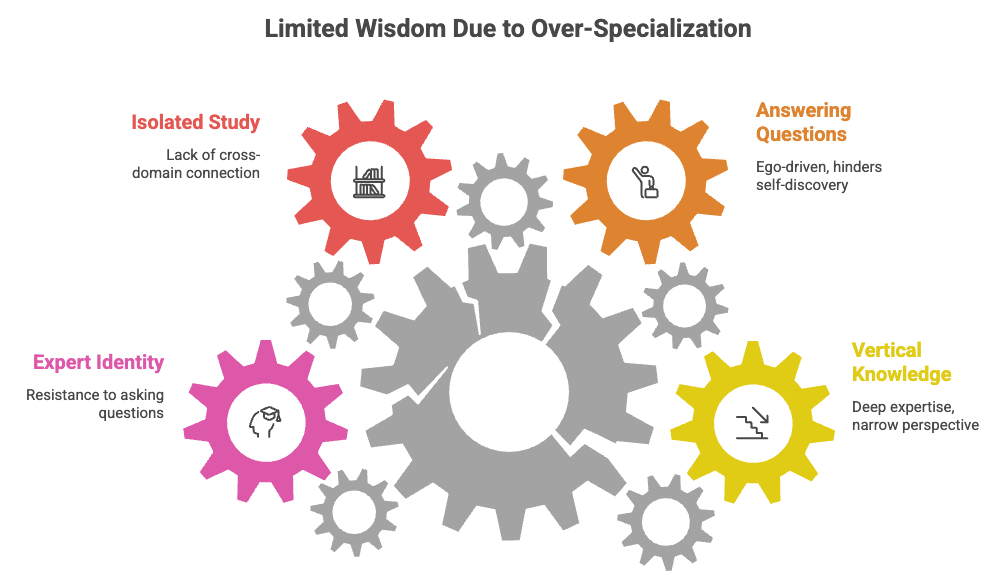
Knowledge is vertical. Wisdom is horizontal.
Knowledge goes deep into specialized domains. Wisdom goes wide across multiple perspectives. I spent years going vertical when I should have been going horizontal. Live and learn. Or in my case, live and eventually learn after making the same mistake for a couple decades.
Knowledge answers questions. Wisdom asks better questions.
Knowledge provides solutions. Wisdom helps people see their situation differently so they can find their own solutions. This was hard for me because I really enjoyed being the person with the answers. Turns out, that’s mostly about my ego and not very helpful to anyone else.
Knowledge comes from study. Wisdom comes from integration.
You gain knowledge by learning more about one thing. You gain wisdom by connecting ideas across many things. This requires being willing to be a beginner in multiple domains instead of an expert in one. My ego hated this. Still does sometimes.
Knowledge makes you an expert. Wisdom makes you a seeker.
Experts have answers. Seekers ask questions and help others find their path. I’m still working on fully embracing the seeker identity. Some days I fall back into wanting to be the expert. Old habits die hard.
The Transformation: From Know-It-All to Fellow Traveler
The journey from knowledge to wisdom changed not just how I worked, but who I was.
I stopped positioning myself as the expert with all the answers. I became the fellow seeker asking better questions.
I stopped trying to know everything about one thing. I started learning something about many things.
I stopped offering specialized solutions. I started helping people see patterns they couldn’t see on their own.
This wasn’t comfortable at first. Actually, who am I kidding – it’s still not comfortable sometimes. My ego preferred being the expert. My reputation was built on specialized knowledge. Admitting I didn’t have all the answers felt risky.
But here’s what I discovered: people don’t actually need another expert telling them what to do. They need someone who can help them make sense of complexity. Who can see connections they miss. Who can ask the questions that shift their perspective.
That requires wisdom, not just knowledge.
And wisdom requires being comfortable saying “I don’t know” a whole lot more than I was used to saying it.
Connecting to The Long Strange Trip
This shift from knowledge to wisdom is at the heart of what The Long Strange Trip is all about.
We’re not building a platform where I position myself as the expert who’s figured everything out about business, retirement, and mortality. I haven’t figured it all out. I’m figuring it out as I go, just like everyone else.
What I do have is a widening perspective. The ability to see patterns across these major life transitions because I’m willing to ask questions across multiple domains. To integrate insights from psychology, business, philosophy, family systems, health challenges, and lived experience.
That’s not expertise. That’s seeking.
When we explore work-life integration, we’re not looking for the one right answer about how to balance business and family. We’re asking questions that help you see your own patterns. What are you really afraid of losing? Where did you learn that work equals worth? How is your business intensity affecting your relationships?
When we talk about retirement transitions, we’re not following some expert’s formula for successful retirement. We’re exploring the identity questions that actually matter. Who are you without your business card? What does contribution look like in this new phase? How do you integrate decades of experience into a meaningful next chapter?
When we face mortality honestly, we’re not prescribing how to prepare for death. We’re asking the questions that help you discern what actually matters. What conversations need to happen while you still can? What are you avoiding that needs to be faced? How do you want to be remembered?
This is wisdom work. Integration work. Pattern recognition across domains.
And it’s work we do together, as seekers, not as expert and student.
Because here’s what I’ve learned on this long strange trip: the questions we’re exploring don’t have single right answers. They have your answers. And finding those requires wisdom – yours and mine together – not just my accumulated knowledge.
The Ongoing Journey: Still Learning (And Still Screwing Up)
Here’s the thing about wisdom: you never fully arrive.
I’m 73 years old. I’ve been working on this shift from knowledge to wisdom for years. And I still catch myself falling back into expert mode. Still find myself wanting to tell instead of ask. Still have moments when my ego prefers answers to questions.
I’m still learning. Still expanding my understanding across different domains. Still discovering new patterns and connections.
The difference is that now I know what I’m aiming for. Not more specialized knowledge, but broader integration. Not deeper expertise, but a wider perspective.
This is especially relevant as I navigate my own transitions – health challenges that have forced me to face mortality sooner than I expected, retirement identity questions as I move away from business, the work of figuring out what matters now that I know time is limited.
The wisdom I’ve developed by integrating insights across multiple domains serves me now in ways my specialized business knowledge never could. But I’m still a seeker. Still asking questions. Still figuring it out.
And honestly? That’s more comfortable now than it used to be. Maybe that’s wisdom too – getting comfortable with not having arrived.
Your Quest: Fellow Seeker Wanted
So here’s my question for you:
Are you accumulating knowledge or seeking wisdom?
Are you going inch-wide and mile-deep in your specialty? Or are you going mile-wide and feet-deep across multiple domains?
Are you positioning yourself as the expert with answers? Or the seeker who asks better questions?
Because here’s what I’ve learned on this long strange trip: the world has plenty of specialists with deep knowledge. What we’re desperate for are fellow seekers with the wisdom to see patterns, make connections, and help us discern what actually matters.
I don’t have this figured out. I’m still on the journey from knowledge to wisdom. Still learning to ask better questions. Still discovering new patterns.
But I’m convinced that this quest – moving from narrow expertise to broad integration, from knowing to discerning, from expert to seeker – is worth pursuing together.
Not because I have the map. But because maybe we can figure out the territory together.
It is what it is. And what it is, is a long strange trip from thinking we know everything to discovering that wisdom comes from integrating what we learn across many things.
Want to come along for the ride?
Let’s figure this out together.

Facebook
LinkedIn
Youtube