
Is That All There Is? Destinations Versus Journey
Is that all there is?
I remember asking myself that question after the sale of my food service company finally closed. Years of negotiations. A deal that nearly happened, then blew up, then came back from the dead. And when it was finally done — when the papers were signed, and the handshakes were over — I felt... nothing.
Or worse than nothing. I felt alone.
The phone stopped ringing. Not gradually. Immediately. No one needed my opinion on the next strategic move. No one was calling with a problem that needed solving. I wasn’t “the owner” anymore. And if I wasn’t the owner, then who exactly was I?
Here’s the thing I’ve figured out, looking back from where I’m standing now at 73. I had completely missed the journey. I was so obsessed with getting to the finish line that I never once looked up to notice what was happening around me while I was running the race.
That’s a mistake I’ve spent years trying to unlearn. And it turns out, the unlearning is where the wisdom lives.
The Call I Refused
Let me paint you a picture.
The first buyer came sniffing around my food service company years before we actually sold. We danced. We negotiated. They played good cop and bad cop — something I could see with perfect clarity in retrospect, but completely missed while it was happening.
There was the reasonable guy. Pleasant. Encouraging. Always talking about what a great fit this would be, how much he admired what we’d built. Then there was the other one. The guy who showed up later in the process with the demands, the red lines, the “we need to revisit the valuation” conversations that made my stomach drop.
Classic good cop, bad cop. Negotiating 101. And I never saw it coming.
Why? Because I was so focused on the deal closing that I wasn’t paying attention to the deal itself. I wasn’t curious about the people across the table — what they wanted, what they feared, what their actual intentions were. I wasn’t asking whether this felt right. I was just trying to get to the finish line.
Eventually, their demands got ridiculous enough that I pulled the business off the market. And I fell into a funk that I didn’t fully understand at the time.
Looking back, there were lessons everywhere. The warning signs were blinking like a neon sign. The whole process was telling me something important — about the buyer, about my business, about my own readiness to let go. But I wasn’t listening. I wanted it to be over.
This is what Joseph Campbell would call refusing the call. Every hero’s journey has this moment. Life is offering you an invitation into something bigger — a deeper understanding, a new chapter, a chance to grow — and instead of accepting it, you turn away. Not out of cowardice, necessarily. Sometimes just out of impatience. Out of the very human desire to skip the hard middle and just get to the end.
That’s what I did. I refused the invitation to pay attention.
And there’s a real cost to that refusal. Not just in missed lessons, but in missed wisdom.
Knowledge Versus Wisdom — And Why the Difference Matters
Here’s something I’ve been thinking about a lot lately.
Knowledge and wisdom aren’t the same thing. Not even close.
Knowledge is what you accumulate. Facts, frameworks, information, expertise. You can get knowledge from books, from courses, from other people’s experiences. You can download knowledge. You can Google it at 11pm when you can’t sleep.
Wisdom is different. Wisdom isn’t something you accumulate. It’s something you earn. And you earn it almost exclusively through paying attention to what’s actually happening in front of you — especially when what’s happening is difficult, uncomfortable, or not going the way you planned.
The hero’s journey isn’t really about the destination the hero reaches. It’s about who the hero becomes along the way. Every obstacle, every unexpected helper, every moment of confusion and clarity — those are the experiences that create transformation. The return home matters only because of what the journey made possible.
I had plenty of knowledge going into that first sale negotiation. I understood deal structures. I’d worked with business owners on exits for years. I knew what a good cop/bad cop play looked like in the abstract.
But I had almost no wisdom about my own blind spots. About how badly I wanted the deal to close. About how that wanting was making me see only what I wanted to see. About what I was actually walking away from, and what I’d need on the other side.
You don’t get that kind of wisdom from knowledge. You get it from paying attention to the journey. From staying curious. From asking the harder questions, even when the answers are uncomfortable.
I didn’t do that. So when the deal fell apart, I had no wisdom to draw on. Just frustration and a funk.
The Road I Didn’t Pay Attention To
Two years later, the buyer came back.
This time, we made it to the finish line. Deal closed. The company sold. Mission accomplished.
And that started eighteen months of the loneliest period of my life.
Nobody talks about this part. The financial advisors don’t mention it. The business brokers definitely skip over it. There are no brochures for what happens after the sale when the identity you’ve been carrying for decades suddenly has nowhere to live.
But here’s the honest truth: I had set myself up for exactly that experience.
I hadn’t asked any questions along the way. I hadn’t let myself get curious about what life after the food service company might actually look like. I had built something to step into, but it was as a rookie, and no one was interested in my opinion or even having a cup of coffee with me. I’d been so focused on getting the deal done that I never once sat with the question of what “done” would feel like.
What would I do with my mornings? Who would I be in a room full of people who didn’t know me as the owner? What did I actually care about, beyond the business that had consumed most of my waking hours?
I didn’t know. Because I’d never asked.
The hero who reaches the end of the journey and finds it hollow almost always makes the same mistake I made. They were running toward the destination instead of walking on the road. Moving too fast to notice what the road was offering. Too busy to let the journey do its work.
Wisdom requires slowness. Not laziness — slowness. The willingness to pause and actually take in what’s happening. To be genuinely curious about the process you’re in, not just the outcome you’re after.
I wasn’t slow. I was sprinting the whole way. And when I finally stopped, I had no idea where I was.
What I Got Right — The First Time Through Cancer World
Here’s where it gets interesting.
Seventeen years ago, I went through cancer world for the first time. And somehow — I’m not entirely sure how — I got the journey thing right.
Maybe it was because cancer doesn’t give you the option of focusing only on the destination. The destination with cancer is either “I’m better” or “I’m not.” Neither one is something you can sprint toward. You’re at the mercy of the process in a way that business never quite forces you to be.
So I paid attention.
I asked questions — not just “what’s the prognosis?” but “what does this treatment actually do inside my body? What should I expect to feel on day three versus day ten? What have other patients found helpful that doesn’t show up in the medical literature?” I was curious in a way I’d never quite been during the food service sale.
I watched every step. Not with anxiety, but with genuine interest. This was my body. This was my life. And the journey through treatment was full of information, if I was willing to take it in.
I learned things about my own resilience I hadn’t known before. I learned which relationships were real and which were transactional — cancer has a remarkable clarifying effect on that question. I learned something about fear, and specifically about how fear shrinks when you look directly at what you’re afraid of instead of trying to outrun it.
That’s wisdom. Not information. Not knowledge I could have gotten from a book. Wisdom that came directly from paying attention to what was happening, step by step, as it was happening.
And here’s what I noticed: the journey through cancer — even with all its difficulty — was more interesting than almost any destination I’ve ever reached. More textured. More full of meaning. The hard parts were hard, but even the hard parts were teaching me something.
That’s not something I could have said about the food service sale. Because I never let the sale teach me anything. I just tried to get through it.
W.H. Murray and the Stream Nobody Notices
There’s a passage from W.H. Murray’s account of the Scottish Himalayan Expedition that I keep returning to. He wrote:
“Concerning all acts of initiative or creation, there is one elementary truth … that the moment one definitely commits oneself, then Providence moves too. A whole stream of events issues from the decision, raising in one’s favor all manner of incidents and meetings and material assistance which no man would have believed would have come his way.”
A whole stream of events.
That’s the journey. That’s what Murray was describing. The moment you truly commit to something — not just intellectually but with your whole self — the world starts responding. People show up. Doors open that you didn’t know existed. Sometimes doors close, too, and that’s information worth having.
But you have to be present enough to notice. You have to slow down long enough to see the stream.
I committed to selling my food service company. I’ll give myself that much. But I never noticed the stream. I was standing in the middle of it, water rushing past my ankles, and I was staring at the far bank, trying to figure out the fastest way to get there.
What was in the stream? People who had navigated similar sales and could have told me what to expect on the other side. Signals about my own readiness — or lack of it — to let go of the identity I’d built. Questions about what I actually valued, what I actually wanted, what a meaningful next chapter might look like. Even the difficult moments — the falling apart of the first deal, the funk that followed — were part of the stream. They were trying to tell me something.
I wasn’t listening.
During cancer, I listened. Every appointment was a chance to learn something. Every conversation with my doctors was a chance to understand not just what was happening, but why. Every hard day was information about what I needed — rest, connection, a different kind of attention.
The stream was flowing the whole time. I just finally decided to pay attention to it.
How We Learn to Pay Attention
So how do we actually do this? How do we stop fixating on the destination and start receiving what the journey is offering?
I don’t have a five-step framework for you. That would be very on-brand for a business consultant, and also probably useless.
What I have is a few things I’ve been practicing, imperfectly and inconsistently, that seem to help.
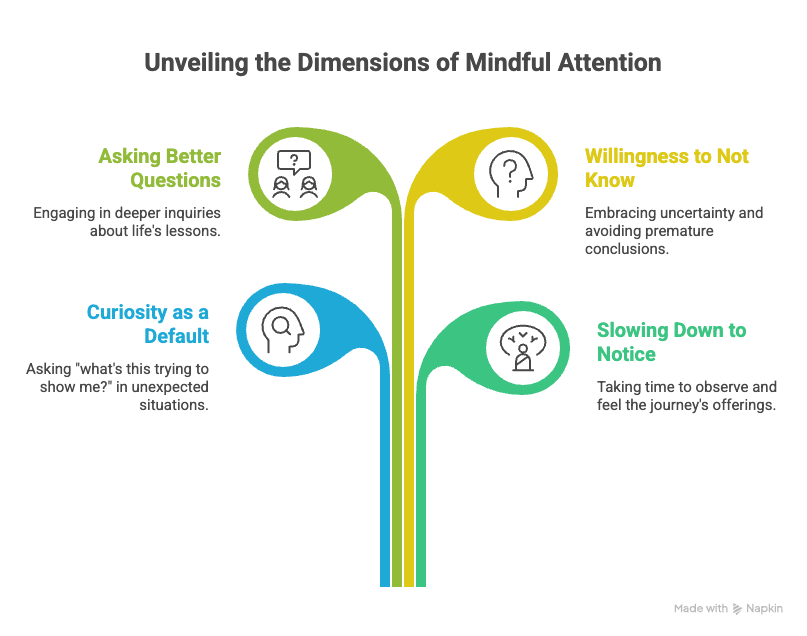
The first is curiosity as a default. When something unexpected happens — a deal falls apart, a diagnosis arrives, a plan goes sideways — the first question I try to ask now is “what’s this trying to show me?” instead of “how do I get back on track?” Not always successfully. But more often than I used to.
The second is slowing down enough to notice. This sounds obvious. It’s not easy. When you’ve spent decades in achievement mode, slowness feels like failure. But wisdom requires contact with what’s actually happening. You can’t receive what the journey is offering if you’re moving too fast to feel it.
The third is asking better questions. Not just “how do I get there?” but “what does this moment have to teach me? Who showed up that I didn’t expect, and why? What is this difficulty telling me about what I actually care about?”
And the fourth — probably the hardest one — is being willing to not know. To stay in the uncertainty of the middle without forcing a premature conclusion. The hero doesn’t get to skip the wilderness portion of the journey. Neither do we.
Where I Am Now
I’ll be honest. I’m back in cancer world right now, and it’s more complicated this time. Two cancers simultaneously, which apparently makes me something of a medical rarity. Not the kind of distinction you’re looking for.
But I’ll tell you what I’m trying to do differently than I did during the food service sale.
I’m paying attention.
I’m asking questions — a lot of them, sometimes to the mild exasperation of my medical team, though they’ve been remarkably patient. I’m noticing what the journey is offering. The moments of clarity that come from facing something difficult without looking away. The relationships that have deepened in ways I wouldn’t have predicted. The strange, unexpected gifts that seem to arrive when you’re genuinely present to what’s happening.
Is that all there is?
That question used to feel like disappointment. Like arriving somewhere and finding it smaller than you’d hoped.
Now I think it’s the wrong question entirely.
The better question is: Am I actually here for what’s happening right now?
That one I’m still working on. But I’m getting better at asking it.
Your Turn
I’m genuinely curious where you land on this.
Have you ever arrived somewhere you’d worked toward for years and found the arrival hollow? Or have you had the opposite experience — a journey that surprised you completely with how much it had to offer?
We all get caught up in the outcome. That’s not a character flaw, it’s just human. But I think there’s something worth sitting with here — what happens when we loosen our grip on the destination just enough to actually feel what’s happening right now.
Let me know in the comments. I’d love to know where you are in the journey.
Josh Patrick is the founder of The Long Strange Trip, where he explores the messy, meaningful passages of business, retirement, and everything in between. He writes as a fellow seeker — not an expert — and thinks the questions are almost always more interesting than the answers.

Facebook
LinkedIn
Youtube