
I Trained Everyone to Believe I'm Fine
I trained everyone to believe I'm fine. And now nobody asks. For a long time I called that independence. Lately I'm not so sure.
The Training Wasn't Complicated
Here's the thing. My family, my employees, my friends — I trained all of them the same way.
Someone would ask how I was doing. I'd say I'm fine. That was the whole method.
No lecture. No boundary-setting speech. Just the same two words, over and over, until they stopped expecting a different answer.
Except I'm Not Sure "Trained" Is the Right Word
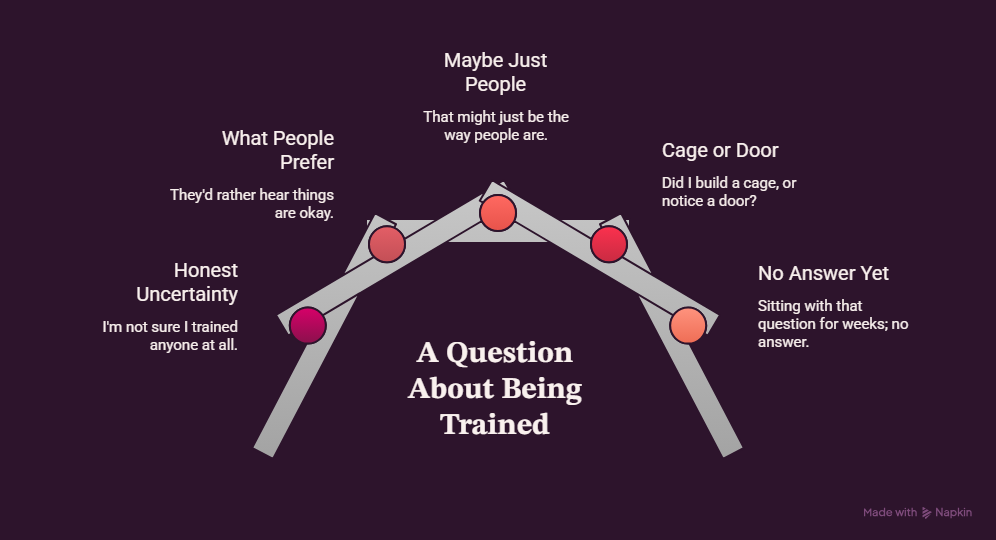
I want to be honest about something before I go further. I'm not sure I trained anyone at all.
I think when someone asks how you're doing, they'd rather hear things are okay. Nobody really wants the litany of what's not.
That's not something I did to people. That might just be the way people are.
So which is it? Did I build a cage, or did I just notice a door everyone already wanted closed?
I genuinely don't know. I've been sitting with that question for weeks now, and I still don't have an answer.
Where Resilience Stopped Working for Me
I've been struggling with the word resilience. I think I finally know why.
Resilience means you got through something. That's all it promises — that you made it out the other side.
Strength means something different. Strength means you built a muscle.
I like strength better, because a muscle is something you can keep building. Getting through something just means it's over.
And here's what bothers me about resilience specifically: I think it lets a lot of people off the hook.
Internal Versus External
I think there's internal strength and there's external resilience, and they are not the same thing wearing two names.
Internal strength is mine. Nobody can hand it to me, and nobody can take it away.
External resilience is what other people assign you from the outside. They watch you get through something, call it "resilient," and the label sticks whether or not it fits.
I don't know exactly what external resilience is made of. I only know it isn't the same material as the strength I've had to build myself.
What Internal Strength Actually Does for Me
Let me paint you a picture. I have two cancers right now, and it would be easy to catastrophize every single test result.
Here's what that actually looks like from inside it. The phone rings, or the portal updates, and there's a half-second before I know anything at all where my whole body is already bracing. My hands know before my mind has read a single word.
Internal strength doesn't mean that half-second stops happening. It means I don't panic before there's a reason to.
Even when there is a reason, panic still isn't the move. It becomes: okay, we have this, there are choices here.
That's the muscle. Not the absence of fear — the ability to sit with it long enough to think.
Shattering Versus the Messy Middle
Almost twenty years ago, I got my first cancer diagnosis. I remember that one as a single hard hit — a phone call, a date, a before-and-after you could point to on a calendar.
I think I'm past the version of me that shatters like that now. What I face today doesn't have a date on it.
It's a scan every few months, a number that moves a little, and a doctor who says, "let's keep watching it," instead of giving me anything I can point to. Some weeks I forget it's happening at all. Some weeks it's the only thing in the room.
Getting through a fog like that takes a different kind of strength than surviving one blow. I didn't know that distinction back then. I think I'm only starting to understand it now.
The Agenda Asks. Nobody Else Does.
I can't remember the last time a person asked me how I really am. Not "how are you doing" as a greeting — how I actually am.
The agenda asks. A doctor's intake form asks. A checklist before a procedure asks.
Outside of that, I honestly don't know what people mean when they ask the question. I don't think I'm being dramatic. I think I trained the question out of my own life, on purpose, one "I'm fine" at a time — or the question was never really there to begin with, and I've just noticed its absence now that I'm looking.
A Door, Not Only a Wall
I called this self-abandonment when I started writing it. I'm less sure of that word now than when I opened.
When I don't make my health the center of the conversation, there's room for someone else to bring up theirs. I think that's often what actually happens.
People, in general, aren't that interested in somebody else's health problems. A few people are — real exceptions — and for the rest, my "I'm fine" might be less a wall and more a door held open for their turn.
The Ones Who Wear It Differently
I went looking for other people wrestling with this exact word, and I didn't expect what I found.
In one caregiver community, someone wrote that they felt lonely, forgotten, and lost — and in the very same breath, called themselves the definition of resilience. Nobody in the replies saw a contradiction. If anything, they leaned into it harder, calling themselves heroes doing a job nobody else could see.
For them, being called resilient wasn't a cage at all. It might have been the only medal on offer for work that gets no other recognition.
I can't dismiss that. I don't think I'm right and they're wrong. I think we're just standing in different rooms, looking at the same word from opposite windows.
Someone Else's Version of Being Trained
I read about a woman managing three cancers over almost thirty years. She assumed her husband understood, without her having to explain it, exactly how those years had marked her.
One ordinary evening, he showed her he didn't understand any of it. Not from cruelty — from simple absence.
That's the same wound as mine, from the other direction. I trained people not to ask. She never had to train anyone — nobody was asking in the first place.
Strength Can Also Be Something Somebody Hands You a Bill For
There's a version of this I hadn't considered before this week, and it doesn't come from inside me at all. A woman grieving her father was blogging through it, honestly, messily, the way grief actually looks.
A friend told her that people of real faith shouldn't grieve — they should show strength through their faith instead. She said it left her carrying guilt she hadn't asked for.
I've never had that exact thing done to me. But I recognize the shape of it, because I think I've done a version of it to myself, and charged myself the same bill.
What CaringBridge Taught Me by Accident
When I first started writing about my cancer, I used CaringBridge, and for most of it, the writing stayed close to reporting. Scans, numbers, next steps.
Near the end of that run, the writing began to drift toward feelings rather than facts. Once I noticed that drift, I knew it was time to move somewhere else.
I didn't examine that decision much at the time. Looking back, I wonder if it was one more version of the same training — keep the feelings contained, even in the one place built to hold them.
What I Still Don't Know
I don't have a clean ending for this one, and I'm not going to force one.
I don't know if my "I'm fine" is self-abandonment, basic human courtesy, or a gift I'm handing someone else without telling them. I don't know if the word I want going forward is "strength" instead of "resilience," or just a different name for the same old habit.
Whether nobody asks because I trained them, or because that's just what people are — I honestly can't say yet.
What’s your thoughts about all of this? Leave a comment and let me know what you think.


Facebook
LinkedIn
Youtube