
I Never Asked Him
My father told me his business was stupid. I bought it anyway.
You've been assuming for years. You have never once asked.
That's the 3am problem. Not gift versus sale. Not the valuation. It's that you've built a retirement, a legacy, and a whole back half of your life around a yes that nobody ever said out loud. You know who you'd hand it to. You've said the name in your head a thousand times. You have never said it to their face as a question.
I found a kid on a forum a few months back. He's twenty-nine. His father is sixty-four and has run a hardware store for thirty-one years. Dad started talking about retiring last year. Here's what the kid wrote: "he's never actually asked me if I want it. He just talks like it's already decided."
Then he wrote the part that stopped me cold. "I think part of him knows and is dodging the conversation, which is exactly what I'm doing too."
Two people. Same fear. Neither one says it. Every quiet month is a month the father plans around a son who isn't coming.
There's another one I can't shake. A man announced at dinner that his longtime employee would get 60% of the company, and each of his two kids would get 20%. His son walked out. Later the son showed up in the same online thread his father had posted in, and explained himself.
He'd never wanted the business. He'd quit at seventeen because, in his words, he didn't understand why his father was only ever really there at work. And not wanting it, he said, had made him feel guilty for not being the son his father wanted.
Read that again. The kid didn't want the company. He wanted the man. The business was just the only room where his father was actually available. Fifteen years of both of them carrying that, and neither one ever put it on the table.
The question my father did ask
My father asked me. Repeatedly. To my face.
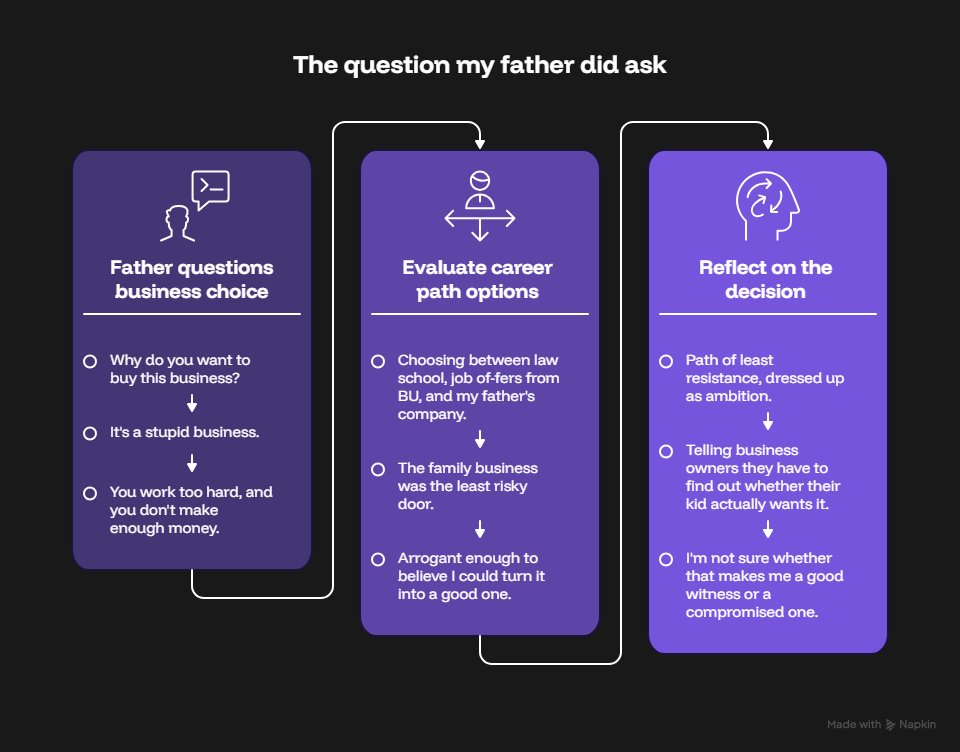
"Why do you want to buy this business? It's a stupid business. You work too hard, and you don't make enough money."
He said some version of that many times. He was not being coy or testing my resolve. He meant it. He did not want me in the business, and he told me so, and I ignored every word of it.
I was choosing between law school, a couple of job offers from BU, and my father's company. I want to be honest about how that decision actually got made, because it doesn't flatter me. The family business was the least risky door. It was the easiest one to walk through. I was also arrogant enough to believe that my father had a lousy business and I could turn it into a good one.
That's it. That's the whole calculus. Path of least resistance, dressed up as ambition.
So here I am, forty-five years later, telling business owners they have to find out whether their kid actually wants it. And the man saying that took the easy road himself, from a father who warned him off out loud. I'm not sure whether that makes me a good witness or a compromised one. Probably both.
How I actually got in
He didn't hand me anything. He had a location two hours from the main plant. One account, seventy-five thousand a year, one and a half employees. He said, you buy it, go up there and run it.
So I became the one employee. We had a part-timer. And we grew that thing fast, which turned out to matter later in a way I didn't see coming.
Eventually I bought him out. Bought. Not received. He sold to me at a discount, and I still had to pay for it every month, and that difference is most of what I've believed for forty years.
What the discount was actually for
Tom Deans wrote the book on this. Every Family's Business. His position is that you never gift a business to your children — you make them buy it, at full market value, with their own capital at risk. His test question is blunt: are you willing to risk your money to buy these shares at full price?
I agree with him about selling. I don't agree about the price, and I think the disagreement matters more than it sounds.
Here's why. The number isn't the point. What the buyer can carry is the point.
I've helped a lot of families through these transfers. Every one was a sale. Every one was at a discount. We structured them tax-efficiently, usually something like half deferred compensation and half stock, because notes get paid with after-tax dollars, and that is the trap nobody sees coming. But taxes were always secondary. The real question was whether this buyer could pay for the business and run the business at the same time.
If they can't, I tell them to pass. Every time. And I'd say the same to a parent: if the only price you'll accept is one your kid can't carry through a bad year, you're not selling them a business. You're selling them a slow way to lose one.
The clause that saved me
We wrote something into my deal with my father. If I needed to, I could pay interest only for three or four years.
Nobody needed it when we signed it. That's exactly why it worked.
Three or four years in, everything went at once. We had a salmonella outbreak. We had an embezzlement. We'd expanded too fast, which is the polite version of what I'd done with that little location. And I did not know the difference between an income statement and a cash flow statement, so the notes coming out of after-tax dollars were invisible to me until they weren't.
My positive cash flow disappeared. I had to go tell my father I couldn't pay him.
That was a kitchen table conversation, and I remember it. He wasn't happy. But my father was very good with really bad news. He was terrible with medium news, the ordinary irritations, and he handled genuine catastrophe better than anyone I've known. We'd already agreed on what would happen. So it happened, and the business survived, and so did we.
That's what affordability actually means. Not a soft price. A clause you write down while everybody is still doing fine.
The compensation change nobody wants
Here's the question underneath all of it. Are your children acting like an owner, or are they acting like an employee?
I used to think you got there through conversation. Sit them down, explain the stakes, help them see the bigger picture. It doesn't work. What I found instead is that action comes first and the mindset follows it.
I had a client with a young guy out in the field as a tech. He liked being a tech. He said that was the only thing he wanted. Over four or five years we gave him more — a job to own, then a section to own. The whole time, every conversation he had with me was about his salary and his bonus. Not once about the company.
So we changed how he got paid. We took away the bonus and gave him a piece of the profits.
He didn't want it. He fought it. He didn't understand he was about to make far more money. The father knew it was a test, because I told him it was my test.
And then it flipped. He started paying attention to what made the company money instead of what made him money. It took a couple of years. When it landed, it was close to magical. He decided he wanted to buy the business; we built something he could afford, and he's since quadrupled the profits and doubled the sales.
I'd seen this before in my own place. We paid our route drivers by the hour and moved them to straight commission, guaranteeing nobody would earn less. They rebelled. A year or two later, they were making far more than they ever had on salary, because they'd started paying attention to what created a sale.
You can't talk somebody into an owner's head. You can change what they're paid for and let their attention follow the money.
The part where I was the problem's father
I bought my father’s business, and he kept his office in our warehouse. I wanted that. He needed somewhere to go, and I wasn't going to take that from him.
He also came out of that office and countermanded me. Not maliciously. An employee would come to him unhappy with something I'd decided, and he'd weigh in, and now that employee has two answers and gets to pick the one he likes.
There's a name for this that I’ve used for years. I call it seagull management. Dad flies in the window, dumps on everything, flies back out.
The check bought me the business. It didn't buy me the chair.
So I started telling parents how to handle it, and it's simple enough that people don't believe it. When an employee comes to you complaining about your son or your daughter, you ask one question first. Have you talked to them about it?
The answer is almost always no. That's the whole game right there. So you send them back. And you tell them that if the two of you can't work it out, then come to me together and we'll decide it together.
I've watched that work for a long time now, with children taking over and with managers taking over. But it has to be explained to the parent, because nobody ever explains it. Not the accountant, not the attorney, not the financial advisor. None of them are trained to.
The one I couldn't fix
I had a client who inherited half a business alongside a sister who never worked in it. He resented it for years, eventually bought her out at a price he thought was robbery, and destroyed the relationship doing it.
Then he came to his own succession. Three sons. One in the business. Two who were never coming anywhere near it. He wanted to give each of them a third of the stock.
I recommended selling the business to the son who worked there at a price he could afford, and giving the other two cash, stock, and other assets. Equal thirds sounds like fairness. What it actually does is guarantee family conflict when the two brothers out of the business want cash, and the one in the business wants to retain cash for growth.
Same problem, different people, as my client had with this sister.
I've seen the far end of that. A woman wrote about her family's farm, where the only son got a thousand acres, the buildings, and the equipment so he could farm full-time, while she and her sister moved away and worked for 20 years for what they have. Her last line about it was three words. Cry me a river.
My client’s wife thought the business was a family heirloom and should be treated like one. She thought I was splitting the family. I talked with her directly and she just didn't like me.
I went back at him several times. I said plainly that he was building the exact machine his father had built for him and his sister. He never gave me an answer.
Then he called and told me the family had decided I was dangerous to family harmony, and they were discontinuing my work. My feelings were hurt. There's an old line in consulting — when you tell the client the truth, you get fired.
I think he voted for peace now over stability later. I don't know that. I never got to ask, because he wasn't interested in talking. It's the case I've turned over the most and I still don't have the bottom of it.
Two things I owe you straight
The first is an idea I've recommended for years and never once gotten to run.
I call it leapfrog. In a bigger company, twenty or thirty million and up, you bring in an outside CEO whose actual job description includes training the son or daughter who'll eventually take over. The successor starts under them and finishes above them. The literature supports it. I've pitched it more than once.
It has never been implemented. Not by anyone I've worked with. I think it's a good idea and I have no proof, and the honest reason it doesn't get run is that the owner isn't going to give up the reins until he's too old or too sick to hold them.
The second is a saying I've repeated my whole career. Shirtsleeves to shirtsleeves in three generations. My explanation has always been that the rising generation wasn't trained properly, and I've had that confirmed by people I respect — James Hughes has written about it for decades, the folks at Purposeful Planning Institute will tell you the same, and I watched it firsthand for ten years in YPO, where second and third generation owners complained constantly about not being allowed to run things when the truth was they weren't competent to.
What I can't tell you is how much of the belief was ever the evidence, and how much was forty-five years of watching it happen in front of me and calling that data.
The question I'd start with
Not gift or sale. Not the valuation. Not the tax structure. Those all come later, and they're all solvable.
Start here. Do they want it? Have you asked them out loud, in words, with a real answer available to them? Have you asked whether this business can pay you what you need and still leave them a living?
In every single company I ever walked into, the answer to that second one was no. Not most. Every one. The parents had never run the numbers on two households from one business.
I think good questions matter more here than good advice. I've been giving the advice for forty-five years, and I'm less sure of it than I used to be. I can't always tell whether that's wisdom or just age.
What I keep coming back to is my father telling me the truth about his own business, and me not hearing a word of it because I'd already decided.
If you've been assuming — tell me in the comments what's stopped you from asking. I'd like to know whether it's the same thing that stopped him.
Hey, this is Josh. You're on the Long Strange Trip. I'm glad you're here.


Facebook
LinkedIn
Youtube