
I Do All the Asking
I'm content down here. That's the part that worries me. A researcher named Glenna Crooks drew a map of my life, and every area came back strong except one. I've been staring at the hole ever since.
Let me start with something I'm not proud of. I said out loud on a podcast that I'm very, very happy in my basement, doing this work. Writing, reading, thinking. And then, almost in the same breath, I heard myself say I wasn't sure that was true.
I've been chewing on that half-second ever since. Not the first sentence. The gap between the two.
Here's my situation. I'm seventy-three, I've got two cancers, both behaving right now, and I can go the better part of a week without a real conversation. Not a transaction. Not a doctor's appointment. A conversation.
I don't say that as a complaint, and that's what makes it strange. I'm not sitting here miserable, waiting for the phone to ring. I'm fine. I like my books, I like my music, I like this.
So what's the problem, exactly? That's the question I can't get to the bottom of.
The map somebody drew of my life
Let me tell you where this started, because I wasn't looking for it. I had Glenna Crooks on the podcast, and she's spent years studying something most of us never think about. She calls them our networks. Not networking. Networks — the actual web of people running through a life.
Her framework breaks it into pieces. Family. Health and vitality. Education. Spiritual. Career. Home and personal affairs. Social and community.
And here's her first finding, which stopped me cold: most people don't even know who's in these networks. I didn't. I'd never once sat down and looked.
So I looked. And what I found was a report card with one bad grade.
Health? Strong — I've got a team of doctors I trust. Career? Strong, and it was strong for forty years. Family? Better than it was. Spiritual, education, personal affairs, all solid.
Social? Thin. Really thin.
That's not a feeling. That's a map. Somebody handed me a map of my own life and there was a hole in it.
What I do instead of calling
Here's what I keep noticing, and it took the map to make me see it. If I want to see somebody, I have to be the one who reaches out. If I want a conversation, I start it. Nearly every time.
I don't think people are being cruel. I really don't. It's just how the traffic runs. I'm the initiator; that's the role, and it's been the role for a very long time.
And a few weeks ago somebody said something to me I haven't been able to shake. I was working on another piece, and in the middle of it this person told me, plainly: you're not very likable. You may want to look into that.
Now, I could dismiss that, and I've got my reasons lined up. My face isn't a friendly face — never has been, and I don't know that there's much I can do about it. And I'm direct. Blunt, even. I'll take you on, and I don't always pick the right moment.
The thing is, I like it when people do that to me. I want you to come at me straight. I find it refreshing.
But the rest of the world doesn't work that way, and I know it. It's like my thing about titles. I think titles are silly; I always have. Most people don't — they worked hard for that title, or that certification, and it matters to them. I can think it's silly all I want. That doesn't change what it means to them.
So maybe the person who told me I'm not likable was right. Or maybe they were describing a man I used to be. That distinction turns out to matter more than I expected.
The other shoe that never dropped
Let me take you back almost fifty years, to the food service company. I went to one of those new-age seminars — this was the seventies, everybody was going to something. And I actually got a thing out of it. One idea. Personal responsibility.
Not the bumper sticker version. The real one, and it took me years to work it through.
Before that, I blamed and justified my way through my life. Something went wrong, and it was somebody else's doing. I was good at it. Afterward, I started doing something different: when a mistake landed, I asked questions, I looked at my own part in it, I took the hit when the hit was mine.
That's a real change. It took years, and I made it.
Here's what I didn't understand at the time. The people who'd been with me the longest never believed it. Not really. They were polite about it; they went along, but they were waiting for the other shoe to drop. Waiting for the old Josh to come back through the door — because the old Josh was the one who lived in their heads.
I've come to think that once you're stuck in somebody's head a certain way, you don't get out. Not with effort, not with time, not with being different for twenty years. The version of you they met is the version they keep.
Which raises a question I didn't see coming. If that's true of them, is it true of me? Am I carrying around a version of myself I met a long time ago and never bothered to update?
Nobody ever came to me and said, "Boss, I made a mistake"
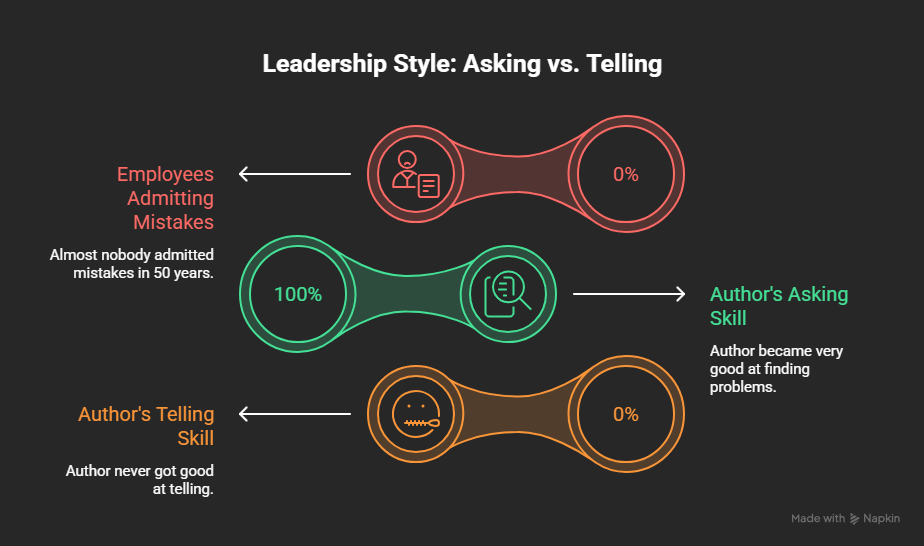
Here's the piece of my own history that's been rattling me. In all my years running companies, almost nobody ever walked into my office and told me they'd screwed up. Almost nobody.
I had to pry it out. Every time. I'd ask questions until the thing finally surfaced.
I got very good at that. It became one of my actual skills — I could find the problem under three layers of nothing-to-report. And I was proud of it. I thought it was leadership. Maybe some of it was.
But look at its shape. I ask, you answer. That's the whole arrangement.
Fifty years of being the one who asks the questions. And in fifty years, I don't remember many people asking me one. Why would they? I built a room where I'm the one who asks.
I got very good at asking. I never got good at telling.
Where the asking came from
Now I have to go back further, and this is the part I'd rather skip.
My father was a verbal man. I want to be precise about that, because it matters. He never hit me. What he did was with his voice, and he was good at it.
Two things set him off. Embarrassment and not getting his own way. Either one would light him up, and I could produce both on demand.
Because here's the part I've only recently been willing to say out loud. I went at him. Regularly. I challenged him, and he was a man who could not stand being challenged.
My sister rarely caught it. I caught it constantly, and I caught it hard. The difference between us wasn't luck. It was that I wouldn't leave it alone.
We've all got a few people running around inside us. I've got one I call Hard Joshy, and Hard Joshy had a job — protecting the rest of the Joshes from whatever was coming.
He worked out the strategy when he was young, and it was a good one. Taking care of myself meant shutting down. Or moving on and not going back for it. Because when I did go back and tell the truth about what had happened, I got slammed. Every time.
I want to be careful here, because I don't want to say this the easy way.
People will tell you they learned that needing less made them better. That's not what I learned. I learned that needing less made the pain stop.
That's a different sentence. It isn't a virtue. It's a nine-year-old doing math.
And the math was correct. That's the thing nobody tells you. Hard Joshy wasn't wrong — telling the truth in that house genuinely did make it worse. He solved the problem in front of him. He just never got the memo that the problem ended.
The part I got wrong when I went looking
Now, I had an assumption about all this, and I want to be honest about it because it turned out to be shaky.
My assumption was that verbal intimidation from a father was just how it was back then. Normal for the era. Half the kids I knew probably got some version of it. That's what I've told myself for sixty years, and it's a comfortable story, because if it's normal it isn't really anything.
So I went and looked, and here's what I found instead.
Researchers only proposed treating childhood verbal abuse as its own category of maltreatment in 2023. Two years ago. A team led by Shanta Dube, working with University College London, went through the literature and made the case that it needed a name of its own.
Before that, it got folded into "emotional abuse," which is a bucket so wide it doesn't tell you much. And the numbers, once they went looking, weren't small. In the UK, twenty-one percent of adults report it — higher than the number reporting physical abuse. In one survey of American adolescents, fifty-five percent reported emotional abuse at home, compared with eleven percent reporting physical.
Here's the part that upended my assumption. Physical and sexual abuse of children have been measurably declining. Verbal and emotional abuse hasn't. If anything, it's gone the other way.
So my story — that it was just the water everybody swam in back then — may have things backward. It wasn't that everyone had a father like mine. It's that nobody had a word for what mine was doing.
I'm still sitting with that one. It doesn't resolve cleanly, and I'm not sure what to do with it.
Other people are up at two in the morning too
I don't want to make this only about me, so I went out and read what other folks are saying about this. In forums. In comment sections. In the places where people talk when it's late and nobody's around.
I'll keep it short, because the research isn't the point. The point is that none of us seem to be getting good answers.
There's a study from the University of York, with almost 7,000 people over 50. They measured loneliness with a standard scale, and then they asked people straight out: are you lonely? Men were twenty-eight percent less likely to say yes. Same measured loneliness. Just less willing to say the word.
One of the men in a related study, sixty-five years old, put it this way: "I don't bang on about me being a bit lonely at times because I don't think they'd really want to hear that anyway." I read that and thought, well, there I am.
Then there's the thing people say about being called strong. I found this in a comment thread, and it's stayed with me. A woman named Téa wrote: "'Strong' serves their agenda. If you are strong, it means you got this, you don't need their help, and they can look away."
That's a harder sentence than it looks. It says my competence isn't just failing to bring people closer. It's actively handing them the exit.
And then there's Wanda, living with cancer, writing in a forum. She said she's sure everybody's fed up with hearing about it, and then added: "That's never once been said to me, but it's what I think."
Nobody ever said the sentence. She installed it herself, and she's been running it ever since. I know that machinery. I've got one of my own, and it's been running since I was a kid.
The thing I found that I can't resolve
Here's what actually surprised me in all that reading, and I haven't made peace with it.
I went looking for the story where the strong one finally asks and somebody comes through. The heartfelt conversation. The friend who shows up. I couldn't find it. Not really. Across hundreds of these posts, almost nobody gets rescued that way.
What I did find was different, and much less satisfying. Every person who got out did so structurally. A standing lunch. A group that meets every other week. A recurring thing on the calendar with other people's names on it.
One man described his: retired guys, lunch every other Tuesday. That's it. That's the whole intervention. Nobody was saved by a conversation. They were saved by an appointment.
I don't like that answer. It's completely unromantic. And here's my honest problem with it — I'm not sure I'd go.
The strongest argument against everything I've just written
Let me give you the other side, because it's better than you'd think.
There's a study out of the UK that looked at solitude across three age groups. Two thousand people — teenagers, working adults, and older adults up into their eighties. Guess who does solitude best.
Older adults reported the most peaceful mood when alone. They mentioned other people in their alone-time stories far less often than younger folks did. And they described feeling alienated almost never—a couple of percent, compared with fifteen percent for the teenagers.
One man in that study, seventy-seven years old, put it this way: "I had nobody to answer to but myself."
I read that and thought, that might be me. Because I'm not miserable down here, and I need to keep saying that or this piece becomes a lie. I like reading. I like music. I like sitting with a hard question until it cracks open.
And this writing — the Long Strange Trip, all of it — somebody asked me early on why I was doing it. I had to think a while. The answer I landed on was that I'm doing it for me.
If you want to come along, I'm glad to have you. Truly. But the honest truth is that this writing is introspective. It's how I figure out what matters. It's how I find the things I've been missing.
That's not a man in distress. That's a man who found a good use for his afternoons.
So which is it
Here's where I actually am, and I'm going to leave it here.
I can't tell whether my contentment is a choice or a very old defense that got good at calling itself a preference. Those look identical from the outside. I'm beginning to think they look identical from the inside too.
Hard Joshy solved a real problem, in a real house, a long time ago, and his solution was correct. But nobody ever told him the war ended. So he's still at the post, still handling it, still making sure I don't need anything from anybody.
And I genuinely do not know whether the peace I feel down here is peace, or just him doing his job well.
Ask me intellectually whether a social life matters and I'll say yes, of course, everything I've read says yes. Ask me emotionally — actually sit with it and feel for the answer — and I get nothing back.
Not a no. Just nothing. A quiet room where the answer should be. That's the most honest thing I can tell you.
There's one more thread I can't quite tie off. The directness that got me slammed at nine is the same directness somebody flagged in me a few weeks ago. Sixty-four years apart, same trait, same result. I don't know whether that's a wound or just who I am, and I've stopped being sure there's a difference.
What I'd hand you, for whatever it's worth
I've got no five steps here. I'd be making them up.
But I'll tell you the one thing I'd want somebody to have told me at forty-five. If you're the person everyone leans on, understand what you've actually built. You didn't just earn a reputation. You built a room.
In that room, you ask, and other people answer. That's the traffic pattern, and it will hold for decades. Nobody is going to change it for you. Nobody is even going to notice it's there. They'll call you strong, and they'll mean it kindly, and it will function as permission to look away.
I'm not saying tear the room down — I'm seventy-three, and I haven't torn mine down. I'm saying look at it. Draw the map. Find out which network is thin.
You may decide you like it exactly as it is, and that's a legitimate answer backed by real research. But make it a decision. Not a nine-year-old's strategy still running fifty years after the threat left the house.
Your turn
I want to hear from you on this one, because I don't have it worked out.
If you're the one everybody leans on — when's the last time somebody asked you a real question? And did you answer it honestly, or did the old reflex answer first?
And if you're happy alone, tell me that too. I mean it. I want to know how you can tell the difference between peace and a habit. Because I can't. Not yet.
Drop it in the comments. I read every one of them.
Hey, this is Josh. You're on the Long Strange Trip. I'm glad you're here.


Facebook
LinkedIn
Youtube