
I Can't Tell Them Now
He was fifty-eight when he said that. He was sixty-five when it stopped being true.
You already know who could buy it. You've known for years. And some part of you doesn't want them to have it.
That's the sentence nobody says at the conference. It sits under a lot of good owners at two in the morning. You watch the two of them run your company all week. Then you can't quite picture them owning it.
I want to say something before I go any further. That reluctance might be honest. It might be the most accurate read you have.
The second job nobody names
Some people are terrific at running a thing and lousy at owning it. Those are two different jobs, and we almost never say what the second one is.
An owner is responsible for exactly two things. That the business is profitable enough. And that it's growing at a rate that's healthy for the business. Everything else you do all day is somebody else's job, not the owner's.
So when you look at your best manager and can't picture him as an owner, ask yourself which of those two you don't trust him with. Sometimes there's a real answer. That's worth something — you've been doing this a long time.
But here's what I've watched for forty-five years. Most owners never find out whether the reluctance was right. They never test it. They just let the clock run and call that a decision.
Bruce at fifty-eight
Bruce owned a construction company. I worked with him for twenty years, and I liked him, and I still do.
He had no outside buyer. Nobody was coming to buy a company like his. His kids lived far away and had no interest, which was fine with everyone. And he had two managers who ran the place and were very good at it.
So when he was around fifty-eight, I started asking him about it. Would you talk to those two about taking over? It wasn't a hard question. There was cash flow enough to pay him well.
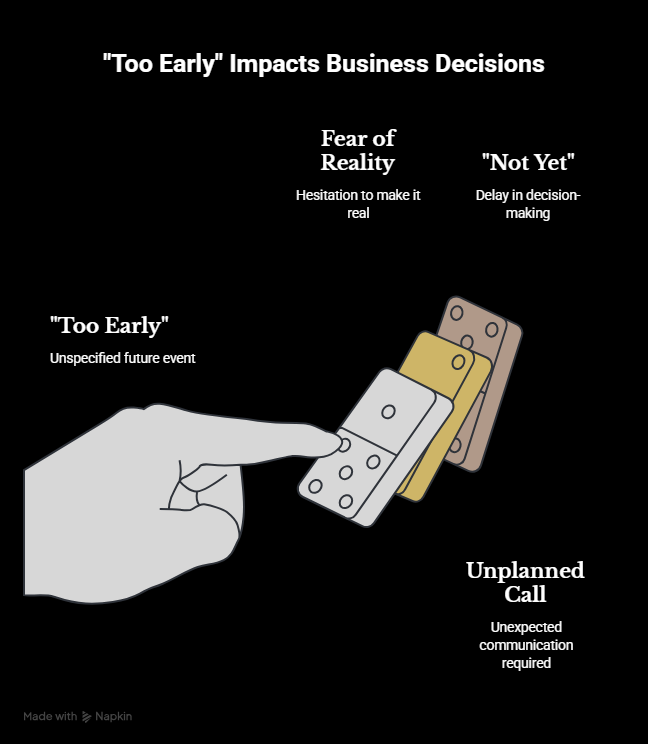
He said, "I can't tell them now. It's too early."
I want you to sit with that sentence for a second. It's too early. He was fifty-eight years old, and it was too early.
I brought it up again. And again. Somewhere in there I stopped counting.
What "too early" actually means
Here's the thing about "too early." It never becomes "now." It becomes "not yet," and then it becomes a phone call you didn't plan to make.
I've since learned to hear that sentence differently. It isn't a scheduling problem. It's a man who hasn't decided anything and doesn't want to be asked to.
Owners tell themselves they're protecting the deal. Announce it and the customers leave. Announce it and the employees walk. I had that fear myself, and I'll get to that.
But that's not usually what's happening. What's happening is that saying it out loud makes it real. Then there's a date. Then there's a version of your life on the other side of the date, and most owners have never once looked at it.
Everybody wants this, and almost nobody plans it
There's research on this that I found depressing in a useful way. Something like ninety-three percent of owners have no formal plan for the life that comes after the business. Seventy percent say they'd prefer to hand it to somebody inside. Seventy to eighty percent of the businesses that go to market never sell at all. And you should distrust these numbers, but trust that they are directional indicators of why businesses don’t sell.
So the preference is overwhelmingly internal, and the planning is almost nonexistent, and most of it ends in nothing.
The other side of the silence
While Bruce was deciding it was too early, two men were living inside his decision without being told there was one.
I went reading in the places where people say things they can't say at work. There's a man who posted about his boss. Fifteen years at the company, most senior person there, and the owner told him he wanted to sell him the business.
Then came the hoops. Take a business class. Save up the down payment. Show me your personal finances. Train your people so the company doesn't depend on me.
He did every one of them. Four years later, he still had no financials, no price, and no timeline. Every time he asked, the boss said he wasn't ready yet.
The line I can't get out of my head
The man wrote that his boss had a health scare recently, and that he wanted to be respectful of that.
He's making relocation decisions. His wife is planning to leave her job. And he's worried about the other man's health.
He was protecting the person who was stringing him along.
It ended the way these end. The boss sold to somebody else and told him afterward. He'd been kept in place to make the company worth more to a stranger.
Why nobody says the obvious thing
I read another one. A man selling a ninety-five-person company after twenty years, four weeks from closing, terrified of telling his staff.
More than a hundred people gave him advice. Don't tell them. Say the buyer is a new general manager. Say he's the new sales rep and let him work for a month first.
One person suggested that he ask his doctor for a beta-blocker before the staff meeting. Nobody in the thread thought that was strange.
Now here's what got me. Out of all that advice, not one person asked whether any of those ninety-five might want to buy it.
Not one. The people were an asset that transfers with the building.
The same silence, from the other chair
I found the mirror image somewhere else. A manager discovers his boss has been quietly selling for a year. Five different strangers ask him the same question: why don't you buy it?
He'd never said it. Fifteen years and he'd never once said the sentence out loud.
The pre-deciding runs both directions. That's the part I didn't expect.
The meeting
Bruce turned sixty-five. He went to his two managers, told them he'd sell them the business, and gave them the price.
It was too much. I'd told him it was too much more than once.
They got lawyers. The lawyers came back at him hard. Neither side would move.
We all sat down in a lawyer's office to bring it together. Inside of five minutes, I knew. We finished the meeting anyway, and at the end of it the thing was dead.
They left and opened their own construction company. Same work, same town.
What was left
Bruce liquidated. There was probably a two-million-dollar sale sitting there for someone inside. He got somewhere between 300,000 and 500,000 from the liquidation.
He also owned the building they'd been working out of. So he lost his tenant on top of it.
What actually killed it
It's tempting to say the price killed it. The price is what the meeting was about.
I don't think that's it. I think the price was where seven years of not talking finally came due.
Two things go wrong in these sales, and I've watched both more times than I want to admit. The first is money. The second is time, and the second one causes the first.
Moving somebody from an employee's head to an owner's head takes four to six years. Sometimes faster. Mostly not.
It doesn't happen through conversation. I used to think it did. What works is changing what a man is responsible for and what he gets paid for. Then you wait, while his attention follows the money.
An employee watches his own number. An owner watches the company's number. You can't talk a man across that line. You can only put him somewhere the line gets crossed.
Why he's an employee in the first place
There's a bigger thing under that, and it took me years to see it.
Most employees are employees because they're risk-averse. That's not an insult. It's the main reason people take a wage instead of a share.
When you ask a manager to buy your company, you're not asking him to do a harder version of his job. You're asking him to stop being risk-averse. You're asking him to become a risk-acceptor, in his forties or fifties, with a mortgage.
That's a real thing to ask a man. It's also a reasonable thing for him to decline.
One afternoon against half a decade
So when Bruce walked in at sixty-five with a price, he was asking two men to do in one afternoon what takes half a decade. Sign a personal guarantee. Put your house up. Carry a note through a bad year.
They'd never thought about any of it in a concrete way. Nobody had ever asked them to.
He didn't fail to sell them the business. He failed to prepare them to own one.
And then they went and prepared themselves, on their own, in a building down the road.
You're the bank now
There's something you have to accept before any of this works. On an internal sale, you are the bank. If you won't be the bank, you don't get to have this conversation at all.
And most owners who agree to be the bank then refuse to act like one. A bank asks for a personal guarantee. A bank asks what you're putting up. That conversation has to happen years early, not in a lawyer's office.
The number that matters is not the price
Here's the piece I'd most like you to take, and it's not the one owners expect.
Affordability protects the seller as much as the buyer. Maybe more.
If you sell at a price your buyer can't carry, you have not gotten a better deal. You've built a machine that runs the business short on cash. The business starts to bleed, and then the payments stop, and the payments were your retirement.
Meanwhile, the company you spent your life on is deteriorating while you watch. Now you're back in it at seventy, fixing something you already sold.
A rough test
My rough test is this. Debt service should eat thirty to forty percent of free cash flow. Not seventy. Not ninety. Every business has a bad year, and at forty percent you survive one.
There are ways to build that. Interest-only for the first few years — that clause is what saved me when I bought my father's company. A management contract for the departing owner. A staged buyout instead of one big transaction.
The mechanics aren't the hard part. A manager buying a business earning $300,000 a year needs something like $1 million. That takes seven to ten years, not three. You have to decide whether that's enough money, and whether that's how you want to get it.
If the answer is no, that's a legitimate answer. Say it in year one. Not year seven.
Where I'm the guy in the story
I sold my food service business outside, and I never considered anything else.
I want to be straight about why, because the honest version is less flattering than a philosophy. I was carrying about two million in debt. It had to be cleared upon sale or change of ownership. There was one door, and it was a cash door.
So I wasn't weighing internal against external. I was asking how I pay off my creditors, how I pay off the bank, and where that much capital comes from.
What I've noticed since
People who sell outside do it because they want the cash and don't want the risk. Both of those were true of me.
I just wasn't thinking about either one at the time. I was thinking about the bank.
I've spent forty-five years telling owners to look inside first. When it was my turn, my balance sheet made the decision before I could.
So I've never actually walked the road I keep pointing at. I don't know what it feels like to carry paper on somebody who works for you. That's worth knowing about the man writing this.
The manager I did have
I had also hired a manager who could probably have run it. He turned out to be lazy in a way I didn't see coming, and unwilling to do the work an owner does. He had ten percent, and we bought it back at the sale.
There were two or three others who might have made it with five to seven years of grooming. I had neither the years nor the balance sheet.
The thing I did right, for whatever it's worth
I told my people early. During due diligence, before anything was signed, I told everybody.
Every piece of advice I've read since says don't. Wait for the wire. Protect the deal.
I also put stay bonuses on the key people. Six months' salary if you're here and productive at the end. That's the piece I'd hand to anybody selling anything, inside or outside — it's what holds the value together, especially if you're carrying a note.
Every key person stayed except one, who wanted nothing to do with the new owners and was honest about it. The customers didn't leave. The buyer wanted our systems and wanted our managers.
They just didn't want me. And that turned out to be good for everybody, which is a sentence that took me some years to be able to write.
I had the fear. I had it the whole time. I just don't think the fear was telling me the truth.
The part I don't have an answer for
Here's what nobody warns you about, and I've watched it wreck good deals after the closing.
Almost every seller hates what the buyer does. Even on an internal sale. Especially on an internal sale.
Because they change things. They run it their way. And you're quietly certain your way was the only way that works. It worked for thirty years, and you've got the scar tissue to prove it.
I don't think that's true. I think there are a lot of ways to run a company well, and I've only seen a slice of them. But I've also never had to sit still and watch someone redecorate something I built.
So I'm holding two things at once. Give up control or the sale doesn't take. And I don't know what it costs a man to do that, because I've never done it.
Bruce, fifteen years later
He lived about fifteen more years. He moved to the Southwest, and when he came back to Vermont, we'd have lunch.
He never took any of it on himself. Not once. It was the managers, it was their lawyers, it was the way it went.
He wasn't even especially angry. That's what surprised me. He just never understood that the reason it failed was how much money he'd asked for.
The money
And now I have to complicate the whole thing.
Bruce had saved plenty outside the business. He got about a quarter of what a sale would have brought him, and it didn't matter. He was comfortable, he had a life in a warmer place, and he had a decent last chapter.
Liquidation is a real option, by the way. It isn't always the sad ending. Sometimes the numbers say close the doors and go, and I've told people exactly that.
So the money never hurt him. I want to be clear about that, because it's the part of this story I got wrong for years.
The other ledger
What hurt him was the other ledger.
Every deal has two of them. There's the financial one, which we're all trained to read. Then there's the one where you find out what thirty years were worth to the two people who knew the business best. The answer came back as a no, in a lawyer's office, in five minutes.
He never said a word about that column. Not at any lunch, not in fifteen years. He held a lot of things close to his vest, and that was one of them.
I can tell you what the liquidation cost him. I can't tell you what the rest of it cost him, and neither could he.
The question I'd start with
Not what it's worth. Not gift or sale. Not the structure, which is solvable and boring.
Start here. Do the people who run your company know they're on the list?
That's it. Not have you offered. Not have you decided. Have you told them they're being considered, so they can start carrying it around and see how it sits?
Because if you tell them at sixty-five, you're not making an offer. You're presenting a bill for a decision you made alone, years ago, and never mentioned.
And if you've already decided they can't do it — that's allowed. It might even be right. But say it while they're young enough to do something with that information.
What I'm still turning over
The thing I keep circling is whether the reluctance was ever the problem. I don't think Bruce ever decided those two men couldn't own his company. I think he decided nothing at all, for seven years. They read the silence as a verdict. What else is a man supposed to read it as?
That's a different sin than the one I set out to write about. I'm still not sure which one is worse.
The other ledger is the one I keep coming back to and haven't gotten to the bottom of. I've got a conversation coming up with someone who works that side for a living, so more on it another day.
If you've got somebody in mind and you haven't told them — tell me in the comments what's stopping you. I'd like to know if it's the same thing that stopped him.
Hey, this is Josh. You're on the Long Strange Trip. I'm glad you're here.


Facebook
LinkedIn
Youtube