
There He Goes Again
A mechanic in a Plattsburgh convenience store still saw me at my worst. I’m not sure he was wrong.
A Convenience Store in Plattsburgh
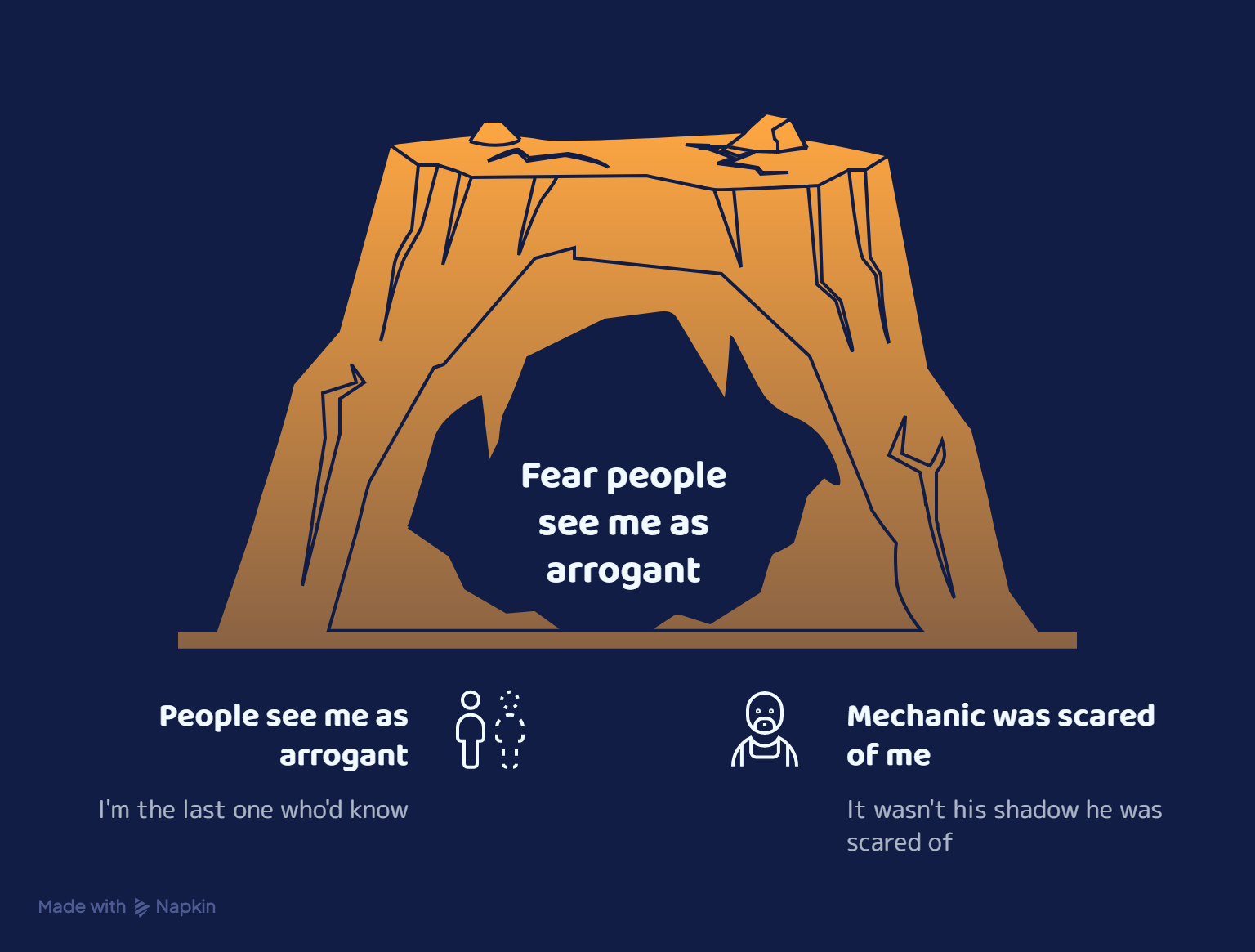
There's a fear I've carried most of my life, and I've rarely said it out loud. It's the fear that people see me as arrogant, that they're right, and that I'm the last one who'd know.
Seven or eight years after I sold the food service business, I stopped at a convenience store in Plattsburgh, New York. Standing there was a mechanic who'd worked for me for twenty years. He always seemed scared of his own shadow. The truth is, it wasn't his shadow he was scared of. It was me.
I expected hello, how are you. Instead, he went after me. Things were so much better now, he said. For the first time, he had money to spend. I didn't say a word back. I just stood there in shock.
What I Didn't Say
Here's what was running through my head. This man had a heart attack while he worked for us. He was out for two months, and we paid him in full the entire time. Our sick pay policy was generous, so it was within the rules, but I never once tried to weasel out of it. We held his job open and kept his paycheck coming. I'm not sure he ever said thank you.
And I notice what I'm doing, even now. Building the case. Listing what I did for him. If the meaning of your communication is the way it's received, then two months of full pay didn't land. Twenty years of something else did.
On the Brink
Let me paint you a picture of what that something else might have been. We ran the company with open-book management. In meetings, I put our financials in front of everybody and told them we were on the brink. Every dollar mattered. I thought I was being honest. I'm not sure anybody believed the numbers. They thought I was making all sorts of money, and I was just trying to keep the company alive. The people who bought the business had plenty of capital, and they were a lot less in-your-face than I was, especially in my first five years running the place.
So here was this man, years later, still seeing me exactly as I'd been. Not on my best days. On my worst.
And I'd changed. I know I had. He never saw it, or if he did, it didn't stick. I drove home with a question I still can't answer. Which Josh counts, the one I thought I'd become, or the one he remembered?
The Kid Who Had the Answer
I'm 74 now, and I've been called a know-it-all for nearly sixty of those years. My father started it when I was fifteen or sixteen. He said it a lot. The annoying part is that he wasn't wrong.
I didn't say "in my opinion." I just said things. If you were wrong, I told you so. And when my father came at me, I was fighting back before he got three words out of his mouth.
In the Seminar Room
That habit followed me into business, and into seminar rooms for years. Someone at the front of the room would make a point, and I'd pipe up with "Well, that's not correct." Then I'd give everybody the right answer, because I knew what it was. I'm sure the people in those rooms saw me as arrogant. I'm just as sure they saw me as a know-it-all.
I've come to think those two travel together. Know-it-alls are always arrogant.
And there I go. That's an absolute, sitting right there in a piece about absolutes. I'm leaving it in, because it's exactly what I do. I mostly believe it. But "always" is a word that closes the door before you've had a chance to disagree with me.
A Line I Heard in My Thirties
In my early thirties, I went through training in neurolinguistic programming, NLP for short. I've forgotten most of it. One line I never forgot. The meaning of your communication is the way it's received.
That hit me hard back then, and it's held for forty years. What I meant doesn't matter much. What landed is what I said. If I tell you something and you hear an insult, then I insulted you, whether I meant to or not.
Here's the thing. I've come to believe arrogance works the same way. It lives in the eye of the beholder, not in my intentions. I can think I'm being arrogant, and the people in the room don't see it at all. Or I can think I'm being perfectly reasonable, and they see someone incredibly arrogant. Their version is the one that counts.
That's what I believe, and it may not be what you believe. I carry a picture of how I come across, and I've hardly ever checked it with anyone outside my own head. I think I know. I almost never ask.
Who Can Actually See It
I went looking for what researchers say about this, and one finding stuck. On traits that carry a lot of judgment, the people around us often see us more clearly than we see ourselves. Arrogance has to be one of those. My intent is invisible to them. My effect is invisible to me.
There's even a name for my half of it, the illusion of transparency. When I say an absolute, the "this is just my opinion" part feels obvious to me. It's right there in my head. It just never makes it out of my mouth.
Sources: Washington University; illusion of transparency.
Hand Up at Modern Elder Academy
I'd like to tell you all of this is history. It isn't.
Not that long ago I was at Modern Elder Academy, listening to Chip Conley talk about transition. He laid out three stages. Through my work with Susan Bradley, I've come to believe there are four, and I felt he was missing one. Anticipation.
So I put my hand up. I said, "In my experience, anticipation is a stage we need to talk about."
Look at what I did there. I put "in my experience" right in front of it. I did the very thing I keep telling myself to do. I don't think it mattered one bit.
In Front of the Room
Chip never asked for my opinion. It was the wrong place to offer it. If I really wanted to help him think about this differently, I could have caught him at a break and said it privately. Instead I said it in front of the whole room, and in front of the room, I made him wrong. People running a program don't like it when a participant makes them wrong. I wouldn't either.
It was a gentler version of the kid saying "that's not correct." Gentler, for sure. But the same move.
Two Voices After the Fact
There's a voice that used to show up in my head after moments like that. At twenty-five or thirty, it sounded like this.
The old me: "I said what I meant. If they heard it wrong, that's on them."
I don't hear that one much anymore. At 74, the sentence that shows up is different. I said what I meant, and I wasn't clear. They heard something else. Let me try again.
I'm not trying to sound humble here. That's just the mantra doing its work. When I'm misunderstood, I believe it's because I wasn't clear, not because they listened badly.
Two Little Words
For years I've told myself the fix for an absolute is two words: "in my opinion." I've said it in coaching. I've written it down. And I still forget to say it more often than I'd like to admit. Worse, I've started to suspect that even when I do say it, people hear it as a throwaway line. A little warm-up before I tell you what's what.
I've never asked anyone whether that's true. Not once. I'm not sure what that says about me.
When I Don't Say It
There's another way I get this wrong, and it's quieter. When I disagree with someone, I often don't tell them. Or I tell them in a much milder way than what I'm actually thinking. I don't like conflict, and neither does Suzanne. Nobody gets the full, unedited me. She comes closest, and when I start going on and on, she'll find a way to say, "Okay, that's enough."
I used to think of that quiet edit as the opposite of the know-it-all. Loud versus soft. Now I'm not so sure. When I'm being responsible about my communication, I'm paying attention to how it lands on the other person. When I go quiet to dodge a fight, I'm editing for my own comfort. The absolute is about me, too. Maybe they're the same problem wearing different clothes. I'm still turning that one over.
The Picture That Doesn't Update
Back to that man in Plattsburgh. In the food service business, there was a stretch when I made a real change. I'd spent years blaming other people and justifying everything I did. Slowly, I moved toward taking personal responsibility for what happened on my watch. It wasn't a small shift for me.
The people who'd been with me for years didn't see it. They kept seeing the old Josh. Honestly, most people who knew me twenty or thirty years ago still do. Every so often one of them will admit there's a new me. Mostly, though, they're waiting. For the explosion. For the put-down. For the arrogant guy to walk back in.
And sometimes he does. That's the part I can't wave away. I still speak in absolutes. When I do, I'm pretty sure what people are thinking. "Oh, there he goes again."
What Other People Told Me
I went looking at what other people say about this, in forums and comment sections. On Mumsnet, a woman wrote about a family that still treats her like the moody teenager she was fifteen years ago. Her friends don't recognize that person at all. Another woman replied with something I keep coming back to. Around her own mother, she said, she turns right back into the stroppy teen. She wondered whether she was acting out her mother's picture of her.
Do I do that? When I'm in a room with people who knew me at forty, do I turn into the guy they're expecting? I honestly don't know.
I don't think many people make the crossing well, from being seen as arrogant to being seen as accepting. I'm not sure I made it well. I may still be making it.
What Sam Sees
A disclosure first. Whenever I write about my kids, I'm writing from my point of view. It may not be theirs, and I want you to know that up front.
A while back, I heard my son Sam make a point in absolutes. Flat, declarative, no room to disagree. My first thought was, "My God, I've been doing this. And man, does it sound arrogant."
He learned to talk that way from me. That's for sure. Our kids learn from us. I picked up some of my father's worst traits, and I worked very hard as an adult to get over them. I'm pretty sure the same thing happened with my kids. I didn't hand Sam the habit on purpose. I handed it to him anyway.
What Sam Told Me
Sam has also told me that what I see in him isn't what he sees. I'm not sure exactly what he was referring to. My first instinct, and I'll be honest, is that he's the one misreading. But if the meaning of communication is the way it's received, then the way Sam hears me is the meaning of what I said. I believe that. I also still believe my first instinct. I'm not going to pretend I've worked out how both fit in the same head.
Where I'm Still Stuck
I don't think there's a "real me" hiding behind the version people see, waiting for the big reveal. What they see counts. It may count more than the picture I carry around of myself.
And here's what I can't get past. I can't tell, in the moment, when I'm being the know-it-all. The people across the table can. I passed the habit to my kids the way my father passed his to me, and I usually find out after the fact. On somebody's face. Or in a convenience store in Plattsburgh, standing there with nothing to say.
How do you find out how you come across while there's still time to do something about it? I don't know yet.
If you've ever been called arrogant when you didn't mean to be, or you've watched someone hold onto the old version of you long after you changed, I'd love to hear how it went. Tell me in the comments. Especially if you're still in the middle of it.
Hey, this is Josh. You're on the Long Strange Trip. I'm glad you're here.


Facebook
LinkedIn
Youtube