
Whose Agenda Is This?
When you're in passage, everyone has advice. Almost nobody asks a question first.
You open your mouth, and the room has already decided. Before you finish a sentence, someone knows what you should do. Sell the house. Take the job. Slow down. Get busy. After a while, you stop finishing sentences. Some nights you wonder whether you're even there.
If you're the one trying to help, here's what I'm learning. The people who help most in that moment listen first. They stay curious. They don't talk louder, and they don't talk first. I'm not good at this yet. I'll get to that.
Everybody has a plan for you
Let me paint you a picture. A woman who writes as The Widow's Comeback posted a list this summer. It was every piece of advice she got after her husband died. Sell the house. Don't sell the house. Take off the ring. Not yet. Get out more. You're out too much.
Every order came with its opposite attached. Nearly ten thousand people reacted to that post. Almost two thousand commented. One line stopped me cold. "They're giving advice about a life they don't have to live."
The comments told the rest
One woman had been widowed two months. She still hadn't unpacked the bag she brought home from the hospital. Someone told her it was just like a divorce. Now she could do whatever she wanted with the house. She was too stunned to answer.
Another said her sister-in-law asked about selling her house. To a friend. A few months after the funeral. Her reaction fit in three words. I'm still here.
It isn't only widows. Retirees on the forums say the same thing. People ask if they're keeping busy. Nobody asks what they think. One man has been retired thirteen years. He's tired of hearing his hobbies should make money.
Plans, not questions
Here's the thing. Most of these people mean well. I believe that. But they show up with a plan, not a question. And the plan is often about their own comfort. A house sold is a problem solved. A busy retiree is one less thing to worry about.
Meanwhile the person in the middle is too foggy to argue. So they nod. Or they go quiet. That's how you start to feel invisible in your own life.
The quiet that follows
The quiet doesn't stay small. On Mumsnet, a British forum, a woman described how it grew for her. Nobody listened, so she stopped arguing her point. Then she became even more invisible.
I found the same pattern in research on older workers. They get talked over once, maybe twice. Then they simply stop speaking up in meetings. One brush-off becomes quiet permission to give up.
That scares me more than the talking-over itself. The damage isn't only what others do. It's what we start doing to ourselves afterward.
I didn't know I was in it
I sold my wealth management business years ago. I thought I knew what came next. I didn't. I walked straight into the fog and never saw it coming.
I'd watched clients go through big transitions. I'd read about them. I still never imagined I'd go through the same things everybody else does. Turns out I wasn't special.
I got some advice along the way. I tried following a bit of it. It didn't fit. It wasn't bad advice. It just wasn't mine.
Three ways to be lost
Here's what I've noticed since. Some days I know exactly where I am in passage. Some days I don't. And some days I don't even know I'm in it.
On those days I just think I'm a little confused about what's next. I sit and look out the window. I don't take any action. It feels like laziness. It might be passage.
People have different names for this stretch. Some call it the fog. Some call it passage. Others call it the messy middle. Pick the word that fits you. The old life has ended, and the new one hasn't started. You're standing in between.
The middle is hard to see
The anthropologist Arnold van Gennep mapped this more than a century ago. Every rite of passage has three parts. There's a leaving, a threshold, and an arrival. William Bridges later called the threshold the neutral zone.
Victor Turner went a step further. He said people on the threshold become structurally invisible. They've left one role and haven't entered the next. The world doesn't quite know where to put them.
That helps explain why people talk over someone in passage. It doesn't let them off the hook. The person in the middle is hard to see. That's a reason to look harder, not talk louder.
Good advice, wrong time
Here's what I keep bumping into. The advice people give you may be good. Sometimes it's excellent. The real question is whether you're in a position to take it. In passage, often you're not.
A woman in a retirement group wrote about her father. He was a doctor. He retired with a hard stop. Then he went mute, for weeks. Then his voice came back. He said he didn't know who he was without the job.
You could have handed that man the best plan in the world. He couldn't have heard it. Not yet.
Another doctor answered in the comments. He hadn't gone mute, he said. He'd just gotten quieter while he found the new version of himself. He'd thought his job didn't define him. Now he wasn't so sure. I know that feeling.
Now, soon, later
So how do you sort it all? The best tool I know comes from Susan Bradley. She founded the Sudden Money Institute. She's spent decades with people in transition. She calls it now, soon, and later.
It's simple. When you're in passage, you sort everything into three piles. What has to be done now. What has to be done soon. What can wait until later.
Now is short. It's the bills that are due, your health, the roof that's leaking. Soon is a few months to a year out. Later is most of it. The house. The ring. The next career. Who you're going to be.
Sorting it together
Here's what I like about the tool. The person in passage does the sorting, not me. That's harder for me than it sounds. My instinct is to grab the list and start dealing. I have to hand over the piles and keep my hands in my lap.
The piles also move. As the now list gets handled, space opens up. Some of the soon items slide forward. Bradley makes a point I hadn't thought about. The later list keeps your hopes in view. They aren't forgotten. They're just not today.
That changes the conversation. "What should you do?" becomes "Where does this belong?"
Urgent isn't the same as important
Here's where other people's agendas sneak in. They rarely show up as a plan. They show up as urgency. You need to decide about the house. You really should figure out what's next.
Much of what gets pushed on you isn't important to you. It's important to them. Their "not important" gets shoved into your "now." I'm not sure how you put it back in the fog. That might be the hardest part.
Think about that sister-in-law. She wanted the house sold now. For the widow, the house was a later. That one conversation holds the whole problem.
A complaint on a caregiver forum
On a caregiver forum, an older woman posted a complaint. Her daughter controlled her life. Her money, her car, even her dollar-store purchases. It read like a hijacking.
Then the replies came in. She'd been lending money to someone who was probably scamming her. Some of what her daughter wanted really was a now. I want to be fair here. Sometimes the other person is right.
So how do you tell a rescue from a takeover? I don't have a clean answer. My best guess is this. The other agenda can be right when that person is listening. Listening for what matters to you. And when they can tell your now from your later.
The uncomfortable part
I'm rarely talked over. I've been lucky that way. But I've talked over plenty of people.
Here's how it goes. Someone starts telling me about their situation. Halfway through, I know what they should do. I start composing my answer. I stop hearing the rest of their sentence. Then I say it as an absolute. Not a suggestion. A fact.
That old voice still lives in me. It sounds something like this:
The old me: "Sell the house. You don't need four bedrooms. Done. What's next?"
That voice was never listening. It was waiting for its turn. Every word was about me. My need to fix things and move on. The person in front of me hadn't asked for that. And I hadn't asked them a thing.
A woman on Substack wrote an essay called "The Crones." She described years in a retirement community. The older men there loved to talk about themselves, she said. They seldom asked her a single question back. I read that and winced. I've been that guy at dinner.
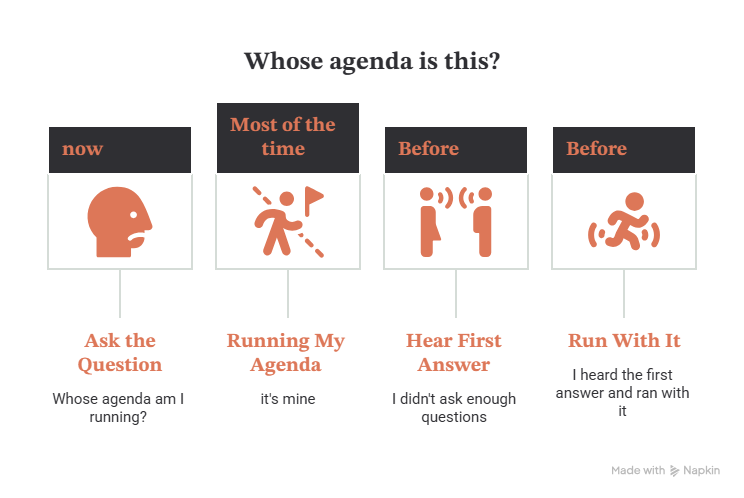
Whose agenda is this?
That's the question I try to ask myself now. Before I give advice, whose agenda am I running? Mine, or theirs?
Most of the time, if I'm honest, it's mine. The reason is simple. I didn't ask enough questions. I heard the first answer and ran with it.
What listening deeply means
Here's the first skill I'm working on. I try not to decide what to say until the other person finishes. That sounds easy. It's brutally hard. Nobody ever taught me how.
We're all trained to have our reply loaded early. Here's what that costs. If you're composing, you're not hearing. You miss the end of their sentence. And the end is often where the real thing lives.
The pauses are the hardest part for me. When someone stops, I rush in. I'm learning to wait instead. Sometimes nothing comes. Sometimes the harder sentence does.
Then I try to say back what I heard, in their words. I get it wrong more than I'd like.
Five questions down
The second skill started on the factory floor at Toyota. They called it the Five Whys. The idea is simple. One question gets you a surface answer. Ask again, and you go a little deeper.
Sometimes you reach the core in three questions. Sometimes it takes six or seven. Five is a good rule. Each question peels another layer off the onion.
Here's the kind of thing I mean. Picture someone saying, "I think I should sell the house." You ask what's behind that. "It's too big." Too big how? "Too many rooms I never go into." What's in those rooms? "His office. His things." What happens when you walk past them? "I can't breathe."
Now you're talking about the real thing. It was never about square footage. If you'd answered the first question, you'd have sold the wrong thing.
There's a trap here, and I fall into it. It's easy to ask five questions that steer. Each one nudges toward the answer I already picked. That isn't digging. That's a cross-examination. The questions only work if I'm willing to be surprised by where they land.
The last thirty seconds
I'm practicing this right now with my uncle. He's 93. We're writing a book together about his sayings. It's the best listening school I've ever attended.
My uncle can talk four or five minutes without taking a breath. The old me would have jumped in at minute one. Now I try to stay with him. The last thirty seconds are often where the most interesting stuff lives. If I cut in early, I never hear it.
Speaking with, not for
There's one more distinction I'm still chewing on. On a seniors' forum, an 86-year-old man described his family. His daughter talks to his wife's doctor. His wife asked for that. By the time they got home, neither could remember what the doctor said.
That isn't being talked over. That's choosing someone to speak for you.
I've never let anyone speak for me. But I have let people speak with me. In concert, working it out together. I'm not sure yet where that line sits. I suspect it matters a lot in passage.
Where I'm standing
So here's where I've landed, for now. If you're in passage, you sort your own now, soon, and later. Other people will try to sort it for you. Most of them mean well. They're still advising on a life they won't be living.
And if you're the one helping, stay curious. Listen first. Ask five questions before you offer one answer.
I'm still working out one thing. When I'm in the fog, how do I tell my now from yours? I don't know yet.
What about you? Have you been handed someone else's now? Or have you been the one handing it out? Tell me in the comments. I read every one.
Hey, this is Josh. You're on the Long Strange Trip. I'm glad you're here.


Facebook
LinkedIn
Youtube