
Why Toughing It Out Is the Wrong Answer
For most of my adult life, I thought resilience meant toughing it out. Head down. Keep grinding. White-knuckle your way through whatever life throws at you and come out the other side. Preferably without complaining too much.
Turns out, I had it mostly wrong.
I’m Josh Patrick, and welcome to The Long Strange Trip — a newsletter about the things that matter most in the second half of life. Work, family, transitions, resilience, and the honest stuff we don’t talk about enough. I’m not coming at any of this as an expert. I’m a fellow traveler figuring it out in real time. Especially now, as I navigate my own dual cancer diagnosis at 73.
Which, honestly, is part of why this conversation hit me so hard.
My guest was Jennifer Hough, founder of Wide Awakening. Jennifer has worked with tens of thousands of people on exactly this stuff — how humans actually grow through hard times, not just survive them. She’s warm, she’s direct, and she has this uncanny ability to say things that sound simple until you realize they’ve rearranged something in your brain.
About ten minutes in, I asked her for her definition of resilience. And she didn’t hesitate.
“The ability to handle whatever life throws your way and still stay in your presence with wisdom.”
I sat with that for a second. And then I thought about every business owner I’ve ever worked with who was running on fumes — convinced that working harder was the answer. Guys like John Aardvark, the fictional plumbing contractor I created for my book Sustainable. John worked 70-hour weeks for 25 years. He wasn’t lacking toughness. What John was lacking — and what most of us are lacking — was presence.
That’s what Jennifer and I spent the whole conversation unpacking.
The Two Types of Resilience
Early in our conversation, I offered Jennifer a distinction that I’ve been sitting with for a while.
“There’s a brute force resilience,” I told her, “where you’re doing stuff because you think you really need to do it. And then there’s the resilience where you accept what you’re going through. And unfortunately, I think most of our fellow humans do resilience with brute force.”
Jennifer ran with that. She told me about her husband’s massive back surgery — the kind of recovery that takes everything you’ve got. And she watched him, in real time, shift from brute force to something different.
“You could see that everything was by — he was being resilient by brute force,” she said. “And at some point I saw it switch into, okay, this is what is, this is how it is.”
That shift — from fighting reality to accepting it — is where everything changes.
Here’s what I know from my own life. Brute force works for a while. You can muscle your way through a bad week, a bad month, maybe even a bad year. But if brute force is your only gear, you’re running up a debt that eventually comes due. I see it constantly in the business owners I’ve worked with. The guy who keeps hiring more employees to solve a capacity problem, only to end up with more management headaches. The guy who works longer hours to compensate for broken systems, and ends up further from his family every year. The guy who tries every new piece of software to fix inefficiency, and just adds another thing to manage.
These aren’t solutions. They’re sophisticated forms of avoidance. And they feel like resilience — they look like resilience — but they’re not getting at the thing underneath.
What Actually Builds Resilience
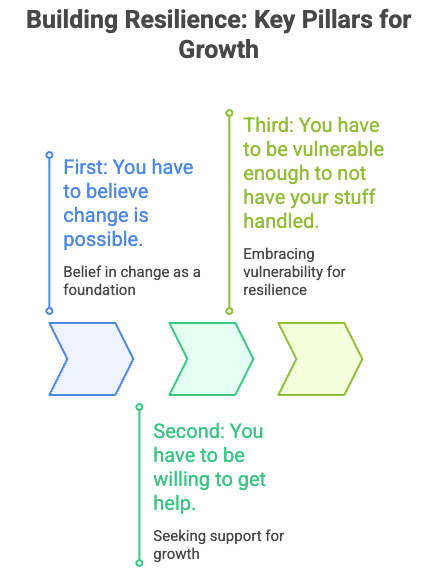
This is where Jennifer and I got into the practical stuff. She laid out three things she’s seen across tens of thousands of people that have to be in place before real resilience can take root. I want to walk through these and add what I’ve learned — not as the expert, but as someone who’s lived most of them the hard way.
First: You have to believe change is possible.
Jennifer put this as simply as I’ve ever heard it. “It’s even possible to change — a willingness to believe that it’s possible to change. Because you wouldn’t even ask the question of yourself to become something new if you just thought, ‘That’s the way I am. I’m just an anxious person.’”
This sounds obvious. It isn’t. I spent a good chunk of my 30s operating as if my personality was fixed — my reactions, my habits, my way of dealing with hard things. It wasn’t until I started doing serious work on myself that I realized the operating system could actually be updated. A 30-year-old Josh could not have had the conversation I had with Jennifer. A 40-year-old Josh might have gotten pieces of it. The 73-year-old version of me can actually sit with it.
That’s not because I got smarter. It’s because I finally believed I could change. And started doing the work.
Second: You have to be willing to get help.
“Nobody gets there by themselves,” I told Jennifer. “Nobody.”
And she agreed — adding that what it really requires is transcending what she called “lone wolfiness.” Which, if you’re a trade business owner who’s built something from nothing with your own hands, is maybe the hardest thing on this list.
I’ll tell you what I told Jennifer. I have been the luckiest guy alive in terms of where the help has come from. Coaches, advisors, therapists, and friends who asked me better questions than I was asking myself. Every significant shift in my life has involved someone else. Every single one.
The guys I work with — the John Aardvarks of the world — almost universally resist this. Asking for help feels like admitting the business isn’t working, or admitting they can’t handle it, or admitting something is wrong with them. But here’s the truth: the most resilient people I’ve ever met aren’t the ones who handled everything alone. They’re the ones who knew when to call for backup.
Third: You have to be vulnerable enough to not have your stuff handled.
Jennifer put this beautifully: “The more you know, the more you know you don’t know.”
This one hit me personally because I used to be a world-class spouter of absolutes. I was right and you were wrong, and that was pretty much the deal. I actually went to a retreat a couple of years ago and decided, in my infinite wisdom, that I was going to stop using absolutes entirely. Just stop. Cold turkey.
Jennifer laughed at that. “Never going to use absolutes ever, ever again.”
Yeah, that didn’t work out well.
What actually worked was noticing when I was using absolutes and adjusting. Recognition before change. Which, it turns out, is also how resilience works. You can’t get somewhere different until you’re honest about where you actually are.
The Shift That Changes Everything: Staying Present
Here’s the piece I kept coming back to in our conversation — the thing that ties all of this together.
“For me,” I told Jennifer, “resilience comes from staying present. If I allow myself to move into the what-was-me in the back, or the catastrophizing of what’s going to happen in the future, I’m going to feel stuck and paralyzed. But if I stay in the present and just realize, okay, here’s where I am right now, here’s what I can do right now — I’m likely to be way, way, way more resilient.”
Jennifer had a definition of presence that I’m still chewing on. She said it was being “pulled by nothing and available to play with anything.”
That sounds abstract. But think about what it actually means.
Most of us spend enormous amounts of mental energy being pulled around — by past regrets, by future fears, by the news cycle, by the running catastrophe film our brains produce at 3 AM. When you’re being pulled by all of that, your actual intelligence isn’t available to you. Your wisdom is offline. You’re just running on history and habit.
But when you’re present — actually here, in this moment — something different becomes available. Jennifer called it your “innate intelligence.” The part of you that knows what to do next, that can ask better questions, that can see the actual situation instead of the story you’re telling yourself about it.
I think about John Aardvark again here. John’s 3 AM anxiety isn’t about what’s happening at 3 AM. It’s a highlight reel of everything that might go wrong over the next five years. His mind has taken real business challenges and turned them into a catastrophe film. The present moment — the actual moment he’s in — is almost always more workable than the movie.
The question isn’t how to make the hard stuff go away. The question is how to stay present enough to deal with what’s actually here, not what you’re afraid might come.
From Surviving to Flourishing
Jennifer pushed the conversation somewhere I wasn’t expecting, and I want to share it because it’s stuck with me.
She said she wasn’t satisfied with resilience as the end goal. What she’s really after — what she’s spent her career studying — is what happens when you go one step further.
“What if not only could we handle whatever came our way,” she asked, “but we actually flourished through it?”
The word flourish is doing a lot of work there. This isn’t toxic positivity. It’s not pretending that hard things feel good. It’s something more like: once you’ve accepted what is, once you’ve stopped fighting reality, once you have some emotional spaciousness — what can you create from here?
Jennifer shared that when she accepted the current craziness of the world, rather than exhausting herself resisting it, two major international projects appeared. Not in spite of what was happening. Because of it. The acceptance created the clearing that made something new possible.
I don’t think you get there without going through the acceptance first. You can’t skip to flourishing without doing the harder, quieter work of getting honest about where you are.
But the possibility that a hard season isn’t just something to survive — that it might actually be the thing that teaches you the most — that’s worth sitting with.
What This Means If You’re In It Right Now
Look, I know most of you reading this are carrying something.
Maybe it’s a business that demands more than it gives back. Maybe it’s a career that stopped feeling meaningful somewhere along the way. Maybe it’s a health scare, a family season that’s harder than you expected, or just a general sense that the life you’re living and the life you want are further apart than they used to be.
Whatever it is, I’d be willing to bet your default response looks something like: keep your head down and keep going.
I’m not telling you that’s wrong. Sometimes that’s exactly what the moment calls for.
But if that’s your only gear — if toughing it out is your whole plan — it will run out on you. Not might. Will.
What Jennifer gave me in this conversation was a different frame. Real resilience isn’t about how much you can endure. It’s about being honest about what’s true, staying present enough to deal with what’s actually here, being willing to get help, and having the humility to know that you don’t have all the answers.
Those aren’t weaknesses. They’re the foundation of something that actually lasts.
I’m still working on all of them. I’ll be the first to admit that. But the conversation with Jennifer moved something in me — and I hope it does the same for you.
One More Thing
Jennifer and I could have gone for hours. We barely scratched the surface.
That’s kind of the whole point of this podcast and newsletter. There are so many people out there who’ve navigated hard seasons — in their businesses, their families, their health, their sense of who they are — and come out the other side with something real to say about it.
If this conversation resonated with you — if you’ve got a story about resilience, transition, reinvention, or just figuring out the second half of life — I’d love to hear from you. Drop me a line and we’ll have a conversation about whether you might be a good guest on The Long Strange Trip. You can reach me at [email protected]. Keep it simple. Tell me a little about your story and why you think it might matter to someone else.
The best episodes of this show come from people who weren’t expecting to have anything worth saying. They usually have the most.
Jennifer Hough is the founder of Wide Awakening and a transformational guide who has worked with tens of thousands of people on living with presence and freedom. You can find her at thewideawakening.com, on Facebook at facebook.com/JenniferHuff, and her community at agentsofawakening.com.
John Aardvark, the fictional plumbing contractor who shows up in my writing, comes from my book Sustainable. If you see yourself in John’s story, that was the whole idea.


Facebook
LinkedIn
Youtube