
The Two Things We All Want (And Why We're Terrible at Getting Them)
I've been reading John Izzo's Five Secrets You Must Discover Before You Die, and the guy makes a claim that stopped me cold.
The two things humans want most are to find happiness and to find meaning.
That's it. Two things. The whole enchilada. Everything else – the career, the money, the house, the impressive LinkedIn profile – is just the delivery vehicle for these two things.
Sounds simple enough. Like ordering a pizza. "I'll take one happiness and one meaning, extra cheese."
Except here's my question: Do we actually know how to do this?
Because I've spent 73 years on this planet, built businesses, raised a family, faced two aggressive cancers simultaneously, and I'm still figuring it out. If there's a manual for finding happiness and meaning, I must have missed the day they handed it out. Knowing me, I was probably on a conference call.
But I've stumbled into some things along the way that might be worth sharing. Not as answers – I'm way past pretending I have those. More like field notes from a fellow traveler who's been paying attention. Sometimes.
The Time Travel Problem
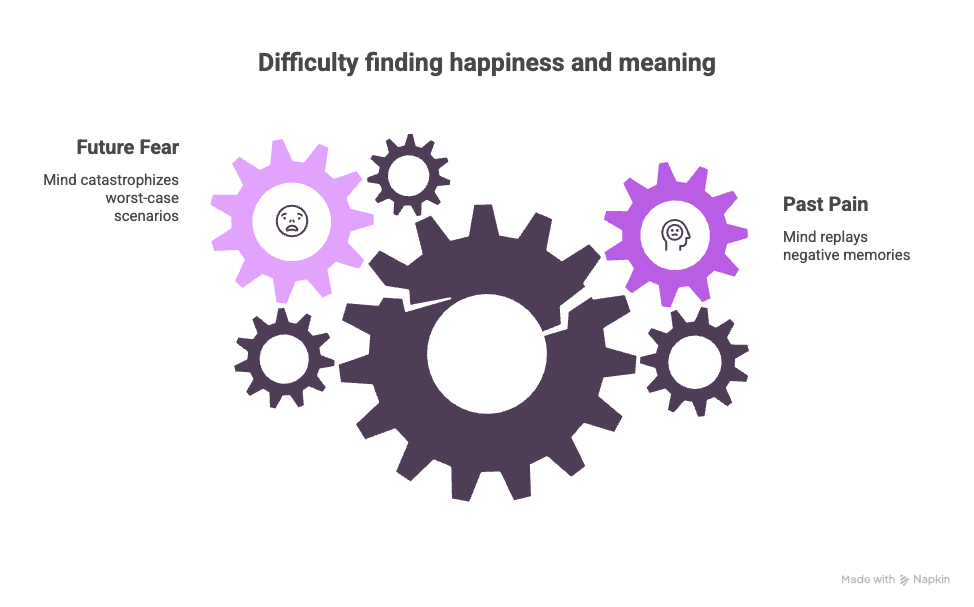
Here's what I've noticed about my own brain. It's a terrible time traveler.
When my mind wanders to the past, it doesn't go to the good stuff. It doesn't replay the great ski runs down Stowe or the time my business hit a milestone I never expected. Nope. It goes straight to the hard stuff. My first cancer diagnosis. Losing the ability to ski – something I did 20 to 30 times every winter for most of my adult life. The slow fade of being able to enjoy live music the way I used to.
When my mind drifts to the past, it's not a happiness tour. It's a pain-and-loss tour. My brain apparently only has one travel package, and it's not the luxury option.
And the future? Even worse.
When I think ahead, I don't dream about adventures and possibilities. I catastrophize. What if the treatment doesn't work? What if my PSA keeps climbing? What if the lymphoma that's mysteriously shrinking decides to stop shrinking? My brain is extraordinarily talented at building worst-case scenarios out of thin air. If catastrophizing were an Olympic sport, I'd be on the podium.
Past equals pain. Future equals fear.
So where does that leave happiness?
The Present Moment Is the Only Place Happiness Lives
Right here. Right now.
I know that sounds like something you'd read on a bumper sticker or hear from someone wearing way too much patchouli at a meditation retreat. But I've tested this theory against my own life, and it holds up.
When I'm in the present moment – actually here, not time-traveling – I'm happy. When I'm writing, and the words are flowing, I'm happy. When I'm having a real conversation with Suzanne, I'm happy. When I'm sitting on the deck watching the world do its thing while my brain isn't running disaster scenarios, I'm happy.
Not the jump-up-and-down, just-closed-a-big-deal kind of happy. I learned years ago that kind of happiness is a dopamine hit that lasts maybe a day or two before your brain starts chasing the next achievement. That's not happiness. That's a hamster wheel with better marketing.
I'm talking about a quieter kind of happy. The kind where you realize that right now, in this exact moment, things are okay. Maybe even good.
The trick is staying there.
And I get it – staying present sounds easy in theory. In practice, your brain has other plans. It wants to replay yesterday's MRI results and rehearse tomorrow's worst possibilities. That's what brains do. Mine certainly does, and with two cancers providing plenty of raw material, the pull toward catastrophizing is strong.
But here's what I've learned: the present is the only moment where happiness is actually available. The past already happened. The future hasn't arrived yet. This moment – right here – is the only one you can actually experience.
Eckhart Tolle talks about this. So do about a thousand other thinkers and probably several million bumper stickers. They keep saying it because it's true. And the reason we all keep needing to hear it is that it's hard to practice.
Maybe "Happy" Isn't Even the Right Word
Here's where it gets interesting.
I've been thinking about whether happiness is even the right target. Stay with me on this.
I've written before about the difference between passion and interest. My argument is that we have a better shot at success when we focus on what we're interested in rather than chasing some grand passion. Passion burns hot and fades fast. Interest sustains.
I think the same logic applies to happiness and satisfaction.
Here's what I mean. Whenever I find myself happy – genuinely, lit-up-from-the-inside happy – that feeling inevitably puts me on a rollercoaster. Up and then down. Happy, then unhappy. The higher the high, the further the fall. It's like my emotional thermostat has a setting it insists on returning to, and the further happiness pushes me from that setting, the harder the snap-back.
But satisfaction? Satisfaction is a different ride altogether. When I'm satisfied, it's more of an even keel. The rollercoaster rarely shows up. There's a steadiness to satisfaction that happiness, at least for me, doesn't seem to offer.
Take skiing. I can't ski anymore. If I try to be happy about that, I'm not there. Honestly, I might never be. But can I be satisfied with the decades I spent on the mountain? With all those winters carving through Vermont powder? With the community and the physical joy and the sheer aliveness of it?
Yeah. I can be satisfied with that. And that satisfaction doesn't swing me into a low the next day.
Now – and this is important – this is only true for me. Your experience might be completely different. Maybe happiness is steady for you, and satisfaction feels flat. Maybe you've found a version of happiness that doesn't come with the rollercoaster. I'm not prescribing here. I'm investigating.
Here's something I'd love you to try. For the next week, pay attention to what actually makes you happy versus what makes you satisfied. Notice the difference. When you feel happy, how long does it last? Does it swing you the other direction afterward? And when you feel satisfied, what's that like? Is it steadier? More durable?
I'm genuinely curious whether other people experience this same pattern – happiness as a rollercoaster, satisfaction as an even keel – or whether my wiring is the outlier. It wouldn't be the first time I was the weird one in the room.
The Meaning Question
Now let's talk about the second thing Izzo identifies: meaning.
This is where it gets deeper and, honestly, more interesting.
Here's what I believe. Meaning often comes from wisdom. And wisdom comes from learning from the experiences we've had in life – both the good ones and the terrible ones.
But here's the thing about meaning that took me way too long to figure out: you can't find it by looking for it directly. It's not sitting in a drawer somewhere waiting for you to open the right one. Meaning tends to show up sideways, through the process of doing something that matters, usually when you're not paying attention to whether it's "meaningful" or not.
For most of my business career, meaning wasn't even on my radar. Achievement was. Success was. Closing the next transaction was. I was giving 95% of my energy to work and 5% to everything else – my family, my relationships, my health, my inner life. All of it crammed into that leftover 5%.
Was I finding meaning? I told myself I was. Building a business, creating jobs, serving clients – that counts, right? And it does count. But I was so busy being productive that I never stopped long enough to ask whether what I was producing actually meant something to me.
Then I retired. And the question I'd been avoiding for decades showed up uninvited and sat down in my living room: If I'm not the business guy anymore, what am I?
That question is uncomfortable. It's also, I think, where meaning starts.
Because meaning doesn't come from having answers. It comes from sitting with the right questions long enough that something real starts to emerge. What have I learned that's worth sharing? Where have I failed in ways that might help someone else avoid the same mistakes? What do I actually care about when the business card is gone, and the phone stops ringing?
Those questions sat with me for a while. And they're still sitting with me. I don't think the good questions ever fully leave.
The Meaning-First, Happiness-Second Discovery
Here's where my own story surprised me. And honestly, it's the part I think Izzo is really getting at.
After I stepped back from active business, I wasn't happy. I was unmoored. I'd spent decades being defined by what I did, and suddenly I didn't do that anymore. The phone stopped ringing. The calendar went empty. I was facing the same identity crisis I write about with other business owners – except now it was my crisis, not a client's.
So I started looking for meaning. Not happiness – meaning. What could I contribute? What did I know that might help someone else? What was worth spending my remaining energy on?
The first clue came from an unexpected place: CaringBridge.
When I got my cancer diagnosis, I started writing on CaringBridge to keep friends and family updated. Pretty standard stuff – here's what the doctor said, here's how I'm feeling, here's the latest test result.
Except my posts kept wandering off the medical reservation. I'd start with a scan update and end up writing about uncertainty, about identity, about what it means to face mortality while trying to figure out who you are without your business. The medical stuff became the opening act. The real show was everything else.
After a while, I realized something. CaringBridge is designed to keep people informed about your medical condition. It's a wonderful platform for that. What it's not designed for is a 73-year-old using his cancer diagnosis as a launching pad for philosophical investigations into the meaning of life. I was basically using a health update site as a personal philosophy blog. Not exactly what the founders had in mind.
So I tried posting the non-medical stuff on my own blog and on Substack. And something clicked. That was the right home for those wandering thoughts. I also discovered that recording a short video each week on whatever topic I was exploring gave my writing a whole new dimension. Turns out, saying something out loud forces you to mean it in a way that writing alone doesn't always demand.
Those experiments became The Long Strange Trip.
And here's the part I didn't expect. I didn't set out to be happy. I set out to do something that mattered. I started writing about the things nobody wants to talk about – what happens when your business identity disappears, how to face mortality honestly, and why the 95/5 split between work and life is destroying families. I started having conversations with people going through the same transitions. I started asking questions I didn't have answers to, inviting others to figure them out alongside me.
Somewhere in that process – without planning for it, without even noticing at first – I became extraordinarily happy with what I was doing.
The meaning came first. The happiness followed.
Not the rollercoaster kind of happiness. The steady kind. The kind that's closer to deep satisfaction but has a warmth and energy to it that satisfaction alone doesn't quite capture.
I think Izzo would nod at this. Finding meaning doesn't just coexist with happiness. It generates it. When you focus on doing something that matters – really matters, not just stays busy – happiness shows up uninvited. Like a neighbor who heard you were grilling and wandered over with a six-pack.
And the reason meaning generates happiness, I think, is because meaning anchors you in the present. When I'm writing about transitions and wisdom and what it means to face the hard stuff honestly, I'm not time-traveling to past pain or future fear. I'm right here, doing something that matters to me right now.
The present moment, meaning, and happiness – they're all connected. Meaning keeps you present. The present is where happiness lives. And happiness, when it grows from meaning rather than achievement, has a steadiness to it that the dopamine-hit version never does.
The Wisdom Connection
So where does wisdom fit in all of this?
Here's what I've come to believe. Knowledge is knowing that the past often brings pain and the future often brings fear. Wisdom is choosing to stay present anyway.
Knowledge is understanding that happiness based on achievement fades in a day or two. Wisdom is building a life around satisfaction and meaning instead.
Knowledge is recognizing that you've lost things you loved. Wisdom is being grateful for having had them while remaining open to what comes next.
Bill Walton taught me this. Sort of.
Several years ago, I went to a conference specifically to hear Bill Walton speak. His talk was everything I hoped for – like taking a ride through my own life alongside someone who happened to be a half a foot taller and had seen 1,500 Grateful Dead concerts to my hundred-plus.
After the talk, I ran into Bill in the men's room. My one chance to ask a brilliant question to one of my heroes.
You can probably guess what happened.
Instead of something brilliant, I asked possibly the dumbest question of my life: "What was the best Grateful Dead concert you ever saw?"
Bill looked at me like I had three heads and answered: "The next one."
Then he left. And I stood there with my face turning red, kicking myself for blowing my one shot.
Except Bill's answer wasn't just smart. It was wisdom in two words.
Why look back when you can look forward? Whatever comes next has lessons. Whatever comes next can be interesting, even when it's not.
The next one.
That's where meaning and happiness and wisdom all meet. Not in the past. Not in the imagined future. In the next thing – the one right in front of you.
An Investigation, Not a Prescription
I want to be clear about something. This isn't me standing on a mountaintop telling you how to live.
This is an investigation.
I'm curious about what happiness actually is versus what we've been told it is. I'm curious about whether satisfaction might be a more reliable companion than happiness – or whether that's just my wiring. I'm curious about the relationship between meaning and happiness and whether one naturally leads to the other. And I'm curious whether your experience matches mine or is completely different.
My experience suggests that meaning comes first. That's when you focus on doing something that matters; happiness shows up as a bonus you didn't know was coming. My experience also suggests that satisfaction is more durable than happiness – that the even keel beats the rollercoaster, at least for me.
But that's my experience. One data point from one guy in Vermont with two cancers and a tendency to overthink things on his deck.
Izzo interviewed over 200 people for his book – people in their later years reflecting on what actually mattered. That's a much bigger data set than my sample size of one. And the pattern he found – that happiness and meaning are what we're all really after – rings true to me.
The part he doesn't fully answer, and the part I want to keep investigating, is the how. How do you find meaning when your old identity is gone? How do you stay present when your brain insists on time-traveling? How do you tell the difference between happiness that sustains and happiness that's just a momentary high?
I don't have those answers locked down. But I'm working on it. And I'd rather figure it out alongside other people who are asking the same questions than pretend I've got it all sorted.
The Question I'm Sitting With
So here's where I'll leave this.
Izzo says we want happiness and meaning. I agree. And I'd add a third thing: the wisdom to know how to find them.
Because wanting them isn't the hard part. Knowing where to look – that's the work.
And from where I'm sitting, the answer keeps coming back to the same place.
Stay present. Find meaning through what you've learned and what you can give. Let satisfaction be enough. And trust that when you focus on meaning first, happiness has a funny way of finding you.
It is what it is. But what you do with it? That's where the good stuff lives.
Here's my challenge to you. This week, notice what makes you happy versus what makes you satisfied. When happiness shows up, pay attention – does it last? Does it swing you the other way afterward? And when you feel satisfied, what does that steadiness feel like? Is it enough? Is it actually better?
I've shared what I've found. Now I want to hear yours. Does meaning lead to happiness for you, or does it work differently? Let me know in the comments – this is an investigation, and I need more data points than just my own.


Facebook
LinkedIn
Youtube