You're Allowed to Grieve Someone Who's Still Breathing
There's no funeral for this kind of loss — and that doesn't make it less real.
This is real grief even though no one has died. I want to say that first. You're allowed to mourn a loss that still breathes, and nobody told the people I've been listening to that. The ones whose grown kids went quiet and never said why.
There's no funeral for this. Nobody brings a casserole. The person you're mourning may be forty minutes away, answering someone else's phone.
I'm not writing this as a man who fixed it. I did real harm to my own kids across the years. I gave everything to the business, and I can't promise you a reunion. I'm writing it because the grief is real, and I'm tired of watching people carry it like it isn't allowed to exist.
The trouble with hoping
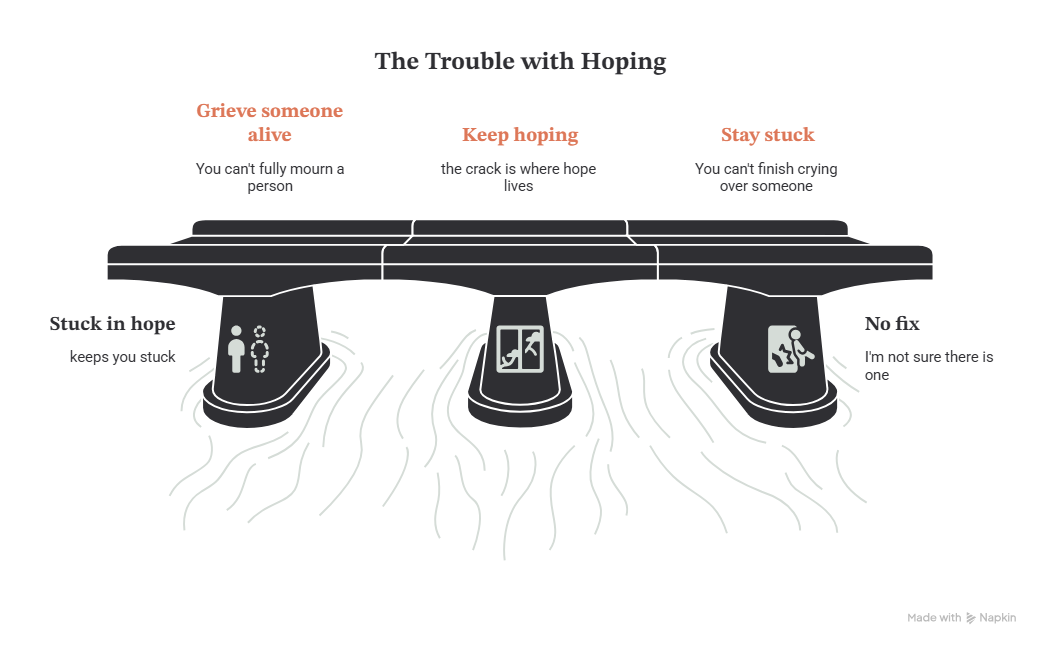
Here's the thing about grieving someone alive. You can't fully mourn a person you're still hoping to get back.
Death closes a door. This doesn't. The door stays open a crack, forever, and that crack is where hope lives — which should be a good thing and, in this particular grief, is also what keeps you stuck. You can't finish crying over someone who might text you tomorrow.
I don't have a fix for that. I'm not sure there is one.
What a steward actually does here
I'm not a therapist, and I've never lost a child to silence. What I have done is figure out, late and slowly, that I was closer to becoming this story than I wanted to admit.
A steward doesn't hand you five steps. A steward says: here's what I've carried; do with it what you need. So let me tell you what I found out about myself first.
The thing I didn't see while I was doing it
I didn't notice it at the time. That's the part that still gets me. I was so wrapped up in building something that I missed the moment I was becoming someone my kids had to manage — not someone they came to, someone they braced for.
I only understood this recently, going back over it with fresher eyes than I had when it was happening. I was the villain in parts of my own kids' story, and I didn't know it while I was living it. That's a hard sentence to write about yourself. It's a harder one to sit with.
The night one of them told me to stop yelling
I'll tell you the moment that's stayed with me longest. One of my kids, years ago, said Stop yelling at me. I remember the face I had on — too intense.
I asked, half-joking, "Do you really want to see me really scream?" And then, I showed them. I showed a child what my anger actually looked like when I let it all the way out.
I have to believe that stayed with them a lot longer than it stayed with me.
What I can actually control
I can control my own actions. I cannot control anyone else's. That sounds obvious, and most obvious things are the hardest to actually live by.
We spend so much energy trying to get the other person to move first — change their mind, apologize the right way, come around. I've stopped spending energy there. Not because I don't care how my kids respond. Because that part was never mine to run.
A composite, not a confession
I want to tell you about a father and a mother I've been reading about, not meeting. Their names don't matter, because they're not one person — they're a shape I kept seeing over and over, in group after group, forum after forum.
The mother posted that her kids "hate me and are abusive to me." Somewhere else, a woman who'd cut off her own parents wandered into a parents' group and told them, essentially, "Stop pretending you don't know what you did." Neither one was lying. That's what makes it so hard to watch from outside — two honest accounts of the same relationship, and they don't match.
A father elsewhere wrote about sending one last message and then waiting. Wondering: is she crying over this? Does she even care? Still checking, months into the silence he'd been told was final.
I read hundreds of these. The performance of certainty, on both sides, is thinner than anyone admits out loud.
Who has to go first
Here's a question we don't ask directly enough: who's supposed to move first? My answer, and it's just mine: if the parent caused the injury, the parent goes first. Most of the time, in my experience, that's exactly who caused it.
I know that's not universally true. I know there are cases where a child walked away from a parent who did nothing to deserve it. But for most of us reading this, if we're honest, we know where the weight sits.
The pushback, and why I still don't buy it
"A moment of frustration does not erase years of love, sacrifice, and dedication."
I found that line in a parents' forum, and I want to give it room, because it isn't stupid. Kids have a part in this too. Communication runs both ways, and pretending otherwise is its own kind of dishonesty.
But here's where I land. Whoever holds more power in a relationship carries more responsibility for how it broke. For most of us, as parents, that was us. It still is. The child's part in the story is real — it just isn't mine to write.
What didn't go in the letter?
I wrote both my kids a letter. I tried to make it accountable and vulnerable, and I gave myself one rule for it.
What didn't go in:
No "but you have to understand."
No asking for anything back.
No explaining why it wasn't as bad as it looked.
No mention, anywhere, of anything either of them had done.
Just what I did. Named. Nothing attached to it.
My father tried something like this, too
My own father, later in life, tried a version of an apology. He acknowledged, in general terms, that he'd done things that weren't good for me growing up, and I believe he meant it on some level.
But it was vague. Not one specific memory, not one moment named. I never took it seriously, and I think that's exactly why.
There's a test that happens whenever someone tries to reach back across a break like this. I didn't have a name for it until I went looking — it's called, plainly enough, the authenticity test, and my father failed it without ever knowing it existed.
What passing that test actually looks like
Specific beats general, every time. "I did this, on this day, and it hurt you" lands. "I know I made mistakes" doesn't.
I've asked people directly recently whether my own reaching out felt authentic to them or like a performance. I don't have the answer yet. The meaning of what you say is decided by how it's received, not by how sure you were when you said it.
Even a real apology can get read as fake
I have to tell you something that complicates everything I just said. In some of what I read, adult children wrote that even a sincere apology from a parent felt manipulative to them — not because it was, but because trust, once broken enough, starts reading effort itself as a trick.
You do the hardest, most honest thing you know how to do, and it gets filed under another angle.
I don't have a clean answer for that one. I'm not going to pretend I do.
Do it anyway
So here's where I land, and I know it's not comfortable: authenticity might not work. Do it anyway.
Not because it guarantees a result. Because it's the only version of you worth them coming back to, if they ever do. I believe this. I could be wrong about it. But a steward has to hand you something more than a shrug, and this is what I've got.
Vulnerability is a muscle, not a switch
Nobody's vulnerable the first time they try. I wasn't. The first real attempt is usually sort-of vulnerable — vulnerable-shaped, still guarding something.
You get better at it the way you get better at anything hard: by doing it again after it didn't land the way you wanted.
A recent conversation, still teaching me
Not long ago, one of my kids told me something I didn't want to hear. My old move would've been to correct it, soften it, argue the facts.
Instead, I just listened. I didn't say she was right. I didn't say she was wrong. I said what I could actually offer and what I couldn't, and that was it.
It ended up being one of the better conversations we've had in a long time — not because I fixed anything. Because I stopped needing to.
One thing money doesn't explain
I went looking to see whether this happens more in wealthy families. My hunch was yes. The research says no — income and education barely move the numbers at all.
What money does do, once a family is already broken, is give the break sharper teeth: an inheritance withheld, a business handed to one child and not the other. Not the cause. Just an amplifier, once the cause is already there.
What I'm actually handing you
I don't have a clean ending for this one.
You can grieve a child who's still alive, and that grief is real, with no funeral to mark it. You can only govern your own actions, never theirs. And if you caused the break, going first — with something specific, something accountable, something that asks for nothing back — is the only honest move you've got.
It might not work. Some doors don't open, not on any timeline you can see from where you're standing.
I'm not asking you to be certain it'll work.
Hey, this is Josh. You're on the Long Strange Trip. I'm glad you're here.


Facebook
LinkedIn
Youtube