Loving Your Kid Isn't a Succession Plan
When the honest answer is "not this business," what do you owe your child?
Loving your kid and wanting them to run your company are two different things. Most owners I've sat with can't say that sentence. They feel it, though. Usually around two in the morning.
Here's the fear, as plainly as I can put it. Some part of you doesn't want to hand it over. Maybe it's this kid. Maybe it's this business. And because you love them, the reluctance feels like betrayal. It feels like proof you're a lousy parent.
I've spent close to forty years in rooms with owners like you. I've never heard one say that out loud. Not once. What I hear instead is two words: "Not yet."
What we say instead
Parents with a kid in the business almost always believe that kid will take over. Someday. Just not yet. "Not yet" is safe. It keeps the door open and the dinner table quiet. It can also last twenty years.
Let me paint you a picture. An engineering firm. A proud father, a son on the payroll. To own the company, the son needed an engineering license. He never sat for the test. Year after year, he just didn't go.
I told the father his son wasn't ready. That was not a comfortable conversation. He didn't fire me. He did something more interesting. He stopped working with me himself. Then he asked me to work with his son instead. Get him ready, he said.
The son still didn't take the test. I eventually moved on. Once in a while I read their newsletter. The father still looks fully in charge. I can't tell if the son is even there.
I don't know how that story ends.
What people say when nobody's watching
Before writing this, I went looking for what people say in private. Farm forums. Tech forums. Parenting boards. The comments under articles about family business. Almost nobody gives the real reason out loud.
On one tech forum, a young man's father wouldn't hire him. The reason given was budget problems. The son asked whether that was true, or just a polite refusal. Commenters figured Dad knew his son didn't like hard work.
On a farm succession blog, a woman wrote that the family ranch went to her sister. Her father had her mother tell the kids the farm couldn't feed three families. Nobody asked her what she wanted.
On a cattle forum, a rancher talked about families who keep grown kids on the farm at low pay. Then he asked a question I can't shake. What kind of life is it at thirty-six, still asking for the pickup keys?
In all three, somebody stayed quiet. The kid found out anyway, just later.
Two reasons, one easier to say
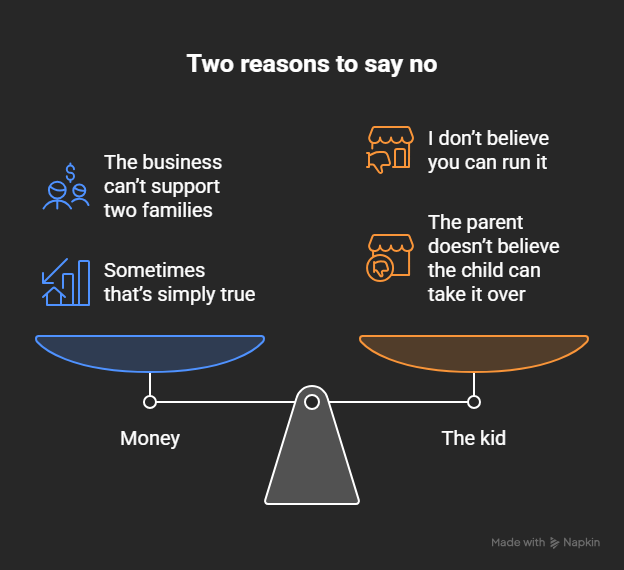
There are really two "no" conversations. One is about money. The other is about the kid.
The money one sounds like this: the business can't support two families. Sometimes that's simply true. I once worked with a vending company in Vermont's Northeast Kingdom. The father had three kids working in it. It gave him a decent living. It would never have supported four households.
I told the father that one of them could buy it. Not three. Two of the kids eventually left. I suspect they earn more now than the business could have paid them. I stopped working with them before the ending.
The other conversation is harder. It sounds like this: I don't believe you can run it.
Here's the thing. Parents use the first conversation to dodge the second. Often, "the business isn't profitable enough" is just an excuse. The parent doesn't believe the child can take it over. And sometimes it's the truth. Often the parent isn't sure which.
My father's warning
I came up in my father's business in upstate New York. Food service and vending. At seven, I was stocking candy for our wholesale tobacco company. At thirteen, I was making sandwiches in the commissary. Once I could drive, I filled vending machines.
By college graduation, I'd done every job but manager. My father still told me how to do them. I'd say I already knew how. Then he'd tell me again.
He said something else, too, more than once. Why do you want to be in this industry? It's a crappy business. You work too hard and don't make enough.
I didn't hear a warning. I heard a challenge. I had plenty of youthful hubris. I figured I could do it better than he had.
Within a month of joining him in Glens Falls, it was clear. We were oil and water. He criticized everything I did, every single day. I was fighting back before he got three words out.
So he sent me north. He sold me the business up in Plattsburgh. Sold, not given. It was small, and it was mine.
Plattsburgh
That move felt like being set free. I had my own company. I could run my own life. Nobody stood over me every morning.
I don't think he ever realized the big favor he did by sending me to Plattsburgh. Had he not done that, I wouldn't have been in the business.
Plattsburgh wasn't smooth. I grew too fast. Our loan payments ran bigger than our depreciation. That's a cash flow hole, and I dug it myself. Around year three or four, I found an embezzlement. Between the two, I nearly went under. I renegotiated everything I owed and kept going.
Later we bought a bankrupt operation in Burlington, Vermont. It was doing about $75,000 a year. We built it to around $2 million. We never made a lot of money, but it made enough money. By 1995, we had about $6 million in sales and 90 employees. Then we sold.
Was he right?
Here's where I get stuck. My father thought he was protecting me. He didn't see growth in it. He didn't see profit in it. For about seventeen years, he was wrong. We built a real business.
Then the world changed. Automation came into the factories we served. A plant with 1,200 people ended up with 200. Our equipment investment in those plants stayed the same. Those accounts went underwater. Within a few years of our sale, about half the factories we served closed. As it turns out, we were lucky that we sold it when we did. Had we stayed, I'm fairly sure we'd have gone bankrupt.
So was it a crappy business? It wasn't when I bought it. It was by the time I left. After all that growth, he'd still have called it crappy. I think he was a little proud of us anyway.
I don't have an answer to whether he was right. What I do see now is that he was warning me about the business. For years, I took it as being about me.
What the reluctance is about
That's what I've learned to ask owners who feel the pull toward no. The hesitation may be telling them something true. But true about what?
It could be about the child. Drive, judgment, appetite for risk. It could be about the business. Margins, the industry, where it's headed. Or it could be about the owner. Identity, retirement, the need to still be in charge.
Researchers who studied family firms in Denmark found something worth sitting with. When the business went to a family member, profits usually dropped. That backs up a wary parent.
But look at which families kept it in the family. Mostly the ones whose first child was a son. It wasn't about who could run it. It was about who was born first.
The blind spot
That brings me to daughters. Researchers have a name for them in family business: invisible successors. Nobody asks them. Nobody trains them. Often they don't consider it themselves.
In my father's generation, and in mine, daughters rarely grew up working in the business. Sons did. In my experience, working in it as a kid is the best preparation there is. I had the commissary and the candy shelves. Most daughters never got either.
So when an owner says his daughter isn't ready, I have to wonder. Ready compared to what? Did she get the summers in the commissary? Did anyone hand her the keys to the route truck?
That's a blind spot, and my generation had it. I'll own that I had it too. Forty years of seeing the same patterns can do that. I call it the expert's dilemma. The patterns get so familiar you stop looking past them.
The question I start with
People ask me for a test. How do I know if my reluctance is about my kid or me? I don't have one. I've never trusted a system for this. Every family I worked with had different facts.
What I trust is conversation. When an owner says, "I don't think my kid can run it," I ask one thing first. What makes you believe that?
Then I ask again, about whatever comes next. Four, five, six questions deep. I try to stay away from "why." It puts people on the defensive. "What makes you believe that?" invites a story instead.
The old me would have skipped all of it: "If he can't cut it, he can't cut it. Next."
That voice wasn't entirely wrong. Some kids truly can't cut it. Pretending otherwise hurts everyone. But the old me never asked what "can't cut it" rested on. Six questions down, there's usually something else. A bad summer at nineteen. A comparison to the parent at forty. A fear about the parent's own retirement.
When your retirement rides on your kid
That last one deserves a closer look. Jaci Russo co-owns BrandRusso, a marketing agency, with her husband. On the 21 Hats podcast, she talked about their son taking it over. The co-host asked the obvious question. What happens if he does a bad job?
Her answer stuck with me. She'd told her husband they had to save as if it wouldn't work. And they had.
I've watched the opposite in plenty of owners. When the retirement depends on the kid succeeding, it's hard to see the kid clearly. The owner's fear for himself gets mixed into his read of the child.
My note to my father covered maybe twenty or thirty percent of his retirement. He'd built the rest outside the business. He preached that to me for years, and I did the same. I wonder now whether that's part of what let him be so blunt with me.
What honesty costs
I won't pretend the honest version is free. Consultants have an old saying. Tell the client the truth, and you get fired.
I learned that firsthand. A client spent two years complaining about his sister. She owned stock in his company. He paid her dividends he wanted to keep in the business. Eventually he bought her out at a price he hated.
Then came his own estate plan. The family decided to split the stock equally among the kids. Only one son was headed into the business. I told him, strongly, that he was building his son the same trap. The one his father built for him.
His wife didn't like hearing that. She felt I was wrecking the family. He chose family harmony. I was let go.
I'd say it again. I also understand why it cost me.
What I'll hold for you
So here's what I'd want you to hear at two in the morning. The reluctance doesn't make you a bad parent. Just don't trust it until you know what it's about.
This may not be everyone's belief, but it's mine. If the relationship between parent and child is good, the child can hear all of it. If it isn't, I'd start with only what they can act on.
And "no" doesn't have to mean "never." Sometimes it means "not here." My father's "not here" sent me to Plattsburgh. It gave me my own life.
Bronnie Ware spent years caring for the dying. She wrote about accepting people as they are, with no expectations. I've thought about that line a lot this week. No expectations can feel like love. It can also feel like "we never thought you were good enough." Which one a child hears depends on the family. How they talk to each other, and whether they ever talked about it at all.
I keep coming back to that vending company in the Northeast Kingdom. Three kids. One business. One of them could buy it. I never learned which one. I never learned if anyone felt chosen, or just left behind.
Your turn
I'd like to hear the story you've never said out loud. Maybe you're the parent who couldn't say it. Maybe you're the kid who heard "not yet" for twenty years. Maybe someone sent you north, and it saved you. Tell me in the comments.
Hey, this is Josh. You're on the Long Strange Trip. I'm glad you're here.


Facebook
LinkedIn
Youtube