
"Your Future Boss Is About to Be Born"
There’s a story I heard once that could just as easily have been about me in my olden days.
A business owner gets the call that his wife has gone into active labor. He grabs his keys, heads for the door, and on his way out he turns to the whole office and announces: “Your future boss is about to be born.”
His son wasn’t even born yet. Hadn’t taken a first breath, hadn’t cried, hadn’t done a single thing on this earth. And the dad had already handed him the corner office. He’d already decided that this unborn kid would run the company someday.
I want to be careful with how I tell this, because I’ve noticed I have two very different reactions to that story, and they show up in a specific order.
My first reaction was to judge the guy. Come on. The kid isn’t even here yet, and you’ve already written his whole life for him?
My second reaction, though, was quieter and a little more uncomfortable. It was recognition. Because I know that feeling. I never stood up in an office and said the words out loud, but I have absolutely looked at one of my own kids and quietly filled in a job description they never applied for. I’ve done the thing that dad did. I just did it in my head instead of in front of the staff.
And here’s the part of his story that I think is worth sitting with, the part that should give every one of us business owners a little pause: neither he nor his son ended up running the place.
All that certainty. All that “future boss” energy. And it just… didn’t happen. Not for the kid, and not even for the dad who was so sure.
The Question I Got Lucky Enough to Dodge
I’ll be honest with you. This is one of the big landmines of family business, and I mostly avoided stepping on it by pure luck and timing.
I sold my food service company when my son was about twelve and my daughter was about ten. They were still kids. Bikes in the driveway, homework at the kitchen table, no idea what an EBITDA was and no reason to care. By the time they were teenagers, there was no company for them to join. The decision that trips up so many families simply never landed on my doorstep.
But I think about it. I think about the version of my life where I still owned that company when my kids hit sixteen, seventeen, eighteen. Who knows what I would have done. And when I’m honest with myself, I’m not sure I would have handled it well.
Would I have been the dad who lets his kids set their own course and figure out who they want to become? Or would I have been the dad quietly, and then not so quietly, trying to talk them into coming to work with me?
My guess? My daughter would have looked me right in the eye and given me a hard no. And she would have been right to. She had her own ideas about her life from a young age, and “take over Dad’s business” was never anywhere on that list.
My son is a different story. He was bouncing around a bit in those years, still figuring things out, still finding his footing. And I could see a world where he joined me. Not because it lit him up. Not because it was his dream. But because it was there, and because I was his dad, and because sometimes the path of least resistance looks a lot like a family business with your name already on the door.
And here’s where I get uneasy. Because if he’d joined me for that reason, if it had been my choice dressed up as his choice, there’s a real good chance we would have butted heads. Maybe badly. Maybe even worse than my father and I did.
I joined my dad’s business once. Do you know how long I lasted?
About two weeks.
Two weeks. That’s it. And I’ve had years to think about why it went the way it did, and a big piece of it is that I was walking into his thing, on his terms, being his son before I got to be my own man. That’s a hard setup for anybody. It’s a hard setup for the parent too, honestly. Nobody’s really at fault, and yet everybody ends up frustrated.
So when I picture myself pulling my own son into the business he didn’t choose, I don’t picture a happy ending. I picture the two of us re-running my dad and me, just with the roles swapped.
The Dream That Usually Belongs to Just One Person
Here’s the thing I’ve come to believe, and I’ve seen it play out over and over in the businesses I’ve worked with:
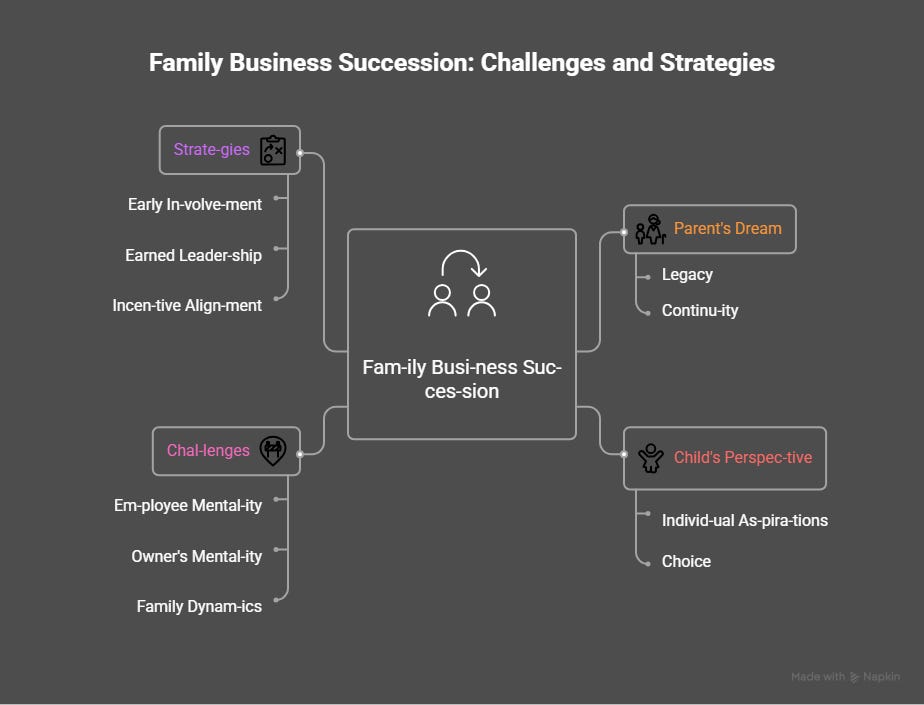
Family succession is very often the parent’s dream, not the child’s.
Read that again if you own a business and you’ve got kids. It’s not a knock on you. It’s not a knock on your kids. It’s just the truth of the situation, and I think the sooner we can appreciate it for what it is, the better off everybody’s going to be.
Most business-owner parents I meet would absolutely love it if their kids came into the business. Of course they would. You build something with your own two hands, you pour twenty or thirty years into it, and the idea of handing it to someone who shares your last name feels like the story is supposed to end. It feels like legacy. It feels like the whole point.
So what do parents do with that dream? It kind of splits into two camps.
Some parents hold it loosely. They’d love it, but they don’t push. They leave the door open and let the kid decide whether to walk through it.
And some parents make it awfully hard to say no. They dangle it, they groom for it, they build the expectation up so high and so early that turning it down starts to feel like a betrayal. Like standing up in the office before the kid’s even born and announcing who the future boss is going to be.
I’m not here to beat anybody up over which camp they’re in, because I’ve felt the pull of both. But I’ll tell you what I’ve watched happen: forcing our kids into the family business rarely works out well. For the business, for the kid, or for the relationship, which is usually the thing that matters most and the thing that gets sacrificed first.
And listen, this isn’t just me on my soapbox. The numbers back it up in a sobering way. The figures that gets quoted the most are that only about 30% of family businesses make it to the second generation, roughly 12% survive to the third, and just 3% are still standing by the fourth.
Now, I’ll be fair here, because I think you deserve the honest version: people argue about exactly what those numbers mean and how they were measured, so I’m not going to wave them around like gospel. But even the folks who quibble with the details agree on the direction of the thing. The family baton gets dropped a whole lot more than it gets cleanly passed. And in my experience, a big reason why is that too many of those handoffs were built on the parent’s dream instead of the kid’s.
And I want to say something to the parents reading this, because I know this can sting a little. Loving your business and wanting to share it with your kids is a beautiful instinct. There’s nothing wrong with wanting. The trouble only starts when the wanting turns into a plan you’ve made for them instead of with them. That’s a subtle line, and it’s an easy one to cross without noticing.
The One Version I’ve Actually Seen Work
Now, I don’t want to leave you thinking it never works, because it does. I’ve seen it. I’ve lived a piece of it myself.
But in my experience, there’s really only one version that tends to work: the child grows up working in the business.
Not handed the keys at thirty. Not parachuted into a VP title straight out of college. Grows up in it. Sweeping the floors, riding along on deliveries, answering the phones, doing the jobs nobody wants to do, seeing how the whole thing actually runs from the bottom up.
That was true for me. And it’s been true for pretty much every successful family transition I’ve worked on over the years. When the kid grows up in the business, something different happens. The business isn’t a gift that got dropped in their lap. It’s a place they know. They’ve got calluses from it. They’ve earned their way up an inch at a time, and by the time they’re in a position to lead, they’ve got the respect of the people they’re leading because those people watched them earn it.
That’s the ballgame, if you ask me. The kids who do well aren’t the ones who were told they’d run it someday. They’re the ones who worked their way up and decided, on their own, that they wanted it.
The One Big Challenge Even When It’s Working
Okay, so let’s say you’ve got that. Your kid grew up in the business, worked their way up, actually wants to be there. Beautiful. You’re way ahead of most people.
There’s still one challenge I run into almost every single time, and it’s a big one. I want to name it clearly because if you can see it coming, you can actually do something about it.
The kid has an employee mentality, but the business needs an owner’s mentality from them.
Think about it. If a kid has worked their way up through the ranks, they’ve been an employee for years and years. They think like an employee. They show up, do good work, collect a paycheck, and at the end of the day go home, and the business’s problems stay at the business. That’s a perfectly healthy way to be an employee. It’s a terrible way to be an owner.
Because an owner doesn’t get to leave the problems at the office. An owner lies awake over the slow month. An owner feels the payroll in their gut. An owner makes the call nobody else wants to make and then carries the weight of it. That mindset doesn’t automatically switch on the day you hand over the title. In fact, in my experience, it usually doesn’t switch on at all unless something forces it.
For a long time I didn’t have a great answer for how to make that shift happen. I’d watch these rising-generation kids do everything right and still think like hired help, and I’d wonder if the owner’s mentality was just something you either had or you didn’t.
Then I learned something from a client, and it completely changed how I think about this.
The Pay Change That Flipped a Switch
I was working with a father and his child, and we were close to giving up on the whole thing. The kid was capable, no question. But that owner’s mentality just wasn’t showing up. The kid kept operating like an employee, waiting to be told, doing the job and clocking out, not carrying the business like it was theirs.
The dad and I were about ready to conclude that this transition might not happen. And then, almost as a last swing, we decided to change one thing.
We changed how the kid got paid.
Instead of a steady paycheck that showed up no matter how the company did, we tied the kid’s pay to the company’s actual performance. When the business did well, the kid did well. When the business struggled, the kid felt it right along with everybody else who owned a piece of the outcome.
And I’m telling you, it was like flipping a switch.
Almost overnight, the mindset shifted. All of a sudden this kid cared about the slow month, because the slow month showed up in their own pocket. All of a sudden they were thinking about margins and waste and whether that expense was really necessary, because now it was their margin, their waste, their money. The distance between “the company’s problem” and “my problem” just collapsed. That was the whole thing. That one change made all the difference.
Now, I’m not going to pretend that a compensation tweak is some magic wand you can wave over every reluctant heir. It isn’t. But it taught me something I’ve carried ever since: mentality follows incentives. If you want somebody to think like an owner, you have to let them win and lose like an owner. As long as the paycheck is guaranteed, you’re going to keep getting employee thinking, no matter how much you talk about legacy and ownership and stepping up. People don’t think their way into a new mindset. They get there through what they actually experience, and few things are more experiential than your own pay riding on the outcome.
So Here’s Where I Land
Let me pull this together, because I know I’ve covered some ground.
If you own a business and you’ve got kids, I’d gently offer you a few things to sit with.
First, notice whose dream the succession really is. If you’re honest and it turns out the dream is mostly yours, that’s okay. But name it, so you don’t accidentally hand your kid a job description they never applied for.
Second, if you genuinely want a shot at this working, get them in the business young and let them work their way up. The keys shouldn’t be a gift. They should be something earned, one real job at a time.
And third, when the day comes that they’re actually ready to lead, pay attention to that employee-versus-owner gap. Don’t assume the title fixes it. Look closely at your incentives, because how someone gets paid shapes how they think. I’ve watched it flip a switch that years of speeches never could.
I’ll leave you where I started, with that dad on his way out the door, so sure of a future that never came. He isn’t a villain. He’s just a guy who loved what he built so much that he wanted to give it to his kid before his kid could even want it back. I get it. I’ve felt the pull of that same thing. That’s exactly why I want us all to be a little more careful with it.
Now I’ll be straight with you: I’ve seen some ways this works and a whole lot of ways it doesn’t, but I don’t have this thing fully figured out. Nobody does. And since we’re all seekers here, I’d genuinely love to learn from you.
What’s your experience with kids joining the family business? Did it work? Did it blow up? Did you find a version I haven’t seen? I want the stories where it went beautifully and the ones where it went sideways, because there’s something to learn in both.
If you’ve got a story, drop it in the comments below. I’ll be reading every one of them.


Facebook
LinkedIn
Youtube