
Fail Fast, Fail Cheap: The Stubbornness Paradox That Took Me Decades to Figure Out
There’s a fine line between persistence and stupidity.
I’ve spent most of my life on both sides of that line, often without knowing which side I was on until it was too late.
Here’s what I’ve learned: the same trait that helped me build successful businesses – my stubborn refusal to quit – is also the trait that kept me trapped in bad situations way longer than necessary. Sometimes stubbornness is your greatest strength. Sometimes it’s the thing slowly destroying you.
The trick is knowing which is which. And I spent decades getting that wrong.
The Two Faces of Stubborn
Let me tell you about persistence first – the good kind of stubborn.
Persistence is what keeps you going when things hit rough patches. It’s what makes you work through the hard parts of building something meaningful. It’s refusing to quit just because something’s difficult or taking longer than expected.
I’ve built a life on persistence. Stayed in the game when others would’ve folded. Worked through problems that seemed impossible until suddenly they weren’t. That kind of stubborn? That’s an asset.
Then there’s the other kind. The kind I’m not so proud of.
You might call it obtuseness. I call it “being an idiot who doesn’t know when to quit.”
This is the stubborn that keeps you pouring energy into approaches long after reality has told you they’re not working. It’s the stubborn that makes you double down on strategies that clearly aren’t serving you – or the people you love – because admitting they’re not working feels like admitting you were wrong.
And admitting you were wrong? That’s something my ego really didn’t want to do for most of my life.
When Stubbornness Destroyed What Mattered Most
Let me tell you about my biggest regret when it comes to obtuse stubbornness.
My children paid the price for it.
I thought there was only one way to parent: be the strict parent. After all, I had rules at work that could never be broken. Why not at home? If structure and discipline worked in business, surely they’d work with my kids.
Except parenting isn’t a business. And children aren’t employees.
I remember one moment that still haunts me over thirty years later.
I was correcting my daughter about something. She told me to stop yelling.
Instead of listening – instead of hearing the feedback that my approach wasn’t working – I doubled down. I showed her what I thought “real yelling” was. I screamed at the top of my voice.
I’m 6’5”. When I get angry, people know to stay out of my way. My voice is big. My presence is intimidating.
I terrorized my daughter that day.
And to this day, over thirty years later, she’s still frightened of me and my temper.
That’s the cost of obtuse stubbornness that nobody talks about. It’s not just wasted time or money. It’s damaged relationships. Broken trust. Years of fear where there should have been safety.
If there ever was a time for flexibility, for adapting my approach based on feedback, for running small experiments to see what actually worked with each unique kid – it would have been how I interacted with my children.
But I didn’t. I dug in. I insisted on my way. And my kids paid the price for my refusal to adapt.
I can’t get those years back. But I can learn from them. And I can share what I learned, so maybe someone else won’t make the same mistakes.
The Turning Point: When Frustrated Finally Led to Clarity
After years – literally years – of this pattern, I finally got frustrated enough to change.
I was looking at yet another situation where I’d invested way too much into something that clearly wasn’t working. And instead of my usual response (double down, try harder, refuse to quit), something shifted.
I thought: “What if I’m asking the wrong question?”
The question I’d always asked was: “How do I make this work?”
The better question turned out to be: “Should I even be trying to make this work this way?”
That distinction? That’s everything.
Because sometimes the right answer isn’t persistence. Sometimes the right answer is: this isn’t working, cut your losses, try something different.
Fail Fast, Fail Cheap: The Mantra That Changed Everything
Somewhere in my frustration, I stumbled on a simple mantra that’s become one of the most valuable things I know:fail fast, fail cheap.
Here’s what it means:
When you try something new – a project, a strategy, an approach, even getting back to an activity you love – you’re experimenting. You don’t actually know if it’ll work until you test it in the real world.
Most of us approach experiments wrong. We go all-in immediately. We invest heavily before we know if the thing even has legs. We commit completely before testing if the approach actually works.
Then, when it doesn’t work, we’ve invested so much that we can’t walk away. We’re pot-committed, as poker players say. So we keep going, throwing good energy after bad, because we’ve already invested too much to quit.
Fail fast, fail cheap flips this completely.
Instead of going all-in, you test small. You invest just enough to learn whether something works. You set clear criteria for success. And crucially – this is the part my stubborn self struggled with – you decide upfront what “failure” looks like and commit to adjusting or walking away if you hit those markers.
Learning to Ski Again: A Perfect Example
Let me give you a concrete example of how this works in real life.
Last year, I decided to try skiing again. Skiing has been central to my identity for most of my adult life. Winters in Vermont without skiing are long and dark. I needed skiing back.
Old Josh would’ve just gone for it. Bought a season pass, jumped on the mountain, and tried to power through whatever challenges came up. After all, I knew how to ski. I’d done it for decades. How hard could it be to get back to it?
That first day was a complete disaster. A fail, in every sense of the word.
I literally couldn’t ski. Not “struggled a bit” – I mean, I couldn’t do it. Couldn’t turn the skis. Couldn’t control my speed. It was frustrating and honestly, scary.
Old Josh would’ve kept trying the same approach. Maybe gone out the next day and the day after, stubbornly insisting that I just needed to remember how it worked, that muscle memory would kick in eventually.
But I’d learned something by then. I stepped back and asked: What’s actually happening here?
So I tried a different experiment. I asked Vermont Adaptive to help me learn to ski again. Small investment. Clear test: can they help me figure out what’s wrong?
What we discovered was eye-opening. I hadn’t forgotten how to ski. My technique was still there, buried in muscle memory. The problem? I didn’t have the leg strength to turn my skis anymore. All the knowledge in the world didn’t matter if my legs couldn’t execute.
That was valuable information. And it cost me almost nothing to learn it.
So I designed another small experiment: work on leg strength. Not “completely transform my fitness” or “get back to where I was 20 years ago.” Just: can I build enough strength to turn skis?
I’m working on that now. Using my indoor bike with more hill settings. Doing kettlebell swings for both my core and legs. Building strength incrementally.
Soon I’ll try skiing again, this time with a stronger body and skis that are much more forgiving. It’s a small experiment that will either work or not.
If it works, great. I’ll keep building on it. If it doesn’t, I’ll have learned something else and can try a different approach. Or maybe I’ll learn that skiing isn’t viable anymore, and I’ll need to find other ways to get through Vermont winters.
But I won’t know until I test it. Small investment. Clear criteria. Willingness to adjust based on what I learn.
That’s fail fast, fail cheap.
Building The Long Strange Trip: Baby Steps Into the Unknown
Here’s another example that’s playing out right now.
I’m in the messy world of passage – that uncomfortable transition between leaving active business ownership and figuring out what comes next. I could’ve made big moves. Maybe started a consulting firm, opened a retirement coaching business, committed to a nonprofit board.
Instead, I’m taking baby steps. Small experiments.
First, I started making deeply vulnerable posts on CaringBridge during my cancer journey. Just testing: does honest, personal writing resonate with anyone? The feedback was positive.
So I tried one post on Substack. Another small experiment. Again, a positive response.
Then I tested the six areas of investigation we’re exploring here – work differently, retire differently, face death differently, build resilience, share wisdom, and understand transitions. I got these to maybe 60% developed. Not perfect. Not fully built out. Just good enough to see if there was any traction.
There was. So I built a simple website around the idea.
Then, finally, after all these small experiments showed promise, we decided it was worth going forward and built out the entire Long Strange Trip ecosystem.
And we’re still running small experiments along the way. Testing different formats, trying various approaches, seeing what resonates and what doesn’t.
Notice the progression? I didn’t invest thousands of dollars and months of time building a complete platform before knowing if anyone cared. I tested small, learned fast, and built incrementally based on what worked.
If any of those early experiments had failed, I would’ve adjusted or moved on. Minimal investment. Maximum learning.
That’s how you navigate passage – the uncertain middle ground between what was and what will be. Not with big commitments and grand plans, but with small experiments that teach you what actually works.
My Health: When Small Experiments Eventually Lead to Big Decisions
Now let me show you the limits of fail fast, fail cheap.
My health journey has been one long series of small experiments, especially with my foot ulcers, which have been a problem for over three years now.
My podiatrist keeps trying new things. Different treatments, various approaches, multiple strategies. These are all small experiments. We try something for a few weeks, see if it helps, and adjust if it doesn’t.
Most of these experiments have failed. We’ve made some progress, but not the breakthrough we’re looking for.
Right now, I’m testing a new experiment – different types of shoes to see if that helps. It’s another small, relatively cheap test.
But here’s what I’m learning: sometimes, fail fast, fail cheap is followed by a big decision. Because eventually, you might run out of small experiments to try.
Foot surgery is on the horizon as a possibility. That’s not a small experiment. That’s a significant decision with real consequences.
But here’s the thing: I’ll only get to that decision point after exhausting the smaller options. We’re trying everything we can try cheaply and quickly first. Surgery would be the last resort because we’ve tested the other possibilities and learned whether they work or not.
Sometimes that’s what fail fast, fail cheap teaches you: when it’s actually time to make a big decision. Not as your first move, but as your final option when the small experiments have shown you there’s nothing left to try.
The 60% Rule: Good Enough to Test
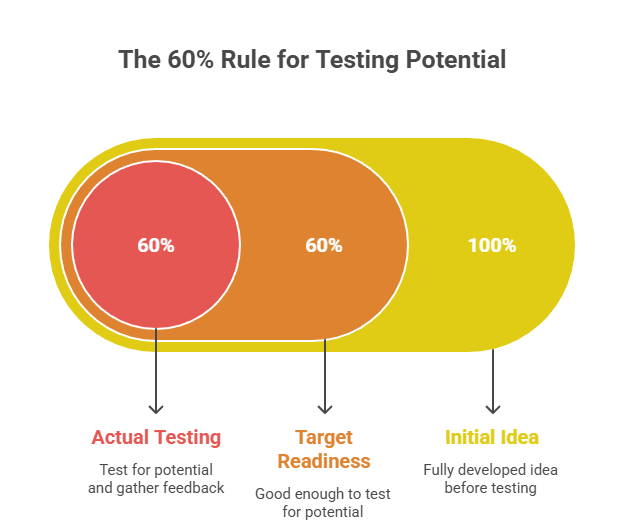
Here’s something I’ve learned that makes fail fast, fail cheap actually work:
You don’t need things to be perfect to test them. You need them to be good enough.
I aim for about 60%. That’s usually enough to see if something has potential, and it doesn’t take very long to get there.
With The Long Strange Trip, I didn’t need fully developed programs, polished content, and complete systems before testing if people cared about these topics. I needed rough ideas that were clear enough to share and get feedback on.
With skiing, I didn’t need to completely rebuild my fitness before trying again. I needed just enough leg strength to see if turning skis was possible.
With parenting – and I learned this way too late – I didn’t need a perfect parenting strategy. I needed to try different approaches with each kid and see what actually worked for them. I needed to listen when my daughter said, “Stop yelling,” instead of showing her what real yelling looked like.
Perfectionism is the enemy of experimentation. If you wait until something’s 100% ready, you’ve already invested too much to easily walk away if it doesn’t work.
Get it to 60%. Test it. Learn from what happens. Adjust accordingly.
How to Know Which Kind of Stubborn You’re Being
So how do you tell the difference between productive persistence and destructive obtuseness?
Here are the questions I ask myself now:
Am I persisting based on evidence, or based on ego?If the feedback, the data, the results are telling me something’s not working, but I’m pushing forward anyway because I don’t want to admit I was wrong? That’s ego-driven stubbornness. When my daughter said, “Stop yelling,” that was feedback. I ignored it because of my ego.
Have I set clear success criteria, or am I moving the goalposts?If I keep changing what “success” looks like to avoid admitting something’s not working, that’s a red flag. With skiing, if I kept lowering my expectations just to avoid facing reality, that would be a problem.
Am I learning and adapting, or just doing the same thing harder?Real persistence involves trying different approaches when one doesn’t work. If I’m just repeating the same failed strategy with more intensity, that’s not persistence – that’s insanity. That was me with parenting. Same approach, just louder.
What’s my exit criteria, and am I willing to honor it?If I don’t have clear criteria for when to adjust or walk away, or if I keep finding reasons to ignore those criteria, I’m probably in obtuse territory.
Is this costing more than I can afford (time, money, energy, relationships)?With my parenting, the cost wasn’t financial. It was my relationship with my daughter. Thirty years later, she’s still afraid of me. That’s a cost I’ll never stop paying.
The Stubborn I Want to Keep
Here’s what I want to be clear about: I’m not against stubbornness.
The persistence that got me through cancer treatment, that keeps me showing up when things are hard, that made me keep working on leg strength even when progress was slow – that’s valuable. I don’t want to lose that.
What I want to lose is the obtuse stubbornness that keeps me in bad situations because my ego can’t handle admitting I was wrong.
I want to keep the stubborn that says: “This is hard, but it matters, so I’m staying.”
I want to lose the stubborn that says: “I’ve already invested too much to quit, so I’m staying even though this is clearly not working and hurting people I love.”
That’s the distinction. And fail fast, fail cheap helps me make it.
Start Small, Learn Fast, Move On Without Shame
If you recognize yourself in any of this – if you’ve found yourself trapped in approaches that aren’t working, unable to shift because you’ve invested too much to walk away – here’s what I’d suggest:
Pick one thing you’re working on right now.Could be a project, a relationship issue, a health challenge, a retirement transition. Anything where you’re trying to figure something out.
Design a small experiment.What’s the smallest, cheapest test you could run to learn if your current approach is working? Not the minimum to build the whole thing – the minimum to learn if it’s worth building.
Set clear criteria.What would success look like? What would failure look like? Be specific. Write it down.
Give it a timeline.Not forever. Not “until it works.” A defined period to test. Maybe a week, maybe a month, depending on what you’re testing.
Assess honestly.When that period ends, look at your criteria. Did it work? Even a little? If yes, keep going or build on it. If no, adjust or try something different.
Move on without shame.You ran an experiment. You learned something. That’s success, even if the answer was “this approach doesn’t work.” Now you know. Try something else.
The goal isn’t to never fail. The goal is to fail fast and cheap enough that you can afford to try lots of things until you find what works.
And to listen to the feedback – especially from the people who matter most – before the cost becomes too high.
Where I Am Now
I’m 73 years old. I’m still stubborn as hell.
But I’m a lot better at knowing which kind of stubborn I’m being.
When I’m facing cancer treatment, persisting makes sense. This matters, the outcome matters, and giving up isn’t an option. That’s good stubborn.
When I’m trying to ski again, I’m testing small. Building leg strength, trying different equipment. If this doesn’t work, I’ll try something else. Or I’ll accept that skiing might not be part of my life anymore and find other ways through Vermont winters.
When I’m dealing with my foot ulcers, I’m still experimenting. Different shoes now. Maybe surgery later if nothing else works. Each test teaches me something.
When I’m building The Long Strange Trip, I’m experimenting constantly. Some things work, some don’t. I keep what works and dump what doesn’t, without attachment to being “right.”
And with my kids? I can’t get those years back. I can’t undo the damage my obtuse stubbornness caused. But I can learn from it. I can share what I learned. And I can try to do better now, even if it’s decades late.
It’s taken me decades to learn this distinction. I wish I’d learned it earlier. I’d have saved myself – and the people I love – a lot of pain and frustration.
But I’ve learned it now. And it’s made the difference between stubbornness that serves me and stubbornness that traps me.
I Don’t Have All the Answers – And That’s the Point
Here’s something important I want you to know: I’m still figuring this out.
Fail fast, fail cheap works for me. But it’s just one approach to handling persistence. And honestly? It can still feel pretty harsh sometimes. Test, measure, cut your losses – there’s not a lot of gentleness in that framework.
I wonder if there are softer ways to navigate the line between productive persistence and destructive obtuseness. Ways that don’t require quite so much ruthless evaluation. Approaches that leave more room for intuition, for patience, for the messy human process of figuring things out.
That’s why I’m doing The Long Strange Trip as a conversation, not a lecture. I want to learn from you. From your experiences. From how you’ve handled this balance in your own life.
When I have guests on my podcast, I’m genuinely curious about their approaches to persistence. How do they know when to keep going and when to pivot? Have they found gentler ways to experiment that don’t feel quite so much like pass/fail tests? What wisdom have they accumulated that I haven’t discovered yet?
Because here’s the truth: I’m a fellow traveler on this journey, not an expert who has it all figured out. I’ve learned some things the hard way. I’m sharing what’s worked for me. But I’m absolutely certain there are other approaches, other frameworks, other ways of thinking about this that might serve you better than what I’ve discovered.
So I want to hear from you. In the comments below, or when you reach out, or if you end up as a guest on the podcast – tell me: How do you handle persistence in a gentler way? What have you learned about the difference between good stubborn and bad stubborn? What approaches have worked for you that I haven’t explored here?
Let’s figure this out together. Because that’s what this whole project is about – not me having the answers, but all of us seeking them together.

Facebook
LinkedIn
Youtube